Welcome
Bill Beuttler is an associate professor in the Writing, Literature, and Publishing department at Emerson College in Boston, where he teaches courses in magazine writing, editing, and publishing and directs the college's graduate program in Publishing and Writing.
His first book, Make It New: Reshaping Jazz in the 21st Century, was published by Lever Press in 2019 and is available in paperback and open access editions. DownBeat magazine called Make It New "a rewarding book that examines some of the key voices directing contemporary jazz."
"In detailing the various meeting points among all of his subjects, Beuttler establishes not so much a sense that jazz is a small world, but that those who reach its creative heights are more alike than different," wrote reviewer Chris Barton. "From [Esperanza] Spalding's sharp, sometimes contrarian conversations with Beuttler on creativity and society, to the author's discussion with [Robert] Glasper around a visit to [Jason Moran's] home in Harlem that seemed near-sacramental with its mix of painting and dinner, Make It New confirms that this is a unique moment in time to be alive and listening to jazz."
Before joining Emerson, Beuttler spent three years covering jazz for the Boston Globe (which he continues to do occasionally) and teaching journalism at Boston University. His magazine work includes stints as a senior editor at the Discovery Channel, Men's Journal, and Boston magazine, and as an associate editor at DownBeat and American Way. He has also been published in JazzTimes, Jazziz, The Atlantic, Esquire, Chicago magazine, The Boston Globe Magazine, Sports Illustrated, Travel Holiday, Cooking Light, The Atlanta Journal-Constitution, and The New York Times Book Review.
Beuttler, a Chicago native, broke into journalism as a police reporter at the legendary City News Bureau of Chicago. His first teaching job was as a visiting professor of magazine journalism at Ohio University's E.W. Scripps School of Journalism. He also spent a summer at the American University of Beirut supervising a journalism program designed by journalist and former hostage Terry Anderson.
Recent Work
Jazz guitarist Mary Halvorson explores territory where there are no rules
By Bill Beuttler
Boston Globe, November 4, 2020
"Orange head secretes a lie above you," sings guest vocalist Robert Wyatt on "Bigger Flames," the fifth song on Brookline native Mary Halvorson's just-released album "Artlessly Falling."
The album — which Halvorson, 40, recorded with her Code Girl sextet in December, a couple of months after being awarded a MacArthur Foundation "genius grant" — features the guitarist/composer's own surreal, impressionistic poetry, much of it obscure enough to seem like it's in code.
"Well now it's your house, set neatly on fire," Wyatt continues a few stanzas further into the same song, "its blistering heart bloats high above you."
That's as close as "Bigger Flames" comes to directly divulging its point. The song's opening line contains a strong hint, though: "Orange head secretes a lie"? Are we talking about Donald Trump?
"Yup," confirms Halvorson, laughing, speaking by phone from her home in Brooklyn a few days before the election. "They're all pretty impressionistic. But that one, to me, was more or less about the environmental crisis, and the state of the world being what it is."
Halvorson's path to where she could enlist a legend like Wyatt to sing her lyrics is an intriguing one.
She took up guitar at age 11 upon discovering Jimi Hendrix. After high school, Halvorson went to Wesleyan University intending to study biology or psychology. There she met two particularly impactful influences who caused her to abandon those plans.
"I got the music bug pretty bad," she says, "and at a certain point I just couldn't go back."
She took private lessons from the experimental guitarist Joe Morris, who lived not far from campus. And she took every class available with the prolific composer and saxophonist Anthony Braxton, a much-beloved Wesleyan professor of music.
"He was just so interesting to be around," says Halvorson of Braxton. "He made music seem fun. He made it seem like there were no rules. I should say, 'He brought to my attention that there are no rules,' which I kind of hadn't realized. So just having that kind of encouragement, and that kind of license to just explore, I think was really what I needed at the time, and also what really sucked me in."
Braxton helped inculcate Halvorson's love of experimentation and disregard for musical genres, beginning with a class she took freshman year, whose title she remembers as "Materials and Principles of Jazz Improvisation."
"What was so cool about his classes is that he loved all types of music," says Halvorson. "And the genre didn't really matter. . . . He also had a class called 'The Music of Sun Ra and Stockhausen.' "
Halvorson graduated from Wesleyan in 2002, moved to New York, and began recording and touring. The first of her own 10 albums was released in 2008. She has also appeared on upwards of 50 others, including four with the collaborative trio Thumbscrew, the most recent of which, "The Anthony Braxton Project," was released this past summer.
Halvorson's renown has grown considerably of late. In 2017 she headlined at the Village Vanguard for the first time and won four categories in that year's DownBeat Critics Poll, including the first of her four consecutive wins as best guitarist.
Her first Code Girl release, an eponymous double album, was the result of her wanting to incorporate words into her music. Halvorson herself wrote the free verse poems that served as the album's lyrics, recorded by a quintet featuring Amirtha Kidambi on vocals, Ambrose Akinmusire on trumpet, and Thumbscrew colleagues Michael Formanek and Tomas Fujiwara on bass and drums, respectively.
"Code Girl," released in 2018, earned Halvorson yet more critical acclaim and the attention of the MacArthur Foundation. By the time she was notified she had won her genius grant last year, Halvorson was already writing words and music for a follow-up. Code Girl had expanded to a sextet, with Adam O'Farrill replacing Akinmusire on trumpet and María Grand added on tenor saxophone and vocals, and Wyatt had agreed to sing on it.
Halvorson had become obsessed with Wyatt's music via his 1974 solo album "Rock Bottom," Wyatt's first after the 1973 accident that had rendered him a paraplegic, and worked her way back to his earlier recordings with the band Soft Machine.
"I found out the way it is with Robert Wyatt is that people either have no idea who he is or they're obsessed with him," she says, laughing. "I knew these two guys that ran a club in New York, and every time I went in Robert Wyatt would be playing, and so we started talking about it. They knew I was a big fan, and one of them said, 'Hey, you know every year we mail him a package. He's a big jazz fan, and we mail him a bunch of jazz vinyl. Would you like to include something?' "
She jumped at the chance. "To my surprise, I got a postcard from Robert Wyatt. So he actually listened to the record and wrote me this really nice note. I couldn't believe it."
That led to a sporadic correspondence. Halvorson would often mail Wyatt new records she put out. So they already had a connection when she approached him about appearing on "Artlessly Falling."
"I really wanted to have a male singer on the record, and so he was my first choice," explains Halvorson. "He wrote back right away and was like, 'Yeah, I'd love to.' "
While the first Code Girl album's lyrics consisted entirely of free verse, "Artlessly Falling" involved stricter poetic forms.
"Last-Minute Smears" is a found poem constructed from words drawn directly from Supreme Court Justice Brett Kavanaugh's testimony to the Senate. Fujiwara accompanies its vocal passages with a militaristic cadence, and uses beer cans for effects elsewhere on the track.
"That was all my idea," says Fujiwara. "So yeah, [the military drum rolls] was something I played around with. Obviously the beer cans. At one point I had some textures that sounded like a gavel."
Fujiwara and O'Farrill are featured alongside Wyatt on the opening track, "Lemon Trees," a double tanka drawing words and inspiration from the Lawrence Osborne novels "Beautiful Animals" and "The Forgiven."
"Walls and Roses" is a pantoum, with Wyatt and Grand alternating wispy vocals on the song's four stanzas and Halvorson unleashing furious bursts of effects-laden guitar chops in between. Its words, like "Bigger Flames" and its orange head secreting lies, keep its meaning coded, inviting listeners to formulate their own interpretations.
"That's why I don't make the lyrics super explicit," says Halvorson. "I like that people can take different meanings from it. So, for instance, even if that song to me wasn't about Trump, or wasn't about the environment, if you took that from it, that would be cool with me. I like that idea that everybody can hear or see things so differently."
On his live album, Christian Scott aTunde Adjuah captures the moment of an arriving pandemic
By Bill Beuttler
Boston Globe, September 2, 2020
The COVID-19 pandemic was just arriving in Boston when Christian Scott aTunde Adjuah and his band performed at Scullers on March 7. The next week they hit the Blue Note Jazz Club in New York for several nights of performances; like most musicians, they haven't performed live again since.
But Scott has nonetheless appeared on a trio of projects over the past week. Last Friday, he released "Axiom," the supercharged live album his band recorded during that final week at the Blue Note.
Last Friday was also release day for "Bill & Ted Face the Music," the third of the goofy science fiction comedies starring Keanu Reeves and Alex Winter. Scott has a cameo in the movie — blink and you'll miss it, but that's him in his now familiar Afro-Futuristic garb playing a noble in the Future Council — and he arranges and performs the trumpet parts for a young Louis Armstrong (played by Jeremiah Craft), who is among the towering figures from music history that Bill and Ted's daughters, Billie and Thea, recruit via time travel to help their dads create the song that will save the world.
And this weekend, the Blue Note website will be streaming the last of the live sets that made it onto Scott's new album, with three airings spread over Friday night and Saturday morning (to better accommodate fans in Los Angeles and Tokyo).
"We didn't want to leave without finishing the job," recalls Scott by phone from LA. "It ended up sounding amazing. You can hear what Weedie [Braimah, on djembe and congas] did, and Elena [Pinderhughes, on flute], playing on this record. It's just really mind-blowing stuff."
Scott stressed the difference between the studio versions of previously recorded songs and what was documented live. "Those last few records, most of the stuff is me playing. It's conversational, but the dialogue doesn't exist in the same way," he says. "What's really great about how this album comes together is [that it] created a mix and a balance that literally make it feel like you're standing in my position on the bandstand."
Scott himself won't be on any bandstands for a while, but he was planning on taking half a year or so off from touring anyway after the Blue Note run.
"I've toured pretty consistently since I was about 14 years old," he explains. "I had never taken a break." He already had several albums recorded and ready for release, including a double album titled "Bark Out Thunder, Roar Out Lightning" slated for summer 2021.
"My lady was just like, 'Maybe you should take a break before you jump into putting all this stuff out.' "
Scott, 37, was already in a better position than most to take a break and get through the pandemic. In May he won a Herb Alpert Award in the Arts, a $75,000 prize given annually to five "risk-taking mid-career artists" working in dance, film/video, music, theater, and visual arts.
But an extended break from work is a relative thing for Scott. He was tickled to be asked to participate in the "Bill & Ted" movie, having dreamt of being the one to write the world-saving song himself after seeing the earlier "Bill & Ted" movies as a child. While he's away from the stage, he has those backed-up recordings to prepare for production, an updated version of his Stretch Music app (which allows student musicians to perform along with his band) in the pipeline, and a relationship with the Ropeadope record label that he continues to build.
And he has his new album to promote. Aside from the covers of existing material, "Axiom" introduces new songs dedicated to the resilience of his mother and other New Orleanian women ("Huntress") and to his maternal grandfather ("Incarnation"). His grandfather and uncle, the saxophonist Donald Harrison Jr., are also celebrated in a live version of "The Last Chieftain," a tune that produced a long spoken tribute to Donald Sr. when Scott last performed it at Scullers.
Scott is an accomplished storyteller onstage, and the live album includes one such tale, when he describes how a bad experience moving to an apartment on Sunset Boulevard in LA led to his writing "West of the West," a song with echoes of 1970s-era Miles Davis, partly owing to the work of Lawrence Fields on Fender Rhodes electric piano.
Scott and Fields met as students at Berklee College of Music, and Fields joined Scott's longtime core rhythm section just behind bassist Kris Funn about a decade ago. (Corey Fonville wanted to join on drums while still in his mid-teens, but Scott made him wait — a story Scott sometimes tells in introducing the band.)
Fields has been riding out the pandemic in New Jersey. He says that knowing something like this might be coming made those final Blue Note sets unique.
"Even when we went there," Fields recalls, "a call went out to everyone to say, 'Hey, is everyone comfortable doing this in the first place?' Everyone agreed to do it, but when we stepped out onto the stage we felt like, 'Wow, we're in the middle of something really uncertain.' I think that gig had an additional level of urgency."
He remembers thinking, "This might be the last night of us playing together for a while."
"And that was incredibly emotional," Fields says. "I remember going onstage, especially the last couple nights, and thinking I'm just so happy to be with these people."
"We had to deal with all of the COVID kind of crises, energy that week," says Scott. "So there's a bunch of stuff where we got everything recorded, but there were moments where [the recording engineers] neglected on certain nights to activate the microphones that were in the house. So you'd play a burning solo and then it's like — a silence, right?"
He laughs.
"On this record is the night where they actually had some of those things active, so that the crowd engagement, you can hear what the actual relationship was," Scott adds. "But I think for that reason the album has an energy that you could never get in another live record, just because of what was going on."
The live Blue Note set streams Friday at 8 and 11 p.m. and Saturday at 7 a.m. Tickets $15. www.bluenotelive.com/eventsold/christian-scott
Tyshawn Sorey forcefully pushes past the boundaries between classical and jazz
By Bill Beuttler, Boston Globe, September 28, 2019
Tyshawn Sorey laughs appreciatively when a description of his composition "Movement," from Sorey's 2014 album Alloy, is read to him during a recent telephone interview.
"It's a bit like Alban Berg playing piano in a hotel lounge at the end of the world," the New Yorker's Alex Ross had written in a piece on Sorey this past spring.
"I love that line," says Sorey, who arrives Tuesday for a three-day residency at New England Conservatory that will culminate with a free concert at Jordan Hall. "It's one of the best, best ways of describing the piece."
"Movement," which will be among several Sorey compositions he'll perform with NEC students and faculty members, is a work that blurs boundaries separating 20th-century classical music and jazz. The piece, like Sorey himself, is a perfect match for NEC's Contemporary Improvisation department, which got its start at NEC in the 1970s under Gunther Schuller and Ran Blake. Back then it was called the Third Stream department, named for the term Schuller had used during a 1957 lecture at Brandeis to describe music that mixes classical and jazz.
"I can't imagine anyone on the planet who more epitomizes what we're going for in Contemporary Improvisation at NEC than Tyshawn," says department co-chair Hankus Netsky by e-mail. "I also see him as a musician who fully understands the ideas of the musicians who combined the worlds of contemporary European and African American composition and improvisation in the 1960s — Cecil Taylor, Eric Dolphy, Ornette Coleman, Bill Dixon and, of course, his teachers, Anthony Braxton and George Lewis, something that, in my opinion, changed our creative musical landscape in a major way."
Braxton and Lewis are both major figures in the Association for the Advancement of Creative Musicians, which got its start in Chicago in the 1960s, sharing Third Stream's eagerness to eliminate barriers between jazz and classical music but from a more African-American perspective. Sorey would eventually study with Braxton while earning a master's degree at Wesleyan University, and go on to work with Lewis at Columbia University, where he earned his PhD in 2017. Later that year, Sorey took over the retiring Braxton's chair at Wesleyan, where he is now an assistant professor of music.
But Sorey had gotten to know both men before studying with them formally, and it was his early encounters with Braxton in particular that made him realize he could become a composer.
Sorey recalls hearing music by Braxton and another AACM principal, Muhal Richard Abrams, on WKCR-FM. "I guess I was just very much into the music," he recalls. "It reminded me of the work of late Coltrane. It didn't quite sound like that, but the vibrations were similar for me."
After hearing that radio broadcast, Sorey found a copy of a Braxton album at the Newark Public Library that changed his life.
"I played it, and then I saw the picture of the composer," Sorey explains. "Now keep in mind, I wasn't much thinking about being a composer. Being a composer was a thing that you don't really learn at all, especially in inner-city households.
"I always wanted to play some kind of music — be a sideman, play in so-called jazz groups and that kind of thing," Sorey continues. "But when I happened on Braxton's work, and then there's a picture of Braxton as a composer, and I'm like, 'Whoa!' It's OK to want to be a composer."
Sorey did in fact go on to become an extraordinary sideman on drums, performing on Vijay Iyer's 2003 album Blood Sutra while still an undergraduate at William Paterson University, and going on to record with Steve Coleman, John Zorn, AACM stalwarts Braxton, Abrams, and Roscoe Mitchell, and many others. This year the DownBeat Critics Poll ranked him jazz's third best drummer, behind Brian Blade and Jack DeJohnette.
But he studied classical trombone at William Paterson and was determined to become a composer. An encounter in a recording studio with his hero Braxton during his sophomore year helped with the latter. When Braxton asked if Sorey was working on any compositions, Sorey replied that he had a handful he wasn't serious about and planned on throwing away.
"He was like, 'Don't throw anything away!' " recalls Sorey, laughing. "He basically said, 'If you write a piece of music, you have to believe in what you're doing.' " Braxton advised Sorey to avoid catering to other people's tastes, and eventually those early compositions became part of a book of 41 Sorey compositions, 10 of which were recorded a decade later on Sorey's 2011 album "Oblique-I."
Sorey first encountered Abrams and Lewis in the early 2000s as well, and recalls Lewis greeting him as "a future co-conspirator." Yet another major influence Sorey met around that time was Butch Morris, whose conduction technique for directing improvised music became the topic of a senior project for which Sorey gave a brief demonstration to a skeptical group of students and wrote an A paper.
Sorey will give a fuller demonstration of conduction on his piece "Autoschediasms" on Thursday. The night's wide-ranging program will also include the aforementioned "Movement," Sorey's orchestral work "For Bill Dixon and A. Spencer Barefield," his chamber pieces "For Fred Lerdahl" and "Inner Spectrum of Variables (Movement III)," his noise project "LOUD" featuring faculty member Joe Morris, a duo improvisation with Anthony Coleman, and excerpts from a Yiddish theater project that features Sorey's arrangements and orchestrations.
Challenging material all of it, for musicians and audiences alike. But what else would you expect from a 2017 MacArthur Foundation "genius grant" recipient whose music for Josephine Baker: A Portrait had its world premiere, in 2016, at the prestigious Ojai Music Festival?
"It's basically a deconstruction of Baker as this 'iconic entertainer,' " says Sorey of that project, which was done in collaboration with renowned theater director Peter Sellars and doubled as the focus of Sorey's doctoral dissertation. "I don't do music for the sake of entertainment. That's never really been a thing about me."
Saxophonist Steve Lehman feels the love
By Bill Beuttler, Boston Globe, September 8, 2019
How admired by critics is Steve Lehman, the alto saxophonist, composer, and professor at the Herb Alpert School of Music at CalArts? His octet album Mise en AbÎme finished first in the 2014 NPR Music Jazz Critics Poll as that year's best album, which was followed several months later by his topping the rising star categories of jazz artist and alto saxophonist in the 2015 DownBeat Critics Poll.
Lehman was also on the 2017 NPR Music Jazz Critics Poll best album as a member of Vijay Iyer's sextet, which won for Far From Over. But for all those critical accolades, Lehman, who'll lead his longtime trio with bassist Matt Brewer and drummer Damion Reid at the Regattabar on Sept. 26, remains relatively unknown.
That could change with the release last month of The People I Love, on which the trio is joined by pianist Craig Taborn. The album's title is taken from a remark by the late vibraphonist Bobby Hutcherson: "When I was younger, I thought music came first. And now that I've gotten older, I realize it's only a reflection of the images of the people I love and being with God."
Lehman acknowledges that there are several ways in which the title applies: alto sax-led quartets that inspired him to try his hand recording with one, the three musicians whose pieces he's chosen to cover on the album (Kurt Rosenwinkel, Kenny Kirkland, Jeff "Tain" Watts), mentors like Hutcherson and Jackie McLean, and the trio mates he'll have with him in Cambridge.
But mostly he's thinking of his wife and young children.
"It's not a particularly novel sentiment, but just having kids and all of that stuff, that's really my headset," explains Lehman by phone from Chicago. "Music is what I do. That's my life's work. But ultimately it's kind of a reflection of other things that are actually bigger than that. I probably wouldn't have thought about it like that when I was in my 20s: something being bigger than music. I just wanted to frame things ever so slightly in that context and see what came of it."
Lehman, who turned 41 on Sept. 1, doesn't perform much in Boston, but he has New England roots. His family moved to Hartford from Brooklyn when Lehman was 8, and he's a graduate of Milton Academy, having been lured there in part by its jazz program.
Lehman returned to Connecticut to earn bachelor's and master's degrees in composition at Wesleyan University, where Anthony Braxton was among his professors, while concurrently commuting to Hartford to study with McLean at the Hartt School of Music. He completed his PhD in music composition from Columbia University in 2012, where his primary mentors were George Lewis and Tristan Murail.
That same year, Lehman released Dialect Fluorescent, his 10th album as a leader or coleader. That first trio album included compositions by John Coltrane, Duke Jordan, and McLean. But on The People I Love Lehman is drawing from more contemporary composers.
"I did make a conscious effort to highlight people that I look up to and are revered in their own right, but sort of shift the emphasis to modern masters," says Lehman. Rosenwinkel, for example: "Kurt's a really great composer, not somebody that's associated very commonly with my circle of musicians."
The Rosenwinkel tune "A Shifting Design" is the only one on the new album that Taborn doesn't perform on. "We love playing that piece trio," explains Lehman, "and we just happened to have this rehearsal take that I thought was really magical, so we ended up using that one on the album."
One of the defining characteristics of Lehman's music is its rhythmic complexity. Taborn was a good fit there as well, having worked with each of the trio's members in other contexts and having already studied some of Lehman's sheet music for his octet because of the similarities in their approaches to rhythm.
"There was a simpatico in terms of how some of the stuff conceptually comes together," explains Taborn. "So it wasn't that foreign to me how he was spelling out a lot of these things, and that made it a little bit easier to jump in with those guys. I'm not saying it was easy, but at least this isn't a new concept to me, where I think with some people it might be."
Taborn won't be with the trio in Cambridge; he'll be en route to Oslo for a solo concert honoring the 50th anniversary of ECM Records. But the new album already has new versions of music Lehman originally wrote for and recorded on albums with his octet and a previous quintet.
"Those are pieces that are really very distinctive, and the treatment that they get in the trio turns them into new vehicles," says Lehman. "I am a big proponent of trying to write music that rewards repeated investigation, and that you can revisit and get something new from over the course of a lot of years."
Jon Batiste is the Newport Jazz Festival's Mr. Everything
By Bill Beuttler, Boston Globe, August 2, 2019
NEW YORK — It was business as usual one recent afternoon as the namesake host and Jon Batiste came bounding onstage to whip up an already warmed-up audience at the Ed Sullivan Theater just before the taping of that night's "The Late Show With Stephen Colbert." Their paths crossed as they darted in opposite directions at the front of the stage, and a couple of members of Batiste's band Stay Human strutted onstage behind them, energetically playing hand drums to further rev up the audience.
Batiste and the band then took their places and did their thing once the taping was under way, laughing at Colbert's jokes and keeping the audience charged up and entertained with virtuosic, upbeat music during breaks between guests.
A few hours earlier, Batiste had sat up from a brief post-soundcheck lie-down on his dressing room couch to discuss his career away from his day gig, which will bring him to the Newport Jazz Festival for "Jon Batiste and Friends," Friday's opening night concert at the International Tennis Hall of Fame. Batiste will celebrate the release that same day of Anatomy of Angels, recorded live over several nights at the Village Vanguard this past fall.
Joining him at Newport will be the band from that album and four guests: Ethan Iverson, ELEW (a.k.a. Eric Lewis), PJ Morton, and Corrine Bailey Rae — each of whom will perform at Fort Adams on other festival stages this weekend.
"I wanted to look at the schedule and see who would be there around that day, and really make sure that I could put together a show that featured a range of different styles of music," Batiste explains, looking stylishly casual in a T-shirt and sweatpants before changing into a suit for the taping of that night's show. "That's what's great about Newport: There's so much that you can hear, so many different styles — different styles, I think, create a really rich performance. You have people from all walks of life coming onstage: jazz, R&B, hip-hop, folk. It's beautiful."
Batiste, 32, is already an old hand at Newport. He played a short but dazzling solo set as far back as 2012, sandwiched between the Preservation Hall Jazz Band and headliner Dr. John for that year's New Orleans-themed opening night. Last year he was featured at both Newport's folk and jazz festivals, organizing a star-studded, protest-oriented set titled "A Change Is Gonna Come" to close out the former and introducing music from his T-Bone Burnett-produced solo album, Hollywood Africans, at the latter.
Friday's performance will likewise include new music, according to Batiste.
"We're going to be playing a lot of music that we've never played publicly yet, and then in between those songs we're going to have special guests," he says. "We're going to play Hollywood Africans songs, Anatomy of Angels songs, and then guests and I are going to play songs that we rehearsed together."
To judge by the album, the Anatomy of Angels music will be the closer to straight-ahead modern jazz than anything Batiste has previously played at the festival. Batiste calls it "celestial jazz," and playing it with him will be his longtime trio mates Philip Kuehn on bass and Joe Saylor on drums, augmented on some songs by three of his favorite young horn players — Giveton Gelin on trumpet, Patrick Bartley on alto sax, Tivon Pennicott on tenor sax — and two members of Stay Human, Jon Lampley on tuba and trumpet and Negah Santos on percussion. (Louis Cato, also of Stay Human, played percussion on the album, and guest Rachael Price of Lake Street Dive sang its only vocal number, the ballad "The Very Thought of You.")
"What I've done is I've created pieces made to be deconstructed in the moment," Batiste says. describing his latest work. "The themes are the same, and the structure is the same. But instead of it being based on just the themes, it's based on these different structures that fit together, almost like Legos, and we can put them together and take them apart in the moment. And it's different every time we put them back together.
"I wanted to create something that was new, and innovative," he continues, "and also if you listen to it and you're not a jazz listener, it has such a deep spirituality to it that you're going to connect to that element of it. And it will take you on a journey every single time."
Christian McBride, Newport Jazz Festival's artistic director, credits festival founder George Wein with putting Batiste in charge of Friday night when other possible scenarios they'd discussed weren't coming together.
"George came in and said, 'Hey listen, let's just have Jon Batiste put something together, and let's just call it "Jon Batiste and Friends" and put it all on him.' And I said, 'Hey, I think that's a great idea.' Jon is such an incredible personality, and people respect him as a musician, and whatever he does, I know it's going to be great."
Muses McBride, "I wonder if people really understand what a damn good musician he actually is," noting that "when someone in the jazz world has that extremely rare opportunity to break that glass ceiling of mainstream stardom" it can obscure how talented that musician is.
This shouldn't remain a problem for anyone who has heard Batiste reinvent "What a Wonderful World," play piano on "Kenner Boogie" and "Chopinesque," or sing his original "Don't Stop" on Hollywood Africans. Or who will hear him and his new band soar on "Round Midnight" and the Anatomy of Angels title tune.
"Had the Stephen Colbert gig not come around, he still would have been extremely successful," says McBride, stating what ought to be obvious. "Because he's got talent, and he's a hell of a piano player."
What do you do if you're Massachusetts' third-most-famous member of Congress, and best known for launching a failed coup against Nancy Pelosi? If you're Seth Moulton, you run for president, of course.
Soaring jazz from Jason Moran's BANGS trio at Sanders Theatre
By Bill Beuttler, Boston Globe, April 8, 2019
CAMBRIDGE — The Jason Moran set that World Music/CRASHarts brought to Sanders Theatre Sunday night, BANGS featuring guitarist Mary Halvorson and cornetist Ron Miles, was a rare live performance of what might be called chamber jazz from a 2017 Moran album of that name. And though no drums were involved, the music — mixing language drawn from traditional and avant-garde jazz and contemporary classical — went over with, yes, a bang.
The trio — each of them seated and facing sheet music — revisited songs from the album, often gliding from one tune to the next without pause, the order shuffled from that of the record.
Miles's "My Father's House" came up early, its memorably old-timey melody inspiring Moran to migrate from stride-inflected simplicity to flurries of notes, his hands racing in opposite directions simultaneously as his solo reached its climax. Miles's "Cupid," arranged for the concert to flow out of a piece drawn from Moran's collaborations with visual artist Joan Jonas ("They Come to Us Theme"), was, similarly, deceptively simple. Both Miles pieces called to mind a Charles Mingus quote about how making the complicated simple is far harder than its opposite, and a good definition of creativity. "Cupid" sounded so familiar it was as if it has existed forever, and that Miles had simply reached up to where its namesake dwells and tugged it down to Earth for human enjoyment.
Brookline native Halvorson had family in the audience. Her intriguing compositions "White Space" and "Red Sky Green" were performed, and she gave evidence of her uniquely inventive approaches to her instrument — on the latter piece, for instance, using a slide to coax percussive sounds from the guitar that sounded vaguely like a tambourine.
Other Moran tunes from the album got airings as well, of course: "Crops," some of "The 13th Fugue," "Gangsterism in the Wind," the last of these from his ever-growing series of pieces inspired by the artist Jean-Michel Basquiat.
For an encore, Moran chose something from a newer project of his, a multimedia celebration of the seminal jazz musician James Reese Europe. Moran told the audience of how Europe and his Harlem Hellfighters often played the 1857 hymn "Flee Like a Bird" at burials during World War I. Moran and his bandmates took advantage of Sanders Theatre's high-ceilinged dimensions to do likewise, sending the audience home by elevating their spirits much as Europe had done the fallen soldiers' souls.
From their roost, Carla Bley and Steve Swallow talk chickens and the art of composing
By Bill Beuttler, Boston Globe, March 27, 2019
WILLOW, N.Y. — Steve Swallow greets a recent visitor to the rustic home he shares with Carla Bley in the woods outside this hamlet a few miles northwest of Woodstock. He puts on some fresh coffee, and calls up the stairs to where Bley, since moving here more than four decades ago, has done the work — composing and arranging music — that got her named a NEA Jazz Master in 2015.
Bley, 82, and Swallow, 78, were about to launch a rare trio tour with saxophonist Andy Sheppard, to conclude with four sets at the Regattabar this weekend — by which time, notes Swallow, "We should be loaded for bear." But seated at their kitchen table that morning, the couple proves a pair of witty, down-to-earth raconteurs.
When, for example, the visitor suggests that Sheppard sounded something like Sonny Rollins on the calypso-accented song "Chicken," from the trio's 1994 live album Songs With Legs, Bley reveals a surprising fact.
"Did you know that 'Chicken' was written by chickens?" she asks. "I swear it's true. There were some chickens that came to the porch in a place we were at — on the island of Tortola, the British Virgin Islands — and every morning the chickens would come and cluck tunes, and to me they were very melodic and interesting. It was done by two chickens actually, so one chicken . . .
"The other one was named John," Swallow interjects.
"John," she confirms, "and who else?"
"I forget what the main chicken . . ." says Swallow, fumbling for its name. "That's terrible to forget the name of the composer."
"Yeah," Bley agrees, "we should give credit to that chicken."
"She shamelessly collects the royalties," Swallow deadpans, eyeing the visitor.
"Chicken" isn't on the menu for this tour, but the trio will be performing a mix of unrecorded, newish compositions and what Bley calls "a couple of pieces that are ridiculously old. 'Vashkar' was written 50 years ago at least, and 'Misterioso' is the one I'm playing that's not by me."
"Vashkar" was first recorded by Bley's first husband, pianist Paul Bley, on his 1963 album Footloose!, along with four other pieces by Carla. "Misterioso" is by Thelonious Monk, but Swallow says Bley's arrangement of it for the trio is "so thoroughly reworked that it's a Carla song anyhow."
Swallow has championed Bley's music since well before they became a couple in the mid-1980s. "Coming across her music was the singular event that turned me into a jazz musician," he says. It happened when he subbed in Paul Bley's band for a concert at Bard College in 1959. Swallow was then a 19-year-old Yale undergraduate but dropped out soon afterward to move to New York, where he presented himself at the Bleys' doorstep and announced, "Your bass player is here."
"I knew Carla and her music very well from that time on," he recalls. "When I started playing with other bands I always brought her music with me, as much for my own sake as for hers. I just wanted to keep playing that repertoire."
"He commissioned a piece," remembers Bley. "That was my first commission. He gave me $50, and I wrote 'Silent Spring' for him."
"Silent Spring" was recorded twice by Gary Burton during Swallow's tenure in the vibraphonist's bands, first on the classic 1967 album A Genuine Tong Funeral (which featured Bley compositions exclusively). More recently, Swallow performed it on Time/Life (Songs for the Whales and Other Beings), the final album of Charlie Haden's Liberation Music Orchestra, for which Bley was Haden's principal collaborator since the late 1960s.
"Good deal, right?" says Swallow. "I got my money's worth. I made out on that one, I would say."
In Cambridge, Bley and Swallow will perform with Sheppard, whom Swallow recommended to Bley when she was becoming frustrated by how so many of the available tenor saxophonists sounded like John Coltrane. "Andy's really got a homemade style," says Swallow.
Swallow is likewise an accomplished instrumentalist, one of jazz's first upright bassists to switch his focus to electric bass, topping fans' and critics' polls on the instrument until Stanley Clarke and Jaco Pastorious began challenging his dominance in the late 1970s.
Bley is less confident as a pianist, but more so than she used to be. "I've become more interested in playing in the last 10 years, maybe only five years," she explains. "And I actually feel happy when I make it to the end of the solo and don't fall off the cliff."
Bley has written loads of strikingly original music through the decades. Are there compositions she's particularly proud of?
"I really like the pieces that have good hooks, good melodies," she answers. "You could name all the different ingredients that music has, and I like the ones that excel in all those categories. But the ones I like best of all are not the brainy things, they're the kind of things that are the melody that you can sing. And not a lot of people can come up with one of those. When I get one of those I feel most — not proud, because I don't feel like it has anything to do with me. It's just luck. And the work comes later — you know, if you have to write it for a big band or something. But I like the ones that have great melodies best."
"Name a couple," Swallow prods.
She brings up the two of them watching a French band play music from her three-LP 1971 collaboration with poet Paul Haines, Escalator Over the Hill. "We were sitting backstage listening, and as I heard those old melodies — I could name anything from that."
"Why?" he asks.
"When I heard them I just got a big, excited heart," she says. She chuckles self-consciously. "It started to sing. I didn't know that this was so important. I thought that maybe the things that I had written where I had used my brain were more important, and I don't feel that way anymore. Things that I'm not responsible for are far better. I just wrote a new one, it's called 'Bells and Whistles.' It's got the greatest melody I've ever heard. I wrote it in August of last year, and I just finished it this week.
"It took like 20 minutes to get the melody and then eight months to get the piece that goes with it," she elaborates. "But the melody, I said, 'Oh my God, I've got it, I've got it. It's great.' It just came to me."
"And it's not bragging to talk about that," declares Swallow, "because you didn't really write it."
"It was like chickens wrote it," she says.
"Yeah, chickens wrote it. The melody came unto you."
"It was a found object almost," Bley says. "You sit there and wait, all good things will come unto you. Because you've got to put in your hours. I don't have a piece now. I just finished one, and I don't know if I'm going to be able to write another one. But I know if I just sit down in my music room, at the desk or the piano, it's about 95 percent sure that I'm going to get something."
A homecoming for Aaron Goldberg
By Bill Beuttler, Boston Globe, February 28, 2019
The stars must have been in alignment for Brookline native Aaron Goldberg to assemble the noteworthy new trio he'll bring to the Regattabar, in Cambridge, on Friday.
It began with the pianist needing a substitute on drums for a gig at a chateau in the middle of France. Goldberg managed to track down an e-mail address for Leon Parker, who was living in a small town there. Parker had moved to France in 2001, after his emergence as a jazz star in the 1990s. But by the time Goldberg reached out to him in 2013, he had ceased performing.
"He'd given up playing drums altogether," notes Goldberg, 44, in a phone interview, "so he didn't have a drum set or anything."
But Parker, 53, remembered their performing together once before, when Goldberg was in his late teens and too intimidated to look at him as they played. They also had mutual friends, among them Joshua Redman, with whose quartet Goldberg will return to Cambridge on March 31 for a World Music/CRASHarts performance at Sanders Theatre. (Redman's new quartet album, "Come What May," comes out two days earlier.)
"So [Parker] basically said, 'If you can come up with a drum set and cymbals and sticks for me, I'll do the gig, but you should know I haven't played a jazz gig in three years,' " recalls Goldberg.
The first show went well and led to another in Paris, Parker a last-minute sub on a set broadcast live on radio. At that point, says Goldberg, "We knew it was something special and worth pursuing. He said, 'I'm convinced now I want to get back into playing on the scene a little bit more, and I'd love to play in your band. But I don't want to sub for anybody else.' So he basically said I needed to start a new band with him in it if we were going to pursue this further."
Around this time, Goldberg was readying an application for a French-American cultural exchange grant for a project with the Guadeloupean-French saxophonist Jacques Schwarz-Bart. It turned out that Schwarz-Bart's residing in New York rendered him ineligible for the grant. So Goldberg switched to Parker as his intended collaborator, emphasizing that Parker had been living in France while developing his "embodirhythm" concept, which involves using one's body to play rhythms rather than musical instruments.
To Goldberg's surprise (Parker was not a French citizen, another potential sticking point), they got their grant, which they used to help finance new albums by each of them.
Parker's album, which Goldberg played on and co-produced, is still being shopped to record labels. "It's a Leon Parker type of project, for sure," says Goldberg, "and if you know his '90s albums you can imagine maybe a little bit of what that means."
Parker considers it better than that. "I am appreciative of the opportunity to document my artistic growth and evolution, and ebullient about the results," he writes in an e-mail. "In my opinion, the recording is pure genius. I perform/sound much more mature, and have produced a recording that perfectly captures my spirit(while my attempts in earlier days were more like experimentation)."
Goldberg's new album, At the Edge of the World, was released in November. He and Parker are joined on it by bassist Matt Penman, whom Goldberg first began playing with in 1994, when Penman was newly arrived at Berklee from his native New Zealand and Goldberg was an undergraduate at Harvard. Penman, best known for his work in the collaborative groups SFJAZZ Collective and James Farm, released an excellent album of his own compositions last year, titled Good Question.
Piano trios are a Goldberg specialty. He leads a longstanding one with bassist Reuben Rogers and drummer Eric Harland and co-leads another, with bassist Omer Avital and drummer Ali Jackson Jr., which has a new album awaiting release, recorded since Jackson left his longtime post in the Jazz at Lincoln Center Orchestra to move to France.
Goldberg contrasts the minimalist approach of the new trio to his more "maximalist" work with Rogers and Harland, which Goldberg attributes to Parker's presence.
"He's always been about playing less, less is more," says Goldberg. "Less drums in the drum set. No hi-hat. Eventually no drums at all, just body rhythm. He famously did a gig with Kenny Barron at the [Village] Vanguard with just a cymbal."
"I think this trio is unique in the maturity with which we approach the use of space, both temporally and in orchestration; we're not afraid of it.," writes Penman in an e-mail. "The way Leon approaches drumming frees up a lot of sonic room for me, and my sound fits in with his body percussion in a really natural way. Also, Aaron likes to create drama from sparse sources, so when we're really hitting, and really swinging, it has more impact."
Parker's assessment: "The trio is top shelf. A beautiful way for me to re-enter the scene. I am proud to be part of it."
Their album's title is a translation of "En La Orilla del Mundo," a contemplative piece Goldberg performs solo, chosen for the deeper meaning of the Martín Rojas lyrics.
"It's kind of about reaching my 40s," he says, "and being able to see and sense, in some way, my mortality, my status as a temporary inhabitant of the Earth."
Two Goldberg originals are included: "Luaty," for the Angolan political activist Luaty Beirão, and the jet-lag-inspired blues "Tokyo Dream." Jazz covers include a pair by Bobby Hutcherson and McCoy Tyner's "Effendi," and there's a reworking of "Black Orpheus (Manha de Carnaval)," which Goldberg had previously recorded with Guillermo Klein on their 2011 album "Bienestan."
The album opens with "Poinciana," the standard that made Ahmad Jamal famous. Both it and "Black Orpheus" have new life breathed into them via Parker's embodirhythms.
"His interest in my embodirhythm language inspired my willingness to participate in building a project with him," acknowledges Parker. "It all seemed very natural, destined."
"As with everything in Leon's life, it's very much a work in progress," says Goldberg,referring to the bicontinental life Parker began living in recent months."He's the most in-the-moment musician and human I've ever met. Which is one reason why he's such a great musician, such a great improviser."
To vibraphonist Stefon Harris, tradition doesn't mean 'old music'
By Bill Beuttler, Boston Globe, November 21, 2018
Stefon Harris was taking a break from shoveling when he was reached by phone to discuss his upcoming show at the Regattabar. He'd had a rough time getting home from his performance in Newark the night before because of heavy snowfall in New Jersey, but was upbeat and engaging nonetheless.
And why wouldn't he be? His new album with his band Blackout, Sonic Creed, their first in nearly a decade, had just topped the Jazz Radio airplay chart for the fifth straight week. Earlier this year, Harris, 45, received a Doris Duke Artist Award, financial support that encourages artists to take "creative risks and explore new ideas." He was also voted top vibraphonist in DownBeat's 2018 critics and readers polls, and graced the cover of the magazine's November issue. And he's now in his second year as associate dean and director of jazz arts at his alma mater, the Manhattan School of Music.
Harris has kept busy entrepreneurially as well, touting his ear-training app Harmony Cloud and giving talks to corporate groups on "the benefits of diversity of thought" and the "science of empathy." In fact, the "sonic creed" giving his album its name can be boiled down to a catchphrase Harris utters twice during our conversation: "Jazz is empathy in action."
"The reason I made Sonic Creed," Harris explains, "is because I make a record when I have something to say that I can't figure out how to say in words, and music is the most articulate platform for me to express it. Given our social and political environment in the United States right now, and the way that African-Americans have been portrayed, I thought it was important to create a piece of art to document the fact that we are fathers, the fact that we are husbands. And also to elucidate the genius of our elders, and the fact that they've been passing on incredible information from one generation to the next. And it's always been a value of mine that if I'm going to pay tribute to one of my elders, or my ancestors, I'm going to do it in a way that they would be proud of me."
To Harris and his bandmates, that means celebrating their heroes' work from their own contemporary perspectives.
"Jazz is a music that's constantly evolving, it doesn't stay in one place," notes saxophonist Casey Benjamin, who like drummer Terreon Gully has been with Blackout throughout its history (original pianist Marc Cary will rejoin them at the Regattabar, and Luques Curtis will be on bass). Benjamin illustrates his point with one of Duke Ellington's most famous songs: " 'Sophisticated Lady' was written for what they thought of as a sophisticated lady 80 years ago. It's different now, so my interpretation will be a little different."
The new album opens with "Dat Dere," a Bobby Timmons composition made famous by Art Blakey, to which Oscar Brown Jr. added lyrics drawn partly from the perspective of an imaginative little boy. It's followed by "Chasin' Kendall," a catchy Harris original inspired by his two young sons, and then a ballad for his wife, "Let's Take a Trip to the Sky."
Tributes to other jazz elders follow — Horace Silver's "The Cape Verdean Blues," Wayne Shorter's "Go," Abbey Lincoln's "Throw It Away," Bobby Hutcherson's "Now" — but the classic tunes are brought up to the moment via fresh arrangements.
"I spent lots of time with Bobby Hutcherson," says Harris, "and he's an incredible influence on me as a man, but it doesn't make sense for me to re-create a piece of music that he did many years ago in the same way. He already did it very, very well. But what I can do is leverage that creation and apply it to the need to tell our modern stories. Every person that we chose to celebrate on the album is because I've had a direct life experience with them. I spent time with Abbey Lincoln, and she said some things to me that changed my perspective on music very early. When Blackout first started, we would play in Los Angeles, and Horace Silver would come to the gigs, and we'd go and hang out with him. That's why 'Cape Verdean Blues' is a part of this album.
"Every cut is there for a reason, including 'Dat Dere,' " he continues. "The reason I chose 'Dat Dere' is because I'm deeply embedded in the field of education now. It's one of my most dear passions. I've heard people use the term 'the founding fathers of jazz education,' and they never mention people like Art Blakey or Barry Harris or Dizzy Gillespie."
Tradition and preservation are separate things to Harris, and it's the former he's most eager to embrace.
"I actually think that we are traditional jazz. If you take a look at the term 'traditional,' many times people are looking at it as if it's old music. But the tradition of jazz has never been to play old music. The cultural tradition of jazz has always been to create a platform for the amplification of marginalized voices, and that's what we're doing."
Those voices aren't limited to jazz voices where Harris and Blackout are concerned. A cover of Michael Jackson's "Gone Too Soon" closes out "Sonic Creed," and the group recorded tunes by Stevie Wonder and George Gershwin on their previous album, "Urbanus."
"For me, there's absolutely no difference between James Brown and John Coltrane," says Harris. "Are you kidding me? These are people who walked the Earth during a similar era and [within] similar communities, and told stories of the same people through different perspectives."
"It's through art that marginalized communities allow other people to understand who they are," Harris explains. "When Jewish people were marginalized in the United States, they used music as a platform for them to tell their stories. Jazz was a platform — and still is a platform — for African-Americans to articulate their life experiences, and it's such a phenomenal creation and gift to all of the world that it's open for anyone to tell their story. It's not just about African-Americans, which is a testament to the brilliance of the people who created it. It's in service of everyone on the planet."
Hutchings and Sons of Kemet flavor their jazz with just about everything
By Bill Beuttler, Boston Globe, September 20, 2018
Maybe you spotted headlines earlier this year in Rolling Stone ("Jazz's New British Invasion") or The New York Times ("With Sons of Kemet, Shabaka Hutchings Brings London Jazz Into the Spotlight") and became aware that an eclectic new energy had arisen on the British jazz scene, and that Hutchings, 34, was prominent among those fueling it.
Or maybe you've checked out Your Queen Is a Reptile, the rhythmically (and politically) charged album that prompted that Times headline.
Released March 30, it was Hutchings's first for the legendary American jazz label Impulse! Records. But it's his third, and best to date, with his band Sons of Kemet, which features an unorthodox lineup of tenor saxophone (Hutchings), tuba (Theon Cross), and two drummers (Tom Skinner and Eddie Hick).
The music they make together is ecstatically danceable, jazz seasoned with healthy doses of reggae, soca, hip-hop, and other pop influences. Cross's tuba switches fluidly from bass lines to horn lines; Skinner and Hick feed off each other like African talking drums; and Hutchings's tenor is often as percussive as it is melodic.
Boston will get its first look at them on Tuesday, when Hutchings brings Sons of Kemet to Brighton Music Hall for the second date on the group's 10-stop tour of North America. Given a description of the venue, one better known for indie and alternative bands than jazz, Hutchings acknowledges the likelihood that there will be dancing involved.
"It comes from the demographics," he notes from London via Skype. "If you're playing for younger people, then you'll get movement. If you're playing for places set up for movement, then you'll get movement."
The cohort of British jazz musicians now gaining international attention — Nubya Garcia, Yazz Ahmed, Moses Boyd, and others; many of them, like Hutchings, first- or second-generation immigrants — are purposefully mining their wider musical interests to attract younger audiences. If that means straying from jazz purism, so be it. Hutchings isn't particularly fond of the word "jazz" to begin with.
"It's the kind of word that's never going to have a definition, because by the nature of the word, any definition I have needs to be kind of open," he says. "Jazz is about exploring and questioning and subverting preconceived notions."
Hutchings's upbringing prepared him to do just that. Born in London to parents from Barbados, he moved to Birmingham at 2, then relocated to Barbados with his mother when he was 6. He began playing clarinet at 9, and his earliest musical influences were the calypso and soca he was exposed to at Barbados' annual Carnival (known to Barbadians as Crop Over). As a teen, he became obsessed with hip-hop and reggae.
Hutchings returned to England and earned a degree in classical clarinet from London's prestigious Guildhall School of Music & Drama. But he also made connections with the British sax stars Soweto Kinch and Courtney Pine, and was active in the jazz educational organization Tomorrow's Warriors.
"I kind of came up, for lack of a better word, as a jazz musician," he acknowledges. "So I listen to jazz. I've been checking it out throughout my life. I have lots of Henry Threadgill stuff, lots of Julius Hemphill, lots of Thelonious Monk, Sam Rivers. I love the tradition of African-American music, so-called jazz."
Sideman work in various jazz groups eventually led to Hutchings recording with three bands of his own: Sons of Kemet, assembled initially for a dance club gig; the Comet Is Coming, the futuristic trio he co-leads with keyboardist Dan Leavers and drummer Max Hallett; and the Ancestors, a collection of seven South African musicians Hutchings had played with on visits there, then brought together to record the 2016 album "Wisdom of Elders."
"One of the things of my growing up has been trying to find a way to connect music that I like," says Hutchings. "So there's a few years where I played calypso and reggae, and then there's a few years where I was very, very into jazz, and then a few years where I decided: Why is there an impasse between the music I grew up loving and the music that I started to love in my early professional training years? Trying to find some way to link those two things together, you know?"
It turned out others his age and younger shared his broad-minded view, and a thriving new London jazz scene was born.
"I just know this from the English context," Hutchings explains, "but it feels like there's been so much stratification of what music is supposed to be that a lot of younger musicians actually start to question: Why are we separating music? And then you get those kind of mergings of different types of music, musicians that are trying to find spaces within the cracks."
Sons of Kemet tubaist Cross agrees. "I think most jazz musicians around my age group listen to or are influenced by hip-hop, R&B, reggae . . .," Cross says in an e-mail, "and I think it's only natural that these influences come through in the way they perform and play jazz music stylistically, rhythmically and conceptually."
In his own case, Cross adds, "I have Caribbean roots in St. Lucia on my mother's side and Jamaica on my dad's side, which definitely informs the way I play music as I grew up around a lot of soca, zouk, basement and reggae music."
The celebratory mood the Caribbean influences inject into Sons of Kemet's music can obscure the new album's politics, which is primarily confined to the song titles — and the swipes at hereditary monarchy embedded in the album title and a combative rap on the first track. Each tune is dedicated to a black woman Hutchings considers a worthy queen. These include Harriet Tubman, Angela Davis, and lesser-known figures.
The album's opening track, "My Queen Is Ada Eastman," is named for Hutchings's great-grandmother. Hutchings retains a memory of the family matriarch, then in her mid-80s, on the roof making repairs to one of the houses she owned in Barbados. "The more I grow old," he says, "the more I appreciate how much of an inspirational and powerful woman she was."
Wynton Marsalis talks Tanglewood, a fateful audition at 17, and his father's enduring influence
By Bill Beuttler, Boston Globe, August 20, 2018
The respective quintets of Wynton Marsalis and his 83-year-old father, pianist Ellis Marsalis, will perform Saturday to help close out the 2018 season at Tanglewood. The younger Marsalis, 56, plans to perform four new compositions of his own, collectively titled "The Integrity Suite," backed by his longtime rhythm section of pianist Dan Nimmer, bassist Carlos Henriquez, and drummer Ali Jackson. Recent Juilliard graduate Julian Lee, 22, will round out the quintet on tenor saxophone and clarinet. Small-group performances have become a rarity for Marsalis, who usually performs leading the Jazz at Lincoln Center Orchestra. But he is no stranger to Tanglewood. Speaking to the Globe by phone this week, he detailed how, in 1979 at age 17, he'd successfully auditioned for the Tanglewood Music Center Orchestra and its artistic director, the late composer and conductor Gunther Schuller.
Q. Your performance on Saturday celebrates the New Orleans Tricentennial. Will you play music associated with New Orleans?
A. It's not really the New Orleans Tricentennial. I mean, it is — but the show is not really like that. It's just modern jazz. My father's playing. I don't know exactly what he's playing, but we'll probably play a song or two together, depending on how he feels. You know, my mother passed away last year. It's good to get him out and playing.
The music we grew up playing is more of a modern music. We played at the family Baptist church marching band in high school, some traditional music, but the music my father and James Black and that generation of musicians played in New Orleans had a different sound. We knew the music of my father and James Black and Kidd Jordan, all these New Orleans musicians. We were always in camps and stuff, studying with them.
Q. Is there a difference when you're playing in a little club with a small combo versus your shows with the whole orchestra?
A. Yeah, it's less formal to be in the club. Music always feels differently based on the setting. If you're comfortable in a concert hall, that can be just as relaxing or as natural as playing in a club. But when you're late at night in the House of Tribes, everybody is dancing and singing and shouting. With those smaller groups, we always had that feeling. When we played at the Village Vanguard, we had that vibe. I think I make a lot of announcements on that ["Live at the House of Tribes"] recording, and I wanted to have that feeling people had about the music.
Q. Do you think you'll do much talking from the stage at Tanglewood?
A. Tanglewood is important for me. It changed my understanding of a lot of things. I was auditioned by the great Gunther Schuller, may he rest in peace. And when I came up here, we played Shostakovich's Fifth under Leonard Bernstein, Prokofiev under Leonard Bernstein. It connected me to the tradition of the Boston Symphony. I learned so much that summer. It was transformative for me as a musician. I'm one of the biggest fans of Tanglewood in the world. Whenever I come to Tanglewood it means a great deal to me.
It's not because I'm talking to you that I'm saying it. I took the audition totally by accident, and [originally] I wasn't auditioning for the first Music Center Orchestra; I was auditioning for the younger orchestra. But when the auditions were held in New Orleans, I caught like four buses to get to his audition. It was pouring down rain. It was so far from my house — it was all the way on the other side of town, at the University of New Orleans — and when I got there, I was absolutely soaking wet. Gunther, who was supposed to be doing the audition, wasn't there. He canceled the audition.
So I still didn't have something to do that summer. I took my Juilliard audition in New York in March of that year, that's 1979. Coming back from the Juilliard audition, I got lost and walked by the Wellington Hotel, and there was a sign [announcing Tanglewood Music Center auditions]. It was absolutely random. I walked in, and they were getting ready to stop. So I signed up, I put my age, 17, and the lady who was in the front said, "Oh, you're 17, you can't audition for this orchestra. You have to be 18 to get in." And Gunther Schuller, because he was finished auditioning, said, "Who is this guy?" I said, "I'm a trumpet player, I'm coming from my Juilliard audition." He looked at my trumpet case and said, "Let him come in and audition." I was prepared for my Juilliard audition, so I had all my excerpts and everything from them, because I was determined to get out of New Orleans. He saw the thing, said, "Play the Brandenburg Concerto . . ." He said, "Man, you can play. I don't know what we're going to do, but let me think about it." And then they sent me a letter saying I was accepted.
And then through the years, of course, Gunther was a mentor of mine. I would play for him. We would discuss and argue about music. I learned a lot well into manhood. I was so glad to see him at the Brubeck Institute, maybe a year before he died, and I was so happy that I had the opportunity to publicly talk about the impact that he had had on my musicianship. Like a New Orleans kind of thing, it was very impactful for me.
With me it was jazz, you come from New Orleans, believing in the music and also writing so much different music and trying to have an opportunity to participate. I was so fortunate. And also having a philosophical frame of reference, I was able to make a different type of assessment of what was going on. A lot of that came from my father. To see him struggle with the music, it made him be very philosophical about the meaning of it, because he certainly was not making money playing.
Q. A lot of times people want to be a musician, and their parents will say, "Make sure you have a backup plan." The story is that your dad said, "Make sure you don't have one, because that way you have to succeed." Is that true?
A. That's right. I'll tell you the whole story. I had received a lot of scholarships — this was back in the time when if a black student made really good grades academically, schools would pursue you. So I had a lot of scholarships not playing music. And all my teachers were saying, "Don't throw your brain away on music," because they didn't respect music. My mama was like, "If you go into music you're going to struggle just like your daddy did. There's no money in this. He's struggled his entire life. You've seen it." I asked my father what he thought I should do, and he said, "Do you really want to do this?" I said, "Nah, I'm going to be a musician." And he said, "Don't have nothing to fall back on."
He was right, because you have to do it. If you have a way to not do it, you're going to find that way. When I left home I had all my stuff in a box — you know, some jeans, some shirts. My father came and said, "Is that all your stuff in the box?" I was ready to get out of my house, and I said, "Yeah, that's my stuff." I was getting kind of testy with him. He said, "Just remember, you can go back to the contents in this box and you'll be OK."
Robert Glasper is bringing his all-star team to Newport
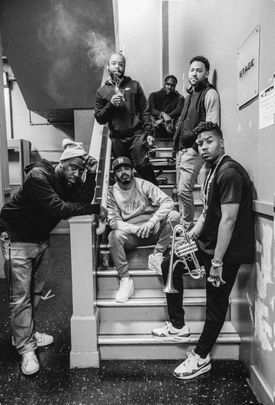
By Bill Beuttler, Boston Globe, August 3, 2018
It wasn't entirely coincidental that Robert Glasper convened his collaborative all-star band R+R=NOW in Los Angeles as the 2018 NBA All-Star Game was being held there. Two of Glasper's high-profile bandmates for the project — trumpeter Christian Scott aTunde Adjuah and bassist Derrick Hodge — are now LA-based and share the same manager as Glasper.
A third, multi-instrumentalist Terrace Martin — best known for his production and sideman credits with the likes of Snoop Dogg, Kendrick Lamar, and Herbie Hancock (Martin facilitated Glasper playing keyboards on several tracks of Lamar's "To Pimp a Butterfly," and Glasper reciprocated by connecting Martin with Hancock) — is a lifelong Angeleno. And as Glasper pointed out by phone recently, Martin having his own manager wasn't an issue.
"Terrace doesn't really go on tour," explains Glasper, who has known Martin since they met at a Colorado jazz camp as teenagers. "Terrace is a studio rat. For the most part he's in the studio, but for this last year he's actually been out with Herbie. Now he just wants to be in the studio, produce, and only go out when we go out."
The band, which follows their July-long tour of Europe with a Friday performance at the Newport Jazz Festival, also features Taylor McFerrin on synthesizers and drummer Justin Tyson. Glasper had brought an earlier version of the group, with Marcus Gilmore on drums, to the 2017 South by Southwest Music Festival. When it came time for him to record a new album for Blue Note Records earlier this year, Glasper ran a few project ideas through his mind before thinking: "Wait a minute, we could do what I did last year. That's an awesome band."
So they reassembled for four days at a studio in LA, where the laid-back vibe included a full bar, a television, and impromptu visits from friends — Don Cheadle, Terry Crews, Omari Hardwick, Amber Navran, and others — several of whom sat in on a track. One night the band jammed with Usher and Common at a pop-up event Dave Chappelle was hosting at a local club, where they ran into the rapper Stalley and invited him to join them in the studio the next day.
All 11 tracks on the resultant album, titled Collagically Speaking and released June 15, were written and recorded in one take over those four days. None of the band members plays on all of them; on her spoken paean to womanhood "HER=NOW," guest Amanda Seales is backed solely by McFerrin's synth and Hodge's bass. Martin doesn't play saxophone at all on the album, focusing on synthesizer and vocoder.
The two R's in the band's name stand for "Reflect" and "Respond," which Glasper says he took from a Nina Simone quotation (Glasper produced and played on the 2015 album Nina Revisited . . . A Tribute to Nina Simone, which also featured Tyson on drums) and a remark of Hodge's.
"Like Nina Simone said, 'As an artist, you have to reflect the times,' " Glasper recalls. "I got the 'response' part from Derrick Hodge. Me and Terrace and Derrick were in the studio together . . . and Derrick played something super-amazing, and me and Terrence were like, 'Oh my gosh! What's that?' And Derrick said, 'Man, I'm just responding.' I took him responding and took Nina Simone's reflecting, and just put R+R=NOW."
Simone famously reflected her times both musically and politically. The politics of R+R=NOW is subtler, but it's there.
"I can't speak for Rob, but I think it references musically and politically," says Christian Scott aTunde Adjuah. "It's just a bunch of guys that really like each other's music, that happen to have close proximity to each other, that are like, 'Why don't we just do this?' So that's how it happened. I mean, it happened quicker than I can remember anything happening."
Glasper's take: "I always try to represent the time I'm in." In this case, he says, that involved "trying to throw in things that are happening during the time period without it weighing down the album. I want people to listen to my record and not feel sad, because it'll stop people from listening to the record. There's already enough things to be sad about. If you watch TV at all, or if you listen to the radio — news, anything — there's so much sadness going around.
"So the one thing that's needed is light. You need something positive, and I want people to be able to put my record on to kind of escape that [sadness]. But at the same time, I wanted to kind of answer some of the things that are happening in a positive way, without it being obvious that that's what I'm doing. But that's exactly what I'm doing."
That Amanda Seales track, for instance. "I thought it was very important to have female representation on this album," says Glasper, "because I think this is the best time for females ever."
That the band's music reflects the times is more obvious: It's both of-the-moment and refuses to be confined by genre.
"For the most part, the album's definitely jazz, because we're really creating on the spot," says Glasper. "So I feel like it's the house of jazz, but there's different rooms. You might walk into the R&B room for a second. You might walk into the hip-hop room for a minute. You might walk into the jazz [room]."
Glasper makes no apologies for that eclecticism. "Jazz is literally a mutt. Jazz is made from blues, jazz is made from classical music. It was made from religious music. And so it always was a music that was mixed together to make something. People say, 'Oh, well if you mix this, is it still jazz?' Yeah! Because it was mixed to begin with. That's how they made it."
Whether anyone will help the R+R=NOW bunch make jazz at Newport, a la the guests who joined them in the studio, is an open question. Glasper's inclination is to stick with the band and their established repertoire, but he won't rule it out.
"It has to be someone who has a like mind of fluidity when it comes to music," he says. Glasper recalls calling Gregory Porter onstage with him at a past Newport festival, for example.
Glasper also recognizes that, life being finite, it's important to seize the NOW. "You don't know when you're leaving," he says. "You want to try to get all the . . ."
"All the juice out of life?" he is prompted.
"Yeah, exactly," he confirms. "Don't just say, 'We'll do it next year.' You don't know that. You really don't."
Jazz master Holland settles in with a band of equals
By Bill Beuttler GLOBE CORRESPONDENT MAY 03, 2017
Dave Holland says he surprised himself at the Kennedy Center during his acceptance speech last month as one of five newly anointed NEA Jazz Masters.
His speech, like others that night, seemed charged by the current political climate, including talk of the Trump administration targeting the National Endowment for the Arts for the chopping block. But Holland’s was especially strong. Among other things, it touched on his evolution from rock-oriented bass guitarist to jazz upright bassist after discovering Ray Brown, the importance of music and the arts to a quality education, and being hired by Miles Davis after Davis saw the Brit perform at a London club in 1968.
The Davis story led to the speech’s best moment. Holland spoke of friends he had met in London being startled to see him onstage with Davis soon afterward at a Harlem nightclub. “They said, ‘Damn, we saw you up there. How did that happen?’ ” Holland told the audience. “I said, ‘I can’t explain it either. I don’t know.’ ”
When the laughter died down, Holland abruptly altered the mood by saying this: “Anyway, I came as an immigrant.”
He nodded his head meaningfully as the audience, catching his drift, burst into sustained applause.
“I’ll just share a personal feeling about this,” recalls Holland later by phone. “As I was saying those words, it suddenly dawned on me, ‘Yes, I’ve arrived here, and this place has been so important to me — the opportunities given me, as all the other immigrants have had when they got here.’ And it was really that moment on stage when it suddenly came over me that, ‘Yes, I’m American now.’ ”
Holland, who will perform with the collaborative all-star band Aziza Saturday at a Celebrity Series of Boston concert at Harvard’s Sanders Theatre, says he finally became a US citizen about a year and a half ago, nearly 50 years after settling in New York. But that moment in his speech was a bigger deal to him.
“Being sworn in as a citizen I just took as a formalization of the way I’d always felt,” he explains. “But that feeling I had at the NEA awards was something else. It took me by surprise, it really did.”
The band Holland is bringing to Cambridge is named for a tune by another immigrant, guitarist Lionel Loueke, who left his native Benin a couple of decades ago to study jazz in Paris, Boston (at Berklee), and Los Angeles. Holland met him coaching students at the Monk Institute in Los Angeles.
“What a great asset he’s been to the musical community and the country as well,” says Holland of Loueke. “He’s brought this wonderful rich heritage of his music that he grew up around in Benin, and he went on this quest to marry it with traditional harmony and jazz tradition. I think he’s done that.”
The idea of inviting Loueke to join them in a group originated with saxophonist Chris Potter, who has played in a variety of bands with Holland over the past 20 years while also leading his own projects, including his just-released album “The Dreamer Is the Dream.” The two had worked with Loueke before on Herbie Hancock’s 2008 Grammy-winning “River: The Joni Letters” project.
For drums they tapped Eric Harland, who has been in two other recent collaborative bands with Holland, alongside leading his own group Voyager. His numerous sideman gigs include a long association with Charles Lloyd.
The band is an equal partnership, though Holland acknowledges filling a few extra roles: making the calls to Loueke and Harland, using his booking agents to line up the initial tour in the summer of 2015, and releasing their eponymous album on his own Dare2 record label, which he launched in 2004 after many years with ECM.
But Aziza is a band of equals. Holland makes sure the fact that he recorded on several landmark Miles Davis albums before the others were born doesn’t alter that.
“You do tend to just defer to him,” admits Harland, “but he’s really about that level of independence and being yourself. He’s constantly giving and making sure that our voice is heard. He’s always, ‘What tunes do you have? Let’s try that, let’s work on that.’ It’s really beautiful, a very modest way of being.”
That’s as things should be in a jazz band, according to Holland.
“It’s a very democratic moment,” he explains. “I think I might have even referred to it in the speech, about how it represented this sort of wonderful social symbology of people working together, coming from diverse streams and just coming to agreements and trusting each other and supporting each other. That’s what happens on the bandstand at the best of times.”
AZIZA
At Sanders Theatre, Saturday. Presented by Celebrity Series of Boston. www.boxoffice.harvard.edu
Bill Beuttler can be reached at bill@billbeuttler.com.
Allen, Carrington, Spalding enjoy playing on an all-star team
By Bill Beuttler GLOBE CORRESPONDENT APRIL 13, 2017
All-star jazz groups tend to come together for projects that busy solo careers render a one-time thing. But the trio of Geri Allen, Terri Lyne Carrington, and Esperanza Spalding will be playing for the third time in Boston with their four sets at Scullers this weekend, having done so before in 2011 and 2013 (the latter as one of three stellar bands celebrating Wayne Shorter’s 80th birthday at Symphony Hall).
They’ve managed this despite full schedules elsewhere. Allen, one of jazz’s most influential pianists of the past 30 years, directs the jazz studies department at the University of Pittsburgh and has a European tour lined up next month as a duo with Italian trumpeter Enrico Rava.
Carrington, a drum prodigy growing up in Medford, returned home to teach full-time at Berklee in 2005 after years spent on the West Coast touring and recording with Herbie Hancock. She has put out a pair of Grammy-winning albums of her own since returning, and at this year’s Winter JazzFest in New York unveiled her new band Social Science, featuring rising stars Aaron Parks and Matthew Stevens.
Spalding has been celebrated in both the jazz and pop worlds since besting Justin Bieber as best new artist at the 2011 Grammys, and her recent “Emily’s D+Evolution” project added a captivating theatrical layer to her singer-songwriter and instrumental prowess. Earlier this week she was streaming rehearsals for her next big project, which she plans to debut in the fall.
That Spalding would interrupt this busyness for a couple of nights in Boston, she explained by phone, is because it’s fun. “I love playing with Terri,” she enthuses, “and obviously with Geri.” Playing with such advanced players, Spalding adds, also ramps up her upright bass chops.
The shifting between her own eclectic projects and full-on postmodern, instrumental jazz is no big deal to her. “This is what I do,” Spalding says. “I play music, so it’s not really important to me what kind of music I’m playing. It’s just if I think it’s good, and if I have time for it.”
The pianist is often assumed the leader in a trio such as this, but Allen, in a separate phone call, clarified that this one works otherwise. “The trio is an equal participation in terms of everything: composition-wise, arrangement, and the way that we improvise together,” she says. “It’s a thrill, it really is.”
Allen credits Carrington with bringing the trio together. In some sense it’s an offshoot of Carrington’s first Grammy winner, “The Mosaic Project,” which featured an all-female cast of 21 instrumentalists and singers, including other such big names as Sheila E., Anat Cohen, Cassandra Wilson, and Dee Dee Bridgewater. But Carrington had known Allen and Spalding well before that.
Carrington says her first gig with Allen came about via Keter Betts, longtime bassist for Ella Fitzgerald.
“I met Geri when I was about 12 or 14,” she recalls. “Keter Betts got me to Washington to play at Blues Alley with him. It was a trio. Geri was a student at Howard University. It was her and Keter and myself.”
Carrington first heard of Spalding when Berklee president Roger Brown came to LA to recruit her to teach and played a recording with Spalding on it. When Carrington began work at Berklee, Spalding had graduated and was teaching there herself. But Brown had been right about them needing to meet. The two share a fondness for exploring music beyond jazz, Carrington having mined a more R&B-oriented vein on her most recent release, “The Mosaic Project: Love and Soul,” with a similarly star-studded ensemble of women.
There’s a good deal of freedom in the trio’s postmodernism. And all three of its members hope to encourage other women to pursue the same.
For the past few summers, Allen has been leading a weeklong summer jazz camp for women at Rutgers University, bringing in musicians, scholars, and industry people to give the camp’s students “some perspective on what it is to be out in the world of music.”
Spalding sees “doing what we do and doing it well” as the trio’s most effective means of inspiring women. “We’re just bad-ass, and that can be enough, too.”
Carrington’s approach to the issue is evolving. She would like to see more women studying instrumental jazz at Berklee.
“When I put ‘The Mosaic Project’ together, I really wasn’t trying to make a political statement,” she recalls. “I never considered myself a feminist. I just am who I am, I do what I do. But recently I’ve really been trying to figure out what I can do to contribute to a change for the better as far as women being encouraged and supported playing this music. Because this does still feel like a boys’ club.
“That’s where my head is now. I think I woke up one day and felt like I didn’t grow up with a whole lot of peers, female peers, and I don’t want it to be that way 30 years from now.”
ACS TRIO: Geri Allen, Terri Lyne Carrington, Esperanza Spalding
At Scullers Jazz Club, Cambridge, April 14 and 15 at 8 and 10 p.m. (The second set on April 14 will be broadcast live on WGBH-FM). Tickets $38, 866-777-8932, www.scullersjazz.com
Bill Beuttler can be reached at bill@billbeuttler.com.
In Gary Burton’s Berklee farewell, nothing but good vibes
By Bill Beuttler GLOBE CORRESPONDENT MARCH 07, 2017
Maybe it was modesty derived from his roots in rural Indiana, but vibraphone great Gary Burton barely acknowledged Sunday’s concert with pianist Makoto Ozone at Berklee Performance Center as his Boston farewell.
Burton, who retired from Berklee in 2003 after decades as a professor and administrator, has returned often to perform. But though he never mentioned it from the stage, he had announced that this appearance would be his last.
“I go way back in this room,” Burton, 74, told the audience after he and Ozone sprinted through Chick Corea’s uptempo “Bud Powell” in the set opener, noting he had patronized the movie theater that predated the concert hall when he was a Berklee student, and then, after Berklee bought and repurposed the building, played the first concert there.
The duo slowed down for their second piece, James Williams’s bluesy “Soulful Bill,” then proceeded through a masterful, wide-ranging set of chamber jazz that included a standard (“I Hear a Rhapsody”), another Corea piece (“Brasilia,” which Burton explained has nothing to do with Brazil), Antônio Carlos Jobim’s “O Grande Amor” (“You don’t get more authentically Brazilian than that”), two classical works from Burton and Ozone’s album “Virtuosi” (Ravel’s “Le Tombeau de Couperin” and Scarlatti’s “Sonata K20”), and Burton’s tribute to tango great Astor Piazzolla (“Remembering Tano”).
The loudest applause in a night full of it came on “Opus Half,” a virtuosic romp Benny Goodman made famous with Teddy Wilson and Lionel Hampton, which Burton said Ozone had learned from his jazz-pianist father. Ozone’s stride piano was particularly impressive here, but he wasn’t boastful about it. “I wanted to be the fastest piano player in the world,” he announced, “and I failed.”
The two classical pieces and two Ozone originals followed an intermission, as did the pianist reminiscing about his association with Burton dating back to a flashy 1983 student recital that impressed Burton less than Ozone’s more subdued work at a cocktail party soon afterward. “So you can play piano, after all,” he recalled Burton telling him.
When they returned for an encore, Ozone said that Burton’s longtime manager, Ted Kurland, had suggested a tour when he heard Burton was planning a final show in Florida. (The one that resulted includes New York City through Saturday, Rockport’s Shalin Liu Performance Center on Sunday, and concludes in Indianapolis on March 17.)
The duo then lit up Ozone’s “Popcorn Explosion.” The retirement talk Sunday night may have been muted, but the music went out with a bang.
GARY BURTON AND MAKOTO OZONE
At Berklee Performance Center, Sunday
Bill Beuttler can be reached at bill@billbeuttler.com.
'Buena Vista' star Omara Portuondo is 85. But you wouldn't know if from her two-hour-long Cambridge concert
By Bill Beuttler GLOBE CORRESPONDENT OCTOBER 13, 2016
CAMBRIDGE — Omara Portuondo will turn 86 later this month, but you might not have guessed it from the two-plus-hour performance she put on Wednesday at Sanders Theatre. Her still-strong voice only increased in power as the evening progressed. This seasoned performer paced herself and her set list brilliantly, aided by featured guests Anat Cohen and Regina Carter.
Fittingly for a World Music/CRASHarts production, Carter and Cohen hail respectively from Detroit and Tel Aviv. Portuondo, the lone surviving vocalist from the Buena Vista Social Club lineup made famous by Ry Cooder and Wim Wenders in the late ’90s, is from Havana, along with her band of pianist Roberto Fonseca, bassist Yandy Martinez, drummer Ramses Rodriguez, and percussionist Andres Coayo.
The music they made together had universal appeal. It began with Portuondo calling comic attention to her age, hiking her dress above her ankle to reveal the white socks she was wearing with her sandals. She took a seat on a stool as she and her band launched into the lively “Lagrimas Negras,” but rose to her feet a few beats in and urged the audience to stand up and dance with her.
She resumed her seat for the slower “Adios Felicidad,” and spoke a few words of English between songs as the audience settled back down from the fiery opener. “I was cold outside,” she announced, ostentatiously removing those socks. “But now I’m hot.”
Cohen joined Portuondo and the band for two songs, soloing impressively and blowing clarinet fills on both, and looking on in amusement as Portuondo gently rocked her microphone in her cradled arms while singing the first of them, the lullaby “Drume Negrita.”
An instrumental interlude gave Portuondo a breather. Cohen and violinist Carter pushed each other to virtuosic heights swapping bars on “Triste Algeria,” then Fonseca dazzled with piano pyrotechnics backed by Martinez and Rodriguez on “San Miguel.”
Carter got her two tunes to shine beside the headliner next, and when Portuondo didn’t get the audience reaction she wanted on “Sitiera,” she shifted gears and launched a singalong on “Guantanamera,” which she concluded by sustaining a note that singers half her age would have trouble matching. The ballad “Duele” followed, arguably the brightest highlight in a night full of them.
Everyone save Fonseca soloed on “La Ultima Noche.” His solo turn was saved for the set closer, “Besame Mucho,” and was as satisfyingly lyrical as his earlier solo had been flashy. Portuondo turned the bolero into a raucous singalong, and departed to a well-earned ovation.
Bill Beuttler can be reached at bill@billbeuttler.com.
George Wein assures that beat goes on for Newport Jazz Festival
By Bill Beuttler GLOBE CORRESPONDENT JULY 28, 2016
George Wein and his Newport Jazz Festival, which opens on Friday and runs through Sunday, have gone through many significant changes over the past several years. Wein sold the festival in 2007, retook control of it two years later when the buyer ran into financial difficulties, and in 2011 reconstituted it as a nonprofit. Late last year yet another important transition was put in motion, when the Newport Festivals Foundation’s board of directors approached the 90-year-old Wein about establishing a succession plan.
“The board says, ‘You have to have a successor, George. You just can’t stay there. Eventually you’re going to go,’” Wein recalled in a phone interview last week. This spring he announced that Christian McBride, a bassist, bandleader, radio personality, and budding impresario, will take charge as artistic director beginning with next summer’s festival, with Danny Melnick, Wein’s longtime associate producer, promoted to producer.
The festival has thrived since going nonprofit, according to Wein, its audience growing steadily over the past four years from 11,000 in 2012 to the close to 20,000 he anticipates this weekend.
“Being nonprofit has been a wonderful asset,” he said. “We’ve got a board of directors that contributes with the galas and our different events. We’re building up an endowment, and we will achieve my dream of keeping this alive for 20 years or more after I’m gone.”
Q. You’ve hired Christian McBride as artistic director; Danny Melnick has been promoted to producer, and Jay Sweet is going to be the executive producer. How do you envision them dividing up their duties?
A. Well, Jay is going to be the administrator, the head of the overall Newport Festivals Foundation, in addition to being artistic producer of the folk festival. Christian will be the artistic director of the jazz festival. He will choose the artists and determine the image and the structure of the festival. Danny will buy the talent. He will be the one to deal with the agents. He will be in charge of production on the field. As artistic director, Christian will have the last say on what artists are playing at the festival.
Q. What drew you to Christian as artistic director?
A. I thought that it would be great to have a musician who is as broad in his thinking as Christian. I’ve known Christian for years. His personality is perfect for what we’re asking of him. It’s a question if he had the time to work with us, because he’s a very busy musician. I think it will help our image at Newport if Christian can handle it — because that’s always the question. Can he be an artistic director of such a huge event, with 45 different artists each year? I think he can — I won’t say without any trouble, but I think he can do it with a degree of ease. My nose will be in there the first year. I’m going to sit back as much as I can, but you know me: If I’m healthy, I’ll be there. But I am going to try to phase myself out as much as possible.
Q. Beginning with the 50th anniversary festival in 2004, you’ve made a point of keeping the jazz festival tightly focused on jazz. What’s your take on why that’s been successful?
A. Well, you don’t know. The big figure in jazz now is Kamasi Washington. We grabbed hold of him. I didn’t want to lose him. He was very busy, so we made sure he’d be in Newport by giving him Friday and Sunday. If he makes a big hit on Friday, which I think he will, then we’ll see whether people come back Sunday for him.
Norah Jones, for instance. . . Norah wanted to play both the folk and jazz festival, but she has a totally different group behind her on the jazz festival. She wouldn’t do the jazz festival if Brian Blade, Chick [Corea]’s drummer, wasn’t available to play for her. She definitely wants to be accepted on the jazz level. That’s fascinating, because we’re [expecting to] sell out Saturday because of Norah. That’s the first time we’ve sold out in years.
The Friday night we’ll sell over 3,000 tickets for Chick Corea and Gregory Porter. I mean, everything is going well. Friday afternoon is a lot of pure jazz, from Tyshawn Sorey and then Eric Revis has Ken Vandermark with him, to bringing back Jimmy Heath, who hasn’t played for us in years, and bringing in Donny McCaslin. Then mixing in Kamasi Washington, Kneebody — young players that are totally dedicated to music, but giving it a little different approach.
Q. That third day of Friday shows is something you added in 2014. It largely seems to showcase artists who aren’t yet big names.
A. It’s partly that. We want them to bring in as many musicians as possible. Adding an extra day did that, but it also allowed us to apply for grants from the Doris Duke Foundation and the Rhode Island Foundation. We’re commissioning artists. It’s not on Friday, but bringing Nels Cline — we’re presenting a new major work with 15 different musicians. Nels Cline wrote me the most beautiful note of what it means to him to be at Newport. I saved that note.
‘I’m going to sit back as much as I can, but you know me: If I’m healthy, I’ll be there.’
Quote Icon
Q. You oversaw lining up this year’s artists. How do you keep up with that whole range of younger talents so different in the types of music they make?
A. I have young people that work with me, but I get out. Kneebody was playing down on Bleecker Street; I went down to hear them. Tyshawn Sorey was playing at a function for Columbia; I went up to hear him. Not only did I hear him, I heard his piano player, Cory Smythe. I said, “this piano player is fantastic.” I put him on the Storyville stage schedule, to give him a solo spot in addition to playing with Tyshawn’s trio. I haven’t had a chance to hear Kamasi Washington, but there’s so much TV on him. And records — I sit and listen on computer. My mind is open to as much as it’s possible to absorb.
Q. We’ve focused on the present and future. Let’s wrap up with one about the past. Do you have a memory or two that stand out from your many years of Newport Jazz Festivals?
A. If you ask me to pick a moment, I think the one that moved me the most — besides the Ellington and Miles Davis historical things — was Mahalia Jackson, when we introduced gospel music at the festival. That was something that was new at the time, and it really moved me. It affected my love of music.
NEWPORT JAZZ FESTIVAL
At Fort Adams State Park and International Tennis Hall of Fame, Newport, R.I. July 29-31. Times, prices vary. 800-745-3000, www.newportjazzfest.org
Best known as a jazz trumpeter, Nicholas Payton is out to break molds
By Bill Beuttler GLOBE CORRESPONDENT JUNE 23, 2016
If there’s a constant about Nicholas Payton, it’s that he’s always evolving. Payton, 42, is best known for playing trumpet, having burst onto the jazz scene a quarter century ago while still a teenager, as his fellow New Orleanian Wynton Marsalis had done a decade earlier.
When he performs two sets at Scullers on Saturday, however, Payton will be playing keyboards along with his trumpet — sometimes simultaneously. He may sing a bit too, having done so on “Y,” the penultimate track on his recent album “Letters.” Backing him will be bassist Vicente Archer and drummer Joe Dyson.
“It’s essentially why I believe we’re here on this planet: to evolve,” Payton says of his transformation from what Christian McBride dubbed “young lions 2.0” — a post-Marsalis second wave of fresh-faced, tradition-oriented virtuosi that included Payton, McBride, and Roy Hargrove — to the multifaceted creator he is today. “Particularly for an artist, I think it’s imperative.”
Payton never liked the young lions designation. “I always shunned that terminology,” he explains. “Not to dissociate myself from my peers or the music, but to me the term ‘young lion’ connoted that you were somehow a flash in the pan, and that there was only interest here because you were young. And I didn’t see a lot of longevity there.”
Another term Payton now rejects is “jazz,” preferring to call his work Black American Music, for reasons detailed in “On Why Jazz Isn’t Cool Anymore,” a 2011 blog post.
“It’s funny how things come full circle,” he says. “ ‘Jazz’ is really not something I initially liked.”
He means the word, not the music. Payton enjoyed the musicians he was exposed to by his bassist father, Walter Payton Jr., but he was more interested in Prince, Michael Jackson, and hip-hop. It wasn’t until he was 11 and working with a local brass band that he began to explore his dad’s record collection.
“Before then, I was listening to standard R&B and soul music and pop fare of any person my age,” he says. “I guess that’s where the term Black American Music is coming from, why the strong preference for that.”
He hinted at that inclination on his early albums, via covers of the Stylistics’ “People Make the World Go Round” and “Sun Goddess,” the Ramsey Lewis/Earth, Wind & Fire collaboration “That’s always been the thing for me,” Payton says, “though I was still calling it jazz at that time. But in my mind, the idea was to say that all of this black music is valid, and it’s all connected.”
Payton didn’t unveil his multi-instrumentalism on record until later, on the albums “Nick @ Night” and “Dear Louis,” his 2001 Louis Armstrong tribute. He began doubling on keyboards regularly in free midnight sessions at the New Orleans club Snug Harbor, staged to boost local morale after Hurricane Katrina.
But Payton had played more than trumpet all along, taking advantage of his father being a school band instructor to study other instruments. “I would stay after school in the band room, and that’s where I first learned how to play clarinet and saxophone and trumpet and trombone and tuba and flute and so forth.
“I really loved the movie and the music for ‘Purple Rain,’” he recalls, “so my parents bought me a piano book with all of the soundtrack written out, and I remember reading in the forward that Prince played 20 instruments. That really inspired me, and affirmed what I was actually doing, that someone I admired was a multi-instrumentalist.”
Payton barely plays trumpet on “Numbers,” the groove-oriented 2014 album he likens to Prince’s late-’80s jazz-oriented experiments. Horn and keyboards alike have leading roles on 2015’s “Letters.” On “Textures,” a collaboration with the visual artist Anastasia Pelias released last week, he limits himself to his laptop, his midi keyboard controller, and Apple Logic software.
Meanwhile, he’s got other irons in the fire. He leads a big band he calls his Television Studio Orchestra. He composed his “Black American Symphony,” which has been performed by three European orchestras but awaits an American presentation. He produced and blows trumpet on Jane Monheit’s new Ella Fitzgerald tribute, “The Songbook Sessions,” and is producing an album for the Trumpet Mafia, a band of 20-some trumpeters plus rhythm section.
His latest project, Afro-Caribbean Mixtape, has him backed by Archer, Dyson, keyboardist Kevin Hays, percussionist Daniel Sadownick, and DJ Lady Fingaz for what Payton calls “my most overt political statement.” There’s an album in the can featuring samples from black intellectuals and musicians, which Payton hopes to release later this year on his Paytone label.
As for what he’s got planned for Scullers, Payton is keeping his options open. “I usually do a mix of things from recent albums,” he says, “such as ‘Letters,’ probably some things from ‘Numbers,’ ‘Textures,’ as well as some standards. And other tunes as well.”
His bassist says even the songs themselves evolve nightly.
“He trusts the musicians to create with him,” says Archer, who’s worked with Payton for 14 years. “We have a sketch of a song — the melody, chord changes, and stuff — but we can go anywhere with the song. It’s very elastic. Night to night, the same song can go many different places.”
NICHOLAS PAYTON
At Scullers, June 25 at 8 and 10 p.m. Tickets: $35, $75. 866-777-8932, www.scullersjazz.com
Saxophonist Kidd Jordan plays free jazz rooted in tradition
By Bill Beuttler GLOBE CORRESPONDENT JUNE 01, 2016
If you’ve never heard of New Orleans saxophonist Kidd Jordan, who’ll perform at separate Somerville venues Friday and Saturday, discard two assumptions arising from his name and hometown. First, he’s no kid; Jordan turned 81 on May 5. Second, he doesn’t specialize in traditional jazz or other genres typically associated with New Orleans. Kidd Jordan is a master of free jazz, even if that’s not necessarily his own term for it.
“I don’t know about ‘free,’ ” Jordan clarifies by phone. “I’m an improviser. I improvise. I play what my environment gives me.”
His environment this weekend will be the Bursts! Music Festival, where he’ll perform with guitarist Donald Miller (of the noise trio Borbetomagus), drummer/percussionist Avreeayl Ra (a Sun Ra Arkestra veteran), and rising tenor saxophonist James Brandon Lewis. Jooklo Duo (saxophonist Virginia Gent and percussionist David Vanzan) will open, and likely will join the others for the finales both nights.
Jordan has worked with Miller “about two, three times,” he says, but doesn’t know the others. Not that that worries him.
“Whatever they do, I’m gonna do my thing on top of what they doin’, and hopefully it will work,” he says. “It’s gonna be in the moment, I can tell you that. I’m not gonna bring a bag of tricks with me.”
The shows are being produced by the father-and-son team of Bill and Matt Goldberg, with the elder Goldberg’s college buddy Russ Gershon playing host Saturday at his Accurate Records loft. Gershon, who leads the Either/Orchestra, considers these rare local appearances by Jordan all the more special for the history Jordan brings with him.
“Kidd Jordan is one of the last of the musicians that plays free music that grew up through the whole history of jazz,” he explains. “He played bebop as a teenager, and of course being a New Orleanian, you’re just steeped in so many different musical traditions there, related to R&B and blues and New Orleans-style marching music and all that stuff. So he’s one of the last people that really embodies that whole arc of jazz, from the earliest New Orleans roots to free jazz to post-Albert Ayler music.
“Because he has all those elements in his playing and all of that history in his life,” Gershon continues, “there’s a wonderful blues quality in his playing, which is what I love about the freer music that really moves me, from Ornette [Coleman] to Albert Ayler. I even hear it in Roscoe Mitchell and the Art Ensemble [of Chicago] guys. I hear the blues. There’s a real earthy quality of rootedness to all of the playing that makes me want to listen to it. There’s some modern jazz and free music that just doesn’t have that for me.”
Other types of music also inform Jordan’s playing and enhance its accessibility. He honed classical chops in graduate school in Illinois (he considers Chicago his second home), and spent three decades teaching at Southern University and leading summer band camps for New Orleans schoolchildren, some of whom became better known than he is. (“Donald Harrison used to play free, free, free,” Jordan recalls. “Branford [Marsalis] didn’t.”) Jordan avoids playing written music, but used to write lots of it for his students; one of his tunes, “Kidd Jordan’s Second Line,” became a staple for the Dirty Dozen Brass Band and similar groups.
Jordan kept busy moonlighting as a working musician during his teaching years, backing Aretha Franklin and other stars when they passed through town. “Ray Charles, Bobby ‘Blue’ Bland, Leonard Williams. . . . I was at Motown working with Stevie Wonder when he was 12 years old,” he notes. “I’ve been around the horn with all that kind of stuff. People used to come to New Orleans without a band. They’d pick a band up when they come. Sometimes I’d go out with some of them for two or three weeks in the summertime. I’d go out with ’em and catch another one goin’ back.”
Those days, though, are behind him. “Now that I’m into my later years that’s all I want to do,” says Jordan of the unbounded improvisations he now focuses on exclusively. “I don’t want to do nothing else but this.”
Free jazz, he acknowledges, can be off-putting to some. But Jordan remains devoted to it, inspired by the example of John Coltrane, who turned resolutely to free jazz at the height of his fame despite alienating many fans.
“The last time I saw Trane, I asked him how did he come out of ‘Giant Steps’ to what he was doin’,” says Jordan. “He had about three or four people in the joint. Everybody had walked out. At the end there wasn’t nobody but him and Elvin [Jones] playing, and that’s the most powerful music I ever heard in my life. Trane said, ‘Man, they all leavin’, but I got to do what I got to do.’ ”
Jordan has experienced some of that himself through the years, but hopes for good shows this weekend. “I hope the people don’t go runnin’ out of the building,” he adds with a chuckle. “But if they do, it won’t be the first time.”
KIDD JORDAN
Presented by Bursts! Music Festival. At ONCE Lounge & Ballroom, Somerville, June 3 at 8 p.m. Tickets $25, advance $20, students $10. 617-285-0167, www.oncesomerville.com. At Accurate Records Loft, Somerville, June 4 at 8 p.m. Tickets: $20, students $10. 617-872-1544, www.brownpapertickets.com.
Busy performer Christian McBride is about to become ubiquitous
By Bill Beuttler GLOBE CORRESPONDENT MAY 13, 2016
“Real jazz will never be a minority at any festival that I’m involved in,” says Christian McBride. “[But] I shouldn’t hold it against an artist if they decide they don’t want to play music that’s coming out of Horace Silver and Cannonball Adderley. They shouldn’t be penalized for that.”
“Real jazz will never be a minority at any festival that I’m involved in,” says Christian McBride. “[But] I shouldn’t hold it against an artist if they decide they don’t want to play music that’s coming out of Horace Silver and Cannonball Adderley. They shouldn’t be penalized for that.”
For local jazz buffs, this is the summer of Christian McBride. The 43-year-old bass virtuoso will perform with a pair of Grammy-winning trios over the next couple of months, leading his own at Scullers on June 3 and 4, then joining Chick Corea and drummer Brian Blade at Rockport Music (July 25 and 26), the Newport Jazz Festival (July 29 and 30), and Tanglewood (July 31). All of this comes as he settles into his new role as Newport’s artistic director, succeeding the festival’s legendary cofounder, George Wein.
McBride was already juggling assorted off-stage roles — most prominently hosting National Public Radio’s “Jazz Night in America” — when Wein announced in March that he was handing over the artistic director gig, and promoting Danny Melnick to producer. But McBride knew all along he would remain an active musician.
“George made it clear,” he recalls. “He said, ‘Listen, I don’t want to compromise any of your relationships, because at the end of the day you're still a bass player. I don’t want you calling up musicians and saying, Hey, you want to play the festival? Let’s work out the details. No, no, no, no — you don’t do any of that. You think up who you want to have, and then Danny makes the calls.’ ”
McBride expects his preferences to resemble what Wein has been booking the past decade or so: jazz as broadly defined, with occasional pinches of other genres for seasoning.
“George told me specifically that one of the reasons he felt comfortable with me stepping into his shoes is because I’ve had a far-reaching concept of what jazz is and what it can be, how it fits into festivals,” says McBride. “He liked the fact that, although I’m pretty democratic in different forms of jazz, the common denominator is straight-ahead jazz. Real jazz will never be a minority at any festival that I’m involved in.”
Jazz that’s less straight-ahead remains welcome, too. “I shouldn’t hold it against an artist if they decide they don’t want to play music that’s coming out of Horace Silver and Cannonball Adderley. They shouldn’t be penalized for that; they should have an opportunity to perform at a major festival.”
Don’t expect pop artists to proliferate the way they have at some jazz festivals. Those with long memories may recall Wein himself announcing that he was refocusing on jazz more exclusively for the 50th Newport Jazz Festival in 2004, a policy he has since maintained.
“That’s the concept that I intend to continue at Newport,” says McBride. “Mostly jazz, but I have no problem with bringing in a little bit of somebody funky or somebody from the rock world.” He remembers once watching rapper Mos Def at Newport. “It wasn’t Mos Def doing his usual thing,” he clarifies. “He was working with the Hypnotic Brass Ensemble from New Orleans. I thought it was great.”
Planning for future festivals won’t be underway fully until this one is over. More immediately, there are those trio dates coming up in Boston. McBride won his fifth Grammy this year for best improvised jazz solo on his trio album “Live at the Village Vanguard,” belying the old joke about nobody listening to bass solos. Jerome Jennings has since taken over for Ulysses Owen Jr., on drums, after previous stints with Sonny Rollins and Dee Dee Bridgewater. McBride was particularly impressed by the Bridgewater connection.
“Any drummer who knows how to play behind a singer, that’s the kind of drummer you want,” he says. “No matter what style band you have, drummers who know how to work with singers, that’s a serious thing for me.”
McBride first encountered pianist Christian Sands, a protege of Hank Jones and Billy Taylor, while subbing as host for Marian McPartland on “Piano Jazz.”
“At the time he must have been 19,” McBride recalls. “I was surprised I hadn’t heard about him, because I always thought of myself as someone who’s got his ear to the ground. But when I heard him play that day I was really upset I’d never heard of him, because he was so incredible. I said, ‘Man, this kid is something.’ And we started working together almost immediately after that.”
CHRISTIAN MCBRIDE TRIO
At Scullers Jazz Club, June 3 and 4 at 8 and 10 p.m. Tickets: $38, with dinner $78. 866-777-8932, www.scullersjazz.com
Saxophonist Noah Preminger finds his voice in Delta-blues honesty
By Bill Beuttler GLOBE CORRESPONDENT MAY 09, 2016
Noah Preminger prefers talking to listening to records — and listening to others tell stories before doing it himself. The critically acclaimed tenor saxophonist, who will celebrate the release of his album “Dark Was the Night, Cold Was the Ground” with a performance at Scullers on Thursday, was relating this over beers in Swampscott last week, having schlepped there to be interviewed after teaching that afternoon in Mansfield.
Preminger, who now lives in Cambridge, essentially gave up listening to recordings upon graduating New England Conservatory eight years ago and moving to Brooklyn. He’ll listen to John Coltrane or Ornette Coleman in small doses, he says — “maybe some Trane from, like, 1962, 1963, where he’s still playing stuff that’s swinging, but it’s really more intense and on the verge of being way out there.” But Preminger’s favorite listening of late, albeit also taken in small doses, has been the foundational Mississippi Delta blues musicians who inspired his past two albums.
“I like storytelling,” he explains. “That’s what the blues is about. And their phrasing, their storytelling, is so unbelievably unique to each person.” That’s especially so of the early, self-taught singer-guitarists who interest him most, whose lack of training left them free to blur the standard blues form in whatever way they pleased. “And so you get Charlie Patton storytelling, you get Robert Johnson storytelling, you get Blind Lemon Jefferson storytelling. The message can be similar, but their voices and the way they phrase, the guitar playing — they’re all very individual. And that’s the most important thing in music: a unique voice.”
Preminger, who turns 30 next month, has a similarly distinctive voice on his horn. Jason Palmer, an assistant professor at Berklee and the trumpeter on both of Preminger’s blues-based albums, has known the saxophonist since his undergraduate days. The two now perform together most weekend nights at Wally’s, where Palmer has led the house band for years and will record a live album with Preminger as a sideman this weekend.
“Noah’s playing covers such a broad range, instrument-wise, the way he covers the horn from top to bottom,” says Palmer, who previously preferred alto players in his bands. “And he’s got a sense of duality with his playing: He can be really, really aggressive in the way that he communicates his ideas over the horn, and at the same time he has this soft, real tender tone that can really bring the listener in, this fluffy type of tone that is reminiscent of the way Miles [Davis] would play a ballad. He’s really multifaceted.”
Preminger’s sound was established on his first four albums, most visibly the pair he made for Palmetto Records, “Before the Rain” (2011) and “Haymaker” (2013), which featured a mix of original compositions and masterful covers of ballads. But his ongoing Delta blues obsession has ramped up his individuality, starting with last year’s “Pivot: Live at the 55 Bar,” which had Preminger’s quartet stretching for more than 30 minutes apiece on the Bukka White classics “Parchman Farm Blues” and “Fixin to Die Blues.”
The new album was also recorded at a club, the Side Door in Old Lyme, Conn. It features shorter arrangements of tunes by nine different blues greats, performed by the same quartet featured on “Pivot”: Preminger, Palmer, bassist Kim Cass, and drummer Ian Froman, all of whom will be at Scullers. The leader made a point of playing his bandmates the original recordings he was working from, but there were no rehearsals.
“It was easy,” Preminger says, “because the songs play themselves. It ain’t rocket science. If you’ve got to rehearse, it probably isn’t worth playing.”
He maximized the band’s freedom by keeping his arrangements simple. For the title track, he zeroed in on the droning guitar from Blind Willie Johnson’s original, slowing it down and setting it in ¾ time before opening up a section for the musicians to blow. Skip James’s “Hard Times Killin’ Floor Blues” had a typical call-and-response, so Preminger’s arrangement has him trading lines with Palmer. The saxophonist took four bars he especially liked from Robert Johnson’s “Love in Vain” and distributed it among the players, writing different harmonies to underscore each instrument’s turn playing lead. Mississippi John Hurt’s “I Shall Not Be Moved” gets a slightly more complex spin, three-point counterpoint building to Preminger stating the melody and Palmer soloing over the form.
“Every single song tells its own story,” Preminger says, “and as a whole, it reads like a book. I think the order is really good. I think the playing is exceptional — everybody is digging in and really putting it all out there. And I think the arrangements are good and the originals are great.”
The men who recorded those originals, he notes, “worked in the fields, or they were in prison, or they were fighting alcoholism. I can’t really relate to that; I’m a white guy from Connecticut. But their music speaks to me because it’s incredibly honest, and you don’t really hear that with most stuff.”
If Preminger has his way, you’ll hear it with his.
NOAH PREMINGER QUARTET
At Scullers Jazz Club, May 12 at 8 p.m. Tickets: $25, with dinner $65. 866-777-8932, www.scullersjazz.com
Melissa Aldana Trio fiery in Regattabar homecoming
By Bill Beuttler GLOBE CORRESPONDENT APRIL 27, 2016
CAMBRIDGE — Melissa Aldana was touring in support of her new album, the Sonny Rollins-inspired “Back Home,” when she brought her trio to the Regattabar on Tuesday night. But the tenor saxophonist and her bandmates — her fellow Chilean Pablo Menares on bass and Jochen Rueckert on drums (taking over for Francisco Mela from her previous trio) — played just one song from the disc during their impressive but lightly attended set.
That tune, Rueckert’s “Servant #2,” led things off and set the tone: a stripped-down stage presence with the musicians clustered together and casually attired, and smoldering drums and bass providing a dynamic but supportive floor for Aldana’s inventive, thematically grounded improvising. Aldana, 27, is the same age as Rollins was when he recorded his famous trio albums “Way Out West,” “A Night at the Village Vanguard,” and “Freedom Suite,” and she and her group accessed a comparable trio language here as they had on her new recording.
“Elsewhere,” introduced as “a brand new tune,” had a cool feel to it, with long, swirling phrases that Aldana dug into deeply with her dry, sandpapery tone — playing with her eyes closed, rising up and down on her toes as she put body English into her phrasing. That her superb solo elicited no applause might have been because it bled directly into Rueckert’s.
“New Points,” from her previous trio album (“Melissa Aldana & Crash Trio”), had a more whimsical, samba-ish feel to it. Aldana moved behind her bandmates while Menares soloed and Rueckert accompanied with brushes, then returned to center stage blowing her horn. Eyes rolling back, she invented long, dreamy phrases that she would snip off without quite resolving, letting the rhythm section finish her thought.
The standard “Never Let Me Go” was another highlight. Aldana began unannounced and unaccompanied. Bass and brushes slipped in quietly as she edged her way around the familiar melody; after a slow Menares solo, Aldana eventually brought the ballad to a breathy conclusion.
After “Turning,” also from Aldana’s previous trio album, she offered one more tune, which turned out to be Thelonious Monk’s “I Mean You.” All three players had one last chance to solo: Aldana tearing into her spot with such fire and fluency that the audience finally remembered to applaud, and an inspired Rueckert responding in kind to wrap things up.
MELISSA ALDANA TRIO
At the Regattabar, April 26
Brad Mehldau's trio brings fire, finesse to Berklee
By Bill Beuttler GLOBE CORRESPONDENT APRIL 19, 2016
The Brad Mehldau Trio has an excellent new album, “Blues and Ballads,” coming out June 3, but only played one song from it Friday. Instead, its show at Berklee Performance Center demonstrated the assorted strengths that ranks the group among the tiny handful of elite trios routinely booked at concert halls rather than jazz clubs.
Renowned for freewheeling yet respectful interpretations of other composers’ work, the trio started its set with three fresh originals. “Solid Jackson” was a blues named for a catchphrase of dedicatee Charlie Haden, with whom Mehldau had collaborated; “Strange Gift” had bassist Larry Grenadier weaving a melody with Mehldau’s piano and Jeff Ballard playing his drums with his bare hands as much as with his mallets and sticks. A third piece was so new it hadn’t acquired a title, but memorably found Mehldau turned to face his colleagues, his right hand resting on his thigh while his left casually repeated a bass figure over and over, while Grenadier and Ballard took turns soloing.
The trio detoured to Brazil for the night’s first cover, “Valsa Brasileira,” a song with lyrics by Chico Buarque — “don’t worry,” Mehldau reassured the crowd, “I’m not going to sing” — and music by Edu Lobo. Three wide-ranging American Songbook selections rounded out the set: a delectable take on Cole Porter’s “I Concentrate on You” (from the new album, and, said Mehldau, in response to a frequent request from his mother: “Play more ballads, Brad”), a rapid-fire run through Charlie Parker’s “Crazyology,” and Sidney Bechet’s wistful “Si tu vois ma mère” (“If you see my mother”).
Grenadier played melody and took a resplendent solo on “Valsa Brasileira,” propelled “Solid Jackson” with energetic walking bass, and generally kept things anchored. Ballard was ceaselessly inventive, and kicked off “Crazyology” at warp speed on cymbals before taking his flashiest solo. Mehldau also took a couple of jaw-dropping tears through the “Crazyology” head, and otherwise flashed facets of his renowned pianism: crystalline touch, deep lyricism, harmonic sophistication, adroit use of space, and the otherworldly independence of his right and left hands.
He opened the encore to audience requests, settling on Nick Drake’s “River Man” because this version of his trio hadn’t played it before. (Ballard joined midway through its 22-year history, replacing Jorge Rossy in 2005.) And thus, almost as an afterthought, the evening ended with yet another celebrated Mehldau specialty: the successful coupling of post-Beatles pop tunes and jazz improvisation.
BRAD MEHLDAU TRIO
Presented by World Music/CRASHarts. At Berklee Performance Center, April 15
Bill Beuttler can be reached at bill@billbeuttler.com.
Esperanza Spalding stages adventurous pop coup at Shubert
By Bill Beuttler GLOBE CORRESPONDENT APRIL 13, 2016
Esperanza Spalding may be physically svelte, but her soul is large and, like Whitman’s, contains multitudes. That much was clear Tuesday at the Citi Shubert Theatre, where Spalding performed songs of herself — or rather of her alter ego, Emily (her real-life middle name) — from her wildly inventive recent album, “Emily’s D+Evolution.”
Spalding had field-tested this material at the Paradise last year, and it was evident even then that the four-time Grammy winner’s pop powers continue to grow. Her singing and songwriting have gained force and confidence. The new project adds a gratifying layer of theatricality to live performances, while the stripped-down backing band keeps a tight focus on Spalding’s considerable, wide-ranging talents.
The Shubert set opened with backup singers Emily Elbert, Shawna Corso, and Corey King — all attired in white with yellow neckties — filing robotlike onto the right side of the stage, and drummer Justin Tyson and guitarist Matthew Stevens taking their places on the left. Spalding, decked out in dark gray dress, red pants, and black crown, and electric bass in hand, made a dramatic entrance climbing over a curtain, and launched into “Good Lava,” the album-opening celebration of uninhibited creativity.
All 12 tunes from the recording got an airing, but their sequence was shuffled, enhancing a narrative arc while also withholding hook-oriented potential hits “Funk the Fear” and “Unconditional Love” until toward the end. The most theatrical pieces came early; backing vocalists recited lyrics in rapid-fire unison with the leader on “Ebony and Ivy,” during which Spalding pored through books from an onstage bookcase and received her own yellow necktie in a graduation ceremony. Elbert played with puppets while Spalding sang at an upright piano on “Elevate or Operate,” and King and Corso took turns being comforted for romantic disappointment on “Rest in Pleasure,” “Judas,” and “Farewell Dolly.”
Spalding’s singing and writing called to mind Joni Mitchell’s sophistication on “Noble Nobles,” “One,” and “Judas,” and her prominent bass was reminiscent of Mitchell’s onetime collaborator Jaco Pastorius. The night’s highlight was the closing “Unconditional Love,” with Stevens and Tyson, joined by Spalding, climactically unleashing their instrumental chops.
Encore covers included Anthony Newley’s “I Want It Now” (from her album) and David Bowie’s “If You Can See Me” (from his 2013 album “The Next Day”). The latter offered sly tribute to Bowie’s longtime associate Tony Visconti, who helped produce Spalding’s album, while paying overt homage to another bold explorer whose artistry contained multitudes.
ESPERANZA SPALDING
At Citi Shubert Theatre, April 12
Convened by Iyer, diverse artists converge at Harvard
By Bill Beuttler GLOBE CORRESPONDENT APRIL 01, 2016
It’s no accident that two of the most highly anticipated local performances during Jazz Appreciation Month in April are not being billed not as jazz, but rather “creative music.”
“I think we have to at least accept that as long as there’s been this word floating around, there’s also been intense critical examination of it from African-Americans,” says Vijay Iyer, a pianist and composer, Harvard professor, and Jazz Artist of the Year in the 2015 Down Beat magazine critics’ poll. He names Duke Ellington, Charlie Parker, Miles Davis, John Coltrane, and Abbey Lincoln as historical figures who resisted the term jazz. “That’s basically the spirit in which most of my colleagues and I work.”
A generous sampling of Iyer’s colleagues will join him in Cambridge on Thursday and Friday for the 2016 Fromm Concerts at Harvard, “Creative Music Convergences.” Iyer will open the event on Thursday in a duo with trumpeter Wadada Leo Smith, sharing a bill with the Chicago trio of flutist Nicole Mitchell, cellist Tomeka Reid, and drummer Mike Reed.
“I wanted to present a spectrum of what’s happening today,” Iyer explains of his curatorial choices. “I wanted to make sure it was representative across generations and across different ethnicities and so forth. Also, that it’s basically the best music that I know about that’s happening right now.”
To illustrate, he offers thumbnail descriptions. “Craig Taborn: a total master, one of the greatest pianists ever, in my opinion. Wadada Leo Smith, a wise and brilliant visionary artist — I’ve been fortunate to collaborate with him, but it isn’t just about me collaborating with him; he’s also doing a project with [laptop percussionist] Ikue Mori. Okkyung Lee, a visionary cellist, sound artist — basically she reinvents the instrument every time she plays it. Steve Lehman, on the cutting edge of creative music, jazz, working with compositional languages from a lot of different sources, including French spectralists, is very informed by hip-hop and electronic music. Tyshawn Sorey, brilliant composer, performer — this is one of the first major performances of this double trio of his.”
Iyer breaks off his recitation to point out that Lehman, Sorey, and another of his featured artists, pianist Courtney Bryan, are products of Columbia University’s doctoral program in music composition. “They all have composerly orientation that’s informed by a lot of different systems of music-making,” he notes. “They all have very rigorous materials that they’re working with, and they’re all truly exceptional performers, too. So that puts them in a rare and special and kind of new category, because they’re radical improvisers and really grounded composers, too.”
These dual qualities also apply to Smith, whose large-scale composition “Ten Freedom Summers” was a finalist for the 2013 Pulitzer Prize in music, and to Iyer himself, as evidenced by their just-released album, “a cosmic rhythm with each stroke.” The two premiered the seven-part suite of that name last week, wrapping up Iyer’s residency at the Met Breuer Museum in New York. But they’ve known each other for years.
Smith mentions getting together on trips to the Bay Area when Iyer was pursuing his Ph.D. at the University of California at Berkeley and Smith was teaching at Cal Arts. He later hired Iyer for the second iteration of his Golden Quartet.
“I look for what they can do, what kind of mentality they have about this art,” Smith says of his approach to choosing collaborators. “It’s a rigorous process of trying to discover the best possible person to be in an ensemble.”
He recalls what attracted him to Iyer as a pianist: “He played the complete range. His hands were large enough to play chords that I would write, which have five or six pitches and cover more than an octave or two. He could play lyrical, he could play all kinds of energetic, jagged stuff. And he also could play anything anybody else thought that he could play.”
Iyer was contemplating a duo recording with his old boss already when the Met Breuer commissioned him to compose music honoring Indian visual artist Nasreen Mohamedi. He decided the two projects could be combined, and introduced Smith to Mohamedi’s abstract minimalism. “It gave us something to relate to besides each other,” Iyer says, “which is a good way to create.”
The suite was created live in the studio, a mix of both written and spontaneous composition. “We both prepared compositional materials individually, and then we merged them in the studio,” Iyer explains. “So we created the music in real time from all these materials we had assembled individually and consulted with each other about, but we wanted to really highlight the moment of music-making. When you listen to the album, you hear things unfolding in a certain way that can’t have all been done on the spot. Or could they? It actually kind of confounded us, even, the way that things resolve themselves.”
Whatever they draw from the suite on Thursday will involve similarly in-the-moment music-making. It won’t replicate what’s on the album, nor should it.
“I think it’s the case with the entire history of creative music that it has elements that are fixed and elements that are unfixed or variable,” Iyer says. “Something about this project is necessarily unfixed. It needs to remain in motion — it needs to be different every time.”
CREATIVE MUSIC CONVERGENCES
Fromm Players Concerts at Harvard, curated by Vijay Iyer. At Paine Hall, Cambridge, April 7 and 8. Free admission. 617-495-2791, www.frommfoundation.fas.harvard.edu
Bill Beuttler can be reached at bill@billbeuttler.com.
Sax master brings unique Charlie Parker tribute to Boston
By Bill Beuttler GLOBE CORRESPONDENT MARCH 07, 2016
When alto saxophonist Rudresh Mahanthappa recorded his Charlie “Bird” Parker tribute album “Bird Calls” two summers ago, he didn’t include a single cover from the bebop legend’s own songbook. Instead, Mahanthappa whipped his crack new quintet with trumpet phenom Adam O’Farrill, pianist Matt Mitchell, bassist François Moutin, and drummer Rudy Royston through new compositions he created from nuggets he had lovingly culled from songs in the Parker canon during long nights in a rented studio space near his Montclair, N.J., home.
Hints at the source material are contained in the new tunes’ titles. “Both Hands” is derived from “Dexterity,” “Maybe Later” from “Now’s the Time,” “Talin Is Thinking” (Talin being the name of Mahanthappa’s young son) from “Parker’s Mood,” “Sure Why Not?” from “Confirmation,” “On the DL” from “Donna Lee,” and so forth. The clues help: Even Mahanthappa’s band needed prompting to recognize from where the new music they were recording had been conjured.
The album, released in February 2015, won Mahanthappa album of the year in the DownBeat Critics Poll and tied for top honors in the NPR Music Jazz Critics Poll.
“I don’t know if surprised is the right word,” says Mahanthappa, 44, who will perform material from “Bird Calls” Wednesday in a sold-out show at the Institute of Contemporary Art (and be interviewed onstage beforehand by a sometime collaborator, guitarist and Berklee professor David Gilmore). “I was definitely happy. I had a sense that it was really timely and refreshing for people to hear me going back to an acoustic format, which I hadn’t done since ‘Codebook,’ and a more traditional lineup. And this orientation with one of the most prominent figures in the history of this music — maybe it took them by surprise! For me, it’s all part of the continuum of what I’m doing, but maybe it’s kind of the right time at the right place as far as my discography goes.”
His next album will be with his Indo-Pak Coalition partners Rez Abbasi (guitar) and Dan Weiss (drums, tabla). They’ll record in August for release early next year. He hopes to eventually record another album with the “Bird Calls” band as well.
In the meantime, he’ll continue touring “Bird Calls.” Sometimes this requires finding substitutes for his busy sidemen, but Mahanthappa’s bench is deep enough that the music doesn’t suffer. “I’m not just hiring anybody,” he notes. “I’m looking for people where the music will very quickly become second nature to them. Part of it is me being lucky enough to have the bandmates that I have, the subs that I have, and keep the company that I keep.”
At the ICA, Thomson Kneeland and Jordan Perlson will sub for Moutin and Royston, respectively. But Mitchell, who has two critically acclaimed albums of his own behind him (and, like Royston, is also a member of Dave Douglas’s formidable quintet), and O’Farrill, whose debut album as a leader is out next month, will both be on hand.
Mahanthappa’s relationship with O’Farrill, 21, is especially noteworthy. O’Farrill’s trumpet makes him a Dizzy Gillespie-like foil to Mahanthappa’s Parker, particularly on the irresistible track “Chillin’ ” (Mahanthappa’s reimagining of Parker’s “Relaxin’ at Camarillo”). His recording “Bird Calls” at age 19, three months before placing third in the 2014 Monk Institute trumpet competition, calls to mind Miles Davis recording with Parker at a similar age. And O’Farrill and Mahanthappa both appear on “Cuba: The Conversation Continues,” which earned O’Farrill’s father, Arturo O’Farrill, best Latin jazz album at last month’s Grammy Awards.
Playing with Mahanthappa has been invaluable for O’Farrill. Mahanthappa mostly teaches by example. “Every night he was just delivering it full throttle,” O’Farrill recalls of a recent tour. “The thing that really makes Rudresh stand out is how he’s able to bring such a high level of intensity and action to everything he does. And emotion, too. And soul. That’s what’s been amazing to take from the experience.”
Sometimes the lessons are more explicit. “We have this tag at the end of a tune where we’re kind of playing off of each other,” says O’Farrill, describing one such lesson. “I kind of kept imitating him too much, without creating my own ideas for him to play off of. Onstage, he said, ‘Play something else!’ He didn’t yell it aggressively. It was kind of funny, but it was also good. I think it’s important for those things to happen. It’s the only way you really learn and grow.”
What Mahanthappa gets in return from sidemen O’Farrill’s age is being reenergized, onstage and off. He recalls having a couple of days off in Paris with O’Farrill and substitute pianist Joshua White, both on their first tour of Europe. “Adam and Joshua were up at 8 a.m. trying to go to all the museums, and I was like, ‘Wait, I’ll do that too.’ There was a time where I did all that stuff. As I’ve started touring more, unless I’m really in a place I’ve never been, I have a million things to do and don’t necessarily have time to do that. I wind up doing a lot of work. That’s all to say that, being in some of these places, I kind of felt like I was there for the first time, seeing it through their eyes.”
Consider Wednesday’s concert taking place at a museum a fitting coincidence, then. And know that Mahanthappa’s artful tribute to Bird is every bit as cutting-edge as it ought to be for any institute of contemporary art.
Bill Beuttler can be reached at bill@billbeuttler.com.
Trombonist Hal Crook takes a starry final bow at Berklee
By Bill Beuttler GLOBE CORRESPONDENT FEBRUARY 19, 2016
“What do you call a trombonist with a pager?” goes the old joke. “An optimist.”
Trombonist and master educator Hal Crook joined the Berklee faculty in 1986 when pagers were still a thing, having himself graduated from the school a decade earlier. On Thursday night the college celebrated his announced retirement with a sold-out, star-studded concert at Berklee Performance Center.
Joining Crook for the evening’s first set was an advertised crew of big-name Berklee alumni whose paths had crossed Crook’s: Esperanza Spalding on upright bass and vocals, her frequent collaborator Leo Genovese on piano, Chris Cheek on tenor sax, and Lionel Loueke on guitar. Drummer Antonio Sanchez, fresh from a Grammy win for his “Birdman” score earlier in the week, was a late addition to the lineup.
They opened by stretching out on Crook’s “Set Me Free,” whose title was the event’s theme and whose structure interspersed restatements of the melody — Spalding’s wordless vocals acting like a third horn — with bouts of free soloing by everyone save Sanchez. Crook didn’t solo much through the night; when he did, his trombone had a trumpet-like brightness as he demonstrated that he can very much keep pace with the famous acolytes surrounding him.
The opening set ended on another highlight, “Domestic Violets,” a Crook bouquet for a pet cause: a shelter for victims of domestic violence. Spalding, who introduced and sang it, said, “We’d like to dedicate this to anyone with a bruise or a cut or a busted lip.”
Crook entertained the audience during an intermission, blowing “For He’s a Jolly Good Fellow” on a kazoo, reminiscing, and cutting up. (One joke mined the pager vein: “Soon I’ll be a retired trombonist. I know a lot of you are thinking, ‘What’s the difference?’ ”) Then he brought out his band Behind These Eyes for a set of jazz-inflected pop featuring the ebullient vocals of Berklee alumna Deborah Pierre, Wesley Wirth’s electric bass (his solo on “What Is Going On” a particular crowd-pleaser), three keyboards, drums, and a tight four-piece horn section.
Crook, who wrote the band’s music and lyrics, skipped soloing the second set. Nor did he solo on the night’s final number — but most everyone else did when the first set’s stars joined Behind These Eyes for “Hide and Seek,” Cheek switching to soprano sax, Genovese launching his piano solo into orbit with palms and forearms. Then Crook, confirming his optimism, reminded the audience that “Life is the greatest prize” as he bid them adieu.
Music review
THE MUSIC OF HAL CROOK: Set Me Free
At Berklee Performance Center, Thursday
Bill Beuttler can be reached at bill@billbeuttler.com.
Mack Avenue SuperBand wows at Berklee
By Bill Beuttler GLOBE CORRESPONDENT FEBRUARY 08, 2016
The Mack Avenue SuperBand came to Berklee Performance Center Thursday night, courtesy of Celebrity Series of Boston, and put on a show that wowed the audience with cordial excellence rather than an old-fashioned cutting contest.
Onstage were bassist and NPR “Jazz Night in America” host Christian McBride’s superb trio with pianist Christian Sands and drummer Carl Allen, augmented by three of their label mates with strong ties to Berklee: saxophonist (and professor) Tia Fuller, trumpeter (and brass department chair) Sean Jones, and vibraphonist (and retired Berklee vice president) Gary Burton. They were promoting the latest in the Michigan-based record label’s series of live albums from the Detroit Jazz Festival, and six of the eight tunes they played came from that mid-January release.
They opened, as does the new album, with Kirk Whalum’s earthy tribute to the late Hank Crawford, “Preach Hank!” All-star bands, unlike all-star sports teams, tend to inspire their members to exert themselves, and Jones was clearly in such a mood when his turn to solo arrived, his effort provoking especially vigorous applause when it was through — and perhaps prompting his bandmates to ramp up their games to match his.
The bulk of the set consisted of a composition apiece by each musician. Fuller’s challenging “Decisive Steps,” she said, is a distillation of what she always advises students about “moving forward in faith and not fear,” and she practiced what she preaches on her roaring alto solo. McBride’s “Paint Brushes” came next, Burton supplying an intro and the bassist wrapping up the soloing with one of his own. Jones’s “Gretchen” was written as Christmas approached, for Mack Avenue founder Gretchen Valade, and he joked that “Contrary to popular belief, trumpet players can write pretty songs” — his lovely waltz proving the point, greatly aided by his own gorgeous flugelhorn solo.
Carl Allen’s “The Sacrifice” celebrated the masters that had come before them (including newly named NEA Jazz Master Burton) and opened with Allen’s mesmerizing unaccompanied drums. Burton’s newest piece was less nostalgic, “Don’t Look Back” opening, as Burton said, “with an intro from our brilliant pianist, Christian Sands.” When Sands soloed on his own contribution, “Up,” the 26-year-old may very well have outdone his elders with the most dazzling solo of the night.
An encore on Makoto Ozone’s slow blues “The Test of Time” featured all save Allen getting solos to demonstrate their utter mastery of the form, McBride choosing to bow his. Super band, indeed.
MACK AVENUE SUPERBAND
Presented by Celebrity Series of Boston. At Berklee Performance Center, Thursday
Bill Beuttler can be reached at bill@billbeuttler.com.
An electric connection for jazz guitarist Lionel Loueke
By Bill Beuttler GLOBE CORRESPONDENT JANUARY 07, 2016
When the celebrated Beninese guitarist Lionel Loueke comes to the Regattabar next Thursday promoting his wide-ranging new trio release “Gaïa,” he’ll be joined, as he is on the recording, by Swedish-Italian bassist Massimo Biolcati, one of two friends with whom he has played since they met nearly two decades ago as international students at the Berklee College of Music.
“Gaïa” ramps up Loueke’s recent emphasis on electric guitars over the nylon-string acoustic models he built his reputation on, but this time he had Biolcati and Hungarian drummer Ferenc Nemeth back with him. (Nate Smith will be subbing for Nemeth at the Regattabar show.)
“We developed something that’s almost impossible to find — that kind of connection, musically speaking,” explains Loueke, 42, from the road in Luxembourg. “We used to play some tunes in 17, 15 — different meters that we developed and keep developing. I wouldn’t feel comfortable if somebody invited me up in a studio and asked me to play something in 35/8. And the way musicians work today, it’s hard to rehearse for six months, or a month, before you record.
“So my guys, besides the fact that we play a lot together, we hang out a lot together. I wrote the music thinking of them, based on all we’ve done in the past and also based on what I would like to do for this record.”
What he did on the record, whose title track is indeed in 35/8 meter (and whose opening track, “Broken,” is in comparably complicated 33/8), is to call attention to the plight of the planet via 11 thematically linked original compositions and a fresh instrumental arrangement of the Bee Gees’ “How Deep Is Your Love.”
The new pieces vary in mood, and Loueke eschews the sort of vocals he used on previous releases. Instead, his guitars mimic talking drums, steel drums, the lute-like African gimbri, and a widow crying on various tracks. He switches to acoustic guitar for “Rain Wash,” and on two tunes, “Wacko Loco” and “Procession,” indulges an old fondness for hard-rocking distortion.
“I always loved blues and rock,” notes Loueke. “Blues was my first love, before jazz. For me, it’s like going back, but going back with the attitudes of the present and the future.”
Loueke’s guitar-playing evolved remarkably between his arrival in Boston in the late ’90s and his doubling back to those early loves on “Gaïa.”
“If you heard me before I came to Berklee,” he recalls, “I was sounding like Wes Montgomery or Joe Pass.”
At Berklee, he began imitating the more modern jazz guitarists his classmates preferred as role models. “It was a good process,” Loueke says, “because it helped me to make stronger my own personality. Later on all those little things that I worked on always influenced me. So I know, ‘OK, this sounds like John Scofield, this sounds like Pat Metheny. It’s not me. I have to reevaluate my playing and take out all those elements and find out who I am.’ ”
He made sufficient progress to be one of seven young musicians chosen for a two-year fellowship to the Monk Institute in 2001, his unorthodox audition earning him actual applause from judges Terence Blanchard, Wayne Shorter, and Herbie Hancock. Biolcati and Nemeth both earned spots in that Monk contingent as well, giving the trio two extra years to woodshed together in Los Angeles after Berklee.
They’ve juggled their work together with their separate projects ever since. In Loueke’s case, these have included lengthy stints in bands led by Blanchard and Hancock (the latter has lasted a decade and is ongoing), sideman work with a slew of other big-name elders and peers, and appearances on his own recordings by Shorter, Hancock, and such contemporaries as Esperanza Spalding, Anat Cohen, and Robert Glasper. Last July was spent touring Europe in a quartet with Dave Holland, Chris Potter, and Eric Harland, with an as-yet-unreleased album and more touring to follow.
“It’s a collaborative project,” says Loueke of the new quartet. “Actually, we finally found a name for the band, which is Aziza, [from] the title of one of my songs on ‘Gaïa.’ ”
Loueke hasn’t performed much around Boston of late. He and Biolcati played two sets with vocalist Luciana Souza at the Regattabar in late November, having also both been on her recent album “Speaking in Tongues.” In 2014, Loueke played at Scullers with Jeff Ballard and Miguel Zenón, shining on a cover of the Frank Sinatra hit “A Very Good Year.”
“Lionel is this rare musician who combines this very intuitive thing with this highly developed and refined musical ability,” says Souza in an e-mail summing up what drew her to Loueke. “Anything he plays sounds deep and ancient, yet modern and new. He is childlike in the purity and joy of his presence in music. He loves exploring and discovering.”
The same applies to working with his regular guys.
“We challenge each other,” says Loueke. “So that’s, for me, the other aspect of ‘Gaïa,’ being aware of what we’ve done but also pushing my electric playing. I don’t like to do the same thing over and over, stay in the same range. I like to try new things.”
Bill Beuttler can be reached at bill@billbeuttler.com.
Either/Orchestra celebrates past and present
By Bill Beuttler GLOBE CORRESPONDENT DECEMBER 21, 2015
SOMERVILLE — Russ Gershon’s 10-piece Either/Orchestra, joined in spots by former band members Jerome Deupree and Dan Fox, celebrated its 30th anniversary at Johnny D’s on Friday with two spirited sets of music from past and forthcoming albums, displaying the broad, good-humored mix of jazz modernism, Latin accents, and Ethiopian exoticism that have defined the locally based ensemble through the years.
That Gershon has kept some version of the group together so long — five of the 10 current members have been aboard for 17 years or longer, with trumpeter Tom Halter there from the beginning and saxophonist Charlie Kohlhase joining two years later — must owe partly to his generosity as a leader. Everyone soloed as the night progressed, Gershon himself just twice and Kohlhase, alto saxophonist Mark Zaleski and trumpeter Dan Rosenthal (newish band members at three and nine years’ service, respectively) a little more than that.
Five Gershon compositions were featured, and several of his arrangements, but he also found room for tunes by former band members Curtis Hasselbring (“He Who Hesitates”) and Bob Nieske (“Fast Edd”), jazz greats Rahsaan Roland Kirk (“Lady’s Blues”) and Horace Silver (“Ecaroh”), and a handful of pieces from his beloved Ethiopia, including the three-movement “Ethiopian Suite.”
Gershon also enjoyed cracking wise during song announcements. When Kohlhase switched from baritone to alto sax for “The Half-Life of Desire,” Gershon joked he was “trying to give [Kohlhase’s] rapidly aging spine a break.” It turned out to be a highlight, Kohlhase swapping the growliness of his bari for a balladic sweetness redolent of Johnny Hodges. Gershon also claimed, tongue-in-cheek, that his never recorded “Holiday Fallout,” featuring Joel Yennior on trombone, was meant to evoke “a little bit of that queasy holiday feeling.”
The newer and/or less familiar stuff came in the second set, building toward the set-closing “Ethiopian Suite,” which Gershon said the band hadn’t played in five years, and the leader’s soprano sax solo on “Feker Aydelemwey,” which included a brief audience clap-along toward the finish.
“I’d also like to thank the 50-some band members we’ve had over the years,” Gershon said as he wrapped up naming Friday’s contingent. John Medeski, Matt Wilson, and Miguel Zenón are three who slipped the Either/Orchestra orbit and achieved renown elsewhere. Gershon and his current guys aren’t as well-known beyond Boston, but as a group they looked comparably capable at Johnny D’s.
EITHER/ORCHESTRA
At Johnny D’s, Friday.
Bill Beuttler can be reached at bill@billbeuttler.com.
Robert Glasper returns to acoustic jazz at Scullers
By Bill Beuttler GLOBE CORRESPONDENT DECEMBER 09, 2015
“A lot of my fans were like, ‘Hey, we miss you playing the piano,’ ” says Robert Glasper of his decision to reassemble the acoustic trio that brought him jazz stardom a decade ago. “And I missed it, too.”
Glasper, 37, had spent the past few years focusing on his crossover side with his electric band Robert Glasper Experiment, earning a pair of Grammy awards for best R&B album (2012’s “Black Radio”) and best traditional R&B performance (“Jesus Children,” with Lalah Hathaway and Malcolm-Jamal Warner, on “Black Radio, Volume 2”).
More recently, he oversaw the music on Doc Cheadle’s long-awaited feature film “Miles Ahead,” and produced a companion album for this summer’s Netflix documentary “Nina Revisited: A Tribute to Nina Simone.” He also played keyboards on several tracks on Kendrick Lamar’s hip-hop landmark “To Pimp a Butterfly,”
But Glasper never abandoned his love of acoustic jazz piano. A year ago this month, he and his trio mates from his first two Blue Note albums, bassist Vicente Archer and drummer Damion Reid, recorded “Covered: The Robert Glasper Trio Recorded Live at Capitol Studios.” They headlined the Village Vanguard for a week in late February, and the album was released in June. The trio has toured steadily since and arrives at Scullers for shows on Friday and Saturday.
But “Covered” didn’t mean Glasper abandoning his pop side. It includes his piano-trio interpretations of tunes by Lamar, Joni Mitchell, Radiohead, John Legend, Jhené Aiko, “Black Radio” collaborators Musiq Soulchild and Bilal, and one of his own tunes from “Black Radio 2.”
“Originally I wanted to call my album ‘iPod Shuffle,’ ” Glasper says, laughing. “It was just songs that I like to listen to that are not necessarily jazz tunes, that other people probably listen to. Familiarity is such a big key to connecting with people musically.”
Connection of another kind was on his mind in the wide range of artists Glasper chose to cover. “The people who like Joni Mitchell might have never heard of Bilal,” he explains, “but because they heard this song, they might go check him out now. The same thing for people who like Radiohead: They may not have heard of Kendrick Lamar, but they check out the last track of my album, they might go check him out.”
Reid applauds the many young faces drawn to the trio’s shows by Glasper’s attention to hip-hop and other popular genres, and hopes it results in a renewed appreciation of instrumentalists.
“Kind of like what happened with ‘My Favorite Things’ or ‘Greensleeves’ or whatever,” Reid explains, citing familiar tunes that John Coltrane famously transformed. “You’ll change someone’s perspective, maybe, if you take the Musiq Soulchild song and improvise on that like you would on any other song. He’s really trying to bring this awareness to a crowd that needs to get back to appreciating the musicians that they sample.”
Glasper’s pianism is relatively understated on most of “Covered,” emphasizing feel and groove over flashy technique. Two notable exceptions are the lone jazz standard — “for people who would have never heard ‘Stella By Starlight’ unless I put it on this album” — and the tour de force “In Case You Forgot” (i.e., forgot what ferocious piano chops Glasper possesses).
The latter, with its insanely precise rapid-fire runs, is intended partly as a friendly warning to younger players who have been borrowing easier-to-imitate aspects of his style. “There are a lot of pianists who are copying my style when it comes to the feel, and either like my chord structure or my voicings or the way I play,” he explains. “But that’s one dimension of the way I play. Now here’s another dimension — cop that!”
And even “In Case You Forget” contains a couple of mini-covers, Glasper quoting Bonnie Raitt’s “I Can’t Make You Love Me” (a nod to Blue Note president Don Was, who produced Raitt’s 1991 LP, “Luck of the Draw”) and Cyndi Lauper’s “Time After Time,” which was still riding the charts when Miles Davis covered it in the mid-1980s.
“Miles was about documenting the time period, as well,” Glasper notes. While scoring Cheadle’s Davis film, the pianist had the chance to ask former Davis bandmate Herbie Hancock why so many live recordings feature the band sticking to standards instead of its groundbreaking original tunes.
“He was like, ‘Well, when we were making records back then, no one knew our songs — Miles wanted to play the songs that people knew,’” Glasper recounts. “So Miles was always aware of his audience. And that made him great: being a great musician, but also being aware. For some reason, people think being aware of your audience is corny.”
For Glasper, audience awareness can even mean his taking a read of each set’s audience, and then fine-tuning the mix of pop and straight-up jazz accordingly. “If I see a lot of gray hair,” he says, “I’m probably going to hold back on playing too much Dilla.”
ROBERT GLASPER TRIO
At: Scullers, Friday and Saturday at 8 and 10 p.m. Tickets: $40, $80. 866-777-8932, www.scullersjazz.com
Bill Beuttler can be reached at bill@billbeuttler.com.
Children of the Light play to members' strengths
Bill Beuttler GLOBE CORRESPONDENT NOVEMBER 24, 2015
CAMBRIDGE — Danilo Pérez rose from the piano midway through the performance of “Children of the Light,” presented at Sanders Theatre Friday by the Celebrity Series of Boston, to playfully introduce his trio mates John Patitucci (“the godfather of the bass”) and drummer Brian Blade. He then shifted gears and made a somber announcement.
“Sometimes you wonder why we behave that way,” he said, alluding to the week’s terrorist attacks in Paris and Mali, the latter having taken place that day. Pérez said they were dedicating the next song, Blade’s “Within Everything,” to all the victims. The piece proved to be a highlight of the performance, as it is on the trio’s album, also named, like the trio, “Children of the Light” — slow, meditative, deceptively simple, with an exquisite folky blues groove to it that calls to mind Keith Jarrett . . . and aptly elegiac.
It was also the only tune Pérez announced from the stage, in a set otherwise split among offerings from the trio’s album (“Looking for Light,” “Sunburn and Mosquito,” the title track), work from Pérez’s own back catalog (“Reflections on the South Sea,” “Suite for the Americas”), and an encore of the beloved bolero “Bésame Mucho.” (“I’ve been thinking about light a lot,” Pérez said after the show, as he and opening artist Joey Alexander greeted fans at separate merchandise tables. “Light and love,” he said.)
On these the trio was freer and more abstract, as they were renowned for more than a decade in Wayne Shorter’s stellar quartet. That group played at Symphony Hall two years ago, when Shorter, 80, stuck to shaman-like bursts of sax sorcery and left the trio most of the workload. The trio debuted as a separate unit at New York’s Blue Note in summer 2014, with Shorter’s blessing (its name is a spin on his classic “Children of the Night”). Their album was released in September.
Patitucci took several strong bass solos, the best on “Within Everything,” switched to a six-string electric for two pieces, and anchored things through Blade’s ceaselessly swirling drum wizardry, which ranged fluidly from chamber-like subtlety to booming climactic crashes. Pérez’s richest contribution was his magical harmonies, some played with balled fists.
Alexander, the Indonesian piano prodigy who opened, has turned 12 since appearing on the front page of The New York Times in May. His set of an original and three standards was impressive, but you could sometimes sense the wheels grinding as he improvised. The boy, paradoxically, has yet to grow into the playfulness his elders exhibited in their freewheeling set.
CHILDREN OF THE LIGHT
Sanders Theatre, Cambridge, Friday
Bill Beuttler can be reached at bill@billbeuttler.com.
Trumpeter Christian Scott brings new directions to Beantown fest
By Bill Beuttler GLOBE CORRESPONDENT SEPTEMBER 24, 2015
Christian Scott aTunde Adjuah is steadily morphing into an elder statesman — but one who continues to stretch. The 32-year-old trumpeter — who adopted his Ghanian names four years ago, but is still often called by his given name professionally — returns to his alma mater, Berklee College of Music, to open the Beantown Jazz Festival at Berklee’s 939 Cafe on Friday. (A full day of free outdoor performances follows on Saturday, along Columbus Avenue between Massachusetts Avenue and Burke Street.) Scott will be celebrating a new album, “Stretch Music (Introducing Elena Pinderhughes),” and the event will be recorded for subsequent airing on NPR’s “Jazz Night in America.”
The album, recorded in January at Berklee’s new Mass. Avenue studio complex, comes out Friday on his own new imprint, Stretch Music, distributed by the hip, genre-mixing label Ropeadope. Also new is a Stretch Music app, which renders the label’s music interactive for student use. Both label and app result from Scott’s insistence on exerting greater control of his business interests.
“You can make a huge argument for artists actually being the labor class in the record business,” he explains via telephone from his hometown of New Orleans, where he now splits his time with his more recent digs in Harlem. “That’s something that has to stop immediately. I’m doing what needs to happen to build resources for these younger artists that are coming up, so that they don’t have to go through the things that I went through.”
Meanwhile, there’s his old business of being a bandleader. Scott is becoming a star maker in the Miles Davis or Art Blakey mold, as necessitated by the need to replace band members who leave to pursue projects of their own. Scott’s longtime guitarist Matthew Stevens is the latest departure, having left to promote his own new album, “Woodwork,” and to back another onetime Scott band member, Esperanza Spalding, on her latest project. Replacing Stevens is the band’s newest member, New Orleanian Dominic Minix.
And then there’s the 20-year-old singer and flutist, a Manhattan School of Music junior, whose name is parenthetically part of the new album’s title. Scott is quick to point out his high regard for the rest of the band, all of whom, save Minix, had already been featured on significant recording projects, rendering them ineligible to be “introduced” on this one. Pinderhughes, for that matter, had appeared on two tracks of Ambrose Akinmusire’s critically lauded 2014 album, “The Imagined Savior Is Easier to Paint.” Scott clearly expects big things from her.
“The first time I heard her play I knew she was a special character,” he says, “and, given the right platform and the space, I really feel like people won’t remember what the flute sounded like before her. She’s just that great, and I wanted to do everything that I can to make sure that people know that’s how I feel about her talent.”
Pinderhughes and her pianist elder brother, Samora, sat in with Scott’s band twice before she was asked to join it, the second time at New York’s Blue Note Jazz Club, where her performance on the leader’s tune “Danziger” was so powerful it provoked tears from Kiel Scott, Christian’s filmmaker identical twin. Pinderhughes, already a fan, was similarly impressed with Scott’s band. “It was an amazing experience to play with them,” she recalls, “because that band plays with an incredible amount of fire, an incredible amount of drive.”
Her eclectic musical tastes — old school R&B and soul, hip-hop, and so on — mesh with Scott’s stretch music concept, based on musicians having access to sounds from over the globe in the Internet age. Pinderhughes’s knowledge of Afro-Cuban music — she studied music in Cuba as a 7- and 8-year-old while her college professor parents taught there — fits especially well with Scott’s grounding in the African rhythmic traditions of New Orleans, a fact further enhanced by a two-drum lineup in which Joe Dyson joins the existing rhythm section (pianist Lawrence Fields, bassist Kris Funn, drummer Corey Fonville) on a hybrid “Pan-African” kit. Braxton Cook rounds out the front line on alto sax.
Scott’s music is stretching, too. The new album is more focused than the sprawling two-disc effort that preceded it (“Christian aTunde Adjuah”), yet arguably more varied in its moods and influences. But he hasn’t stopped referencing social issues in his music, in tunes like “Danziger” and “Dred Scott” on the double disc or his earlier “K.K.P.D.” (a reference to New Orleans police officers threatening Scott that if he didn’t quit arguing with them, his mother would be picking him up at the morgue). The titles may be more oblique, the focus sometimes farther from home, but Scott’s social consciousness remains prominent. The opening track is a good case in point.
“ ‘Sunrise in Beijing’ is composed about the fact that the carbon emissions in Beijing are so bad you can’t see the sun,” Scott notes. “People have had to erect towers all over the city so they can see the sunrise, which really feels like something out of a science fiction novel. So yeah, the titles may not be as pointed as they were earlier on, [but] those dynamics are still very much in the music.”
Bill Beuttler can be reached at bill@billbeuttler.com.
Celebrating jazzy reunion of Joe Lovano, John Scofield
By Bill Beuttler GLOBE CORRESPONDENT SEPTEMBER 19, 2015
CAMBRIDGE — They were called “the John Scofield Joe Lovano Quartet” on the Regattabar’s website and announced at the sold-out first set Friday as “John Scofield and the Joe Lovano Quartet.” But the first of four weekend performances was mostly about celebrating the reunion of old pals Scofield and Lovano on “Past Present,” Scofield’s delicious new album for the recently resuscitated Impulse label, with a night of spirited, virtuosic jazz.
The set opened briskly with Lovano’s late-’90s tune “Cymbalism,” Lovano starting off blowing the tune’s tricky, rapid-fire melody on his tenor saxophone and Scofield then whipping through it on his guitar. Bill Stewart, a longtime Scofield associate, propelled everything forward on drums throughout the set, also taking impressive solos on “Past Present” and “Chap Dance.” Ben Street on bass was the lone man onstage who hadn’t been on Scofield’s album, but he took strong solos on the two slower-tempo tunes from it, “Museum” and “Hangover.”
The focus, however, was on the two at the front of the stage. Scofield, 63, and Lovano, 62, have been playing together off and on since their student days at Berklee, but their most recent tour together was in 2008. Professors themselves (Scofield an adjunct at NYU, Lovano the Gary Burton Chair at Berklee), Scofield and Lovano put on a de facto master class, their expansive interpretations of songs demonstrating how ace musicians inspire each other.
This was especially so on “Past Present,” the set’s highlight. Scofield took a brilliant solo early on, then Lovano outdid himself when his followed. He stalked the stage a la Sonny Rollins, making eye contact with audience members as he constructed a Rollins-caliber solo, driving home the point with a quick quote from Sonny’s famous “Tenor Madness” showdown with John Coltrane.
Lovano’s tribute to another sax titan, “Ettenro” (Ornette spelled backward), had an angular bluesiness to it, aptly capturing the spirit of Ornette Coleman. “Season Creep” and “Chap Dance” from Scofield’s album ended the set, Scofield introducing the latter by thanking the audience for sticking around for such jazz-nerdy music. But he needn’t have worried. The crowd, demanding an encore, was rewarded with the groove-oriented “Chariots,” scrounged up from a 1991 Scofield quartet album.
John Scofield Joe Lovano Quartet
Regattabar, Friday, first set
Bill Beuttler can be reached at bill@billbeuttler.com.
Jazz saxophonist Kamasi Washington is formidable at the Sinclair
By Bill Beuttler GLOBE CORRESPONDENT AUGUST 22, 2015
CAMBRIDGE — Saxophonist and composer Kamasi Washington set the jazz world abuzz this past spring with his gargantuan genre-blending three-CD album “The Epic.” On Thursday night, he brought a core septet of lifelong pals and fellow Los Angeles studio aces to the Sinclair, demonstrating that his music travels well, even without the strings and choir that helped make the recording epic.
Washington proved himself a formidable tenor saxophonist, and a formidable composer as well. His music’s mix of jazz with hip-hop attitude and ’70s soul was as inviting as it was spiritual. Its energy was palpably different from much current jazz, having clearly come not from classrooms but from clubs, recording studios, and the streets.
Washington gave himself the most solo time on tenor sax, but he was a generous leader. The only band member who hadn’t been on “The Epic,” keyboardist Jamael Dean, got the first solo of the night on “Change of the Guard” (which also opens the album), and Washington boasted afterward that, for all said solo’s poise and brilliance, Dean is just 17 years old. Trombonist Ryan Porter was featured on a tune of his own, “Oscalypso” (inspired by the great jazz bassist Oscar Pettiford), and bassist Miles Mosley sang on his own “Abraham,” as well as taking a couple of crowd-pleasing, effects-enhanced solos during the set.
Drummer Ronald Bruner Jr. improvised some brief lyrics about Boston on a dare from Washington, but the set’s other six pieces all came from Washington’s album. Bruner and Tony Austin — his partner in the unusual two-drum lineup — dazzled with dueling solos on the night’s penultimate number, “The Magnificent 7.”
Patrice Quinn, Washington’s “favorite singer in the whole world,” sang wordless horn parts with Washington and Porter in the front line. She was also featured singing lyrics on two other of the night’s highlights. Quinn and the band were joined on “Malcolm’s Theme” by Washington’s father, Rickey Washington, who was called from his duties overseeing the merchandise table to join the horns on soprano sax, and contributed an impressive solo.
The set ended with Quinn’s other vocal feature, “The Rhythm Changes,” which also included one of Washington’s most memorable solos, bringing Sonny Rollins to mind with its calypso-like start, another patch emphasizing rhythm over melody, and his ceaseless invention throughout.
The young audience, already revved up by the Boston-based, horn-fueled opening band Ripe, ate it all up, then mingled with the musicians near the merch table afterward.
Bill Beuttler can be reached at bill@billbeuttler.com.
Elling delivers passion-filled performance
By Bill Beuttler GLOBE CORRESPONDENT MAY 18, 2015
CAMBRIDGE — Kurt Elling, returning to the stage for his encore, drolly acknowledged that he was pushing pre-sales of his forthcoming album pretty hard when the Celebrity Series of Boston brought him to Sanders Theatre Friday night. “It’s crass, I know,” the singer said, “but jazz is in a jam.”
“Passion World” is due out June 9, and judging by that night’s show, Elling owes no apologies. Joined for four tunes by special guest Anat Cohen on clarinet, Elling and his working band — John McLean, guitar; Gary Versace, jugging piano, organ, and accordion; Clark Sommers, bass; Bryan Carter, subbing for Kendrick Scott on drums — played a crowd-pleasing set that mixed seven songs from the new disc with five from Elling’s repertoire.
The core group started by bookending seven pieces with two associated with Frank Sinatra to honor his birth centennial: “Come Fly With Me,” which Elling covered on his 2012 album, “1619 Broadway: The Brill Building Project,” and “I Have Dreamed,” better known from the musical “The King and I.” Perhaps inspired by his Brill Building exploration, Elling wrote the lyrics for four tunes on “Passion World,” two of which — “The Verse” and “After the Door” (the latter for music by Pat Metheny) — came here, along with the doleful Scottish traditional “Loch Tay Boat Song” and Elling’s earlier “Samurai Cowboy” and “The Waking” (from the Theodore Roethke poem). Each instrumentalist got some well-used solo time, with Elling himself scatting a drumlike exchange with Carter that climaxed amusingly with the singer rhythmically rubbing his microphone on his double-breasted gray suit jacket.
But the performance climaxed with Cohen onstage. She eased her way in slowly on another tune with Elling lyrics, “The Tangled Road,” taking a relatively modest solo and then looking on approvingly during Versace’s piano turn. Elling sang the next tune, “Si Te Contara,” in Spanish while beating a steady rhythm on a cowbell, and Cohen’s resplendent solo here earned a huge burst of applause.
Elling introduced “Bonita Cuba” with a charmingly detailed story of overhearing Arturo Sandoval playing a mournful melody in the next cabin while on a cruise ship and offering to put words to Sandoval’s impromptu lament for his native island, and this tune, too, proved a highlight. Elling scatted a vigorous intro to “Nature Boy” to wrap up the set, and sent people home with the calming “Where Love Is,” a James Joyce poem put to music.
KURT ELLING’S PASSION WORLD
With Anat Cohen
At: Sanders Theatre, Cambridge, Friday
Bill Beuttler can be reached at bill@billbeuttler.com.
A grooving double bill from Terence Blanchard, Ravi Coltrane
By Bill Beuttler GLOBE CORRESPONDENT APRIL 27, 2015
The double bill of the Terence Blanchard E-Collective and the Ravi Coltrane Quartet was a daring one for the generally conservative Celebrity Series of Boston, both being newish ensembles and the Blanchard unit eschewing mainstream jazz for groove-oriented fusion. But Saturday’s Berklee Performance Center show proved at least a qualified success.
The Coltrane Quartet opened. A couple of years old and with no albums released as yet, the group features Coltrane (son of jazz icon John Coltrane) on saxes, acclaimed Cuban import David Virelles on piano, Dezron Douglas on bass, and Johnathan Blake on drums. But on Saturday Glenn Zaleski — a Massachusetts native whose debut album dropped last month — filled in for Virelles. Perhaps his tentativeness caused the workmanlike feel in the front end of the set, which included a pair of Coltrane originals (“Marilyn & Tammy,” “The Thirteenth Floor”) and one by his sometime associate Ralph Alessi (“Cobbs Hill”).
Blake played his unconventionally set up kit (cymbals fixed waist-high, level with his snare and toms) brilliantly throughout, though, and by their final two tunes the whole group was shining. Coltrane blew a fine tenor intro to his ballad “The Change, My Girl” that led a strong solo from Zaleski. Charlie Parker’s “Segment” got Douglas’s second bass intro of the night, then sped off at breakneck speed, Coltrane on the smaller sopranino, and concluding with a techie hunched under Blake’s ride cymbal trying to fix a broken foot pedal as Blake soloed.
Blanchard’s E-Collective is about six months old but has an album out next month. It was traveling as an all-instrumental quintet, meaning the vocals and spoken word tunes that break up the album weren’t available Saturday. The musicians were looser and less focused than on the album as well, but there was still much to like if you’re a fan of, say, late-period Miles Davis. (Many among Saturday’s audience weren’t, judging by the steady trickle of departing audience members.)
This group’s Cuban keyboardist, Fabian Almazan, was particularly strong on his own “Everglades” and Blanchard’s “Tom & Jerry,” juggling the grand piano and a pair of synthesizers. Charles Altura contributed strong fusion guitar on those two and “Soldiers,” sounding more Kurt Rosenwinkel than John McLaughlin. Oscar Seaton played flashy drum solos, but was more valuable keeping the groove with electric bassist Donald Ramsey. Blanchard stalked the stage as a Milesian trumpet hero, inserting blistering phrases into the groove throughout, especially on “See Me As I Am” and the set-closing rocker “Cosmic Warrior.”
THE TERENCE BLANCHARD E-COLLECTIVE AND THE RAVI COLTRANE QUARTET
At: Berklee Performance Center
Saturday
Bill Beuttler can be reached at bill@billbeuttler.com.
Rudresh Mahanthappa: Moving the Eye
By Bill Beuttler
(DownBeat, February 2015)
Rudresh Mahanthappa wasn’t interested in hearing Blue. I had offered to play some of the controversial note-for-note reconstruction of Miles Davis’s Kind of Blue by the band Mostly Other People Do the Killing, but the alto saxophonist declined.
Repeating jazz history has never interested him much. Mahanthappa, 43, prefers taking jazz to new places, whether on his dozen or so acclaimed and wide-ranging albums as a leader, or in collaboration with artists such as Vijay Iyer, Bunky Green, Danilo Pérez, Jack DeJohnette, and Rez Abbasi.
Mahanthappa has spent the past decade ranked at or near the top of various polls, including three wins in the Alto Saxophone category of the DownBeat Critics Poll in 2011-'13. He didn’t get such honors by adhering to bebop or other established styles; instead, he created his own vocabulary by melding the jazz, fusion, and pop he grew up on in Colorado with post-graduate school studies of the music of his Indian ancestry and other influences he has picked up along the way.
That insistence on keeping things fresh holds true on Bird Calls, Mahanthappa’s vigorous new tribute to Charlie Parker (1920-'55). Far from aping Bird’s oeuvre as straight repertory work, Mahanthappa mined choice nuggets of the master’s genius to inspire eight electrifying compositions of his own, titling each of them with playful references to their source material: “On the DL” comes from “Donna Lee,” “Both Hands” from “Dexterity,” “Sure Why Not?” from “Confirmation,” and so on. The album will be released by ACT on Feb. 10.
Mahanthappa had been wanting to honor his hero for a while, and took two early cracks at it via a May 2013 concert and as half of a weeklong residency at New York's The Stone in January of last year. Longtime collaborator François Moutin was with him on bass, with new recruits Matt Mitchell (piano) and Rudy Royston (drums)—already band mates in Dave Douglas’ quintet, as well as leaders on their own recent albums.
Mahanthappa reports that acclaimed alto saxophonist Steve Lehman caught the evolving Bird project in January 2014 and told him, “It sounds like you guys have been playing together for years. That should be your next album.”
Mahanthappa agreed. Trumpeter Adam O’Farrill (son of Arturo, grandson of Chico) was added to the group, and the full quintet debuted at the Newport Jazz Festival. Bird Calls was recorded the next week in New York.
On the afternoon of Mahanthappa's interview with DownBeat, his young son was having a playdate with a friend, so we strolled to the practice space the saxophonist rents in a church near his Montclair, New Jersey, apartment. This was the same room where Mahanthappa had spent many late nights listening deeply to Bird, sparking his imagination.
DownBeat: All of your albums up to this point have focused on highly original material. This is the first one I’m aware of where at least the DNA is coming from classic jazz.
Rudresh Mahanthappa: That’s true. It's been really fun for me. A lot of other people have an opposite sort of trajectory. But this is a project I’ve been thinking about for a long time. Bird has always been an inspiration. When I’m doing workshops or teaching, people always ask, “How did you come to your sound?” I’m flattered that people think it’s something fresh or new, but I always describe it as being Bird a little bit twisted, taking the familiar and just rearranging it a very little bit. I liken it to Picasso painting a woman and moving the eye, and it looks like something completely different and unique. I see a lot of what I do as being Charlie Parker with the eye moved.
I took a lesson with Gary Bartz in the mid-’90s. I played him all the stuff I was listening to. I played him some Steve Coleman, and of course Gary knows all of these people very well. I was telling him about what was inspiring me, and I said, “Well, what inspires you?” And he said, “Oh, it’s always Charlie Parker. If I need inspiration, I’m always going back to that. I’m not listening to new stuff.” And I was completely shocked. I was like, “Really? It’s the cutting-edge stuff!” But as I’ve gotten older, and hopefully a little wiser, I find myself in the same scenario. I go back to Bird, too. I go back to Coltrane also. But Charlie Parker was the real impetus for me to even pursue this music.
You’ve cited other influences: Grover Washington, Jr., the Brecker Brothers, David Sanborn, the Yellowjackets. Did all that precede Bird for you?
It did precede Bird. That was inspirational in a different way. That was music that really made me want to practice and be a good saxophonist. A lot of that music was like what I was hearing on the radio: It was funky, it had a backbeat, it was familiar in that way. But the first time I heard Charlie Parker, that was when I said, “Hmm, this might be fun to do for the rest of my life.”
Whenever I heard a Charlie Parker record, even back then—and maybe I didn’t have the words to describe it—I always felt like he was playing for me. I didn’t think about him as a cultural icon or a jazz icon. When I put [one of his albums] on the stereo, and it was just me and him in that room together. And I still feel like that. At 2 in the morning when everyone’s asleep, I put some Charlie Parker on, and he makes everything OK.
So, you had been thinking about this new project for years. What made you decide now is the time to do it?
A combination of things. I’d been wanting to get back to a piano-based, kind of “acoustic jazz” format. I’d been playing with guitarists for years. Since Codebook, since 2006, I hadn’t made a record with a piano player. I wanted to feel that energy again. The reality is that playing with [my groups] Samdhi and Gamak—it’s so fun, but it’s really exhausting. Those are loud, almost rock—as a horn player, sometimes the volume has me totally winded after those gigs. I remember the funniest thing: I did a tour of Samdhi in Europe, and then hooked up with Vijay [Iyer]’s trio to do one gig because somebody wanted his original quartet. And we were doing a sound check, and I said, “Oh, God, it’s so nice to play with a quiet band.” They were like, “Quiet? We’re blaring!” I was like, “You have no idea.”
But the real impetus was Willard Jenkins, who directs a concert series called “Lost Jazz Shrines” that happens at Tribeca Performing Arts Center. Last year, the theme was Birdland and Bird, and he wanted three alto players to each present what Bird means to them. It was me and T.K. Blue—[a.k.a] Talib Kibwe—and Marty Ehrlich. And we all did very different things. I think Marty did a larger thing with a poet, Talib did a Latin Bird thing, and I was like, “This is the opportunity to do this project.” Willard said, “I don’t expect you guys to play Bird tunes, but if you could somehow frame what you do in Bird, you can do whatever you want.” So I only wrote maybe three tunes or something for that thing, and then I did a bunch of other original work of mine. It was the same band: Matt [Mitchell] and Rudy [Royston] and François [Moutin].
Why those three sidemen?
Well, François is always my go-to guy. We’ve been playing together since I moved to New York, pretty much. The story with Rudy is, Rudy’s from Colorado, too, and so we have this crazy connection. I’d gotten on a cruise ship, done that dreadful summer job back in, I think, 1991. I thought it was going to be great: I was going to save all of this money, I was going to have fun in the Caribbean. And within a couple of weeks, I just hated it. It was terrible on many levels. Obviously the music was terrible, but the lifestyle was terrible, too. There was serious alcoholism and substance abuse. And there was just this very beleaguered atmosphere—people who had gotten on the ship planning on staying for six months and six years had gone by. Then to compound the issue, I developed this problem in my arm that made it very painful to play, so then I just had to leave. I lasted about six weeks.
So I went back to Colorado completely, utterly depressed. The turning point was when I started to play again. I went to this hotel in Boulder where they always had jazz on Friday afternoons. So I sat in and played a couple of tunes. We played “Cherokee,” and at one point everyone dropped out, and it was just me and the drummer. We got into this great space—it was like, “This is killing it!” And it was Rudy. That was such a positive shot in the arm for me. I always tell Rudy—I joke about it—but I always say that he saved my life.
Matt Mitchell was someone I really wanted to play with. We had a weird connection, because he had subbed in an art-prog-rock band that my Colorado saxophone teacher [Mark Harris] plays in. They ended up doing a little tour of Europe or something. So Mark, my old teacher, said, “You’ve got to check out this pianist Matt Mitchell. He’s living in Philadelphia, he’s working a day gig, but he sounds really great.” So Matt emailed me, and I had no idea that he was playing at the amazingly high level he was. All of his emails were really humble, just like, “Oh, I’m working on this”—he was literally a librarian at University of the Arts in Philadelphia. And then I think [John] Hollenbeck did a workshop there and heard Matt play, and was just like, “Holy moly.” A similar thing happened with Ralph Alessi, and then before you knew it, everyone’s talking about this guy. Then Rez Abbasi hired him to do a little tour that I was on, and as soon as Matt started playing, I was like, “Holy moly, man. People are right.”
And you added Adam O’Farrill to the band later?
Right. George Wein had asked me about playing Newport. He said, “What do you think about a quintet? How about you play with another horn player? How come you never do that?” I was like, “Ah, well. I don’t know. I do sometimes, but maybe not in ways that you would like.” But then I told him about the Bird thing, and he said, “Well, this is the perfect situation. What do you think about trying to evoke that Bird and Diz frontline?"
So my manager and I were thinking about different trumpet players and aesthetics. I’d been hearing about Adam. Steve Bernstein had mentioned him, Vijay had done something where he’d hired Adam, and I’d kept hearing that this guy was ridiculous. I watched a couple of YouTube videos, and I was like, “Holy crap!” So I wrote him. I just said, “Man, I’ve watched these videos. You sound great. What do you think about being part of this project?” And I was flattered that he was flattered. Later, I found a bio of his for some other gig where he’s talking about the major influences on his work, and he lists me.
He’s of that generation where he’s grown up with all of us making this complicated music. So you have these guys who are in college that can do all of this stuff very intuitively that we had to work very hard to be able to do, because we weren’t surrounded by it. It wasn’t in the vernacular at all. He had most of the music memorized at the first rehearsal, so then it was more about how we connect, and how he connects with the band. We have a very good, intuitive relationship. I mean, we haven’t done a lot—we played Newport, rehearsed a bunch, we did the recording session—but he’s a good foil in a similar way that Dizzy was to Bird.
Explain how you approached the Bird songs that you chose. What was your working method?
I first went to Bird tunes that I really liked and played through them. But I played through them in funny ways—like stopping and starting in, for lack of a better word, unorthodox places. Just to see: “Oh, wait a minute, if you play that, but you start on the beat instead of on the upbeat, actually the whole sound is different.” Or, “Yeah, this is in 4/4, but this actually implies this other rhythmic structure, so run with that.” So it was little things like that. And then there were obviously solos, little bits of solos, that I thought were remarkable. So I’d listen to a ton of stuff and would write down time codes. Like, “OK, a solo at 1:02—that is a jam right there.” I did a lot of cataloguing like that first, and had maybe 25, 30 little snippets—I’m talking about things that are maybe eight beats long.
When you brought the finished tunes to the guys in the band, what was their reaction?
That was really interesting, because they didn’t initially hear the source, and then when I told them what the source was, they were like, “Oh yeah, of course!” Tune by tune it was like that. So that’s when I felt like it was really successful, because that’s what I was going for.
So let’s say, for example, the “Donna Lee” tune [“On the DL”]. That’s actually based on something that happens much later in the melody. You want to hear [sings lick] – but it’s not that. It’s something that’s almost three-quarters of the way through the head, that you don’t necessarily go to like, “Oh yeah, that’s from ‘Donna Lee’!”
Your song “Chillin',” by the way, brings to mind the term ear worm.
Yeah, that one got stuck in my head, too. That one was the toughest one to write, because I knew that I wanted to deal with “Relaxin at the Camarillo” somehow. I just love that tune. But it’s also really eluded me. It has this very funny, rhythmic twist. You can almost hear the downbeat in two different places because of this bizarre syncopation of the melody. It’s an ingenious tune. I can see why everyone loves playing it so much.
But I was like, “Well, what can I do with this?” And it just kind of popped out, where I was dealing with the notes and somewhat the initial structure. Again, do people hear “Relaxin at the Camarillo” if I don’t tell them? I’m not sure.
“Gopuram” is based on “Steeplechase,” but in this very allusive way. “Talin is Thinking” is “Parker’s Mood,” but it’s really only that first thing that Bird plays [sings lick] but kind of squared off. That was very much connected to my son, because when he was a little younger, he used to make this very intense, focused face. I always wanted to know what was going on. “What are you thinking about right now?” It was like a guy with plans.
What else? “Both Hands” is “Dexterity.” “Maybe Later” is actually Bird’s solo on “Now’s the Time” with just a bunch of different notes, at least most of it is. If you just take the rhythm alone from a Charlie Parker solo and forget about the actual notes, that’s just deep on its own.
Do you have any guesses about the response that you'll get to this? There’s all this stuff being said, pro and con, about Blue. Do you anticipate reactions one way or the other to Bird Calls?
I don’t know what I’m expecting. But I’m hoping it helps people see my more Indian-oriented projects with more of a jazz perspective, and a greater understanding of where I come from. Yes, I’m Indian-American—and I’ve spoken about that to death in lots of interviews. But my roots as a jazz saxophonist are coming from Charlie Parker. And that’s really been a constant through pretty much everything I’ve done.
The Moutin Connection
Among the talented players on Rudresh Mahanthappa's new album Bird Calls (ACT), the alto saxophonist has had the longest, deepest working relationship with bassist François Moutin. The two met in 1997 when they were both new to New York; Mahanthappa caught a trio date Moutin was involved in on Manhattan’s Lower East Side.
Mahanthappa sat in on “Giant Steps,” Moutin loved what he heard, and they decided that night to begin working together. Bird Calls is the fifth Mahanthappa release Moutin has appeared on, making him uniquely qualified to discuss what it represents in terms of the saxophonist’s artistic evolution.
“The funny thing is,” Moutin recalls, “when I met Rudresh — because he was fluent with odd meters and this kind of language — a lot of people were asking him if his music was connected to Indian music. I remember him saying, ‘No, I don’t know anything about Indian music. It’s jazz.’ And it’s true; it was jazz. It was coming from Chicago. Having hung out on the Chicago jazz scene for a long time, he had his own ideas, which came also from the whole thing around Steve Coleman. I remember playing a lot of real jazzman standards with him on these gigs, even though he was already writing a lot of original material.
"But as soon as we started doing recordings, it was really focused on his own thing. And gradually he implemented ideas around which the music would be conceived — like you probably know this one that’s conceived around Indian languages, Mother Tongue. He also became familiar with Indian music, so of course he started implementing that in his music, too. But for the first time the idea around which it is done is the personality of Charlie Parker, who really belongs to the story of jazz. So that makes [Bird Calls] a little different.”
Moutin notes that Mahanthappa co-led an acoustic group with fellow saxophonist Bunky Green on the 2010 album Apex, but the lineup on Bird Calls is significantly different from that one and a departure for him.
“Apex didn’t have a guitar; it was more piano trio plus horns," Moutin explains. "But [Bird Calls] is the first time that the second horn is a trumpet. It’s the first time I’ve really heard Rudresh playing constantly with a trumpet player whom he chose for one of his projects."
Moutin is quite impressed by said trumpeter: 20-year-old Adam O’Farrill. “I was blown away, man," Moutin says of the phenom, who took third place in the 2014 Thelonious Monk Jazz Trumpet Competition on Nov. 9. "Adam is incredible. He’s new on the scene, and I’d heard his name but hadn’t played with him or even heard him before we started rehearsing for this, and I was like, ‘What?!’ He has so much fluency, and his sound is very wide and deep and lucid. It’s very exciting to play with him.” —Bill Beuttler
Omer Avital
New Song
Motéma
By Bill Beuttler
(JazzTimes, November 2014)
Omer Avital’s New Song picks up where his marvelous Suite of the East left off two years ago, with more of the rich mix of modern jazz and the music of his multicultural roots that the bassist-composer thrives on. The core quintet has changed slightly, with Yonathan Avishai taking over for Omer Klein on piano but Avishai Cohen, Joel Frahm and Daniel Freedman remaining on trumpet, tenor sax and drums, respectively. The music, again, is fresh, sophisticated, authentic and—something that can’t always be counted on accompanying those other qualities—great fun to listen to.
The set includes impressive nods toward the home countries of each of Avital’s parents, in “Maroc” and “Yemen Suite” (Avital himself was born and reared in Israel), and three satisfying slower numbers, “Avishkes,” “Ballad for a Friend” and the title track. “New Middle East” starts off slowly as well, via Cohen’s piano, before picking up steam as the horns kick in. “Bedouin Roots” lopes along, suggesting a camel caravan, its charge provided by shifts in dynamics and strong trumpet and piano solos. But the album at its most characteristic is energetic and danceable, an organic blend of North African and Middle Eastern influences with hard-bop-flavored jazz. “Sabah El-Kheir (Good Morning)” is a standout in that vein, featuring rapturously gutbucket blowing by Frahm; “Tsafdina” has some rapid-fire work from Cohen toward the end; and the opening “Hafla” is a soaring, expectation-swelling introduction to what will follow. The album ends, as did Avital’s earlier Live at Smalls, with the slow, bluesy “Small Time Shit,” the musicians going out chanting the title as a refrain.
Avital’s melodies, as a rule, are remarkably singable. More power to him if his big-hearted music compels listeners to sing or dance along.
John Zorn
The Testament of Solomon
Tzadik
By Bill Beuttler
JazzTimes, November 2014
Someone whose introduction to John Zorn came from dipping into the Masada Marathon at this past summer’s Newport Jazz Festival might be surprised by the composer’s quieter side. If the idea of Masada is, as Zorn has said, “to produce a sort of radical Jewish music” and to “put Ornette Coleman and the Jewish scales together,” of late he has also sometimes eschewed Masada’s fire and explored a softer, more mystical and minimalist approach via his Gnostic Trio.
On this newer path, Zorn sets his saxophone aside and writes gorgeous melodies and contrapuntal weaving for the trio of guitar great Bill Frisell, harpist Carol Emanuel and, switching from his usual drums to vibraphone, Zorn’s (and Frisell’s) frequent collaborator Kenny Wollesen. The music for this, the fourth Gnostic Trio recording, was originally an instrumental prelude to Zorn’s vocal work Shir Hashirim and leaves more room for improvisation than those preceding it. The lushness of Emanuel’s harp contributes a celestial, Middle Eastern feel, especially at the outset of “Gappuha.” Wollesen’s impressive vibes work occasionally takes the lead (on “Atarah,” for instance) and sometimes calls to mind Gary Burton’s chamber-ensemble-like collaborations with Chick Corea.
But Frisell is the star instrumentalist here. On some tracks he’s all crisp ringing melody, as on his own album Nashville; on others he’s more into his effects pedals, dropping in rich chordal coloration and/or quiet distortion. Either way, Frisell, who played some of Zorn’s fiercest, wildest music in the band Naked City, is every bit as well matched with the maestro as Pat Metheny was on last year’s exquisite Tap: John Zorn’s Book of Angels Vol. 20.
Did the avant-garde firebrand mature and mellow as he passed age 60, or does he just contain Whitmanesque multitudes? Maybe both. What matters is that he’s staked another claim to his great range as a composer with this very lovely album.
HERBIE HANCOCK, ON IMPROVISATION, CHANTING, AND GETTING SOBER
One of America's best musicians, in his own words
By Bill Beuttler
(Esquire, October 27, 2014)
The publication this month of Herbie Hancock’s new memoir, Possibilities, is a choice opportunity for the master musician to look back on his protean career and what it taught him. The book covers the many highlights: Growing up a classical-piano prodigy in Chicago. Joining Miles Davis’s second great quintet at 23. The hit tunes (“Cantaloupe Island,” “Watermelon Man,” “Maiden Voyage,” “Rockit,” et al), albums (Head Hunters), and Grammy wins (most notably River: The Joni Letters, which in 2008 became the second jazz album in Grammy history to be voted album of the year). The fascination with technology that put him in friendly competition with Stevie Wonder to be first to own each new synthesizer as it came on the market. Scoring TV shows (Fat Albert and the Cosby Kids) and films (Blow-Up, Death Wish, best original soundtrack-winning ’Round Midnight, in which he also acted). Extra-musical successes include being named a UNESCO Goodwill Ambassador and delivering a series of six lectures at Harvard this past spring as Charles Eliot Norton Professor of Poetry. More significantly, the book explores Hancock’s long, deep commitments to his wife, Gigi, and to chanting Nam Myoho Renge Kyo each day as an adherent of Nichiren Buddhism.
Hancock’s life has not been trouble-free, however. His book makes public for the first time how he eventually overcame an addiction to crack cocaine. Just out of rehab at the tail end of 1999, he toasted the new millennium with Martinelli’s Sparkling Cider instead of champagne, and decided that night that he was giving up alcohol, too. Hancock spoke of all this with me by phone in late August. This is what he said:
Going out into the unknown, there’s nothing really to fear. But it opens the doorway toward new possibilities. A broadening of one’s talent. Growth. Moving forward. All of those things that make life exciting and wonderful.
What I’m thinking about is the purpose of jazz, the purpose of music, the purpose of improvisation. It really is a vehicle for bringing people together. It’s not just about playing notes. It’s encouragement. It’s hope. It’s courage itself. Because we’re improvising, we’re in the moment, we don’t know what we’re going to play next. At its best, we are really fearlessly stretching out and trying things—and getting outside of the comfort zone.
I got a lot of encouragement from Miles, because his whole impetus was in being true to yourself musically. Doing what you believe in, and not depending on someone else’s reaction or response to it. It’s a great life lesson to learn how to have what in Buddhism we call “stand-alone spirit.” To have the conviction to be true to yourself, and not have to depend on the opinions of others. That’s been a rock for me.
Yet, we’re committed to not just serving ourselves, but to sharing this experience with an audience. The audience becomes a member of the band, in other words. That’s why live recordings sound different from studio recordings: because the lives of the people are part of the equation.
My outlook and my perspective of life got a lot clearer. It was almost like putting on glasses for the first time, when I was about 7. I mean, what I thought was clear before wasn’t clear. But I didn’t know that until I put the glasses on. Then I realized, “Oh, this is what it really looks like.” That’s what Buddhism does.
Actually, chanting refreshes you. It’s like clearing out the cobwebs.
This is the 21st Century, and it looks horrible—the world is more difficult now than it was when I was younger. But personally, I really think that it’s the storm before the calm.
We have to create the kind of world where we actually work together in harmony. I use the metaphor of the human orchestra—working toward that.
We have a huge challenge for humanity, and that’s global warming. We can’t solve that fighting these stupid wars that are going on now, having values turned upside down. Having power being at the top of the list, having money being at the top of the list. That’s not what should motivate people. That’s just greed and ignorance. What’s going to lead us into a more harmonious road is placing value in the potential that every human being has. The greatness that’s in every human being. That’s what Buddhism talks about—about building and encouraging that.
Look, slavery is over. I don’t want to be another slave to that. I want freedom.
I had snorted coke before. Many people have done that. I didn’t realize that first time that crack is not something you can just fancy seeing what it is, and then say, “Oh, okay, that’s what that is,” and walk away from it. I didn’t know that until I actually did it. And when I did it that first time, as it says in the book, I said inside, “Oh, no. I should have never done this.” Because it threw me into this hole that’s not easy to get out of.
I needed the intervention that happened, that my wife did. For me, it was like, “The jig is up.” On one hand, I was relieved. At the same time, I was totally embarrassed and ashamed. But I knew that this was the end. I’ve got my road out of this. And I had to go to rehab. And I said, “I have to chant my butt off. And I want to do everything they say and do it right, because I don’t want to have any regrets about, like, I didn’t try hard enough.” I went to AA meetings and chanted every day in the hospital, in rehab.
I wasn’t that heavy a drinker. I mean, I could drink heavy. I’m not saying that I couldn’t. But I stopped.
The first thing that I noticed happened when I went to one of my favorite spots here, a little bar that’s in Beverly Hills not far from my house. They have a piano in there, musicians—usually rock musicians—would come in there. Sometimes they would just start playing some music, and I would sit in with different people. When I stopped drinking, I went to that club, and I just drank water and juice. And for the first time, I saw what happens to people.
I didn’t realize how severe it was until I observed it sober. I’m watching other people drink and what happens to them. They thought they were clever. And it wasn’t at all. It was annoying.
The most important thing is for you not to depend on the other person for your happiness. Your happiness is your own responsibility. It’s not something that you put on anybody else. And they have to do the same thing. And it’s not about you changing another person, either. The only person you have a responsibility to change is yourself.
SONNY ROLLINS: WHAT I'VE LEARNED
Musician, 83, Woodstock, NY
By Bill Beuttler
(Esquire, May 16, 2014)
Sonny Rollins is one of the greatest musicians of his age. A protégé of Thelonious Monk. A close friend and rival of fellow tenor man John Coltrane. A junkie who did two bids at Rikers Island before kicking his habit in 1955 and cranking out an astounding twenty-four albums under his own name in the next four years, most notably the immortal Saxophone Colossus in 1956, and the groundbreaking civil rights album Freedom Suite in 1958. Then in 1959, at the peak of his fame, he dropped away for two years to practice, nights, on the Williamsburg Bridge in New York City. That wasn’t the last prolonged sabbatical he took from music. A decade later, Rollins dropped off the scene to study Eastern philosophy and religion in India and Japan.
Rollins, eighty-three, has been combating a respiratory illness over the past year, and when I showed up at his house in Woodstock, New York, his sax was resting on an easy chair. He says he has been able to resume practicing for short stretches. He hopes to start performing again. In the meantime, his Road Shows, Vol. 3—culled from concert highlights between 2001 and 2012—recently dropped.
I’m not about enjoyment. Enjoyment is a serpent with a lot of heads. I’m here to do something; I’m here to learn something. Make an impression on myself. Know for myself that I’m doing something better than I did yesterday. That’s my enjoyment. And I’m at an age where I can say that.
I grew up going to the movies every week. So for me, it was the happy ending and the picket fence and the wife and living forever—I believed in that as a young person growing up. Human beings don’t behave that way.
Do you remember Andy Capp? Andy Capp was my favorite cartoon. Oh boy, that Andy Capp. He was incorrigible.
All my friends wanted to be jazz musicians. We can get all of the girls, dress sharp, drive cars, wear sunglasses—the whole thing. But only me, out of my group—I’m not talking about the other guys I began playing with, this is just the kids I grew up with—none of them had the gift.
That’s my curse. I have to play. That’s what I’m known for. “Saxophone Colossus,” remember?
I don’t want to go to my grave thinking, I wish I could have one more bottle of Moët & Chandon. Or, I wish I could have one more sirloin steak. Those are things of this world.
I knew that the circumstances that got me sent to Rikers Island were not good. I knew that I was doing things that were antisocial, so I deserved to be there. I didn’t feel I’m a victim and all this stuff. I never felt that. All my life, I realized that, to one degree or another, what I did was my own doing. I caused my own problems.
Once I find a way to live properly, the dying will take care of itself.
Look at Coltrane. Coltrane, at the end, all he was talking about was spiritual things. That’s the kind of music he was trying to play. That’s where he was at. The goal is not to be one person off the stage and another person on the stage. The goal is to be a complete circle.
There’s beauty in the world. If there wasn’t, forget about it. But it’s the ugly things that you have to work on.
I was born black. That means in this world I’m going to have problems. That’s what I have to deal with in this life: being born black.
Drugs release a certain inner spirit in a person. The creative spirit is released by the use of these narcotics, or even alcohol or other things. There are other ways to get it done, but that’s an easy way.
It mattered then, to be cool.
Well, how about being born with talent? You can’t be taught music. You can be taught the mechanics of music, but you can’t be taught to be Bud Powell.
Bach was gifted. Or Handel. How many guys in Handel’s group could be Handel and create that music? Handel could. He heard it. It was a gift. But no, not everybody’s going to be a great musician. It just can’t be.
No, you can’t reach into your subconscious. You just have to play and let it happen. I don’t reach into my subconscious. My subconscious asserts itself.
I realize that I’ve got to live off of the bandstand, as well as when I’m on the bandstand. And I realized this when I was using drugs, because I was just on the bandstand maybe three hours a night, but the rest of the day I was out there looking for drugs. It doesn’t compute.
All of the great musicians that I know, that I’ve had the honor of working with—all of those guys—were great guys. Now, did they cheat on their wives? Okay, but they were good people. Inside, they were good people. And in another world, they would be gods.
You can’t think and play at the same time. Impossible. I’ve tried it. You can’t do it. The music is going too fast.
Miguel Zenón at the SFJAZZ Center, May 22-25
Respecting the past, and moving forward
By Bill Beuttler
(JazzTimes, June 4, 2014)
Luciana Souza was teaching at the Berklee College of Music when Miguel Zenón arrived there from his native Puerto Rico in 1996, and she remembers all the talk the new student was soon generating in the college’s hallways. “We all knew that there was someone who would change jazz,” she told the audience from the Miner Auditorium stage at SFJAZZ Center, where she was performing with Zenón’s longtime quartet on the third night of Zenón’s recent four-night residency there.
That hallway gossip looked prescient throughout Zenón’s run at San Francisco’s sparkling 18-month-old answer to New York’s Jazz at Lincoln Center. The alto saxophonist was wrapping up his second and final season as one of the Center’s handful of resident artistic directors (Bill Frisell, John Santos, Regina Carter and Jason Moran are the others), and he used the occasion to focus on Latin Americans and jazz, with the help of a series of special guests.
For the most part, that meant having the guest artists join Zenón’s quartet with pianist Luis Perdomo, bassist Hans Glawischnig and drummer Henry Cole. But opening night, a Thursday, was a duo performance with another of Zenón’s early mentors, the Panamanian pianist Danilo Pérez. Perdomo and Glawischnig were in the audience as the duo led off by premiering the Zenón composition “La Izquierda Latino-Americana” (“The Latin American Left”), sheet music arrayed across the piano as Pérez’s left hand sounded the tune’s the opening chords. Two other new Zenón pieces were debuted that night, titled “La Libertad” (“Liberty”) and “Centro de Gravedad” (“Center of Gravity”). Newish Pérez work was also featured, the tunes “The Expedition” and “Panama 500,” duo versions of work on his recent release Panama 500.
The emphasis that night was on impressionistic lyricism rather than Latin heat. You could sense the Spaniards traversing in Panamanian jungle in “The Expedition,” the celebrants toasting the occasion in “Panama 500,” Pérez’s disgust with a recent American president in “Cobilla”—the last of which Zenón described wryly as coming “from the very, very beautiful but twisted mind of Danilo Pérez.” Each man contributed five compositions to their collaboration, and Zenón led Pérez into the Latin American standard “Irremediablemente Solo” when they returned onstage for an encore, a tune Zenón knew Pérez had recorded on his first album as a leader (it also appears on Pérez’s more recent Providencia). “This musician served as an example for me,” Zenón said of Pérez. He recalled how, despite considering himself a “shy guy,” he had bounded onstage after a Pérez performance to introduce himself, and how the Boston-based Pérez had invited him to his home to hang out and play together.
Playing together is something Zenón and Pérez very rarely get the chance to do anymore, owing to their separate thriving careers. But their rapport was palpable, and Pérez didn’t seem the least bit tired onstage despite having just returned stateside from a trip to western Africa.
“I can’t tell you how much fun it is to be up here with this amazing musician,” Zenón told the audience as they were about to wrap up the scheduled program with Pérez’s “Galactic Panama.” But he didn’t need to: It was right there in front of them for all to see and hear.
Friday night’s focus was on rhythm and the plena tradition of Puerto Rico, which Zenón had introduced to the jazz world on his 2009 album Esta Plena. The first half of the evening was given over to Héctor “Tito” Matos and his five-piece group Viento de Agua, with Joksan Ramos (seguidor), Eric Noel Rosado (Segundo), Guillermo “Willie” Cubero (guiro) and Luis “Lagarto” Figueroa (requinto). Matos, aside from handling lead vocals, explained the function of each of the band’s hand-held percussion instruments, describing plena as “music for humble people, working-class people, and we’re really, really proud to represent this tradition.” He played washtub bass on one tune, and the whole group switched to various-sized cowbells for Matos’ arrangement of “Ola de la Mar.” But mostly they stuck to their drums and their energetic storytelling, on tunes such as “El León” (the tale of a lion escaping from the Mayaguez zoo) and the Juan “Llonsi” Martínez classics “Pa’ un Plenero” (a lament for a departed plenero) and “Las Tarimas” (a celebration of the street corner as the pleneros’ true stage).
Zenón joined them for the final tune of their set, his alto sax joining the drummers’ vocal response to Matos’ lead. And Matos, Ramos and Rosado joined the Zenón quartet for the show’s second half, Matos taking over for Figueroa on requinto. The musicians worked their way through a selection of four tunes from Zenón’s album—“Villa Palmeras,” “Esta Plena,” “Óyelo” and “¿Qué Será de Puerto Rico?”—the objective being, as Zenón explained two songs into the set, “to pay tribute to this amazing style of music, and also try to find a crossroad” where it can intersect with jazz. Zenón himself served as a bridge here, proving himself no dilettante by singing lead on “Óyelo” and backing vocals elsewhere, while alternating brilliant instrumental solos with Perdomo (Cole took one as well, on “¿Qué Será de Puerto Rico?”). The pleneros augmented the quartet, one of the best working units in jazz, without disrupting its finely honed rapport, and the result was all the more satisfying for the rare chance to witness this music live. As an encore, Zenón chose “Despidida” (“Farewell”), his selection inspired by the New Year’s Eve parties Matos hosts annually (in a couple of spots his alto quoted “Auld Lang Syne”).
Saturday’s show with the quartet joined by Luciana Souza shifted focus somewhat to her native Brazil, though room was made for one more tune from the album Esta Plena, Souza wrapping up the evening’s first half by singing “Pandero y Pagode” in Portuguese (which she had decided would work just as well as Spanish). For the most part, the pendulum swung back to Thursday night’s emphasis on lyricism. The performance opened with the great Cuban folk singer Silvio Rodríguez’s “Pequeña Serenata Diurna,” which Zenón had meant to record with Souza on his debut album; a family matter caused her to miss the session, so he recorded it as an instrumental on Looking Forward. “But hey,” he told the SFJAZZ Center audience, “we just did it now, 18 years later.” Brazilian classics included Milton Nascimento’s “Tarde” and a pairing of Chico Buarque’s “As Vitrines” and the Elis Regina-associated “As Aparencias Enganam,” the latter two stitched together by a Perdomo piano interlude.
Souza contributed three pieces of her own: “Straw Hat,” “No Wonder” and the recent “Filhos de Ghandi” (“Children of Ghandi”). “I’m going to bring the simplest songs,” Souza said she had told herself, introducing the last of these, written as Nelson Mandela lay dying to celebrate “these people who were here to change humanity.” Her idea had been to balance her tunes’ simplicity with Zenón’s more lushly complex contributions, which aside from his arrangements included two recent pieces of his own to which he had added lyrics for Souza to sing. “More to Give,” which he’d recorded without lyrics with the SFJAZZ Collective, and “Sangre de mi Sangre” (“Blood of My Blood”), which his quartet had performed once before in public, were heartfelt tributes to his wife and young daughter, respectively (who joined Zenón in the lobby as he mingled with the audience and signed CDs after each night’s show). And Zenón and Souza ended the evening with a duo performance of Cartola’s wistful “As Rosas Não Falam” (“Roses Don’t Speak”), Zenón blowing a fluttery accompaniment to Souza’s singing and tambourine.
The final night of Zenón’s residency saw the quartet augmented by the dynamic Cuban percussionist Pedrito Martinez, who showed himself as at home with Zenón’s artier music as he is with the more nakedly entertainment-oriented offerings of his own quartet. Martinez contributed rich, forceful vocals, in Spanish and Yoruba, and Zenón sang harmony in spots. But the instrumental work was especially stellar. Zenón and Perdomo shone their brightest, and Martinez and Cole fed off each other brilliantly, most obviously as they traded fours toward the end of the set on Zenón’s new arrangement of the Cuban traditional “Baba Cuello Mao.” Glawischnig got in some bow work on that one as well, following Martinez’s conga intro, and played a strong solo on “El Cruze,” one of three pieces Zenón reached into his back catalog for during the set. (The others were “Ya!” from his album Ceremonial and “Third Dimension,” from Awake.)
The emphasis that last night, however, was on the new. Zenón premiered his arrangements of three pieces “Baba Cuello Mao” and two Pablo Milanes songs, “Nelson Mandela, sue dos Amores” (which quoted the South African national anthem) and “Homenaje”—as well as an evocative new composition of his own, “Ciclo,” which led off with Glawischnig’s bass and incantatory vocals from Martinez and provoked a particularly rich and supple solo from Perdomo. “The Center is one of the best places to play in the world,” Zenón told the audience when “Ciclo” concluded, praising the way its residencies encourage artists to risk trying new things. And his own residency proved that Zenón, the sole remaining founding member still touring with the 10-year-old SFJAZZ Collective, embodies SFJAZZ’s forward-looking, international approach to repertoire and new music as well as anyone.
The idea here is to respect the past without being hamstrung by it, and Zenón’s delicious choice for an encore that final night was a perfectly apt demonstration of how that can work. He and Martinez returned to the stage alone and launched into one of the earliest and best-known contributions of Latin America to jazz. There was no need to name the tune: Juan Tizol’s “Caravan,” made famous by Tizol’s employer Duke Ellington in the 1930s. Zenón kept referring to and taking liberties with the familiar melody, gently lyrical one moment and taking things out a bit the next, and he did what amounted to comping on his alto when Martinez took the lead on congas. The encore didn’t last long, but nothing could have sent the audience home happier.
Jason Moran's Fats Waller Dance Party
Berklee Performance Center, Boston, April 4
By Bill Beuttler
(JazzTimes, April 7, 2014)
The album is due out from Blue Note Records in September. But Jason Moran’s tribute to Fats Waller had its genesis when Harlem Stage commissioned Moran to create a celebration of Waller’s music for a 2011 performance, and he surprised the uptown arts organization with a “dance party” featuring Meshell Ndegeocello, 21st-century modernizations of Waller hits, Moran himself performing much of the set wearing a magnificent papier-mâché mask of Waller’s head … and of course lots of dancing.
Roughly 30 more such performances have followed in other cities, the most recent of them Friday night at the Berklee Performance Center as part of the Celebrity Series of Boston. (Others will follow this month in Milwaukee and Kalamazoo, with more next month in Houston and San Antonio.) Ndegeocello, a late addition to the Boston show’s lineup, opened the set with a hip-hop/neo-soul-oriented update of “Ain’t Misbehavin’” that helped set the tone for the wide-ranging tribute to come.
“We look back not in reverence but in joy,” she explained to the audience before exiting the stage with fellow vocalist Lisa E. Harris for the instrumental piece that followed, “Lulu’s Back In Town.” This one was straight-up jazz, albeit jazz as it has evolved over the seven decades since Waller’s death. Longtime Moran associate Tarus Mateen took a seat with his electric bass (he’d played “Ain’t Misbehavin’” standing) and contributed flurries of propulsive bottom notes while Moran and Charles Haynes likewise broadened the tune’s familiar parameters, on piano and drums, respectively.
But the party got fully underway with “Yacht Club Swing.” Moran donned his outsized Waller mask (made for him by the Haitian artist Didier Civil), which had rested prominently until then on its wooden packing crate, at a front corner of the stage near Moran’s piano and Fender Rhodes electric piano. Mateen stood back up and began moving his feet, and soon the musicians and singers were joined by a trio of dancers recruited from local dance companies: Janaya Dailey and Jon Marcus Shaw-Mays of Jo-Mé Dance and the mixed media performance artist Pampi, founder and director of In Divine Company. The dancers would drift on and off stage through much of what followed, singularly or together, their sinuous improvised movements accenting the music and emphasizing its warmth and danceability.
Jazz has a history as dance music, after all, and Waller was as much entertainer as virtuoso. Some would say more so. As Richard Hadlock put it in Jazz Masters of the 20s, “Thomas Waller, pianist and organist extraordinary, was destined to play a subordinate role to Fats Waller, entertainer and buffoon. Yet by way of his easy humor, Fats brought jazz to many people who might otherwise have turned away from it.” (People whom jazz wouldn’t have turned away, too: “Fats Waller,” mused Sonny Rollins to this reviewer in a recent interview. “That’s one of my first guys who really hipped me to music.”)
None of this was lost on Moran, who told the audience that when he investigates older artists (Thelonious Monk, for example), he explores their whole personalities in addition to their music. (Moran also noted that he is now 39, coincidentally Waller’s age when he died.) Moran and company kept their focus off Waller’s comic antics: The humor was confined mostly to song lyrics and that mask, its cigarette jutting out provocatively and its eyes seeming to lock on those of audience members whenever Moran glanced around the room. (“This mask is so hot,” he confided when he finally removed it, noting that he has been wearing it “longer and longer and longer” with each show.) Instead, the focus stayed on Waller’s music and how it compelled people to want to move.
A highlight was Moran stretching out a solo performance of “Handful of Keys,” a stride classic that he took to postmodern places that Waller likely never dreamed of. Mateen was applauding when he rejoined Moran onstage, and he said afterward that he’d been urging on the pianist from the stage wing, coaxing a longer and even deeper exploration of the tune from Moran than usual. Another highlight was much closer to Waller’s own interpretation of a tune while still safely avoiding banal imitation. Leron Thomas, who delivered impressive trumpet work, muted and not, throughout the set, sang a thoroughly charming rendition of the Hoagy Carmichael/Frank Loesser classic “Two Sleepy People,” while Pampi danced elegantly in the period-appropriate red dress it turned out she’d been wearing all along beneath her baggy harem pants.
Harris achieved a sort of reverb effect by singing just behind Ndegeocello on a slow, heavily reimagined “Ain’t Nobody’s Business,” then sang lead on the livelier and more easily recognizable “Honeysuckle Rose.” Moran and Haynes played a vigorous duet called “Fat Lick” to lead up to “Two Sleepy People.” And everything seemed meant to build to “Sheik of Araby” and “The Joint Is Jumpin’.” But whereas at previous shows audience members have been known to get up and dance, sometimes joining the performers onstage to do so, this particular Boston crowd never did get jumpin’. Ndegeocello, to her apparent bemusement and frustration, couldn’t even get people to join in when she proposed the sing-along phrase “We are one.”
In fairness, the Berklee Performance Center’s bolted-down seating doesn’t exactly invite dancing. Neither are typical Celebrity Series subscribers the young, adventurous types for dancing in aisles. So this dance party’s dancing remained confined to the professionals onstage, and Ndegeocello’s benediction as she departed—“Enjoy your life”—sounded equal parts blessing and brush-off.
Which isn’t to say that the audience members didn’t enjoy the show. Their (mostly seated) ovation was sufficient to bring Moran and the musicians back for an encore, introduced by Moran as “a slow version of one of my favorite songs, ‘Jitterbug Waltz.’” He and Mateen kicked it off, Haynes and Thomas soon joined in, and Waller’s instrumental classic took on a funky Rhodes groove for a bit before Moran switched back to piano to end the evening with some special flair.
Vijay Iyer Trio with Special Guest Robert Pinsky/PoemJazz
Cambridge collaboration is experimental but embraceable
By Bill Beuttler
(JazzTimes, March 18, 2014)
Vijay Iyer’s appointment to the music faculty at Harvard University hadn’t been announced when the Celebrity Series of Boston booked his trio and former U.S. poet laureate Robert Pinsky to perform together at Harvard’s Sanders Theatre. But when the event took place March 14, it doubled as a highly impressive, albeit accidental, welcome-to-town party for Iyer.
The duo of Iyer and Pinsky, who has taught for years across the Charles River at Boston University, opened the festivities. Both men have significant experience coupling poetry with jazz. Pinsky’s PoemJazz project with pianist Laurence Hobgood was released as an album in 2012, and his training as a saxophonist and deep love of jazz fuel the unmistakable musicality of his work. Iyer has collaborated on projects with the late, great Amiri Baraka and the hip-hop artist Mike Ladd, the latter pairing having produced three albums, among them last year’s Holding It Down: The Veterans’ Dreams Project.
They went right to work together, with minimal chit-chat between pieces, looking to pack in as many as possible before Iyer’s trio mates joined him onstage. (“What a pleasant thing it is to not have to yack a lot between songs,” Pinsky said about midway through the seven they did.) Pinsky stood at a microphone in a tie and gray sport coat, moving his legs to the rhythms being produced by Iyer’s piano and the cadences of his own voice; Iyer sat at a grand piano, an Apple laptop to his right, which he occasionally employed for sampled electronic accompaniment. (“You see, this piece is a trio,” joked Pinsky, as the second poem, “Last Robot Song,” opened with a soft computer drone.)
They opened, appropriately enough, with “Horn,” a tribute to Charlie Parker wrapped around an image of Bird taking seriously some chanced-upon ideas of a lesser player. “The master, a Legend, a ‘righteous addict,’ pauses/While walking past a bar, to listen, says: Listen—/Listen what that cat in there is doing. Some figure,/Some hook, breathy honk, sharp nine or weird/Rhythm this one hack journeyman had going./Listen, says the Dante of bop, to what he’s working.”
“Last Robot Song” also referenced music, opening with the lines “It was a little newborn god/ That made the first instrument.” But the rest of the set’s poems—“Antique,” “Takes and Gives,” “The Want Bone,” “The Refinery,” “House Hour”—explored other topics, with Iyer providing sensitive accompaniment throughout. “Takes and Gives” had a film noir-like feel to it, Pinsky shuffling the order of its handful of lines while repeating them in a deadpan tone. “House Hour” was a highlight, Pinsky’s “love song to a lower middle class neighborhood” such as neighboring Somerville.
The trio’s set followed after a short break. Iyer described the enjoyable busyness of his new life at Harvard, which has coincided with Herbie Hancock’s series of lectures at the school. “It’s like the Internet,” he said, “because everywhere you look, there’s something to click on. Before you know it, six weeks have gone by.” He then introduced his longtime bandmates, Stephan Crump on bass and Marcus Gilmore on drums, noting that Gilmore grew up in Queens but has local ties. “Maybe you know his grandfather, whose 89th birthday was yesterday,” Iyer teased before naming him. “The great Roy Haynes.”
Then they got down to work, moving through material drawn from their albums Historicity and Accelerando as well as new work to be recorded later this year. The paused just once for Iyer to announce tune titles: “Hood” and their cover of Henry Threadgill’s “Little Pocket Size Demons” from #Accelerando#, the ballad “Our Lives” (available with Historicity as an iTunes bonus track) and “before that a bunch of stuff.” The titles didn’t seem important, though. The fun was in witnessing the group’s distinctive redefinition of the jazz piano trio.
Familiar jazz touchstones were generally absent. No walking bass lines from Crump, no reliance on ride cymbal triplets from Gilmore, or on left-hand chord changes comping right-hand melodic excursions from Iyer. The bluesiest the music got all night had been Iyer’s intro to Pinsky’s reading of “Antique,” and the trio deemphasized soloing as well—though Gilmore had a brilliant extended one late in the set, with Iyer smiling on appreciatively, and Iyer himself played an entire piece solo, Crump and Gilmore remaining onstage as he did so.
Those absences, Crump’s emphatic bow work and the group’s interplay sometimes called to mind a classical chamber ensemble. But the music was intensely improvisational. Rhythm was paramount, and not just owing to Gilmore’s nonstop dynamism. At one point Iyer’s left index finger tapped a repetitive midrange note for the others to maneuver around, his own right hand crossing over his left for a rumbling bass pattern. Twice the trio wowed the crowd by building a groove toward a climax, then stopping abruptly in perfect sync, precision made possible by their decade of playing together. Celebrity Series jazz events tend to lean toward the tried and true, but if this performance was more experimental than most it was also embraceable. The rhythms kept feet tapping and white-haired heads bobbing noticeably throughout the theater.
The highlight of the evening, though, was when Iyer announced that the trio was going to do something it had never done before and brought Pinsky back onstage to join them for one more poem. “These guys do produce some energy, don’t they?” Pinsky asked the audience as he resumed his place at the microphone. “Ginza Samba” was a masterly, narrative-rich history of the invention of the saxophone and the spreading of jazz throughout the world, with references to a pair of African cousins, their ties to the Russian poet Pushkin and “A great Hawk or Bird, with many followers/Among them this great-grandchild Of/the Jewish manager of a Pushkin estate, blowing/His American breath out into the wiggly/Tune uncurling its triplets and sixteenths … .” The musical accompaniment to this was spot on (and the four performers’ varying ethnic backgrounds seemed to serendipitously underline the poem’s intercontinental theme); no one would have guessed this the first time the trio had worked with Pinsky.
One final trio piece followed, and then Iyer grabbed his mike to name his bandmates once and say he wasn’t sure when next they would be back in town. “You’ll see more of me, because I have tenure,” he added playfully. “So it will be hard to get rid of me.”
Wayne Shorter Quartet at Symphony Hall, Boston
Still adventurous, if not always transcendent
By Bill Beuttler
(JazzTimes, November 30, 2013)
The Celebrity Series of Boston brings some of the best concert-hall jazz to the city each year, and this past weekend, as part of its own 75th anniversary year, it outdid itself by booking what must surely have been the last of this year’s several celebrations of Wayne Shorter’s 80th birthday (whose actual date was August 25): a triple header at Symphony Hall of the trio billing itself ACS (for Geri Allen, Terri Lyne Carrington and Esperanza Spalding), the Dave Douglas and Joe Lovano co-led quintet Sound Prints, and Shorter’s own magnificent and longstanding acoustic quartet. For all that instrumental firepower, however, the evening was most memorable for reinforcing Shorter’s status as one of jazz’s greatest composers.
The hall was full of musicians (Miguel Zenón, Bill Pierce, Aristides Rivas and Tupac Mantilla of the Julian Lage Group, and the husband-wife duo Mili Bermejo and Dan Greenspan were among those in the audience) when ACS took the stage shortly after 5 p.m. for a set of their arrangements of a half-dozen Shorter classics. They led off with pieces associated with two previous great bands Shorter had been in: “Masqualero” (which appeared on the 1967 Miles Davis quintet album Sorcerer) and “Mysterious Traveller” (from the so-titled 1974 Weather Report album). Carrington soloed on drums early into “Masqualero,” with Spalding bowing the lead for a stretch on bass and Allen providing sparse, thoughtful comping on piano.
Spalding had seemed more a sidekick on the trio’s previous pass through Boston, but this time she was upfront with her trio mates and clearly enjoying herself flashing her jazz bona fides, her upright bass being featured more as a lead instrument than in most ensembles. Her arrangement of “Virgo” (from Shorter’s 1964 Blue Note debut album, Night Dreamer) was a highlight of the set, and opened with her whistling the theme while plucking a few notes from her bass. Carrington chimed in with percussion and Allen added some minimalist piano, as if tossing Spalding suggestions via the instrument, the tune developing more slowly than the previous material. Eventually it morphed into Allen quoting Shorter’s perhaps best-known composition, the haunting “Nefertiti” (from the great Davis quintet album of that name, also from 1967). Allen floated some fluffy, billowing chords, Spalding plucking fiercely beneath her. Allen’s playing grew more abstract and weightier as the tune built toward its climax, Carrington creatively churning the beat a la Tony Williams. The trio’s set concluded with Carrington’s arrangement of “Infant Eyes,” from another of Shorter’s stellar early albums for Blue Note, Speak No Evil, which led off with Carrington using mallets and featured Spalding briefly playing her bass unaccompanied.
The Douglas-Lovano quintet, which followed after a short pause for the stage to be reset and the piano retuned, was more obviously hierarchical. Douglas and Lovano manned the front line on trumpet and tenor sax, respectively, and took turns announcing tunes and introducing (and reintroducing) the band, which is rounded out by Lawrence Fields on piano (best known otherwise as a member of Christian Scott’s band), Linda Oh on bass (she’s also in Douglas’ working quintet) and Joey Baron on drums.
Baron, one of the more in-demand and inventive drummers now at large, was playing his kit with his hands early into the group’s first number, “Sound Prints,” the Lovano original for which the ensemble is named. Lovano and Douglas each took strong solos, followed by another from Fields, with Oh anchoring the action with her fleet pizzicato work and the horns eventually kicking back in with some masterful interplay. A similarly brisk reading of Douglas’ “Sprints” followed, and then it was time for a pair of compositions the group had commissioned from Shorter himself, unveiled two months earlier at the Monterey Jazz Festival. Curiously, neither piece (their titles were “Destination Unknown” and “To Sail Beyond the Sunset”) afforded the principals much space to stretch out with their horns. Instead, Douglas and Lovano were confined more to playing written lines than one would expect, and the featured soloist on both pieces was Fields, who rose admirably to the occasion. Oh also took a strong solo on the second commissioned work, and Baron was at his quick-witted best accompanying her, mostly by striking the rims and sides of his assorted drums, the two of them smiling widely at each other as her solo concluded.
Was it Shorter’s little joke to keep the horns on a short leash for the commissioned works? His slyly reducing his risk of being upstaged in Boston? Probably not. After all, two very strong horns were similarly constrained through that classic recording of “Nefertiti” by Davis’ second great quintet, repeating its memorable theme while the rhythm section sizzled inventively beneath them. Shorter doesn’t let others’ expectations dictate how he composes. Whatever his motivation in this case, though, the intense blowing that had characterized Sound Prints in previous appearances seemed tightly rationed here by comparison.
Shorter’s own set followed a slightly longer intermission, and he didn’t do a lot of blowing either. Instead, he let his all-star sidemen—pianist Danilo Pérez, bassist John Patitucci, drummer Brian Blade—do the heavy lifting while he stepped in and out with short, pointed lines on tenor or soprano sax, offered up like a Zen master’s koans. Shorter didn’t seem entirely himself at times: He sat on a stool against the piano for roughly half of the set, shook his left hand repeatedly trying to rid it of some kind of dirt or stickiness picked up from his music stand, and breathed hard after some of his more energetic snatches of playing. That would never have worked for another great octogenarian saxophonist whom Celebrity Series had scheduled for the same venue two months earlier, and indeed Sonny Rollins had canceled that show due to illness. Shorter’s playing is more about picking his spots than sustained stretches of power and invention a la Rollins, and his band mates’ being stars in their primes affords him the luxury of mimicking a shrewd veteran pitcher who has lost some hop from his fastball but still excels on smarts. Or in Shorter’s case, genius.
The quartet, which Shorter assembled in 2000, is widely regarded as jazz’s premiere working combo, its playing free and abstract without the abrasiveness those words can imply. In some ways it builds on the freedoms that second Davis quintet established and loosens things even further, while maintaining beauty and approachability. They led off the Symphony Hall set with another of Shorter’s most recognizable pieces, “Orbits,” which appeared on the Davis quintet album Miles Smiles and which Shorter has recorded twice since with this quartet, on Alegría and this year’s live album Without a Net. Patitucci opened bowing his bass, as he would much of the set, and Pérez played deep, booming chords from his left hand, soon joined by clusters of others with his right. Shorter rose from his stool and blew fragments of the familiar melody on his tenor, Pérez echoing him on piano, Shorter adding some fluttery notes as accents when Pérez took a solo. Blade joyously kept things swirling rhythmically, as he would throughout the set; at one point he woke up the room with a thunderous bang that might have been heard outside on Mass Avenue.
None of the several tunes the band stretched out on was named, though melodic lines of varying familiarity emerged in places. Shorter went back and forth between tenor and soprano, and when he rested his sidemen demonstrated they could be among jazz’s most groundbreaking trios were they so inclined (and not already busy leading their own groups). Their rapport, and their familiarity with Shorter’s musical language, was remarkable. As with Rollins, knowledgeable fans come to the quartet’s performances knowing the music will be strong and hoping it will be transcendent. This night didn’t quite clear the latter bar, and all that freedom on stage proved too much for some. A handful of people left before the set was done, and perhaps a quarter of the audience departed before the encore, which proved a mistake. Shorter was by far his most energized for that final short piece, standing and blowing his soprano powerfully through most of it, his sidemen remaining at full throttle. Judging by that, the master and his late-period quartet still have some transcendence left in them.
Berklee BeanTown Jazz Festival 2013
A jumbo block party in the midst of Boston
By Bill Beuttler
(JazzTimes, October 1, 2013)
The Berklee BeanTown Jazz Festival commenced at a club this year, with Scullers playing host to two Friday sets by the New Gary Burton Quartet (two more would follow the next night). It was the second BeanTown appearance in three years by this all-star band—Burton on vibraphone, Julian Lage on guitar, Scott Colley on bass, Antonio Sanchez on drums—but in 2011 they had closed out the festival with a performance at the much larger Berklee Performance Center. This time, as last, they were promoting a new album (Guided Tour is the title of this one), but this visit—touted as part of Burton’s 70th-birthday tour—was also a celebration of the leader’s just-published autobiography, Learning to Listen: The Jazz Journey of Gary Burton.
The intimacy of the club venue was a treat for those catching the group there. The audience could hear and see Burton’s four-mallet technique up close, as well as Lage’s phenomenal fretwork, Colley putting body English into his energetic bass lines and Sanchez’s rich dynamism at the kit. But a wider audience got the chance to hear the music as well, Friday’s second set being broadcast live on WGBH-FM, hosted by Eric Jackson.
That second set got underway with a cover of Mongo Santamaría’s “Afro Blue,” with stops for Colley’s “Never the Same Way” (from the quartet’s 2011 album, Common Ground), the standard “I Hear a Rhapsody” and Keith Jarrett’s “In Your Quiet Place” following en route to the set-closing cover of Burton’s fellow vibes great Milt Jackson’s “Bag’s Groove.” The ballad-like Jarrett tune, which Burton and Jarrett recorded together for a 1971 album, drew especially appreciative applause from the audience. (“Well, I’ll tell Keith,” Burton responded, before pausing to give his book a quick plug.) But three originals from the new album were also highlights. Burton’s own “Remembering Tano” was written for nuevo tango great Astor Piazzolla, with whom Burton recorded a live album (The New Tango) and whose music he has revisited on subsequent albums. Sanchez’s “Monk Fish” had a Monkish (as in Thelonious), jazz-standard feel to it, bluesy with slippery shifts in tempo and deft solos by Lage and Sanchez.
Lage’s “The Lookout” had a rock/funk feel to it in places, particularly when he and Burton cut loose on their solos. It seemed at those moments to hint at Burton having helped fuse jazz and rock nearly a half-century ago. And in introducing it, Burton reminded people that he and Lage have a history, too. “He looks very young,” acknowledged Burton of his 25-year-old sideman. “But we made our first record together when he was 15.”
Their history also includes their association with the Berklee College of Music, where Burton, Lage and Sanchez have all studied and taught. (Burton, who retired as a Berklee vice president a few years back, recently began teaching a MOOC—Massive Open Online Course—for the college, which he bragged 39,000 had signed up for.) No wonder, then, that the quartet is a repeat headliner for the Berklee-associated event, many of whose performers at the free, afternoon-long festival on Saturday also had Berklee ties. Three stages were in operation from noon to six on a gloriously sunny and warm autumn afternoon, for what resembled a jumbo-size block party running along the city’s Columbus Avenue from a point a few doors down Massachusetts Avenue from the venerable jazz club Wally’s Cafe. The Berklee Stage devoted to current and/or former Berklee students, Natixis Global Asset Management Stage tossing funk and other elements into the jazz mix, and the Aramark/Coco-Cola Stage working its way through this lineup of jazz pros: Giorgi Mikadze Group, Rick DiMuzio Group featuring Lage Lund, Matt Savage Quartet featuring Bobby Watson, Will Calhoun Trio and trumpet star Christian Scott.
Not that there weren’t impressive jazz pros at the Berklee stage. The 2:30 set brought Mike Tucker and his organ trio, with Jake Sherman on Hammond B3 organ and Lee Fish on drums, augmented (as on their recent live album) by rising-star vibraphonist Warren Wolf. Tucker, a tall tenor saxophonist in a black suit and tie, whipped the band through the first three tracks on that album—“The Sherminator,” Monk’s “Trinkle Tinkle,” and “Transform”—with his and Wolf’s playing being particularly impressive. The drums kicked off “Trinkle Tinkle,” with Tucker coming in sounding more modern and abstract than on the opener, before Wolf joined in taking Monk’s melody at a furious clip and they took turns soloing. On “Transform” Wolf took an even more blazing solo, which he kept under control while ignoring a tech guy adjusting his microphones mid-solo.
There was more to that set, but there was also another group with another ringer to catch at the opposite end of the festival: 21-year-old pianist Matt Savage’s quartet with alto sax veteran Bobby Watson. Savage seemed to split his time between piano and a Fender Rhodes, playing the latter on his tune “Power Pop,” which Watson sat out. But the saxophonist returned to the stage for a couple of additional pieces, closing the set with a ballad and a brisk run-through of "Cherokee."
There was time for a quick stop at the Natixis stage, where Meshell Ndegeocello played a set mixing vocals and occasional turns on electric bass and hitting a few tunes from her recent Nina Simone tribute album, Pour une ȃme souveraine, starting with “one of my favorites,” the Leonard Cohen-penned “Suzanne.” Julian Lage was spotted watching a couple of former students in her band and scanning the crowd for Sanchez, who was likewise making a busman’s holiday of the afternoon’s offerings before their sets back at Scullers that night.
The Will Calhoun Trio was the surprise of the festival. Best known for his work on drums with the rock band Living Colour, Calhoun returned to his jazz roots on his recent album Life in this World, and it was that sort of material he was joined for on the Aramark/Coca-Cola stage by pianist Marc Cary and bassist Charnett Moffett. They kicked off their set, as Burton’s group had the night before, with a version of “Afro Blue,” and kept things burning throughout, concluding with an especially rousing piece that incorporated synthesized drumbeats from the leader. Cary, whose fine new album For the Love of Abbey celebrates his longtime employer Abbey Lincoln, excelled on both piano and the Fender Rhodes, sometimes simultaneously; Moffett, whose album of solo bass works The Bridge also came out this past spring, was perhaps even more dazzling when he switched to electric bass from his upright for solos, which is saying a lot.
A band lesser than Christian Scott’s might have been intimidated by the Calhoun set. But Scott’s quintet proved more than up to the challenge of following it. The leader alternated stalking the stage throwing out directions and encouragement to his sideman with powerful, well-thought-out solos. Matthews Stevens, Scott’s “partner in crime for over a decade” (including regular work at Wally’s in their Berklee student days), didn’t solo much beyond the set’s opener, but his rocking guitar riff made the set’s second piece and brought to mind the heyday of jazz-rock fusion. Lawrence Fields began that tune on Fender Rhodes, reverting to piano for his solo, which was followed by solos by Kris Funn on upright bass and Corey Fonville on drums. Scott played a ballad for his new wife on flugelhorn next, the custom-made horn as unique in its design as the trumpet with the built-in mouthpiece and Dizzy Gillespie-style upraised bell he spent the rest of the set playing. Fields’ piano solo on the ballad, incidentally, was as impressive as his boss’s on flugelhorn. Scott ended the set with his controversially titled tune “K.K.P.D.,” explaining its reference to Scott having been bullied by a group of police officers in his hometown of New Orleans, in a harrowing confrontation that climaxed with one of them threatening Scott that if he didn’t shut up, his mother would be picking him up at the morgue. Scott’s soloing on this tune looked and sounded especially personal, as he bent this way and that, forcing bursts of air into his instrument and, apparently, reliving the incident as he played.
And with that, promptly at 6 o’clock, the festival was over. The Scott set had been too riveting to make the schlep back up Columbus Avenue to the Berklee stage for vocalist Robin McKelle and the Flytones, a pity considering the high quality of their new album, Soul Flower (which features a guest spot from Gregory Porter, who had appeared on The Tonight Show with Jay Leno the night before). Also missed at the Berklee stage on this impressionistic tour of the festival: the Berklee Global Jazz Ambassadors featuring Adam Cruz, the Bell Affair featuring Karen Bell and the Simon Moullier Quartet. At the Natixis stage: Berklee City Music All-Stars Big Band Jazz, Matt Jenson and the Liquid Revolution, Berklee P-Funk Ensemble and Lawrence “Larry” Watson and the Workforce. More music would follow Sunday night from the jazz-funk-world group Snarky Puppy at the Berklee Performance Center and on Monday from the rising eclectic jazz group Kneebody at Berklee’s club-sized 939 Cafe.
Concert Review: Dave Douglas in Cambridge, 11-15-12
The trumpeter is joined on hymns from his new album ‘Be Still’ by singer Aoife O’Donovan
By Bill Beuttler
JazzTimes, November 18, 2012
Dave Douglas doesn’t generally work with vocalists of any type, let alone folk singers. But he made an exception for Be Still, the eclectic album of hymns he recorded at the request of and in tribute to his late mother. And he was doing so again when he passed through Cambridge, Mass., playing the Regattabar on his brief East Coast tour in support of the new album.
Joining trumpeter Douglas were most of the standout young musicians from Be Still: Jon Irabagon on tenor sax, Matt Mitchell on piano and Linda Oh on bass, with Clarence Penn subbing for Rudy Royston on drums. On vocals, as on the album, was Boston native Aoife O’Donovan, best known for her work with her longtime alternative bluegrass group Crooked Still, and introduced by Douglas as “my favorite singer in the world.”
Douglas led off the night’s opening Regattabar set with a pair of instrumental originals, with O’Donovan seated just offstage. “Going Somewhere With You” began with Douglas’ unaccompanied trumpet before the rest of the quintet kicked in. Irabagon blew an impressive solo, Douglas indicating his approval by snapping his fingers along with the audience’s applause, and Mitchell followed it with something lyrical, the two horns interweaving lines together atop it in places. “The Turkey and the Straw Man,” which is not on the album, was up next, Oh smiling as she navigated the tricky theme as it got underway. Douglas took the first solo, with rapid comping from Mitchell and walking bass from Oh supporting the leader. Energetic solos by each of the other members of the group followed, with Penn’s punctuated by the two horns trading fours.
It was now time for Donovan to join the others onstage. “One of the reasons I started doing [Be Still] was that my mother wanted me to do hymns,” Douglas explained. “It was sort of laughable at first, and then threatening, and then possible, and then very possible.”
O’Donovan began with a pair of Douglas-arranged traditionals. “This Is My Father’s World” included another impressive solo by Irabagon and some supportive trumpet from Douglas accompanying O’Donovan’s vocal lines. Of his slow, stately “Barbara Allen” arrangement Douglas joked, “We took a few verses of it and cobbled it together and then tossed it in a fryer and shook it up.” O’Donovan’s part included both lyrics and wordless vocals, a verse of the former a cappella; Douglas used his left hand to mute his trumpet in places, the only times he did so during the set.
Another tune not on the album followed: Gillian Welch’s “One Morning.” Welch and O’Donovan share both a fondness for old-timey music and an education at one or another of Boston’s leading music schools (O’Donovan at New England Conservatory, Welch at the Berklee College of Music), so it was no surprise that O’Donovan was at ease with her part. New to the mix, though, was the horns trading lines early on in the piece, the ethereal piano of Mitchell, and the accompaniment of a jazz trio. Penn, while new to this ensemble, is fully comfortable with vocalists; a few months earlier he had backed Kate McGarry across the Charles River at the Boston club Scullers. Penn also appreciates and enhances a finely wrought bass solo; he appeared practically ecstatic as he accompanied Oh’s on “One Morning” with his brushes.
O’Donovan exited for another instrumental, “Middle March” (and began tuning her guitar in the hallway behind the stage). It was the most abstract piece of the set, and dedicated to the late Paul Motian in addition to Douglas’ mother. Neither hymn nor folk music, the piece was anchored by Oh’s bass while the others soloed or complemented one another at their freest, the rhythms expanding and contracting as they went. Mitchell was at his best here, but everyone’s playing left no doubt that this was first and foremost a formidable jazz quintet.
O’Donovan rejoined the band with her guitar for the album’s folkiest and most upbeat tune, the Ola Belle Reed bluegrass favorite “High on a Mountain,” which transforms bittersweet lyrics into something so bubbly Douglas could be seen joyously mouthing the words as O’Donovan sang them. O’Donovan’s lovely original “Glowing Heart” followed, and then the set proper ended with the Jean Sibelius hymn that gave the album its title, “Be Still, My Soul,” which featured O’Donovan’s graceful singing and glowing solos by Douglas, Irabagon and Mitchell.
Douglas returned to the stage with Mitchell, Oh and Penn to sneak in an encore between sets, explaining, “We’re going to keep playing until you quit clapping.” They played the somber benediction that closes the album, Ralph Vaughan Williams’ “Whither Must I Wander?” Douglas’ soaring solo flowed gracefully into Mitchell’s more understated one, Oh and Penn provided delicate underpinning to both, and together it was all lushly reverent.
The Cambridge performances would be followed immediately by two nights in Philadelphia, with two more scheduled for Chicago in mid-December. Let’s hope there are more. This is sophisticated yet accessible music that should appeal to jazz buffs with tastes expansive enough to include church music, folk and bluegrass. Or, for that matter, to anyone who has had and loved a mother.
Concert Review: Julian Lage Group/Juanito Pascual New Flamenco Trio
Somerville Theatre, Somerville, Mass., November 3, 2012
By Bill Beuttler
JazzTimes, November 9, 2012
Boston’s near neighbor Somerville on Nov. 3 hosted a double bill of standout small ensembles led by gifted guitarists Julian Lage and Juanito Pascual and sharing the one-of-a-kind percussionist Tupac Mantilla. Though most of the featured musicians have since moved away, all of them have ties to Boston from having studied here. And all share an interest in brushing aside the boundaries separating established musical genres.
The Julian Lage Group opened, kicking off their set with “233 Butler,” which likewise begins their 2011 debut album, Gladwell. This group of theirs—Lage and Mantilla joined by Aristides Rivas on cello, Dan Blake on tenor sax, and Jorge Roeder on bass—was formed with the old Jimmy Giuffre Trio and Wayne Shorter’s longstanding current quartet as its lodestars, the former presumably for the chamber and folk elements it brought to jazz, the latter for its extraordinary mix of sophisticated writing and daredevil improvisation. And so the group took liberties with the opener, Lage toying with the theme in places like a cat with a mouse, and Mantilla, when his turn came, performing the bulk of his solo on himself rather than his array of percussion instruments—constructing a riveting, full-fledged improvisation from snapping his fingers and slapping his legs, chest, and cheeks.
Five tunes not on the first album followed, suggesting a follow-up could be in the offing. “Up from the North” is a new favorite that has been getting regular play lately. Blake took an impressive roaring solo toward the front end of it, but the tune is built on a soft, airy melody and pleasing shifts in dynamics, so Lage and Mantilla settled things back down as the music moved on to Lage’s sinuous guitar line. “For Us to Sing” had a classical feel to it, opening with a quiet guitar meditation from Lage and featuring lush cello work from Rivas. “Bossa” was set up to feature Roeder, who used an octave pedal to elevate the pitches he interwove with Lage’s accompaniment. But “Bossa” also included a bluesy solo from Blake, Mantilla’s most fully developed solo of the set, and some burning guitar from Lage as it climaxed.
“Going Home, Parkton” was a trio effort by Lage, Roeder and Mantilla, with Lage comping for another Roeder bass solo (this one sans electronic effects) and, as customary for this group, the fun involved in flashing one’s chops was not allowed to get in the way of the music. (Lage, in particular, seemed to dial down the showier aspects of his playing for most of the set, while nonetheless playing brilliantly throughout.) “Woodside Waltz” slowed things down considerably and gave a satisfying taste of Blake’s ballad skills, with Lage following with a lyrical guitar solo of his own and Mantilla swirling the time along with his brushes. And then the set ended, as it often does these days, with another tune from Gladwell: the ferociously up-tempo “Telegram.” Lage and Blake kept the focus largely on them by doing their variation on trading fours, each echoing the other’s improvisational inventions as they swapped the soloing back and forth. Lage, still only 24, has the well-deserved reputation as the musical prodigy, but Blake showed no strain in keeping up with him.
Pascual referenced Lage’s reputation when his New Flamenco Trio came out for its turn to play, gushing that the evening’s event was “a little like doing a double bill with Mozart.” The trio opened with a piece new enough to lack a title as yet (Pascual welcomed the audience to email suggestions to his website) and led off with Mantilla on percussion, joined soon thereafter with some particularly percussive moments from Pascual on guitar and Brad Barrett anchoring the proceedings on bass. The trio’s second offering, on the other hand, dated back to before Pascual, now 39, left his native Minneapolis to study at New England Conservatory. It was titled “Mañana,” as it looked toward what was then his future, and Barrett snuck peeks at sheet music while supporting the guitar lead; Mantilla took his flashiest solo of the trio set on this tune, a bravura effort built around his frame drums and cajón. The trio then moved directly on to something more meditative, the pillowy tango original “Tiferet,” which featured elegant dancing among the instruments to a quiet, lovely theme that called to mind Pat Metheny at his poppiest.
The tune most directly connected to jazz in the set, though, was up next. Pascual switched from playing his traditional flamenco guitar seated and cross-legged to standing with an alternate instrument he’s begun experimenting on, an Alhambra electro-acoustic model whose built-in pickups provide him better volume control for soloing with the trio. (He also, he says, wasn’t willing to cut holes in his hand-made flamenco guitar to install strap buttons so he could play standing up.) Pascual announced that the trio would be playing a jazz standard, and suggested that audience members not recognizing it ask the person seated beside them. Pascual plucked his guitar energetically, Barrett bowed a well-wrought solo, and Mantilla finally brought his ocean drums into the mix, the beads inside them yielding a snare-like sound meant to conjure water rolling onto shore. It wasn’t easy, but those listening closely could just make out the outlines of the Miles Davis classic “All Blues” peeking out from the improvising.
Pascual took his seat again for a solo piece, “Rio,” and was then rejoined onstage by his trio mates and a guest, Juan Pérez Rodríguez, on palmas for “Llegó la Noche .” The three others stood together in a row and clapped their hands to rhythmically augment Pascual’s guitar, and as the song climaxed Pérez Rodríguez took on #cantaor# duties, offering up impassioned vocals as punctuation.
Pascual then grabbed back up his electro-acoustic, and, after joking that he was ready to play a Bob Dylan cover, set up the next piece with some talk of his connections to rock music. Aside from having worked at a record store back in Minneapolis with a woman who had grown up with Dylan—“Bobby Zimmerman was the weirdest thing that ever walked the streets of Hibbing,” he mimicked her telling him—Pascual grew up listening to Jimi Hendrix recordings, from which he said the guitar-trio format left an early imprint on him. This led him to telling how the present trio had been invited by Danilo Pérez to perform in a rain forest in Pérez’s native Panama. The trip inspired a new composition, the rumba “Mamoni,” the trio’s set-closer, which Pascual got the audience to help them out with by calling up the atmosphere of the rainforest via wind, bird, and animals sounds. (Versions of “Mamoni” and “Tiferet” were on the two-song EP distributed to audience members before the show to promote the trio’s Kickstarter campaign for what would be their debut album, the details of which—among them that Grammy-winning sound engineer Rob Griffin, a longtime collaborator with Paco de Lucia and Wayne Shorter, would be involved—Pascual invited them to check out on his website. )
An encore followed: the trio’s tribute to another pop hero of Pascual’s, titled “Rumba for J.B.,” the initials standing for James Brown. Brown, of course, was known as “the hardest-working man in show business.” Mantilla, with his double duty as a member of both bands, could plausibly lay claim to being that night’s hardest-working man in Somerville. But both groups demonstrated exciting, audience-friendly new ways to explore guitar improvisation.
Way More Mr. Nice Guy
Scott Brown rode his pickup, barn coat, and genuine likability all the way to the U.S. Senate in 2010. Two years later the charm offensive is back and bigger than ever. But can Brown convince Massachusetts voters to return him to Washington just because he's a good man?
By Bill Beuttler
Boston Magazine, September 2012
Senator Scott Brown arrives at South Boston’s grassy Medal of Honor Park, trailed by a handful of aides. He’s wearing a dark gray suit and a red tie, and stops to shake the hands of supporters as he ambles toward the park’s South Boston Vietnam Memorial. The memorial, which bears the names of the 25 Southie residents who died fighting in that war, holds the distinction of being the first to honor Vietnam veterans in the United States.
In front of the memorial, staffers for Brown, who is up for reelection this year, have placed a podium with a blue “Scott Brown: He’s For Us” campaign banner on it. A few bored-looking journalists and supporters wait around. It’s a Friday morning in July, and the senator has come here to reiterate his support for the Stolen Valor Act of 2011, a bill he introduced last fall that would make it illegal to lie about military service and then profit from the lie. The bill is just the sort of legislation that Brown has specialized in since taking office after a special election in 2010: middle-of-the-road proposals that only a fool would oppose. They’re the kinds of bills that can provide strategic cover for the votes he regularly casts with the more extreme elements of the Republican party.
After a brief introduction by Tom Kelley, a Medal of Honor winner and a former secretary of the Massachusetts Department of Veterans’ Services, Brown steps up to the podium, flanked by a dozen middle-aged veterans. “The Stolen Valor Act of 2011 is a bipartisan bill that safeguards the honor and valor of our military heroes,” he says, comparing its broad support to another bill of his that banned insider trading in Congress and was signed by President Obama in April. “I’m hopeful that the commander in chief will lend his voice to this very, very worthy cause,” Brown continues, “because even with all the gridlock in Washington, and the partisanship in Washington, passing Stolen Valor into law is one of the last chances that we have to get something done in this country before the elections.”
The reporters wait, ready to ask about a story CNN aired two days earlier in which Brown told the network, “I can name a litany of Democratic-sponsored bills that never would have passed had it not been for me. The president has called me. The vice president calls me. Secretary [of State Hillary] Clinton calls me for my vote all the time.” Brown’s remarks were clearly designed to establish that he is both a significant presence in Washington and an independent thinker who’s willing to collaborate with Democrats on sensible issues, two points that are crucial to his reelection chances. But when the Globe started asking questions, Brown’s staff admitted that there had been only a few such conversations with the administration—a particularly unhelpful development since Brown had recently generated headlines by falsely claiming to have had “secret meetings” with “kings and queens.” Once again, the senator looked like he was trying to overstate his influence.
Right away, a reporter asks about the controversy. Brown has a ready-made reply: “I’m a guy from Wrentham driving a truck, and I’m honored each and every time that I can speak to the president and his administration,” he says. “I’m going to continue to work with him and others in the administration, as I’ve been doing since the day I’ve been down there.”
Another reporter asks Brown to respond to criticism from Democrats about the statements. “It’s an election year. I get it,” he replies. “My record speaks very clearly for working across the aisle. I’m the second-most-bipartisan senator in the United States Senate. I do work with the administration and have spoken to the individuals I’ve referenced.”
“Are you embellishing?” the reporter asks bluntly.
“No, I’m not embellishing,” Brown answers. After five questions, he signals that the press conference is over, and begins to shake hands with the assembled veterans. Then he and a couple of aides walk out of the park, headed for another event.
* * *
The first time I met Scott Brown was back in December, before I’d started reporting this story. I’d had a couple of martinis at a holiday party in Quincy when my father-in-law, a Republican business owner and Brown campaign contributor, walked up and announced he had someone he wanted me to meet.
To my surprise, there stood the senator, wearing his famous brown barn coat. We exchanged hellos, and in my next breath I said something about how it seemed as though the Republicans needed to get a handle on the Tea Party. Just the day before, the Senate had voted 89–10 to extend unemployment benefits and the temporary payroll tax cut for two months. Given the struggling economy, it seemed a smart, pragmatic, and, judging by the vote, nonpartisan move. But suddenly the House of Representatives was balking at passing the bill. Conventional wisdom was that the House was buckling to pressure from the same Tea Party members whose brinkmanship had already provoked a near government shutdown in April and the debt-ceiling crisis a few months later.
Brown may have split with the Tea Party on that issue, but he wasn’t prepared to criticize the group. “It’s the Democrats’ fault,” he told me. This seemed preposterous, so I asked Brown why he’d defend the Tea Party, given its growing hostility toward him for his occasional willingness to vote with Democrats. He just stood there silently. If he was caught off guard or insulted, he didn’t show it. My father-in-law abruptly decided that this would be a good time to introduce his prize visitor to other party guests, and led him away.
Despite my cheekiness and the senator’s peculiar take on whom to fault for the Congressional standoff, I came away from the encounter liking Brown. Talking to him had been like arguing with some guy in a bar. There wasn’t a hint of stuffiness in him, unlike what one might expect from the moneyed Ivy Leaguers the commonwealth has a habit of sending to the Senate.
In any case, by the next day, Brown had apparently changed his mind about where blame for the impasse lay. “The House Republicans’ plan to scuttle the deal to help middle-class families is irresponsible and wrong,” he said in a statement. So why fault the Democrats the night before? It’s possible he assumed I was a Republican and that he was telling me what I wanted to hear. (His fundraising letters to Republicans are full of warnings about the left-wing radicalism and Hollywood financing of his opponent, Elizabeth Warren.) Most likely, though, Brown simply recognized an opportunity to play up his maverick credentials and shrewdly seized it.
Tailoring the message to the audience isn’t unusual for a politician, but Brown has a more difficult challenge come November. To win, he’ll have to leverage his genuine likability to convince supporters of President Obama to also cast their ballots for him rather than for Warren, whom he typically paints as an elitist, carpetbagging, anti-capitalist Harvard egghead.
* * *
The moment Scott Brown won the January 2010 special election to succeed Ted Kennedy in the Senate, he had a major problem: He was a Republican in a heavily Democratic state—just 11 percent of Massachusetts voters are Republican. Worse, he owed much of his upset victory to the work of the Tea Party, which was now expecting him to be a reliably conservative voice in Washington. But his prospects for reelection would be tied to convincing Massachusetts independents that he was no radical.
Seen in this light, the fact that polls show Brown and Warren essentially tied right now is pretty good news for the senator, even though that’s usually a dangerous position for an incumbent. Still, this time around, Brown is going to have to win a lot more votes than he did in 2010. Turnout in the special election was low, with just 2.2 million people casting ballots, which meant that Brown’s passionate supporters had an outsize influence on the result (he ended up getting 52 percent of the vote). With a presidential election this November, however, Massachusetts is expecting more than 3 million people to go to the polls, and it looks like a big majority of them will be Obama supporters. The president pulled 62 percent of the vote here in 2008, and he remains popular in the state. Which means that, in order for Brown to be reelected, he’s going to have to persuade a sizable percentage of Obama voters to “split the ticket” and also go with him.
Adding to Brown’s difficulties is the fact that he holds some pretty conservative views—he opposes any tax increases, for instance, and voted to strip the EPA of its power to regulate greenhouse gases—while Warren’s liberal ideas are more closely aligned with the majority of Massachusetts voters.
Marc Landy, a political science professor at Boston College, sums up Brown’s difficult dance this way: “Since he is to the right of the Massachusetts electorate, he must do three things—emphasize that he is a regular guy with good character, emphasize elitist aspects of his opponent, and tread a fine line between maintaining his conservative credentials while still showing himself to be a maverick.”
* * *
Just before Father’s Day, Brown’s campaign launched a pair of ads, called “Dad” and “Husband,” highlighting his role as an omelet-making family man. The commercials featured Brown’s wife, the television reporter Gail Huff, and his two daughters, Ayla and Arianna. “Scott’s always been the one who encouraged me professionally,” Huff tells the camera, “encouraged me to have my own life, to have my own identity. He’s always been very, very sure about the women in his life to have their own lives. He is, by far, the most understanding of women probably of any man I know.”
Absent from the ads are any mention that Brown’s a Republican—a fact he rarely brings up on the campaign trail, either. What you do hear a lot about from Brown is bipartisanship. In January, a CQ Weekly study ranked him the second-most-bipartisan senator in 2011 for having voted with his party only 54 percent of the time. (Other studies put that figure at closer to 70 percent.) He touts the dozen or so endorsements he’s gotten from local Democrats, including former Boston Mayor Ray Flynn and Medford City Councilor Rick Caraviello. Mayor Tom Menino has so far declined to officially endorse anyone in the Brown-Warren race, but his silence all but amounts to siding with Brown. And then there’s New York Mayor Michael Bloomberg, a Medford native and powerful political independent, who in July announced that he was for Brown.
In an effective display of good-guy-ness, Brown proposed a ban in January on all negative ads from third-party groups. Warren quickly signed on. The pledge was supposed to ensure that the race focused on the issues rather than on the tearing down of the candidates, but it’s had the unexpected effect of removing issues from the race entirely. The television ads that have run have, for the most part, been superficial, like Brown’s “Dad” and “Husband.”
But that doesn’t mean the candidates haven’t found other ways to go after each other. In interviews and campaign mailings, Brown attacks Warren for being out of touch with regular Massachusetts voters. He refers to her as “Professor Warren,” and highlights her comment that she provided the “intellectual foundation” for Occupy Wall Street. He also characterizes her as an elitist, which is curious given that he attended prestigious private institutions (Tufts and Boston College), while Warren went to state schools (the University of Houston and Rutgers).
But Brown’s most successful line of attack came after the Herald reported in April that Warren had made claims of Cherokee ancestry on several occasions, including while at Harvard. The implication was that Warren had benefited from affirmative-action policies even though she wasn’t actually Native American. Warren provided no documentation of her heritage, and, after a couple of flailing responses to the charges, stopped talking about the issue for two weeks. The story quickly went national. When Warren finally did respond, she appeared unprepared and awkward. Brown surrogates, meanwhile, worked hard to keep the issue in the news. Though a Suffolk University poll in late May found that 69 percent of voters believed it was not a “significant story,” the controversy gave Brown something else to focus on whenever he was asked about Warren’s assertions that he was a senator who represented not his own state but Wall Street. The Cherokee issue, he argued, was evidence of Warren’s “credibility problem.”
Brown’s strategy of contrasting his fair-mindedness with his opponent’s alleged extremism appears to be working. Though Warren has the advantage of being the Democrat in the race, and though she has out-fundraised Brown—she brought in $8.6 million in the second quarter, compared with his $5 million—the contest remains close. At press time, polls showed the candidates tied, with each getting the support of about 43 percent of respondents. Meanwhile, 49 percent of those polled in a late-June survey by Public Policy Polling saw Brown as an “independent voice for Massachusetts.” Only 39 percent believed him to be a “partisan voice for the national Republican Party.”
“Warren’s task should have been easier—reminding Massachusetts voters that she is with them on the issues and showing that a Harvard law professor can be likable,” says Boston College’s Landy. “The Cherokee business may not change votes, but it heightens a perception that Brown has a better character, which in addition to his likability and his show of independence on social questions has enabled him to remain competitive despite his heavy partisan handicap.”
After Brown leaves the press conference at Medal of Honor Park in Southie, I stick around to ask a few of the veterans about what draws them to Brown. “Veterans is number one,” Dennis Moschella, a retired U.S. marshal and police officer who served in Vietnam, tells me. “Number two is he’s conservative.”
Tom Kelley, who earlier introduced Brown, tells me Brown was a “straight shooter” back when he was a state legislator and they worked together on veterans’ issues. Kelley, who’s an independent, says he also admires Brown’s continuing service in the National Guard—Brown holds the rank of colonel—and his bipartisan record. “I’ve always admired people like [Maine senators] Susan Collins and Olympia Snowe, people like that,” he says. “And Democrats also who vote the issue, not the party line necessarily. And I think Scott follows that trait.”
That’s true. Democrats have successfully wooed him on some major bills over the past two years. In 2010 Brown voted with Democrats on a $17.5 billion jobs bill pushed by Obama, and on the new START arms-reduction treaty with Russia. This year he joined with Democrats to reauthorize the Violence Against Women Act; to defeat Republican efforts to eliminate clean-air rules governing mercury and other toxins; and to support the Supplemental Nutrition Assistance Program (SNAP), the renamed federal food stamp program.
Taken collectively, these votes create the impression of a determined moderate. And depending on where you happen to sit on the political spectrum, Brown’s occasional siding with the opposition party makes him a maverick, a traitor, or a canny political operator. “Scott Brown is a conservative, not a moderate, but he does occasionally vote with the Democrats,” says Tufts political science professor Jeffrey Berry. “He picks and chooses visible votes that will convey a message of moderation to voters here in Massachusetts.”
At the same time, though, Brown has sided with Republicans on a host of very conservative bills. He voted for the unsuccessful Blunt Amendment, which would have let employers with moral objections to contraceptives ban them from their company healthcare plans. And on fiscal issues, he’s rarely strayed from Republican orthodoxy. He has voted against ending tax breaks for oil companies; against a Balanced Budget Amendment proposal that would have prohibited new tax breaks for people with incomes of more than $1 million a year; against the “Buffett Rule” requiring an effective tax rate of 30 percent on people who make more than $1 million a year; and for permanently ending the federal estate tax.
There have also been times when Brown has voted with Democrats on an issue only after winning concessions that moved the legislation to the right. Because Democrats don’t have enough senators to override potential filibusters of their legislation, they often find themselves having to cut deals with Brown and a few other Republicans, which gives those GOP senators a lot of leverage. In 2010, for example, Brown, Snowe, and Collins voted with Democrats to pass the Dodd-Frank Wall Street Reform and Consumer Protection Act, which tightened banking regulations in the wake of the abuses that contributed to the recession. A condition of Brown’s support for Dodd-Frank, though, was that Democrats scrap their plan to have the banks pay the nearly $20 billion cost of implementing the bill and instead charge taxpayers. “It never would have passed if it wasn’t for me,” Brown said in April on MSNBC’s Morning Joe. “I was tired of having banks and Wall Street act like casinos with our money.”
* * *
It’s the day after the press conference at the park, and Brown and his wife, Gail Huff, pull up to the Plymouth Maritime Day festival in his trademark green 2005 GMC pickup. Brown, who is wearing khaki slacks and a Boston College polo shirt (it’s a steamy July afternoon, so the barn coat was left at home), stops at the entrance to the festival and treats his staff (and me) to Italian ices. Then he and Huff begin a slow loop of the vendors, pausing every few feet to shake hands and pose for photos. The senator seems to prefer small events like this, where he can walk and talk among the people, rather than traditional rah-rah rallies.
After circulating for about an hour—trailed the whole time by that fixture of modern campaigning, an opposition staffer with a video camera who’s waiting to capture any slip-up—the couple begins to head toward the exit. On the way out, Huff asks her husband to buy her a gift for their 26th wedding anniversary, which they celebrated two days earlier. As the moment demonstrates, Huff has become a valuable asset for her husband on both the trail and in television commercials. In 2010, her reporting job with Channel 5 prevented her from campaigning with Brown—the station was covering his run, after all—but now she’s working for a station in Washington and is free to assist in Brown’s reelection campaign.
The couple met in 1985, not long after Brown had graduated from Boston College Law School. For Brown, just making it to BC Law was quite an accomplishment, given his troubled youth. He revealed in his 2011 memoir, Against All Odds, that as a boy he’d suffered through a succession of homes and abusive stepfathers, and had fended off two attempted sexual molestations. His fortunes began to turn while he was at Wakefield High School, where his skills on the basketball court led to a scholarship to Tufts. From there, it was off to law school.
After Brown and Huff married, Brown juggled his family, service in the National Guard, and a law career focused on real estate. He also helped out with the household duties so Gail could work the 3 a.m.-to-10 a.m. shift at the TV station. The couple settled in Wrentham, and Brown began a modest political career that quickly picked up speed. After being elected town assessor and selectman, he won a seat in the state House of Representatives in 1998 and then, in a 2004 special election, in the state Senate.
When Ted Kennedy died in 2009, and former Lieutenant Governor Kerry Healey and former George W. Bush chief of staff Andrew Card decided not to run for the Republican nomination for his seat, Brown stepped in. No one expected him to win, including, according to his memoir, his wife and his team of advisers, among them the longtime Mitt Romney aide Eric Fehrnstrom. Everyone saw the Senate run as a way for Brown to position himself for a more realistic office, like lieutenant governor or attorney general. Brown, of course, won anyway, thanks in large part to his genial, Everyman appeal, the terrible campaign run by his Democratic opponent, Martha Coakley, and his promise to serve as the deciding vote in upholding a filibuster against the Affordable Care Act, better known as Obamacare. Brown never got to make that vote, however. Two months after he was sworn in, Democrats found a way to pass the act using rules that weren’t subject to filibuster.
Despite his campaign-trail pledge to help torpedo Obamacare, Brown attempted to take advantage of one of the provisions in the law by adding his daughter Ayla to his health insurance in 2010—only to discover that the measure hadn’t yet been instituted. Still, Brown remains a staunch opponent of Obamacare. The day after the Supreme Court upheld the law in June, he published an editorial in the Globe tearing into it. The fact that he voted in 2006 for the very similar Massachusetts plan Romney championed while governor has never caused Brown nearly the grief it has Romney.
* * *
Brown initially refused several requests to speak with me for this story because, I heard indirectly, the magazine had run an article about him a few years ago that he found to be overly negative. Eventually, though, he changes his mind and agrees to give me time for a few questions. So after the Plymouth campaign stop, we meet at an Italian restaurant.
I bring up the issue of taxes, mentioning Grover Norquist, the Republican activist who’s fashioned something of a career for himself by demanding that GOP candidates across the country pledge to never raise them. The idea is that fewer tax revenues will result in lower government spending. Moderate Republicans like George H. W. Bush and Jeb Bush have recently criticized Norquist’s pledge, believing that it’s bad policy and bad politics. Bruce Bartlett, an economist and historian who’s worked for Ronald Reagan, Ron Paul, Jack Kemp, and the elder Bush, told me: “If you believe in Norquist’s ‘starve the beast’ theory … all the tax cuts of the [George W.] Bush administration should have caused spending to go down. It went up. The history of the past 20 years proves conclusively the exact opposite of the theory that underlies Grover Norquist’s whole reason for being.” That sounds like exactly the kind of stance that a middle-of-the-road politician from a liberal state could embrace. Instead, Brown seems almost annoyed that Norquist would get the credit for insisting on no tax increases. “I’m glad Grover agrees with me that we shouldn’t be raising taxes in the middle of a three-year recession,” Brown tells me. “And if people want somebody who’s going to raise taxes, they can vote for Professor Warren. If they want somebody who’s going to hold the line, they vote for me. It’s pretty simple.”
From there, Brown pivots to a recent success, a last-minute agreement hammered out by the two parties that prevented interest rates on student loans from doubling. Brown had been pummeled by Democrats for weeks for not agreeing to their proposed method of paying for the student-loan bill. To Brown, the criticism was a sign he was doing his job. “You have to sit down and you have to look people in the eye, you have to negotiate with them, and that’s what we did,” he says. “We got flood insurance, we got the highway bill, and we got student loans. Now, [Warren] would have just settled for the student loans and taxed it on the back of our sub-S corporations. That’s a failure.”
* * *
In early June, I meet Alice Shea during a Brown campaign event at a strawberry festival in Danvers. A pleasant middle-aged woman, she’s wearing a “Brown for Senate” hoodie. Shea is precisely the kind of voter Brown’s going to need to win. She tells me that her father always insisted that she forever remain three things: an American, a Catholic, and a Democrat. But as she’s grown older, she says, she’s begun questioning that third point. She makes a joke about coming out of the closet as a Republican. Brown has been the catalyst for her evolution, and she tells me that character should come before party. If you were to keel over on the sidewalk, she says, and someone were to offer you CPR, you wouldn’t ask him what party he belonged to. Character is what matters, and she likes Brown’s.
What about his policies? I ask. Does she agree with them?
“Not always,” she acknowledges.
And when she doesn’t?
“I e-mail him,” she says, though she concedes that she usually doesn’t change his mind. But, she tells me, he knows more about the issues than she does. And besides, he’s such a nice guy.
Dmitry Baevsky
The Composers
Sharp Nine
By Bill Beuttler
JazzTimes, June 2012
Alto saxophonist Dmitry Baevsky’s aptly titled new album is a delectable tribute to nine great composers. The Russian émigré tackles tunes written by a roughly even mix of familiar giants (Herbie Hancock, Wayne Shorter, Horace Silver, Ornette Coleman, Duke Ellington) and less-heralded heroes (Cedar Walton, Duke Pearson, Tadd Dameron, Gigi Gryce), with an overall emphasis on exploring overlooked masterpieces.
Backing Baevsky on all nine tracks is the crack rhythm section of pianist David Hazeltine, bassist John Webber and drummer Jason Brown. Hazeltine was playing with Baevsky for the first time on this recording date, but the quartet exudes an easy familiarity that suggests a longtime working unit. Guitarist Peter Bernstein joins the fun on three tracks, Baevsky commenting in the album notes on his fondness for having alto and guitar play a melody together, as he and Bernstein do on Pearson’s “Gaslight,” Silver’s “To Whom It May Concern” and Hancock’s “Three Wishes.”
Hazeltine shines throughout and gets the first solo on the album’s opening track, Walton’s peppy and Latin-accented “Ojos de Rojo.” Brown solos on “Three Wishes,” Webber on Coleman’s “Tears Inside,” but mostly they’re here to keep richly swinging time. Baevsky’s alto sax mastery is on full display. He dares to take on Ellington’s collaborative ballad with Coleman Hawkins, “Self Portrait (of the Bean),” and makes it an album highlight. His explorations of Shorter (“Mister Chairman”) and Coleman are pulled off with similar moxie and élan.
He’s at his fleetest here on Gryce’s “Smoke Signal,” but also whips his way through the bluesy complexity of Dameron’s “Swift as the Wind” with ease. Baevsky wrote nothing of his own for this album, but in honoring nine revered predecessors he demonstrates deep study, refined taste and prodigious talent.
Eric Alexander & Vincent Herring
Friendly Fire
HighNote Records
By Bill Beuttler
JazzTimes, June 2012
It’s been more than half a century since hard bop was born and blossomed. Despite the inevitable passing of many of its creators and brightest lights, the form remains alive and kicking on certain nights in certain clubs. For proof, consider Friendly Fire, the joint live album from veteran saxophonists Eric Alexander (tenor) and Vincent Herring (alto). Recorded over two August nights last year at the Manhattan club Smoke, the disc features the co-leaders in friendly battle, with strong rhythmic support from pianist Mike LeDonne, bassist John Webber and drummer Carl Allen.
Each sax man gets a ballad to explore alone with the trio. Herring’s tone calls to mind one of his heroes, Cannonball Adderley, on a lovely reading of “You’ve Changed,” and Alexander manages not to let memories of Nat King Cole overwhelm his take on “Mona Lisa.” But the burners impress, too. Hank Mobley’s familiar “Pat ’n’ Chat” kicks off the set in high gear, the saxophonists and LeDonne each soloing with aplomb. Mobley’s bluesy “Dig Dis” arrives later, lopes along charmingly at mid-tempo, and is another highlight. So is McCoy Tyner’s “Inception,” with Alexander even managing to toss in a quick quote from John Coltrane’s “Mr. P.C.”
Newer material includes the successful transformation of the 1963 Billboard chart-topper “Sukiyaki” into a credible jazz vehicle, and a Herring original, “Timothy,” that starts off ballad-like before building in vigor and intensity. Smoke patrons saw some great stuff those two summer nights, much of it preserved here for the rest of us.
Renegade of Funk
Whether you like it or not, Robert Glasper is going to make the jazz world safe for hip-hop and R&B — and vice versa
By Bill Beuttler
JazzTimes, May 2012
IT’S LATE JANUARY, AND AT BLUE NOTE RECORDS’ Manhattan offices, piano music drifts quietly from behind a closed door. I’m led inside, where 33-year-old Robert Glasper sits at a Yamaha grand, his back to me, taking advantage of the piano and the empty room in order to squeeze in a little practice. (Practice can be a scarce commodity when you’re the father of a 3-year-old, as Glasper is. “He runs and sits on my lap, and he has to play now,” the keyboardist says later of his son, Riley, whose voice makes a cameo on Glasper’s star-laden, pop-oriented new album, Black Radio. )
He’s wearing blue jeans, a gray hoodie and a dark knit hat, and is entranced mid-tune. As he grooves his way through a progression of pillowy chords, the melody to “On Green Dolphin Street” pokes out just often enough to be recognizable. He senses he’s being watched, and the spell is broken.
“Oh!” he says, startled. He rises from the piano bench, laughing. “Wassup?”
WHAT’S UP IS BLACK RADIO. THE MEDIA BLITZ THAT WILL kick in as the Feb. 28 release date nears—profiles in the New York Times, on NPR and elsewhere; guest spots on both The Late Show With David Letterman and The Tonight Show With Jay Leno—is still in the offing. But even a month before the album drops, the buzz—including features in the then-current issues of Ebony and Essence—is building and will pay off: Weeks later Black Radio debuts at No. 15 on Billboard’s Albums chart, moving 20,854 units in its first week. For a jazz-rooted artist, those numbers are almost unfathomable.
Black Radio and its heavy emphasis on R&B and hip-hop—not to mention its many guest vocalists—is a big departure from previous Glasper albums. That’s not to say Glasper hasn’t worked in genres beyond jazz before. He’s a been a sideman to a select array of hip-hop and neo-soul artists, most notably in his gig as musical director for Mos Def. Glasper’s own recordings, too, have included increasing tastes of his outside influences, going back even to his acoustic trio albums—just cite the half-minute-long hip-hop interlude on his 2005 Blue Note debut, Canvas; or his backbeat-driven “F.T.B.” and J Dilla tribute “J Dillalude” on 2007’s In My Element. His piano playing has always flaunted a gliding and distinctively soulful touch that begs to be sampled.
Most recently, his quartet the Robert Glasper Experiment spent half of the 2009 album Double Booked stretching stylistic boundaries—and, with saxophonist Casey Benjamin’s vocoder cover of Herbie Hancock’s “Butterfly,” honoring past jazz-plus-R&B fusioneers. (The group’s two other members are drummer Chris “Daddy” Dave, whom Glasper labels “our generation’s Tony Williams,” and electric bassist Derrick Hodge, who recently signed his own deal with Blue Note and shares Glasper’s penchant for genre-jumping; among the many hats Hodge wears is that of musical director for the neo-soul star Maxwell.)
Black Radio, though, is something different—something that risks rubbing the jazz cognoscenti the wrong way. All those earlier recordings had essentially and unmistakably been jazz, or an electric jazz band reinventing R&B or hip-hop. But Black Radio, despite the loose yet learned improvisational nature that provides its identifiable jazz DNA, is primarily a pop album. It starts off with a pair of vocal covers—Erykah Badu singing the Mongo Santamaria/Oscar Brown Jr. staple “Afro Blue,” followed by Lalah Hathaway covering Sade’s “Cherish the Day”—that serve a omens of what’s to come. Seven originals follow, most involving a guest vocalist adding lyrics to music composed in whole or in part by Glasper. Lupe Fiasco and Bilal join the Experiment—Fiasco rapping, Bilal singing a Glasper-penned refrain—on the hip-hop/soul/jazz mashup “Always Shine.” “F.T.B.” gets rechristened “Gonna Be Alright,” with lyrics from the jazz-influenced soul standout Ledisi. Meshell Ndegeocello adds vocals to the strongest instrumental track on the disc, “The Consequences of Jealousy.” Mos Def, now calling himself Yasiin Bey, raps on the title track, which arose from an old joke about how, if the black box is what survives a plane crash, planes themselves should be built entirely of the same material. And so on. Two more covers conclude the disc: Bilal’s one-take interpretation of David Bowie’s “Letter to Hermione” and a slowed-down vocoder reassessment of Nirvana’s “Smells Like Teen Spirit,” with Hathaway adding backing vocals on the latter.
On paper, that might seem like a familiar, cashable game plan. But the success of Black Radio lies in its balance of contemporary appeal and intelligence; to start, the music Glasper and his cohorts craft underneath their guests is worlds smarter and more improvisational than that of the records that surround Black Radio on the Billboard chart. “We’re not trying to do something that’s too cyclic or that’s in the form of what’s typically played on the radio all the time,” explains Hodge. “We’re trying to be honest to what we like but not dumb anything down for the audience.” Alternately, the musicians hold their considerable chops in check and focus on the songs. “I’m not playing a lot of piano solos,” says Glasper, who flits among acoustic piano, Fender Rhodes electric piano and synthesizer on the album. “I’m just filling in there and there.” Benjamin takes no sax solos whatsoever.
Meshell Ndegeocello calls Black Radio “the most improvisational album I’ve been on in a while,” and doesn’t much care if it’s “jazz” or not. “He just references so much,” she says of Glasper. “I’m hoping people check this out and give it a few listens and have patience, and really get into the sound and textures of it.”
Among the album’s earliest appreciators is Don Was, who became Blue Note’s president in January after several months as its chief creative officer. “My first day on the gig was Robert coming in to play the record,” he recalls. “I had nothing to do with making it, but he came in to play an unmixed version of it. Look, the only thing I could relate it to at the time is The Creator Has a Master Plan by Pharoah Sanders. It had familiar elements, but I’d never heard them all put together in that way.” Was mentions the first times he heard Jimi Hendrix and the Stevie Wonder album Music of My Mind as having been similarly revelatory. Like those earlier breakthrough recordings, Black Radio “was familiar puzzle pieces put together in a shockingly new and seamless way that was captivating and mesmerizing.”
ASSEMBLING GENRE-BASED PUZZLE PIECES COMES naturally to Robert Glasper. His late mother, Kim Yvette, was a well-known singer in Houston who specialized in gospel but also sang R&B, jazz and the blues. Glasper was playing piano in church by age 12, and graduated from Houston’s High School for the Performing Arts before moving to New York to study at the New School. There he befriended classmate Bilal, through whom he began establishing connections to hip-hop and soul artists with a taste for jazz, who were looking to move on from looping samples of classic jazz to hiring bands. Eventually Glasper was dividing his time between recording and touring with his piano trio and more pop-oriented work (and connecting, via the latter, with the likeminded instrumentalists who would join him in the Experiment).
The idea of combining those two worlds had been percolating for years; Glasper had told me as much six years earlier in an interview for the Boston Globe, so as we take our seats at Blue Note I read him his old quote back: “I’ve been tempted to do some hip-hop stuff, and some other kind of stuff, too. But you know, I kind of try to wait and when I do it, do it in a good fashion. Because some people do it, it’s wack.”
The quote prompts an outburst of laughter, but Glasper has his reasons why he’s now ready to more fully explore his pop side. “Jazz is my first love,” he says, “and I just really wanted to solidify myself as a jazz pianist and get some records out. Stay with that, and then move on to something else, because the media and everybody, they’re quick to peg you as something. ‘Oh, the hip-hop guy.’ They couldn’t wait to do that to me. But now I have a body of work. That was very important to me to do that—especially being a young black pianist. People are so fast to peg me as something other than a jazz pianist.”
Glasper also knows more potential collaborators now than he did then. “Throughout the years of me playing stuff, I’ve become friends and worked with a lot of different artists,” he notes. “So now I have this plethora of artists that I’ve worked with. Back in 2006, I had four.”
Exploring newer, more commercial styles also dovetails with greater exposure, of course, something Glasper wants not only for his own music but for jazz in general. “Yeah, I’m a jazz pianists,” he explains. “But I also like other things, like everyone else. I like chicken and I like beef. It’s not that big of a deal. The point of this record was to bring music to the mainstream people to hear: something they can identify with, and that I identify with. I identify with jazz. I identify with gospel. I identify with soul. I identify with neo-soul. I identify with pop, R&B, rock, pop rock, hard rock—all that. It’s all a part of me. So I don’t want my music to be just a secret for jazz people.”
Glasper is proud of how his earlier work drew listeners from outside jazz’s usual orbit. He brags of club owner Lorraine Gordon coming up to him during a Glasper Trio run at the Village Vanguard and saying, “Don’t take this the wrong way, but I’ve never seen this many young black people in here.” And he enjoys it when people approach him at performances and confess things like, “This is our first jazz show. Me and my wife don’t own any jazz CDs, but we love your music.”
Jazz was once the popular music of its day, he notes. Even into the fusion era, he says, Miles Davis was “hanging with Richard Pryor” and the Supremes were coming to Tony Williams’ shows. “We had swag back then,” Glasper says. “Now we’re just known as nerds that no one cares about or something. We’re like this little jazz society.”
He’s hoping Black Radio helps remedy that, even if his experimenting with popular forms—as Davis, Hancock and others did with rock and funk—risks reigniting jazz’s culture wars and getting him labeled a sellout. I’m just trying to make the music hip again, but not by selling out,” he insists. “I’m not saying, ‘Let me do hip-hop now, or let me do R&B, because I think that’s going to sell records.’ I didn’t pick up the phone and call random people trying to do a hit record. This is family to me. It’s just who I am. Like Herbie had another side. That’s who he was It’s like, ‘Hey, I did “Maiden Voyage”; I did “One Finger Snap.” I did all that, so now I feel like doing this.’ This is where the times are going, so you don’t want to get left behind.
“I think I’ve already pleased, if you will—or accommodated—the people who are not going to be into this record,” he continues. “I’ve got three or four other records that they probably like . … To be honest, I could care less if jazz musicians buy this record or not, or people who are just jazz heads buy this record. My point is to get other people who don’t listen to the music to check it out, because that’s going to help everybody at some point.”
OF COURSE, JAZZ PEOPLE ARE CHECKING OUT BLACK RADIO as well. One of them who loved it right off the bat is Jason Moran. “I remember hearing Double Booked and [getting] stuck listening to ‘Butterfly,’ ” he writes from Europe the week of Black Radio’s release. “Immediately afterward I called Robert and congratulated him on accomplishing something that had NEVER been done in the music. He made a true original statement while covering someone else’s composition, and that is quite an achievement. Like Monk playing Ellington, we have Glasper playing Hancock. So once Robert started telling me of the plans he had for Black Radio, I immediately thought that this was going to be the BIG statement. This would be the statement I heard glimpses of in his early recordings. He was ready, and here it is. He had produced a recording that snapshots the current state of who he is as an artist. He snapshots his community, his sound, his family and the creative state of black music. These elements have been evolving for a while. And he is occupying a space in the music that genuinely nods to all forms, and sacrifices nothing in the gene splicing. It’s marvelous to hear, and I know his mother is proud.” (That last statement holds especially sad meaning for Glasper, whose mother, along with her second husband, was murdered in Houston in 2004.)
Mulgrew Miller, Glasper’s favorite pianist and Hodge’s onetime employer, catches the Letterman appearance and phones his congratulations, but later admits the Black Radio material isn’t his cup of tea. “It’s not what I prefer to hear from them,” Miller explains. “But I understand that their reality is a little different from mine. They’re in a different age group, and they came along at a different time. So they’re just dealing with their reality. … It’s not what I prefer to hear Robert do as a piano player, but I respect it. I respect what he’s trying to do, and I certainly respect him and his talent.” (This jibes with something Hodge had said earlier: “Mulgrew Miller, Terence Blanchard, Terell Stafford—all those guys were very supportive of whatever I wanted to pursue or play. They’d say, ‘Respect the history, respect the tradition, learn as much as you can. But be you. What you do with that information, that’ s uniquely yours.’ ”))
Facebook is chockablock with praise for Black Radio in the days surrounding its release. But the time of a pair of stray comments from jazz musicians—one griping of the desire for money dictating “ignoble” artistic decisions, another decrying musicians for inattention to older music—seemed aimed at Glasper and his record. If so, Blue Note’s new president emphatically disagrees. “Our catalogue rivals any catalogue that any record company ever created,” Was says, “but it [is] important to take that Alfred Lion aesthetic and project it forward into modern times. What would he be doing today? Probably not the same thing he was doing in 1960.”
Besides, Blue Note’s beloved glory years were built on hard bop and soul jazz, mixtures of bebop and the popular black music of the day, principally R&B. “If you go to the birth of the Jazz Messengers,” Was points out, “Art Blakey wanted to change the beat around, man. He wanted to throw a backbeat in there now and then. And Horace Silver wanted to play gospel licks, and he’d throw Southern stuff on top of it. It was a radical departure. Doesn’t sound like it now when you listen to it, but I think that was always the case. I asked Herbie. As soon as I got the gig I called Herbie Hancock up, and he said, ‘Remember, those records that you love from that period, these were young, avant-garde guys. And they were pushing the boundaries.’ … I think Robert has come up with certainly one way of embodying the traditional Blue Note aesthetic [while] making it something thoroughly new.”
That newness, Was argues, is no sellout. “It you listen to his playing, it’s not any different that on his other records,” he explains. “Selling out implies compromising your art for the sake of making a buck, and I don’t think Robert’s compromising anything. Listen to the track with Meshell Ndegeocello. Listen to the piano on that. It’s what he does when you go to see him with his trio, an acoustic trio. His playing hasn’t changed. He’s simply surrounded himself with some different textures. Which is what Miles Davis did. Miles didn’t change his playing that much. He just put himself in new territory all the time and played his way out of it. I think Robert’s in the tradition of jazz, to be honest. Being sedentary is selling out.”
SEDENTARY GLASPER IS NOT. THE WEEK OF THE ALBUM’S release, he and the Experiment play a pair of sold-out shows at New York’s Highland Ballroom with some of their guest vocalists, then swing through Cambridge, Mass., for two sets at the Regattabar before heading weat for SXSW in Austin and their Tonight Show appearance in L.A.
The first Regattabar set, before a nearly full house on a Tuesday night, begins with Casey Benjamin’s vocoder gradually easing into “A Love Supreme” (a bonus Black Radio track available via iTunes), then moves through covers of Roy Ayers’ “A Tear to a Smile” and Herbie Hancock’s “Trust Me” before tackling material from the album. Glasper drives the band hard on his Fender Rhodes as the Ayer tune climaxes, and takes a lyrical acoustic solo on “Trust Me.” Benjamin’s vocoder replaces Musiq Soulchild’s vocal part on “Ah Yeah” and is prominent on the crowd-pleasing set-closer “Smells Like Teen Spirit,” but he also takes startlingly strong solos on alto and soprano sax. In the lobby afterward, a young fan dares to suggest that Glasper add more sax solos. Glasper politely disagrees. He’s more interested in bringing new listeners to jazz than in burning sax solos. “Those are the people I’m trying to attract, and they’re a young audience,” he tells the fan. “Now we’re in the T-Pain age. So that’s why I put the vocoder in there, to change it up. I like that stuff too, but I don’t want to just be like any other ‘Here’s my electric band, the saxophone up front.’ So I feel like two songs a set—the sax, if he blows on that, it’s enough for everybody.”
Informed of the Facebook grousing the week before that may have been directed at him, Glasper could care less. “The feedback’s been great, and an innovator only looks back so long,” he replies. Staying in the past, he says, would render him “just like the other five billion players who no one cares about.
“I want to play music I like,” he continues. “I want to play music of my generation. I want to play music that actually affects me, which is music that is now. And that’s what I’m doing. And fortunately, when you’re relevant and you’re playing music that’s innovative and now, you get paid. That’s a good thing.”
* * *
TALK RADIO
Robert Glasper discusses a few of his new album’s standout cuts
“Afro-Blue” (featuring Erykah Badu)
“In my mind I always heard her doing a jazz-standard-type tune. For years, I heard that song with her in my mind. She said yes, right off the bat. Most people here, I asked them; we didn’t go through any managers or anything. I initially just hit them myself, ‘Hey, I’m doing a record—I’d like for you to be on it.’ And everybody was like, ‘Cool.’ Then the managers would get involved after that.”
“Cherish the Day” (featuring Lalah Hathaway)
“I did a gig with her in February [2011]. She was a special guest of my band at the Blue Note. I wanted to do a cover song that most people knew, and most people know Sade tunes. So we did it at the Blue Note, and at that point I asked her, ‘Hey, will you be on my album?’ She was also there when we recorded ‘Smells Like Teen Spirit.’ She lives in L.A., so she came back to the studio to hang out, and I was like, ‘Hey, why don’t you get on that?’ ”
“Always Shine” (featuring Lupe Fiasco and Bilal)
“I wrote the thing Bilal sings in there, but other than that, I don’t want to write lyrics. Whenever I write a song with an artist, I pretty much give them a musical idea and leave room for them to come up with a melody and lyrics. … With a lot of these artists, I e-mailed them an idea—just piano or something—and then they write to it.”
“Move Love” (featuring KING)
“They live in L.A., too, so I just went over to their house and played them the idea I had.and then they came up with it right there. I didn’t even help them with it. I went to wash my clothes—I was in the middle of a tour. They had a washer and dryer, and I was like, ‘Yes!’ When I finished washing my clothes, they had it done. We recorded it the next day.”
“Black Radio” (featuring Yasiin Bey, née Mos Def)
“[Bey] had a joke, ‘If the black box survives, why don’t they make the whole plane out of that?’ So we had this tune we wrote like four years ago called ‘Black Radio,’ and it was just because of that. The second verse he’s singing, ‘Big bird flying high in the mountain pass, only thing that survived the crash, black radio.’ And then he flips this around: ‘You want to fly free and far and fast, built to last, we made this craft from black radio. Black radio.’ ”
“Smells Like Teen Spirit”
“I’ve loved that tune since like 7th grade. It’s a beautiful song, actually. The melody’s really pretty, and the lyrics are killin’. It’s dope. I wanted to change the vibe so the melody really sticks out—how pretty it is. It’s such a rocked-out tune. A lot of times melodies can get lost.”
Esperanza Spalding, Orpheum Theatre, Boston: April 22, 2012
A triumphant homecoming for the Grammy winner and rising star
By Bill Beuttler
JazzTimes, May 2, 2012
Esperanza Spalding had much to celebrate when she headlined Boston’s Orpheum Theatre on April 22. Most obviously, the show was an early stop on her tour promoting her pop-chart-climbing new album, Radio Music Society. But it also took place on Earth Day, a fact she acknowledged by offering a free download of her sand animation video version of her cover of Wayne Shorter’s “Endangered Species” via her website (the film premiered earlier that day on three Jumbotron screens on the National Mall). It was also a homecoming of sorts, Spalding having begun her rise to prominence while a student (and, briefly, a teacher) at the Berklee College of Music.
It was also worth celebrating a jazz musician having been booked at a venue of Orpheum’s size (2700 capacity), and nearly filling the space with a diverse crowd of jazz buffs and pop fans. Four-year-old Brooklynn Masso sat watching raptly from her daddy’s lap while a couple of rows in front of her was Fred Taylor, longtime local jazz impresario, who gave Spalding’s career early support by booking her at his current club, Scullers, and at the Tanglewood Jazz Festival. Not far from Taylor sat saxophone hero George Garzone, whose path no doubt crossed Spalding’s at Berklee, and there were likely others on hand who had never seen live jazz before, let alone played it.
The show opened with the focus on an oversized boombox, its dial spinning from station to station, from one familiar radio staple to the next, eventually leading to Spalding’s 11-piece backing band of top young pros getting quick little workouts—including a snippet of scat singing by trumpeter/vocalist Leala Cyr—on an introductory instrumental. Spalding soon strolled out to join them onstage, resplendent in a tight green dress with some sort of white flower affixed to it (both in honor of Earth Day, as she noted later in the set), playing her electric bass and singing wordless vocals.
From there Spalding went on to perform nearly all of the songs from her new album, generally pausing between them to deliver short spoken introductions—the most interesting of them being to “Black Gold,” a racial pride song she was inspired to write, she said, because she recalled encouragement she’d gotten while participating in arts programs as a young black girl, and “I worried there weren’t programs like that for the boys.” (Backing vocalist Chris Turner was more prominent on “Black Gold” than elsewhere.) Visual effects were limited to the bandstand boombox and the prison bars projected behind the stage for her protest song “Land of the Free,” which called attention to the three-decades-long wrongful imprisonment of Cornelius Dupree Jr., and ended with the sound of a cell door bolting shut.
But the emphasis was very much on the music. Spalding switched back and forth from upright to electric bass throughout the set, with longtime associate Leo Genovese carrying much of the musical load, comping and soloing on piano, Rhodes electric piano and electronic keyboards. About half of the seven “Radio Music Society Horns,” like Genovese and drummer Lyndon Rochelle, date back with Spalding to her Berklee days, and all of them helped her ramp up the jazz feel to the music in concert—tight horn sections such as this one aren’t seen much in pop concerts these days, after all. Spalding’s voice, too, seemed weightier than it does on her album.
Beyond their ensemble work, the horns were granted just enough solo time to impress the audience without distracting it from Spalding and her lyrics. Guitarist Jef Lee Johnson, trumpeter Igmar Thomas, and alto saxophonist and musical director Tia Fuller all got short, quick turns on “Smile Like That,” and trombonist Corey King and tenor saxophonist Aaron Burnett did likewise on “Hold on Me.” But mostly the tunes featured one prominent instrumental solo apiece. Trombonist (and Berklee professor) Jeff Galindo blew a crowd-pleaser that meshed brilliantly with Spalding’s singing on “Crowned & Kissed.” Spalding took one herself on upright on “Vague Suspicions.” Fuller was showcased on “Cinnamon Tree,” with Thomas yelling encouragement from behind her as her fiery extended solo built toward its climax. Then Thomas followed with an even more dazzling solo of his own on “Endangered Species.” Dan Blake’s tenor sax solo on the set closer, “Radio Song,” was short, but smart and impassioned. “Radio Song” also saw Rochelle’s lone drum solo of the evening, and an only moderately successful attempt by Spalding to turn it into a sing-along—the melody was a little too complex, or the audience a little too self-conscious, for that to have worked fully as intended.
The audience may have held back its singing, but it didn’t hold back its applause. A standing ovation brought Spalding back onstage for an encore. She said that normally the band would have joined her for “City of Roses,” her tribute to her hometown of Portland, Ore. But she said that she’d spent “so many years living here in Boston,” that she figured she’d sing something about New England instead, and closed out the evening with a lovely a cappella version of a song celebrating the region (whose title, alas, she didn’t announce).
Jason Moran & the Big Bandwagon: Boston, February 2, 2012
A Monk-inspired rumination worth rejoicing over
By Bill Beuttler
JazzTimes, February 6, 2012
Recordings and concerts honoring a certain revered jazz titan have been so ubiquitous that pianist Kenny Werner once told me he “used to joke that you could not get your union card unless you did a tribute to Thelonious Monk.” Yet even in a world chockablock with Monk tributes of varying merit, it’s worth rejoicing over Jason Moran’s refreshing multimedia work In My Mind: Monk at Town Hall 1959, performed most recently in Boston on February 2, at New England Conservatory’s Jordan Hall.
The work, commissioned by Duke University, the San Francisco Jazz Festival, the Chicago Symphony Center and the Washington Performing Arts Society, got its start five years ago when Moran was asked to help celebrate Monk’s 90th birthday year by recreating the famous 1959 concert documented on the live album Monk at Town Hall. A passionate Monk admirer since an epiphany-inspiring incident in his early teens, Moran was nonetheless leery of a straightforward recreation of the original concert. He proposed using video and recorded conversations to examine the making of Monk’s Town Hall concert, and performing that historical exploration alongside the music itself. The result was In My Mind, which, Moran writes in the program notes, “allows me to ruminate on African-American slavery, jazz history, the piano, my life, religion and redemption.”
It was performed at Jordan Hall by an ensemble identified as Jason Moran and the Big Bandwagon (my italics), consisting of Moran and his longtime Bandwagon associates—bassist Tarus Mateen and drummer Nasheet Waits—augmented by a horn section (Andrew Halchak, alto sax; Carlos Fernandez, tenor sax; Kai Sandoval, trumpet; Jonathan Kenney, trombone; Cale Israel, bass trombone) culled from one of two student ensembles Moran directs as a part-time NEC professor. The music was the same half-dozen Monk compositions from the Town Hall concert: “Thelonious,” “Friday the 13th,” “Monk’s Mood,” “Off Minor,” “Little Rootie Tootie” and “Crepuscule with Nellie,” plus the brilliant and moving insertion of the hymn “Blessed Assurance” just before intermission.
The performances themselves were impressive. The horns each took at least one solid solo, Mateen kept the arrangements aptly anchored yet fluid, and Waits deftly delivered whatever the music called for, playing fiercely and/or freely in spots, switching to quiet brushwork for “Monk’s Mood.” Moran, dressed in a dark suit, strolled onstage alone to start the performance and put on a pair of headphones. His playing only rarely imitated Monk’s: a snippet of stride-like piano here, a tinkly tone cluster to end a piece there, and of course the Monk pieces’ familiar melodies. Mostly he went his own way, strategically dropping in chords to guide the proceedings, with occasional flurries of notes calling to mind Cecil Taylor more than Monk, most notably during a flash of pyrotechnics in “Off Minor.” “Crepuscule with Nellie,” in particular, sounded similar to the version on Moran’s superb recent album Ten, but with the added horns.
For all that good music, though, it was the visuals and supplemental audio that made the performance stand out. It started before Moran even came out onstage, with a projected image resembling a ’50s television screen showing the first of the many images assembled by video artist David Dempewolf to accompany the music. “Friday the 13th,” for example, ran through a handful of alternating images of Monk, among them a famous cropped shot of Monk in profile with cigarette and hat, taken by W. Eugene Smith during the Town Hall concert rehearsal. “Monk’s Mood” contained a written account of Moran discovering Monk via his parents playing “’Round Midnight” to mourn the death of a family friend in an airplane crash. The pale yellow Dempewolf chose for the typeface for this segment, alas, was nearly impossible to read over the imagery flowing beneath it. The colors chosen to spell out the audio that went with the other pieces were more visible. A good thing, too, since it helped make the illuminating and often humorous dialogue between Monk and arranger Hall Overton more intelligible.
Then there were the two marches. The first ended “Blessed Assurance,” which had accompanied an account of Monk’s life, with information concerning his slave ancestors and a harrowing story of Monk having his hands beaten by police as he gripped the steering wheel and refused to exit a car belonging to his patroness and friend, Baroness Nica de Koenigswarter. The brass instruments rose as they played the song’s refrain (“This is my story, this is my song”), the other musicians having left the stage, and then the three of them walked offstage single file, still playing, the dirge-like repetition of the refrain audible a time or two more even after they were out of sight.
The second march, which concluded “Crepuscule with Nellie,” was the first one’s opposite. Where the first mourned Monk’s struggles as an African-American, this one celebrated his life and art. Moran, Mateen and Waits gently rang bells as they led the horns offstage and through the audience, Moran pausing as they passed the first row to smile and greet fellow NEC professor Ran Blake, then turning and leading the ensemble up the aisle and out the door, the horns still joyously sounding, onto Gainsborough Street and into the night.
Dave Douglas
Three Views
Greenleaf Music
By Bill Beuttler
JazzTimes, January/February 2012
Dave Douglas is relentlessly innovative. In 2005, the trumpeter launched his Greenleaf Music label to keep pace with his huge compositional output and to get his music to listeners more efficiently. This summer came the cloud-based Greenleaf Portable Series, the first three volumes of which—each featuring Douglas with a wildly different ensemble—have now been released as a limited-edition three-CD box set titled Three Views.
For Volume 1, Rare Metals, Douglas is joined by his sometime group Brass Ecstasy—Vincent Chancey, French horn; Luis Bonilla, trombone; Marcus Rojas, tuba; Nasheet Waits, drums—for their third album. “Town Hall” kicks off the six-track disc and is the most traditional cut on offer, with echoes of old-time New Orleans turning modernistic as Bonilla takes over the lead part, then hands it to Douglas for an energetic closer. “Thread,” Douglas’ tribute to Henry Threadgill, is the most avant-garde piece, and one of the best. “Safeway,” an elegy nudged slowly forward throughout by Waits’ somber brushes, was written during Douglas’ 2011 Copland House residency to memorialize the just-occurred attack on Arizona Congresswoman Gabrielle Giffords. The one tune on the album not written by Douglas, Billy Strayhorn’s “Lush Life,” gets new harmonies from him and some out passages from the band while remaining a respectful tribute.
Volume 2, Orange Afternoons, is an all-star quintet date featuring Ravi Coltrane on sax, Vijay Iyer on piano, Linda Oh on bass and Marcus Gilmore on drums. It’s the most conventionally instrumented and modern disc of the three, but there’s a uniqueness to the compositions and playing that feels akin to Andrew Hill’s all-star Blue Note sessions of the ’60s. “The Gulf,” another sad nod by Douglas toward another recent U.S. tragedy, opens (and closes) with Iyer’s ruminative piano, with Douglas and Coltrane soon joining in to state the soaring theme and take solo turns. Oh, whose own next album is in the works for the Greenleaf Portable Series, shines, holding down and soloing on the jaunty “Valori Bollati.” Coltrane, Gilmore and Iyer stand out on “Solato,” the latter’s more furious runs sounding Cecil Taylor-ish in places. Douglas’ mute gives the title track a slow, stately Miles-ian vibe, and is primarily focused on color; Iyer here steers a middle ground between his lyricism on “The Gulf” and his power on “Solato.” And Douglas makes good use of a stint of jury duty with the set-closing “Frontier Justice.”
Volume 3, Bad Mango, is the furthest out of the bunch but arguably the most fun. Douglas is joined by the new music quartet So Percussion: Josh Quillen, Adam Sliwinski, Jason Treuting and Eric Beach. It is all Douglas and his trumpet afloat sophisticated, polyrhythmic accompaniment from pipe organ, steel drums, glockenspiel, marimba, musical saw and assorted other percussion. It’s a moody, high-wire performance, but it works—and the sense that at any point it might not injects a comic edge to the proceedings aptly conveyed by the disc’s zany title.
Rudresh Mahanthappa
Samdhi
ACT Music + Vision
By Bill Beuttler
JazzTimes, January/February 2012
Samdhi, the latest release from alto saxophonist Rudresh Mahanthappa, was one of the freshest, most exciting albums of 2011. It is named for the Sanskrit word for twilight and, as twilight blurs the boundary between day and night, Samdhi blurs the boundaries separating jazz, the music of Mahanthappa’s ancestral India, electronics, jazz-rock fusion and funk. The result is uniquely charged and beautiful.
Mahanthappa is joined by David Gilmore on electric guitar, Rich Brown on electric bass, Damion Reid on drums and Anantha Krishnan on South Indian percussion; these players, solo or in duet, provide introductory tracks that precede the ensemble cuts. Brown’s bass anticipates “Playing With Stones” with an improvisation titled “Richard’s Game,” his fat, bouncy tone calling to mind Jaco Pastorius. Gilmore sets up “Breakfastlunchanddiner” with “Rune,” whose shimmering chords and bent notes give it a slow, meditative feel despite some quick runs, and whose Indian accents may reference John McLaughlin more than Mahanthappa. “Meeting of the Skins” is the joint introduction Reid and Krishnan provide for the shape-shifting “Ahhh.”
Mahanthappa introduces two tunes himself. “Parakram #1” opens the album, the leader’s alto soaring plaintively over a computerized drone, a call to assembly that segues into the most riveting track on the disc, the infectiously frenzied “Killer.” Mahanthappa’s balladic “For My Lady” sets up “For All the Ladies,” the more idiosyncratic intro giving way to a balladic set-closer on which Gilmore also has his say.
Julian Lage Trio in Boston, Dec. 31, 2011:
A rising star guitarist and his new trio ring in the new year in style
By Bill Beuttler
JazzTimes, January 12, 2012
This year the Boston leg of National Public Radio’s annual New Year’s Eve “Toast of the Nation” featured guitarist Julian Lage’s crack new trio with Larry Grenadier on bass and Eric Harland on drums, plus special guest (and Julian Lage Group band mate) Dan Blake on tenor saxophone. The hour-long live set took place at the Berklee Performance Center, the nightclub ambience of previous years’ “Toast” segments in Boston giving way to a setting more accessible to the crowds sampling the city’s assorted First Night celebrations.
As in years past, though, the live nationwide radio broadcast meant some priming of the audience was in order. Longtime WGBH radio host Eric Jackson stepped onstage just before the 8 p.m. performance to urge those in attendance to applaud “so they can hear you all the way across the country.” In fact, Jackson added, he personally knew some people who would be listening to NPR’s simultaneous webcast in Paris, “so maybe you should clap in French.”
Once the music itself got underway the audience needed no prompting to applaud. The band opened with “233 Butler,” from Lage’s recent album Gladwell. Lage, who had celebrated his 24th birthday on Christmas Day, took the first solo, straying widely from what he’d done with it on the recording but as phenomenally fleet-fingered as always. Blake’s impressive solo followed, short and fiery, and then Harland took over with a two-minute beaut of his own, prodded along toward the end by comping from the others.
Lage’s “Greylighting” was next, the tune’s tricky melody having almost an Irish-folk feel to it. Harland switched to brushes here, and Lage introduced the theme and, after Blake joined him on it, took the first solo. For all of his solo’s complexity and sophistication, he made it look easy, casually plucking the guitar strings and at one point literally playing with one hand (his left) behind his back for a short stretch. Blake, who had played a pair of small Boston clubs earlier in the month promoting his own excellent The Aquarian Suite, had a little more room to stretch out when his turn came here and made the most of it. His solo took off by repeating a phrase that had ended Lage’s, and then—aside from a short pause to let Lage echo one of his lines—the ideas flowed fluidly from Blake until it was time for the two of them to jointly work their magic playing around with the melody.
The Irving Berlin standard “Best Thing for You” [a.k.a. “The Best Thing for You (Would Be Me)”] followed, with a sublime introductory improvisation from Lage eventually joined by Blake’s blues-tinged statement of the melody. The sax solo that followed was bluesier still in places, and masterfully inventive throughout, and when Lage took his turn he made it clear he can stick close to the jazz tradition when the mood strikes him. Blake did likewise when it came time for them to restate the theme, but first Grenadier got his chance to shine. The lone bass solo of the set was richly melodic and energetic, and nicely offset by Harland’s drumming.
A short, mid-concert interview with Lage, conducted by Eric Jackson, came next, which ended with Lage introducing “a new piece written a week ago,” a composition in two movements titled “Up from the North.” This one was quietly complex, with shifts in mood and tempo, and playing that was freer and more abstract than what had come before. Some visually aided telepathy between Lage and Harland during Lage’s solo on the first movement was fun to watch; the second movement seemed built largely around a ghostly trill from Blake’s sax and some deliciously infectious creeping from the rhythm section.
Lage then grabbed a microphone to introduce another of his compositions that he would perform alone. “I think this is my dad’s favorite song, “he explained, “which is why I’m playing it. And so I hope he’s listening right now. This is called ‘The Time It Takes.’ It’s kind of my mock version of a country waltz. We’re about due for a country waltz, I thought, so...”
His band mates stayed onstage for the short, quiet piece, Jackson came out to rattle off the musicians’ names one more time, and the band took the Boston segment of “Toast” out with a Blake original from Gladwell titled “However.” The group’s rapid-fire version of the tune had a jam-session feel to it, Lage and Blake obviously enjoying themselves tearing up the familiar melody, right up until its sudden conclusion with a ring from Lage’s guitar and a final breathy note from Blake’s tenor. You wouldn’t have believed the four of them had played their first concert as a group just the night before in New Haven.
That last bit may not have made the live broadcast, as the set ran a little longer than its scheduled hour. But you can catch the whole thing, Jackson’s mid-set interview with Lage included, here: http://www.npr.org/event/music/144532044/julian-lage-trio-live-in-concert (or at link below).
Miguel Zenón/Vijay Iyer @ Berklee, 12/9/11
A double-bill features two of today's best
By Bill Beuttler
JazzTimes, December 14, 2011
The Celebrity Series of Boston on December 9 brought Miguel Zenón and Vijay Iyer and their bands to Berklee Performance Center for separate sets featuring two of the jazz world’s most celebrated and talented youngish stars.
Zenón and his longtime quartet went first and stuck to a program drawn entirely from his album Alma Adentro: The Puerto Rican Songbook, minus the 10-piece backing horn ensemble on the CD. (Coincidentally, Alma Adentro was that same day named best jazz album of 2011 by NPR’s “A Blog Supreme.”) They began with Zenón’s arrangement of Rafael Hernández’s “Silencio,” Zenón and his alto saxophone having no trouble setting the tune’s mesmerizing melody in motion despite the absence of the extra horns. Zenón also took the first solo, bopping from foot to foot as it built toward a controlled frenzy of a climax. Pianist Luis Perdomo followed with something more straightforwardly lyrical, and bassist Hans Glawischnig and drummer Henry Cole kept the complex rhythms churning in precision throughout. There was a certain genius, one might say, to how the musicians kept chopping up that hypnotic melody together on their last few passes through it, the seeming randomness of the interruptions to the oft-repeated line executed casually and cleanly.
The album’s two tunes by Sylvia Rexach, a ’50s-era favorite of Zenón’s mother, followed, both of them balladic in feel. “Alma Adentro” opened with piano and bass, with Cole switching to mallets as he entered the piece. Perdomo took the first solo, too, after Zenón had stated the theme, and an instant of quiet separated it from Zenón stepping back in with a riveting solo of his own afterward. “Olas y Arenas” followed with its own lush lyricism, and built to Zenón’s most dazzling solo of the set. At its most intense, it seemed almost as if Charlie Parker himself had been set loose on Puerto Rican pop music. And then it slowed down and sunk satisfyingly back into Rexach’s pretty melody.
The fourth stretched-out tune of Zenón’s hourlong set was Tite Curet Alonso’s “Tiemblas,” which put the spotlight on Glawischnig and Cole more than what had come before it. It opened with a mood-setting bass intro, and throughout it seemed freer than the album version. Cole had kept fluidly and impressively busy at his kit throughout the night, but on “Tiemblas” he got a solo as well, and he made the most of it.
“I went to school here a couple of years back,” Zenón announced at his set’s conclusion, “as did a couple of guys in the band.” (Those would be Glawischnig and Cole; Perdomo moved directly to New York from his native Venezuela.) It had been a highly enjoyable homecoming, for them and the audience as well.
The Iyer trio’s set was different in several respects. None of them studied at Berklee, and they ignored their Grammy-nominated and critically lauded album Historicity in favor of new material, much of it to appear on Iyer’s forthcoming album, Accelerando, due out in March. Iyer was also chattier onstage than Zenón had been. And droller: “I play piano,” he said, as he began introducing his band mates from his seat at the keyboard. Pause. “That’s why I’m sitting here.” (Or a bit later, having his mention of Historicity applauded by crowd, responding, to laughter, “I guess some of you downloaded it for free.”)
But there were similarities, too. The trio brought modern jazz interpretations to pop tunes when it wasn’t working out on Iyer originals. And the three of them, like Zenón’s quartet, have stayed together for an admirably long time. Iyer noted that bassist Stephan Crump has been with him since 1999, and is also a composer and bandleader in his own right. Iyer said that his drummer, Marcus Gilmore, joined them eight years ago while a junior in high school, adding that Gilmore “has family ties to Boston” without bothering to spell them out. (Roxbury’s own Roy Haynes is Gilmore’s grandfather.)
Those long ties showed in their cohesiveness. The trio worked very much as a unit. Crump made more frequent use of his bow than most bassists do, and even when playing pizzicato avoided routine walking, preferring judicious accenting of whatever Iyer and Gilmore were up to. Gilmore demonstrated why he’s in such demand as one of today’s finest young drummers, having also performed with Chick Corea, Gonzalo Rubalcaba, Dave Douglas and other of Iyer’s heroes. Gimore was to varying degrees vigorously propulsive and gracefully empathetic, depending on what the moment called for, and took a brilliant extended solo on the Iyer original “Actions Speak,” toward the set’s end. Iyer himself displayed his formidable chops, which can range from pyrotechnic flurries of notes to lovely little single-note lines handled entirely by his right hand. His idiosyncratic compositional gifts were in evidence, too, on the tunes “Bode,” “Optimism,” “Actions Speak,” “Abundance” and “Hood,” the first three of which will be on that new album. (The trio had no trouble adapting “Abudance,” which gets guitar and tabla backing on Iyer’s album Tirtha; it started off at Berklee with the rich tone of Crump’s bass contrasting with light tinkling from the right end of Iyer’s piano.)
The originality of Iyer’s work can call to mind such brilliantly off-center predecessors as Andrew Hill and Herbie Nichols, and one of the set’s (and the album’s) covers was a supple read of Nichols’ “Wildflower,” an engagingly dissonant swirl of tradition and modernism. Crump took a dark, bluesy solo early on, and Gilmore got one later on as well.
A pair of pop covers from Accelerando was similarly sophisticated and pleasing. One of them, the Michael Jackson-associated “Human Nature,” Iyer had already recorded alone for his recent album Solo. So had Miles Davis, on his 1985 album You’re Under Arrest, a late-career example of Davis’ nose for charming, improvisation-worthy melodies. But Davis used the tune more as a simple, recognizable break from the funk he was emphasizing then; in the hands of Iyer and his trio, “Human Nature” is more stretched out and artier. Iyer splintered the melody in places before doubling back to it, Gilmore’s drumming sizzled exquisitely, and the tune ended with Crump bowing the familiar melody along with Iyer’s piano.
For all that, the revelation of the evening may have been the trio’s take on “The Star of a Story,” a tune recorded in the late ’70s by the disco group Heatwave. It revealed Iyer’s own shrewd eye for improbable jazz covers. (Also his apparent affection for the music of Michael Jackson. Iyer told the audience that “The Star of a Story” had been written by the author of Jackson’s hit “Thriller,” Rod Temperton.) My 5-year-old heard the track from the album a couple of days later and announced, “This song rocks!” It rocked live at Berklee that night, too, Gilmore rocking especially hard as the music built toward a climactic ending that had Iyer playing rumbling bass notes on his piano while Crump bowed his bass.
Like much of what preceded it that night, “The Star of a Story” was modern jazz at its most sophisticated, taking on pop music without pandering.
Brian Lynch and Spheres of Influence
ConClave Vol. 2
Criss Cross
By Bill Beuttler
JazzTimes, December 2011
Trumpeter Brian Lynch’s latest release with his Spheres of Influence band demonstrates the state of jazz bilingualism. The jazz spheres that influenced Lynch most heavily—straight-ahead hard bop and Latin—are personified in two heroes who employed him early on, Art Blakey and Eddie Palmieri. Lynch and his sometime collaborator, trombonist Conrad Herwig, were among the first crop of musicians to come up planting themselves in both traditions so thoroughly, but now such grounding is becoming common.
Witness Lynch’s smoking young band here, a sextet consisting half of Cubans (alto saxophonist Yosvany Terry, pianist Manuel Valera, percussionist Pedro Martinez) and half of gents from cities scattered across the U.S. (bassist Luques Curtis, Hartford; drummer Justin Brown, Oakland; Lynch himself, Milwaukee). You want straight-ahead? Check out their cover of Kenny Dorham’s “Blue Friday,” particularly the funky solos by Curtis and Valera. The Lynch original “Dance the Way U Want To” dates back to an earlier recording made just after his run with Blakey, and would have felt at home in the Messengers’ songbook; this time out Lynch kicks the Latin flavor up a notch with an extra handful of Afro-Cuban rhythmic spiciness. Those Afro-Cuban influences are even more in play in Lynch’s four newer originals—“The Downside of Upspeak,” “With a Single Step,” “Magenta’s Return,” “One for Armida”—whose various complexities the musicians master with fluency and aplomb.
The Miles Davis classic “Solar” gets the strongest Latin treatment, Lynch having been down this road before with Herwig on the live disc Sketches of Spain y Mas. Terry, Lynch, Curtis and Valera each take strong solo turns, and Martinez runs wild over a piano vamp toward the tune’s end. The heat gets turned down for Charles Tolliver’s “Truth,” with Valera and Curtis adding quiet solos to a leisurely beauty of an opener from Lynch.
Sam Yahel
From Sun to Sun
Origin Records
By Bill Beuttler
JazzTimes, November 2011
Sam Yahel switched his allegiance largely to Hammond B3 organ roughly 20 years ago, but don’t get the idea he gave up playing piano. For the past decade Yahel has also led a piano trio with bassist Matt Penman and drummer Jochen Rueckert, and their engagingly sophisticated new album, From Sun to Sun, deserves to catapult them into the front ranks of today’s working trios.
There is a touch of atmospheric organ here and there as well (most noticeably on the title track), but piano dominates the recording, with traces of Yahel’s apparent influences peeking out in various spots—as perhaps hinted at by the album’s title. A little of Ahmad Jamal’s airy precision here (“2 Pilgrims”), Herbie Hancock-style harmonics there (“One False Move”), Keith Jarrett-like bluesiness elsewhere (“Git It”), and occasional evocations of more than one of them (“Saba,” “Toy Balloon,” “By Hook or by Crook”). Nat King Cole famously performed two of the three standards covered (“A Beautiful Friendship,” which Cole sang to George Shearing’s accompaniment, and Vernon Duke’s “Taking a Chance on Love”), and Chick Corea recorded the third—Cole Porter’s “So in Love”—with his Akoustic trio a few years back. On the latter, Yahel’s playing calls to mind Corea and Bill Evans more than the others named above. “Prelude,” meanwhile, could cause listeners to think of Bach.
But Yahel is no mere mimic. His playing, improvising and composing are all quietly brilliant. His compatriots get their opportunities to shine, too—Penman on “Taking a Chance on Love,” or Rueckert on “One False Move,” or the two them jointly propelling “So in Love”—but they keep their focus on serving the trio and the music. And that music, like that of Yahel’s pianist predecessors, combines a highly enjoyable mix of challenge and charm.
Dave King Trucking Company
Good Old Light
Sunnyside
By Bill Beuttler
JazzTimes, November 2011
Dave King’s career sounds as ferociously energized as his playing. Best known for his high-octane drumming with the Bad Plus, King also belongs to eight other bands, according to his website. If that weren’t enough, last year he released a solo album of himself on drums and piano. His latest release, Good Old Light, features the newest of his bands exploring what might have resulted “if the great Nashville bands of the ’60s and ’70s could improvise and were Coltrane fanatics.”
Joining King are his frequent collaborators Erik Fratzke on guitar, Chris Speed and Brandon Wozniak on tenor saxes, and Adam Linz on acoustic bass—but not on the opening track, “April in Gary,” a somber, brooding piece that King plays unaccompanied on piano and seems a transition (or leftover) from his solo album. Most everything that follows from the Trucking Company is what you’d expect from a King band: lots of speed, vigor, improvisation and an eagerness to reach outside jazz itself for inspiration.
A few pieces slow things down: “I Am Looking for Strength” has a prayerful feel to it, with a strong solo from Speed above suitably heavy drumming from the leader; “Church Clothes w/Wallet Chain” is a ballad-like piece highlighting Linz on bass backed by King’s brushes. “Night Tram” is the jazziest tune on the disc, leaning more Ornette than Trane and featuring several strong solos. “You Can’t Say ‘Poem in Concrete’” has a rock beat, a gentle, infectious melody and a charged solo from Wozniak. Another rocker, Fratzke’s “Hawk Over Traffic,” boasts a quirky yet hard-to-forget head, soaring sax work and a guitar break redolent of the Mahavishnu Orchestra.
There’s lots of smart, joyous energy to be found here. Purists may cringe and think it bombastic, but that’s what has often lured young listeners to jazz.
Pat Metheny & Larry Grenadier in Boston
Wide-ranging program features a revised Orchestrion project and hits "Bright Size Life," Metheny/Mehldau cuts
By Bill Beuttler
JazzTimes, October 13, 2011
Those anticipating that Pat Metheny and bassist Larry Grenadier would be playing material from the guitarist’s recent solo album of pop covers, What’s It All About (Nonesuch), at the Somerville Theatre in suburban Boston were in for a surprise. The duo’s Oct. 9 set ignored the new disc in favor of music largely drawn from tunes they had tackled together before in a trio with drummer Bill Stewart or in collaboration with Grenadier’s longtime pianist employer, Brad Mehldau.
The idea, Metheny explained during a pause to announce tune titles, was for him and Grenadier to more fully explore the deep rapport they discovered on those earlier outings. Putting together a tour of duo performances in Europe would have been a breeze, Metheny noted, but the two of them had also managed to line up roughly 20 concerts in the U.S., including a run still in progress at the Blue Note in New York.
By this point the audience had already seen ample evidence of said rapport. The pair had opened with Mehldau’s “Unrequited,” from the 2006 album Metheny Mehldau, then moved on to the Metheny classic “Bright Size Life,” which they’d recorded with Stewart on a live trio disc. The opening chords of the latter drew an appreciative wave of recognition, and Metheny later noted that he had written that breakthrough song of his while living in Boston.
And so it went through the set’s first half. The tune closest in feel to a traditional jazz standard, Metheny’s bluesy “Soul Cowboy,” came next, and Grenadier’s earthy solo on it earned him a big round of applause. Two pieces from Metheny’s album Question and Answer with Dave Holland and Roy Haynes followed, the Grammy-winning composition “Change of Heart” and the title tune. Metheny was at his best on “Question and Answer”—passionate, precise, inventive; exquisite melodic embellishments coupled with offhand harmonic wizardry—and Grenadier’s solo outdid even his masterful effort on “Soul Cowboy.” Metheny’s brilliance is old news by now, but in this duo setting Grenadier got a real chance to shine, with solo turns on virtually every piece.
The set’s second half began with Metheny’s “Find Me in Your Dreams,” which he recorded with Mehldau and said he had then forgotten about until the flamenco singer Estrella Morente did a version of it. Metheny played his own lovely, flamenco-flavored take on the tune, then followed it with “Always and Forever,” which Grenadier was also showcased on.
Now it was time to go more experimental. Grenadier exited the stage so that Metheny could improvise a piece on his custom 42-string Pikasso guitar. What he came up with seemed downright orchestral, Metheny layering chord upon chord as the piece built in intensity, somehow keeping all those strummed notes up in the air and sensibly balanced.
More orchestral still was another entirely improvised piece, this one performed via a scaled-down version of Metheny’s Orchestrion project from last year. Grenadier rejoined him onstage as Metheny set into motion a bank of eight or more computerized speakers lined up across the stage behind the two of them. Metheny’s guitar sounded vaguely sitar-like early on as a snippet of rhythm kicked in, accentuated by a flashing spot of white light on one of the speakers, as Grenadier stood respectfully watching and swaying to the rhythm. The piece soon began building in power, Grenadier digging into a groove as Metheny kept everything in motion via his guitar and an array of foot pedals. Soon it sounded as if a drummer had joined them, and as the piece climaxed it seemed the two of them had been transformed into a full-fledged band. This was the only piece throughout the set to make use of all that electronic equipment, so Metheny would have been excused had he spared himself the extra trouble and expense by leaving it at home. But thankfully artists aren’t accountants, and this mesmerizing performance was arguably the main highlight in a show full of them.
A pair of standing ovations earned the audience a pair of encores. “Stranger in Town” came first, and then Metheny and Grenadier took their leave with a fast run-through of “James,” Metheny’s tribute to James Taylor. Here, finally, came an oblique nod to Metheny’s love of pop music. This concert never was about Metheny’s new record, as it turned out. But no one seemed to mind much.
Stefon Harris/David Sánchez/Christian Scott
Ninety Miles
Concord Picante
By Bill Beuttler
JazzTimes, October 2011
Bring three of jazz’s brightest stars to Havana and pair them with two of Cuba’s best young pianists and their quartets. It took a year to make it happen, but that was the drill for Ninety Miles, the multimedia brainchild of Concord Music Group’s John Burk. The result: a sizzling nine-track CD of clave-accented modern jazz packaged with a DVD preview of a documentary of the same name, including video performances of two tunes from the album.
Vibraphonist Stefon Harris, tenor saxophonist David Sánchez and trumpeter Christian Scott are all established bandleaders and composers and some of the foremost talents on their instruments. The pianists, Rember Duharte and Harold López-Nussa, are lesser known in the U.S. but comparably talented. Each has a distinctive style, and each contributed two compositions to the project. “Rember is more rooted in the African sound, and he’s a little more raw in some ways,” explains Sánchez in the project’s press release. “But Harold is completely different. You hear the Cuban influences in his music, and perhaps more of the European classical piano.”
Three Harris compositions—two from earlier albums (“Black Action Figure” and “And This Too Shall Pass”) plus the newly penned, hard-bop-flavored “Brown Belle Blues”—are performed with the Duharte group, whose electric bassist, Osmar Salazar, shows signs of having been influenced by Jaco Pastorius, particularly on Duharte’s “Ñengueleru” and “Congo.” Sánchez’s two pieces—“City Sunrise” and “The Forgotten Ones”—were influenced by the music of Cameroon and the plight of post-Katrina New Orleans, respectively. The former is performed with López-Nussa’s group, which features the leader’s younger brother, Ruy Adrián López-Nussa, on drums; on the latter it’s just Sánchez, Harris and the batá of percussionist Edgar Martinez Ochoa. “City Sunrise” and López-Nussa’s “La Fiesta Va” are on the DVD, along with some Havana street scenes and commentary from the musicians.
Cedar Walton
The Bouncer
HighNote Records
By Bill Beuttler
JazzTimes, October 2011
In the sure-handed notes accompanying this new release from 2010 NEA Jazz Master Cedar Walton, Fred Bouchard reminds us that Walton logged a little piano duty on the John Coltrane masterpiece Giant Steps before going on in the early ’60s to join one of the better iterations of Art Blakey’s Jazz Messengers, alongside frontliners Freddie Hubbard and Wayne Shorter. Walton’s swinging, tasteful playing and composing have, in other words, gotten prominent airings going back a half-century or so. But like the trees whose name he shares, Walton’s work, for all its steady elegance and endurance, has a tendency to be overlooked.
Let’s hope The Bouncer changes that. Joining Walton are Vincent Herring on saxes and flute, Steve Turre on trombone (for two tracks), David Williams on bass, Willie Jones III on drums, and—on a Latinized rearrangement of Walton’s now thrice-recorded “Underground Memoirs”—Ray Mantilla on congas. The title tune kicks things off in a hard-bop vein, with bouncy interplay from the horns on the head and deft soloing all around. Walton’s Milt Jackson tribute, “Bells for Bags,” has a classic ’60s feel to it as well, though here Turre lays out. Herring’s sax is also featured on bassist Williams’ calypso-influenced “Got to Get to the Island,” as is his flute on Walton’s lovely new waltz, “Halo.”
Both horns are absent on the three tunes that remain: Walton’s onetime employer J.J. Johnson’s “Lament” and his own “Willie’s Groove” (a showcase for Jones’ drumming) and “Martha’s Prize,” which is built on intricate unison work involving piano and bass and named for Walton’s wife—said prize being Walton. There’s nothing particularly groundbreaking about anything on the disc, mind you. But listeners looking for new music set solidly in the postbop tradition would be hard-pressed to do better than this.
Benny Green
Source
JLP
By Bill Beuttler
JazzTimes, September 2011
Pianist Benny Green explains in the notes accompanying his new album that it’s his first trio recording as a leader in 10 years. “I just wasn’t motivated to have a band,” he writes, and it’s tempting to think he spent the time sulking, Achilles-like, because so many young people “know nothing of what jazz is. Who can blame them for believing it’s a face on a magazine cover or anything employing a horn or improvisation? Most singers and songwriters today are marketed as being somehow jazz-influenced or jazz-based.”
Be thankful, then, that Green has decided to re-enter the battle to give his beloved jazz its due, joined by the stellar bass-drums team of Peter Washington and Kenny Washington. “They keep me honest and inspire me to practice,” says Green of the Washingtons (no relation), who also bring extraordinary rapport from more than a decade working together in Bill Charlap’s trio. Green, who cut his teeth with Betty Carter and Art Blakey’s Jazz Messengers, among others, is best known as a hardcore hard bopper, and there is plenty of great stuff in that vein here: Sonny Clark’s “Blue Minor,” Carl Perkins’ “Way ’Cross Town,” Donald Byrd’s “Little T,” Kenny Drew’s “Cool Green” and Duke Pearson’s “Chant” all getting exemplary hard-swinging, blues-soaked takes.
But Green can play slow and quiet, and breaks things up with lush, idea-rich interpretations of ballads by Dizzy Gillespie (“I Waited for You”), Benny Golson (“Park Avenue Petite”) and Mel Tormé (“Born to Be Blue”). As strong as all the rest of it is, though, the album’s highlights are arguably Bud Powell’s “Tempus Fugit,” which Green flies through at warp speed, and the nearly as breakneck set-closer, Horace Silver’s classic “Opus de Funk.” Source could make a delightful postbop primer for those benighted young folks Green worries about.
Miguel Zenón
Alma Adentro: The Puerto Rican Songbook
By Bill Beuttler
Globe Correspondent / August 29, 2011
Having devoted previous albums to modern jazz interpretations of the jibaro and plena folk-music forms of his native Puerto Rico, the brilliant alto saxophonist Miguel Zenón is now doing the same for the island’s popular music. On “Alma Adentro: The Puerto Rican Songbook,’’ Zenón’s longstanding quartet - including pianist Luis Perdomo, bassist Hans Glawischnig, and drummer Henry Cole, augmented by a 10-piece wind ensemble - offers boldly virtuosic reworkings of two tunes apiece from five of Puerto Rico’s most beloved songwriters. Zenón keeps the melodies recognizable but takes rhythmic and harmonic liberties in making the songs his own. Bobby Capó’s “Incomprendido’’ is transformed into a balladic tribute to Ismael Rivera, the singer who made it a ’70s salsa hit; conversely, Capó’s ballad “Juguete’’ is taken vibrantly uptempo. Bolero masters Rafael Hernández and Pedro Flores get similar rethinking, and salsa’s ’60s-era political conscience Tite Curet Alonso gets tapped for tunes revealing his lyrical side. Best of all are those by Sylvia Rexach, a favorite of Zenón’s mother. But everything here is dear to Zenón, and it shows. (Out tomorrow)
ESSENTIAL “Olas y Arenas’’
A welcome Return and a night of virtuosity
By Bill Beuttler,
Globe Correspondent / August 13, 2011
A fourth incarnation of the legendary jazz-rock fusion band Return to Forever took an enthusiastic audience back to a time when dazzling musicianship could still land an instrumental group on the pop charts. Thursday night at the Bank of America Pavilion, RTF stalwarts Chick Corea, Stanley Clarke, and Lenny White were joined by violinist Jean-Luc Ponty and guitarist Frank Gambale in the current lineup. Zappa Plays Zappa - Dweezil Zappa leading a crackerjack young band through similarly challenging repertoire from his late father, Frank Zappa - was the opening act.
In introducing the Clarke tune “Dayride’’ midway through Return to Forever’s set, White made a crack about modern boy bands in which no one plays an instrument. “We are a man band,’’ he declared, pointedly.
And man, can these men play their instruments. White confined himself primarily to propelling the others through their paces with precise, vigorous drumming, his one big solo coming toward the end of the night on Corea’s “Spain,’’ which also featured Chick leading the audience on a wordless sing-along with his keyboards.
Gambale took his best electric solo on Corea’s “Señor Mouse’’ early on, and a solid acoustic one later on Corea’s “Romantic Warrior.’’ Ponty, who put in some time with rival fusion behemoth the Mahavishnu Orchestra in the ’70s, excelled on his own “Renaissance,’’ the night’s acoustic highlight.
Clarke alternated between keeping everything anchored and, when soloing, bringing jaw-dropping flamboyance on both electric and acoustic bass. His “School Days,’’ the band’s rocking encore, showed why he ranked with Jaco Pastorius as a god of the electric bass, and his acoustic work - on “Renaissance,’’ especially - was even more breathtaking.
Corea, meanwhile, demonstrated why Clarke calls him maestro. His playing on assorted keyboards was phenomenal - Corea has no equals on electric piano - and his compositional gifts did as much as the musicians’ virtuosity to put RTF forever on the front ranks of jazz-rock fusion. A Chelsea native, a much-slimmed-down Corea (he is looking as trim as he did in the band’s ’70s heyday) made callouts to old friends and family in the audience. But he was obviously inspired by his old friends onstage as well.
Zappa Plays Zappa was an ideal opener, running through such complex old favorites as “Dancin’ Fool,’’ “Pojama People,’’ “Don’t Eat the Yellow Snow,’’ and “Peaches en Regalia.’’ Ben Thomas blew trumpet and handled the frenzied, wiseacre vocals, and Scheila Gonzalez (saxes and keyboards), Joe Travers (drums), Billy Hulting (vibes, percussion) and Dweezil Zappa (guitar) were instrumental standouts.
Bill Beuttler can be reached at bill@billbeuttler.com.
RETURN TO FOREVER
At: Bank of America Pavilion, Thursday
John Hiatt
Dirty Jeans and Mudslide Hymns
By Bill Beuttler
Globe Correspondent | August 2, 2011
Singer-songwriter John Hiatt’s 20th album shows him still cranking out quality roots music for grown-ups. His stylistic range, as usual, is impressive. A trio of love songs - “Til I Get My Lovin’ Back,’’ “I Love That Girl,’’ “Don’t Wanna Leave You Now’’ - appear to contain the same sort of autobiographical origins that fueled his 1987 breakthrough album, “Bring the Family.’’ Other songs, including “Damn This Town,’’ “Train to Birmingham,’’ “Down Around My Place,’’ and “Adios to California,’’ are built from oblique shards of invented narrative. (The latter, a twangy coming to terms with a lover’s abrupt departure, supplies the album’s title and writerly detail about “eatin’ doughnuts and readin’ Twain.’’) The rockin’ “Detroit Made’’ is a revved-up celebration of a classic Buick, the Electra 225. The album ends with “When New York Had Her Heart Broke,’’ a moody remembrance of 9/11 in time for its 10th anniversary. Hiatt sings of having been there that day and not knowing what to say, but he makes a somber, dignified attempt at it. (Out today)
ESSENTIAL “Detroit Made’’
David Bromberg
Use Me
By Bill Beuttler
Globe Correspondent / July 25, 2011
Great session players easily cross genres, and guitarist David Bromberg is one of the great ones. For proof, look to his rootsy new concept album “Use Me, ’’ for which Bromberg also sings solid lead vocals backed by the big-name collaborators he approached to write and/or produce songs. John Hiatt planted the idea with Bromberg and gifted him with a humdinger of a song in “Ride on Out a Ways.’’ Other originals include the timely Keb’ Mo’ slow blues “Diggin’ in the Deep Blue Sea’’ and Tim O’Brien’s country lament “Blue Is Fallin’.’’ Levon Helm and Larry Campbell add themselves and a horn arrangement to the blues braggadocio on Bromberg’s “Tongue,’’ and the two also join in on the jug-band gem “Bring It With You When You Come.’’ There is New Orleans funk with Dr. John on “You Don’t Wanna Make Me Mad,’’ R&B on the Butcher Bros.-produced title track, Tex-Mex accents from Los Lobos on “The Long Goodbye,’’ and more country with Vince Gill on “Lookout Mountain Girl.’’ Meanwhile, Linda Ronstadt produces and sings backing vocals on the old Brook Benton hit “It’s Just a Matter of Time.’’ And all of it’s a terrific listen. (Out now)
ESSENTIAL “Ride on Out a Ways’’
Terri Lyne Carrington
The Mosaic Project
By Bill Beuttler
Globe Correspondent / July 19, 2011
Women have made big strides in jazz since local heroine Terri Lyne Carrington came onto the scene nearly three decades ago. Consider the drummer-composer-Berklee professor’s new album, “The Mosaic Project." It features several prominent female vocalists, and all the instrumentalists are women. The fresh-sounding album of contemporary jazz laced with pop, soul, funk, and fusion influences includes Gretchen Parlato’s breathy takes on Carrington’s reinterpretations of Irving Berlin’s “I Got Lost in His Arms’’ and the Beatles’ “Michelle’’; Cassandra Wilson’s succulent cover of Al Green’s “Simply Beautiful’’; Esperanza Spalding’s playful “Crayola’’; three Nona Hendryx contributions (one sung by Dee Dee Bridgewater); and “Magic and Music,’’ Carrington’s vocal tribute to the late Teena Marie. “Mosaic Triad’’ is the standout instrumental track. Then there’s the politically charged centerpiece, “Echo,’’ which features civil rights commentary from activist Angela Davis and vocals by the always superlative Dianne Reeves. It’s strong, supple stuff by a strong bunch of women. (Out today)
ESSENTIAL “Echo’’
James Carter
Caribbean Rhapsody
EmArcy
By Bill Beuttler
JazzTimes, July/August 2011
Charlie Parker no doubt helped inspire subsequent saxophonists—Branford Marsalis and David Sánchez come to mind—to want to perform backed by strings. James Carter, on the other hand, claims he had to be talked into it. A good thing, too, that classical composer (and Cornell professor) Roberto Sierra persuaded Carter to let him write a piece for him; the result, “Concerto for Saxophone and Orchestra,” debuted with Carter’s hometown Detroit Symphony Orchestra in 2002, had a handful of subsequent public performances in Detroit and elsewhere, and was finally recorded in late 2009 in Warsaw, Poland, with Carter joined by the Sinfonia Varsovia Orchestra and conductor Giancarlo Guerrero.
That concerto in three parts now makes up roughly half of Carter’s fine new CD. It’s unusual, and remarkable, in that it’s a full-fledged orchestral work penned with Carter’s improvisational genius firmly in mind, and it manages to successfully blend rhythmic nods to Sierra’s native Puerto Rico, European classicism and swinging jazz and boogie-woogie into an organic whole. A second Sierra composition for Carter gives the album its title. This one finds the saxophonist backed by the Akua Dixon String Quintet (the customary string-quartet configuration plus bass), with Carter joined on the frontline by his cousin, the comparably formidable violinist Regina Carter. “Caribbean Rhapsody” conjures Sierra’s “memories of tropical colors and sounds” via a sensual bolero opening that gives way to Latin jazz and salsa, ending with the Carter cousins trading phrases in a dance that is indeed rhapsodic.
Carter alternates between his tenor and soprano saxophones on the two Sierra compositions, and he fills out the album with a solo improvisation on each of the two horns, inspired by the 1985 Sonny Rollins improvisational masterpiece The Solo Album. They’re more modest in length and derring-do than the Rollins lodestar, but bravura performances nonetheless.
Buddy Guy with Junior Wells and Junior Mance
Buddy & The Juniors’
By Bill Beuttler
Globe Correspondent | June 28, 2011
A digitally remastered gem first released in 1970, “Buddy & The Juniors’’ catches rising blues greats Buddy Guy and Junior Wells joined by blues-steeped jazz pianist Junior Mance. Guy and Wells had spent time backing Muddy Waters on guitar and harmonica by then, Wells had had his own hit record (“Hoodoo Man Blues’’), and Mance had toured with Cannonball Adderley and Dizzy Gillespie. It opens with two tracks of Guy and Wells improvising without Mance, trading grousing comic vocal lines on “Talkin’ ’Bout Women Obviously’’ and turning a catchy guitar lick into the 7 ½-minute instrumental “A Motif Is Just a Riff.’’ Guy sings on “Buddy’s Blues’’ and a much slower “Five Long Years’’ than the electric version that would turn up on his 1991 breakthrough, “Damn Right I’ve Got the Blues.’’ Wells handles the vocals on the Willie Dixon/Muddy Waters staple “(I’m Your) Hoochie Coochie Man,’’ Arthur Crudup’s “Rock Me Mama,’’ and his own “Ain’t No Need.’’ The instrumental work throughout is exemplary. It’s history getting new life in time for Guy’s 75th birthday next month. (Out today)
ESSENTIAL “Five Long Years’’
Lee Konitz/Brad Mehldau/Charlie Haden/Paul Motian
Live at Birdland
ECM Records
By Bill Beuttler
JazzTimes, June 2011
An early favorite for best live release of 2011, Live at Birdland documents extended improvisations on a half-dozen jazz and pop standards over two nights in December 2009. Lee Konitz, Charlie Haden and Brad Mehldau had done something similar in Los Angeles more than a decade ago, resulting in a pair of albums. This time they’re joined by Paul Motian, with whom they’d each worked previously—anywhere from the decade or so Motian and Haden logged together with Keith Jarrett in the ’70s to Mehldau’s first encounter with Motian a few months earlier at the Village Vanguard.
These masters couldn’t be better suited philosophically. Konitz and his breathy, cerebral alto sax were there at the birth of the cool with Miles Davis and Gerry Mulligan, and for the contemporaneous birth of free jazz with Lennie Tristano. Motian cut his teeth underpinning Bill Evans’ refined freedom. Haden helped Ornette Coleman make free jazz famous, but his Quartet West is latter-day cool at its best. And while at 40 he’s half the age of two of his bandmates, Mehldau shares the group’s reverence for standards and the notion that “free” can be soft, slow, smart, subtle and sophisticated. And pretty.
They worked sans set lists. Konitz or Mehldau would back his way into a classic of his choosing, and the others would join in, adhering to Ezra Pound’s dictate that artists “make it new.” Sonny Rollins’ “Oleo” gets the freest workout; Motian adds a strong solo to his colorful rhythmic support on Miles Davis’ “Solar”; and George Shearing’s “Lullaby of Birdland” has extra resonance with Shearing’s death earlier this year. (December 2009, not incidentally, was the 60th anniversary month of the original Birdland’s opening.) Haden takes the best of his deeply melodic and meditative bass solos on “I Fall in Love Too Easily.” And Konitz and Mehldau leave enough crumbs behind in their dazzling deconstructions of familiar melodies to prevent anyone from getting lost.
Julian Lage
Gladwell
EmArcy
By Bill Beuttler
JazzTimes, June 2011
There was a time not so long ago when merging jazz with other genres tended to involve either fusing it with rock rhythms or going a more European-classical route (à la artists associated with the ECM label). These days, though, musicians are casting wider nets in their search for new combinations of sounds. A case in point is Gladwell, the brilliant young guitarist Julian Lage’s even better follow-up to his Grammy-nominated debut album of two years ago, Sounding Point.
The prodigy is all grown up now at 23, more dazzling than ever on guitar, and fronting a tight, unorthodoxly instrumented ensemble of cellist Aristides Rivas, percussionist Tupac Mantilla, bassist Jorge Roeder and saxophonist Dan Blake. There’s a chamber-jazz feel to the group, what with Rivas’ cello and the way Blake’s playing sometimes calls to mind the pristine, soaring tone of saxophonist Jan Garbarek. But the Blake-composed tune “However,” for example, pulls Afro-pop, Irish fiddle music and American folk influences into a mesmerizing mix. “Margaret” celebrates Lage’s singer-songwriter friend and occasional collaborator Margaret Glaspy, Blake’s switch to melodica gives “Cocoon” a European-folk feel, Latin- and flamenco-like inflections appear here and there, and the trio piece “Iowa Taken” sounds at times like something Oregon or Pat Metheny might have done.
The uptempo set-closer “Telegram” is the flashiest tune on the disc, but Lage throughout is more interested in making music than flaunting technique. That’s especially evident in the five of the CD’s 12 tunes he performs solo. Three of those five are multitracked efforts on which Lage accompanies himself in evoking specific moods. But the best are two utterly charming solo-guitar covers, with Lage applying a quiet virtuosity to “Autumn Leaves” and the folk standard “Freight Train.”
A tale of sin, grace, and redemption from singer Earle
By Bill Beuttler
Globe Correspondent / May 24, 2011
Steve Earle’s debut novel, “I’ll Never Get Out of This World Alive,’’ could become a talking point for critics of graduate programs in creative writing. Earle, one of our better singer-songwriters, never bothered to finish high school. But he put out a surprisingly impressive collection of short fiction, “Doghouse Roses,’’ a decade ago, and has now successfully moved his songwriter’s gift for storytelling onto a still larger canvas.
The novel takes its title, as does a CD of new songs Earle released in last month, from the final single released in the short life of country great Hank Williams. The notes Earle included with the CD suggest he has been pondering mortality lately, as might be expected of a man who has lost his father and gained a newborn son in the past few years. Such thoughts also permeate his novel, which at one level is an allegorical tale of sin, grace, and redemption.
The book opens in late 1963, on a rough side of Earle’s native San Antonio. Its three principal characters’ names contain nods to their roles in the allegory: Doc Ebersole, a morphine-addicted abortionist literally haunted by Williams for having provided the shot that killed him 10 years earlier; Graciela, a spiritually attuned young Mexican immigrant whose punk boyfriend brings her pregnant to Doc for treatment and abandons her; and Manny, a good-hearted giant of a pusher. The other lowlifes populating the novel as minor characters have good in them, too, and include a lesbian boardinghouse owner, a fat cop on the take, a tough, brainy barmaid, and a handful of hookers, one of them a cross-dressing former football player.
Doc’s frequent squabbling with the ghost of Hank Williams isn’t the only magic realism in Earle’s novel. When Graciela leads a contingent to see President and Mrs. Kennedy at the San Antonio airport (a stop on their way to the tragedy in Dallas), she cuts her wrist on a chain link fence waving to Jackie. The wound never heals, and what seem like miracles begin happening. One of them is Doc kicking his drug habit, after an equally miraculous recovery from a near-fatal Christmas Eve overdose. Earle famously kicked heroin himself, and offers informed glimpses of the seamier side of life throughout his novel. Here’s a snippet of Doc going cold turkey:
“[S]ometime deep in the third night, Doc sat bolt upright and wild-eyed to find that he had outrun some unnamed denizen of his dreams only to awaken in palpable agony in the world of light. Pain the likes of which he had imagined in only the most twisted of his medical-school horror fantasies assailed him, as if his spinal cord had been neatly but not necessarily painlessly removed, leaving him raw and empty for an instant before the hollow was filled with alternating layers of fire and ice that froze him and burned him, and he writhed and thrashed until the sheets hung damp and twisted from the bedposts.’’
The bad guys in the novel are two men of the cloth: Father Paddy Killen is a confused zealot with more interest in miracles than in forgiveness and redemption, and Father Ciaran Monaghan, secretary to the auxiliary archbishop to whom Killen reports some of Graciela’s miracles, has little interest in either, and pointedly warns Killen against loose talk about stigmata.
The allegorical aspects never overwhelm Earle’s novel, which is shot through with humor and insight, and has enough action and intriguing characters in it to keep readers turning pages. “I’ll Never Get Out of This World Alive’’ makes a good case that writing workshops aren’t the only places to learn how to tell stories.
Bill Beuttler, publisher-writer in residence at Emerson College, can be reached at bill@billbeuttler.com.
© Copyright 2011 Globe Newspaper Company
Greg Brown
Freak Flag
By Bill Beuttler
Globe Correspondent / May 23, 2011
Greg Brown’s 24th album comes with an unusual back story. After lightning destroyed one set of recordings, Brown wrote a batch of new songs and split for Memphis’s legendary Ardent Studios, where he started recording again from scratch. The autobiographical title tune is all that remains from the doomed sessions. Brown sings of coming of age during Vietnam, and of promising his dying preacher father to use his music “to raise a hopeful cry.’’ And like any good, individualistic American to “let my freak flag fly.’’ The newer songs include some uptempo ones (“Someday House’’), others slower and more pensive. “I Don’t Know Nobody in This Town’’ is a countrified look at recent American alienation (“Now, the USA is out of touch/ Looks like the big dog ate too much/ Whining and turning, whining and turning around/ And I don’t know anybody in this town’’). Brown turns his raspy growl loose, savoring slow covers of his equally talented singer-songwriter wife Iris Dement’s “Let the Mystery Be’’ and his daughter Pieta Brown’s “Remember the Sun.’’ It adds up to one heck of a salvage job. (Out now)
ESSENTIAL “Freak Flag’’
Levon Helm
Ramble at the Ryman
By Bill Beuttler
Globe Correspondent / May 17, 2011
Levon Helm’s “Midnight Rambles’’ in Woodstock, N.Y., have become nearly as legendary as Helm. Occasionally, he takes the party to larger venues, as evidenced by this fabulous live CD (also available on DVD). This concert took place in September 2008, between the release of Helm’s Grammy-winning albums “Dirt Farmer’’ and “Electric Dirt,’’ and his voice remains strong. As with the Band, Helm blends blues, rock ’n’ roll, country, gospel, bluegrass, and folk into high-octane American roots music. A third of the 15 tunes here were written by his onetime Band-mate Robbie Robertson. Two more are from “Dirt Farmer,’’ and others include classics from Chuck Berry, the Carter Family, and special guest Buddy Miller. Additional guests are bluesman Little Sammy Davis, Sheryl Crow, and John Hiatt. Then there’s Helm’s killer band. Brian Mitchell stands out on piano and organ and sings a raspy lead on “The Shape I’m In.’’ Larry Campbell is casually brilliant on guitar and fiddle, adding lead vocals on “Deep Elem Blues’’ and “Chest Fever.’’ (Out today)
ESSENTIAL “A Train Robbery’’
She learned to sing by osmosis
Jazz singer Gambarini tapped knowledge of the masters
By Bill Beuttler
Globe Correspondent / May 13, 2011
Roberta Gambarini is old school. Meaning the two-time Grammy-finalist jazz singer whose two sets at Scullers tonight will see her backed by Cyrus Chestnut on piano, Dwayne Burno on bass, and Victor Lewis on drums learned her craft entirely from records, from performing every chance she got, and from tapping the knowledge of accomplished elders outside of classrooms.
“I studied some classical music,’’ explains Gambarini by phone, just back from a spring visit to her parents in Turin, her hometown in northern Italy,’’ but I’m self-taught as far as what I do. I came to the States with the idea that I wanted to get in touch with some of the masters and try to learn by osmosis, so to speak.’’
She arrived in 1998, in her late 20s, with several years of performing in Europe behind her and a scholarship to New England Conservatory. That was as close as she ever came to academic jazz studies. Within a month, she took third place (behind Teri Thornton and Jane Monheit) in the Thelonious Monk International Jazz Vocals Competition, where she befriended the first of her jazz masters, Jimmy Heath, with whom she would later tour in the Dizzy Gillespie All-Star Big Band.
Her success at the Monk competition led quickly to gigs and other masters. Lionel Hampton showed up at her first headliner date in New York, and booked her for his namesake festival in Idaho, where she met piano great Hank Jones. She and Jones toured together soon thereafter, and eventually spent an afternoon recording a couple of dozen standards, 14 of which wound up on the 2007 album “You Are There.’’ Jones, who died a year ago Monday at age 91, called Gambarini “the best new jazz vocalist to come along in 50 years.’’
Gambarini soon abandoned her NEC scholarship for New York, where her day job transcribing scores for publisher Second Floor Music led her to yet more masters. She bumped into Billy Higgins and Harold Land in the halls at work (and later worked with them on bandstands), and also met her manager, Larry Clothier, whose previous clients had included her idols Sarah Vaughan and Carmen McRae. Clothier took Gambarini to Los Angeles to meet Benny Carter, who helped set up her first West Coast engagement. She met the master she was closest to, James Moody, in Cape Town, South Africa, in 2002 while touring with Toots Thielemans. Dave Brubeck she met at a festival at Saratoga, N.Y.; their most recent collaboration was recording “Alice in Wonderland’’ for the 2011 Disney compilation “Everybody Wants to Be a Cat.’’
Some of what these and other jazz greats saw and heard in Gambarini would be hard for anyone to miss: her fabulously full voice and classic jazz phrasing; her dexterous scatting and vocalese best evidenced, perhaps, on her recording of “On the Sunny Side of the Street,’’ where her voice replicates the horn solos of Sonny Rollins, Sonny Stitt, and Dizzy Gillespie on their classic 1957 version of the same tune.
But the masters also would have noticed her determination, a trait that proved useful when she couldn’t find a record label that considered her marketable. Instead, she, Clothier, and producer Jacques Muyal put together their own label, Groovin’ High Records, which led to her 2006 debut album, “Easy to Love,’’ and the first of her Grammy nominations. “Being a self-produced album, we didn’t have a lot of money for ads,’’ Gambarini recalls. “The attention I garnered was based on the concerts. It wasn’t so much media visibility as being out there and doing my thing.’’ That first Grammy nomination led to Groovin’ High signing a distribution deal with EmArcy. Gambarini’s latest, “So in Love,’’ was also a Grammy finalist.
Most of all, the masters must have recognized in Gambarini’s perfectionism a kindred spirit. Gambarini identifies two common points shared by her mentors when asked what she learned from them. “I’m talking about from Hank Jones to Moody to Slide Hampton to Dave Brubeck these people really made excellence the focus of their lives,’’ she replies. “In other words, their goal was to play their next note better than the note that they just played. On and on and on forever, up until the very end of their days.’’
The other thing the greats share, she says, is a devotion to simplicity. “At the core, the search is always to do something that’s extremely refined and sophisticated, but simple at the same time. For Hank, for example: His advice would be to take a song and try to peel off the layers of cliches or whatever you’re used to doing with the song, or whatever you think conceptually about the song, and try to free your expression from all those elements that are not leading you to the heart of the song, which is the story and the message.’’
ROBERTA GAMBARINI
At: Scullers, tonight, 8 p.m. and 10 p.m. Tickets: $25. 617-562-4111, www.scullersjazz.com
A family man sings it like it is
By Bill Beuttler
Globe Correspondent / May 3, 2011
In the 40-odd years of his career to date, Loudon Wainwright III has had one bona fide hit song (“Dead Skunk,’’ which topped out at No. 16 on the Billboard “Hot 100’’ chart in 1973). A handful of others have been covered by heroes of his (Johnny Cash did “The Man Who Couldn’t Cry,’’ Mose Allison “I’m Alright’’), his first wife and his sister-in-law, Kate and Anna McGarrigle (“The Swimming Song’’), his son, Rufus Wainwright (“One Man Guy’’), and his daughter Martha Wainwright (“Pretty Good Day’’). He’s done some acting (the TV shows “M*A*S*H’’ and “Undeclared,’’ such films as “The 40-Year-Old Virgin’’ and “Knocked Up’’), and fathered three successful professional musicians (Lucy Wainwright Roche, his daughter by Suzzy Roche, is the third).
But what Wainwright ought to be famous for is his excellence as a singer-songwriter. Now the director of “Undeclared’’ and those above-mentioned films, Judd Apatow, has done something about it, co-producing “40 Odd Years,’’ a five-disc box set celebrating Wainwright’s music. Wainwright’s work is typically confessional and self-deprecating. It is usually funny, or poignant, and often some combination of the two. Adult wordplay abounds: “I remember those coming out parties,’’ he sings in “Westchester County,’’ “Where us country-club kids had our fun/ Steal a kiss, cop a feel, off a girl in high-heels.’’
The three principal CDs here consist of songs Wainwright culled from his 24 previous albums. “I was the ‘decider’ on what was included in this box set,’’ he writes in the 40 pages of album notes, “so if your favorite songs of mine were left off, you can blame me.’’ Aside from his own takes on everything named above, the 68 songs making the cut include gems for his father, the journalist Loudon Wainwright II (“Surviving Twin’’), mother (“White Winos’’), and kids (“Dilated to Meet You,’’ “Your Mother and I’’); on fatherhood (“Bein’ a Dad’’), breakups (“Unhappy Anniversary,’’ “Whatever Happened to Us?’’), and a philandering musician (“Motel Blues’’); a pair from the “Knocked Up’’ soundtrack (“Daughter,’’ “Grey in L.A.’’); and three more from his recent Grammy-winning album, “High Wide & Handsome: The Charlie Poole Project.’’
A fourth CD of rare and unreleased tracks includes a homemade one with Kate McGarrigle from before their unhappy marriage. Disc five is a DVD with more than three hours of footage from TV performances and an insightful 1993 Dutch documentary, “One Man Guy.’’ It includes other strong songs left off of the three main discs and elucidates how so many of Wainwright’s songs are rooted in real-life marital, filial, and parental struggles. “Now,’’ writes Apatow, “when anyone I meet tells me they are not that familiar with the work of the great Loudon Wainwright, I can slip them this box and say, ‘Enjoy.’ ’’
Local jazz scene celebrates 30 years of ‘Eric in the Evening’
By Bill Beuttler
Globe Correspondent / May 1, 2011
“Let’s take a listen.’’
If you had your radio dialed to 89.7 FM most any weeknight over the past three decades, you probably heard the mellifluous baritone of Eric Jackson intone that signature phrase. This week Jackson, 61, celebrates 30 years hosting his jazz program, “Eric in the Evening’’ (changed a couple of years ago to “Jazz on WGBH With Eric Jackson’’), with events tomorrow and Friday at Scullers and Arlington’s Regent Theatre, respectively.
The New Jersey native let us pay a visit to his studio one recent evening, fielding questions for an hour or so with breaks to do his job and announce selections from some of the dozens of CDs he had wheeled in from home that afternoon. Jackson wore a dark red cardigan over a black JazzBoston T-shirt and gray slacks, and appeared in good health after having been on medical leave for a month last summer. A snippet of the night’s conversation follows. Let’s take a listen.
Q. So you got your start in radio about a dozen years before “Eric in the Evening’’ began, as a student at Boston University?
A. I had come to Boston wanting to go to med school. I wanted to be a psychiatrist, and I started listening to ’Trane [John Coltrane] and Miles [Davis]. It was like, “Forget that stuff!’’ I started on the air in February of ’69, just about two weeks after my 19th birthday. It was something that I thought would be fun to do while I was in school. I certainly wasn’t thinking about it as a job. There was an ad in the campus paper. It said “no experience necessary.’’ I said, “OK, this would be fun to do.’’ Then, as I started doing it more and more, I thought, well, why not? If I can do this, why not do this? I also, at that point, knew I wanted to work around music. That was definitely clear, that med school was gone. Music was definitely the occupation of choice.
Q. Those early years of yours were lean times for jazz. Did that make you wonder is jazz solid enough to make a career out of?
A. No, I’ve always been an optimist when it’s come to music, because I’ve always just thought that the music stays around. What’s in trouble about the music is the economics. The music’s not in trouble. There are still people who want to play this music, and I don’t see that going away.
Q. You’ve conducted an estimated 3,000 on-air interviews since launching “Eric in the Evening.’’ Were any especially memorable?
A. Dizzy Gillespie was a great one, and his was almost funny. Somebody this day decided that they were going to do me a favor, and they brought Dizzy in 15 minutes early. Dizzy looked like he was high as a kite. I mean, he looked like he could barely talk. I’m sitting there actually getting upset. Then 9 o’clock came, and it was almost like somebody had said, “Showtime, Diz!’’ He was wonderful after 9 o’clock. I remember asking him a question: “Dizzy, I’m going to name some trumpet players. Why don’t you give me a response to them?’’ I started in the 1890s, with Buddy Bolden, and I think I said Bunk Johnson, Freddie Keppard. He saw exactly what I was doing, and he picked it up and went through the whole lineage of the jazz trumpet. Just amazing. The next day, I got a call from his manager, and he said, “Look, I’ve been working with Dizzy for 25 years, I’ve never known him to do this: He wants a copy of the interview.’’
Q. Are you glad that you junked med school and this is where you wound up?
A. Oh, extremely happy. First of all, it’s working around the music I love. I’ve met so many people that I just thought were great, and not only the musicians, but even just the fans, the people that love the music. In addition, besides the direct opportunities to do the job here, all the stuff that I call “spinoff stuff’’ — getting the chance to teach at Northeastern University, or write a chapter in Leonard Brown’s book on Coltrane that just came out in September. Those kinds of things are the spinoffs that keep this job exciting and fresh. There’s something new coming up all the time. So yeah, it’s great. I still love it, and I think I probably would have gone crazy myself had I gone into psychiatry. But it is interesting: I’ve told a number of people about the psychiatry, and they’ve said, “You know, you’ve probably been very good for the mental health of Greater Boston.’’ So I guess it worked out.
Bill Beuttler can be reached at bill@billbeuttler.com.
FOR ERIC, EVENING I
With Danilo Perez, Cecil McBee, Rebecca Parris, Terri Lyne Carrington, Donal Fox, Bill Pierce, Dominique Eade, Walter Beasley, Grace Kelly, and many others.
At: Scullers, tomorrow, 7:30 p.m., $5 suggested donation. 617-562-4111, www.scullersjazz.com
FOR ERIC, EVENING II
A screening of rare video footage of John Coltrane, Miles Davis, Sonny Rollins, Duke Ellington, Sarah Vaughan, and others will be preceded by a reception with Jackson and jazz historian Hal Miller.
At: Regent Theatre, Arlington, Friday, 7:30 p.m. Tickets: $7 advance, $10 day of show. 781-646-4849, www.regenttheatre.com
© Copyright 2011 Globe Newspaper Company.
Delfeayo Marsalis
Sweet Thunder
By Bill Beuttler
JazzTimes, May 2011
Delfeayo Marsalis struts his trombonist-arranger chops while paying tribute to Duke Ellington’s 1957 tribute to William Shakespeare, Such Sweet Thunder, joined by a rotating cast including his saxophonist brother Branford and piano standout Mulgrew Miller. It’s a daring project, which at least one prominent figure is already on record politely objecting to. Credit Marsalis for printing Gunther Schuller’s misgivings in the album’s liner notes. Schuller calls what Marsalis has brought forth “a good effort,” but also writes, “My profound admiration and love for Duke’s music make me want to protect it from any diminishment of its true greatness. … As great as your musicians are in their respective ways, collectively, you cannot match the warmth, fullness, richness of the Ellington sound, the Ellington character.”
That Marsalis published Schuller’s letter suggests he at least partially agrees. Yet there’s also much here for Marsalis to be proud of. The album opens with “Such Sweet Thunder,” with Branford offering a joyously old-timey soprano sax solo recalling his earlier homage to Romare Bearden. Delfeayo follows with a nod to Dickie Wells, and Miller offers elegantly bluesy piano. “Sonnet for Sister Kate” showcases the leader’s muted trombone and Jason Marshall’s bass clarinet. Victor Goines’ soprano sax plays the jester on “Up & Down, Up & Down,” while referencing the part’s puckish originator, trumpeter Clark Terry. Mark Gross channels Johnny Hodges’ alto sax on “Star-Crossed Lovers,” Delfeayo taking the Romeo role. More modern turns include Branford’s snake-charmer celebration of Cleopatra on “Half the Fun,” his tour de force on “Sonnet for Caesar,” and Mark Shim’s brisk tenor sax on “Sonnet for Hank Cinq.” It may not measure up to Ellington’s own take on the material, but, after all, who could?
Moving meditations on life, death
By Bill Beuttler
Globe Correspondent / April 26, 2011
Steve Earle’s stellar new album, produced by T Bone Burnett, takes its name from the final Hank Williams single (as does the multitalented Earle’s debut novel, out next month). It fits the theme Earle, who lost his father three years ago, says ties together the 11 tracks on the CD, all self-penned. “They are all, as far as I can tell,’’ he writes in the album notes, “about mortality in one way or the other.’’
Some may already be familiar. “This City,’’ featuring horn arrangements by Allen Toussaint, earned Grammy and Emmy nominations via the HBO series “Treme’’ (in which Earle has a recurring role as a New Orleans street musician). Two others, “God Is God’’ and “I Am a Wanderer,’’ were covered on Joan Baez’s Grammy-nominated “Day After Tomorrow,’’ which Earle produced. Another, “Heaven or Hell,’’ was written for an aborted follow-up to the Burnett-produced Robert Plant-Alison Krauss collaboration “Raising Sand’’; Earle and his gifted singer-songwriter wife, Allison Moorer, handle it here.
Guitarist Lage's virtuosity takes center stage
By Bill Beuttler
Globe Correspondent / April 25, 2011
CAMBRIDGE — The Julian Lage Group kicked off the release this week of “Gladwell’’ with two nights of prerelease celebrating at Club Passim. And celebrate they did, with stretched out and ramped up performances of material taken almost entirely from the album, featuring jaw-dropping virtuosity from the group’s ferociously gifted 23-year-old namesake guitarist.
All five musicians did their jobs well. Classically oriented cellist Aristides Rivas bowed lush lead turns on the newer piece “Welcoming Committee’’ and “Cocoon,’’ with tenor saxophonist Dan Blake helping out on the latter and taking the melody soaring on “Margaret,’’ a tribute to Lage’s sometime collaborator Margaret Glaspy. Blake also cut loose on his own hypnotic “However’’ and the burning set-closer, “Telegram,’’ and bassist Jorge Roeder alternated holding down the bottom with his fingers with bowing in tandem with Rivas.
Percussionist Tupac Mantilla was phenomenal, working primarily with his hands (the index and middle fingers of both of them taped), so precise he seemed in telepathic contact with Lage. He was a crowd-pleaser, too, conducting the audience in integral handclapping on “233 Butler’’ and standing up to slap (and stomp) the rhythm to Neal Tefti’s “Li’l Darlin’ ’’ on everything in reach save his drums and cymbals — his own thighs, chest, cheeks, and lips, that is, as well as Roeder’s bass and shoulders. He also drew a laugh on the same cover by massaging the still hunched over Roeder for a couple of beats after a finely crafted bass solo.
As good as they were, though, the four were clearly the supporting cast to Lage’s Michael Jordan. Lage wore his guitar genius lightly, augmenting it occasionally with casually flashy tricks. That he seemed as surprised and delighted by what he was doing as the audience was kept it from seeming showoff-y, even on the untitled solo piece he said began as his attempt to write a jazz standard. “It started as mocking jazz guitar,’’ Lage explained, jokingly, “and then it turned into this thing. It’s so awkward.’’
Lage returned onstage alone to offer “the musical equivalent of a nightcap,’’ a solo performance of the folk standard “Freight Train.’’ His encore version was jazzed up from the simpler one on the new CD, and was eaten up by the Club Passim packed house. Said club may be “our favorite place to play in the whole world,’’ as Lage told the crowd of 125 early on, but talent as large as his is clearly destined for bigger venues.
THE JULIAN LAGE GROUP
At: Club Passim, first set, Saturday
Honoring Harvard's jazz past
April 11, 2011 | By Bill Beuttler, Globe Correspondent
CAMBRIDGE — There was much to celebrate at Sanders Theatre on Saturday, as Harvard’s pair of extracurricular big bands were joined by a distinguished alumnus and a handful of jazz masters for a concert honoring “40 Years of Jazz at Harvard.’’
The evening began with the student musicians, who were plenty impressive in their own right, all the more so considering that none of them is majoring in music. A highlight of the short opening set by the Mark Olson-directed Sunday Jazz Band was “Peedlum,’’ dedicated to the late pianist Hank Jones, who would have admired how deftly Andrew Chow introduced his composition.
Jazz at Harvard founder Tom Everett then led the Monday Jazz Band through a three-song set consisting of Billy Strayhorn’s “Take the ‘A’ Train,’’ Charles Mingus’s “The Shoes of the Fisherman’s Wife’’ (Everett’s bowdlerization of a title apparently not suitable for Sanders Theatre), and Betty Carter’s “Myra.’’ Kevin Sun took an especially impressive solo on the Mingus tune, and fellow tenor saxophonist Alex Rezzo traded licks on “Myra’’ with scatting vocalist Samara Oster, who before arriving at Harvard had sung jazz at Milton Academy.
Don Braden (class of ’85) joined the band with his tenor sax, leading it through his tune “Landing Zone,’’ which featured Andrew Kennard on some swinging piano and brief solo drumming from Kevin McNamara. Braden concluded the set by taking the Illinois Jacquet role on “Flying Home.’’ A video montage followed of some past Jazz at Harvard Artists in Residence Carla Bley, Randy Weston, Jim Hall, Hank Jones, Jimmy Slyde, and others making return visits Saturday that ended with Jacquet himself leading previous Harvard students through the same tune.
Then came the masters. Eddie Palmieri and Brian Lynch led the students through Palmieri’s Latin-accented “Elena, Elena,’’ with Lynch conducting and supplying scorching trumpet. Benny Golson, Cecil McBee, and Roy Haynes joined the others on tenor sax, bass, and drums, respectively, for Golson’s “Whisper Not,’’ Charlie Parker’s “Steeplechase,’’ and blues dedicated to late jazz master James Moody, plus a dazzling solo drum improvisation by Haynes and his mallets.
All performed masterfully, of course. But a visual image may have best summarized all being celebrated: Kennard seated beside the piano, peering over Palmieri’s shoulder and delighting at his choice of complex chords and how Haynes was accenting them.
Bill Beuttler can be reached at bill@billbeuttler.com.
© Copyright 2011 Globe Newspaper Company.
The Dave Liebman Group
Turnaround
Jazzwerkstatt
By Bill Beuttler
JazzTimes, April 2011
Newly minted NEA Jazz Master Dave Liebman has been releasing a lot of albums lately. Now here’s another one too good to let pass without mention, on which Liebman and his longstanding quartet successfully take on the music of Ornette Coleman.
Liebman’s album notes confess that Coleman’s influence on him was less pronounced than it was on others of his generation, mostly due to Liebman’s strong interest in harmony. (“For the most part,” he writes, “Ornette’s brand of ‘free-bop’ doesn’t really place much importance on harmony per se.”) Yet it’s hard to imagine Coleman’s music getting a more sympathetic or effective reconsideration. The blues-based title cut is the most easily recognizable of the 10 Coleman compositions to turn up here. The least recognizable is another Ornette standard, “Lonely Woman,” which Liebman performs on a wood flute with ethereal support from his bandmates, the combination suggesting a searching cry from a precipice into outer space.
Bassist Tony Marino has notable solos on “Una Muy Bonita,” “The Blessing” and “Face of the Bass,” the latter a duo performance with drummer/percussionist Marko Marcinko that bleeds into Liebman and guitarist Vic Juris performing a beautiful and contemplative “Beauty Is a Rare Thing.” Juris’ range is especially impressive. From tune to tune his playing evokes everyone from bop-oriented players like Kenny Burrell and Russell Malone (“Enfant,” “Bird Food”), to the funky electronics of Mike Stern and John Scofield on later Miles Davis albums (“Turnaround,” “Cross Breeding”), and the classical-leaning lyricism of Ralph Towner and Pat Metheny (“Kathelin Gray,” “Beauty Is a Rare Thing,” “Una Muy Bonita”). Liebman alternates tenor and soprano saxophones, arranges nine of the Coleman pieces and contributes a set-ending composition of his own—all masterfully.
An updated lesson in jazz appreciation
Boston Globe, March 28, 2011
“The Smithsonian Collection of Classic Jazz’’ debuted in 1973, was revised by its creator, critic Martin Williams, as a five-CD set in 1987, and has long been the standard “text’’ for courses in jazz appreciation. Lately, though, it’s been out of print. So the release of its six-CD, 111-track successor, “Jazz: The Smithsonian Anthology,’’ is big news and likely to start some professors rethinking their syllabi.
The new set includes a 200-page text featuring short essays on each track’s history, with accompanying photos and personnel listings. But the real draw is the music itself, which ranges in style from three versions of Scott Joplin’s “Maple Leaf Rag’’ through Dixieland, stride, swing, bebop, free jazz, fusion, and beyond. Much of the fun for those familiar with the earlier collection will involve comparing (and arguing about) how the committee-chosen selections here stack up against those of Williams.
The extra disc, for instance, makes room for fusion, expanded international contributions, and recent-vintage heroes such as Wynton Marsalis, Pat Metheny, Michael Brecker, and Medeski Martin & Wood. But genuine giants Louis Armstrong, Duke Ellington, Charlie Parker, and Thelonious Monk all have their contributions significantly trimmed back. Miles Davis gets a track apiece as an exemplar of cool, modal, and fusion (plus two more as a leader besides, and another as a teenaged sideman to Parker). John Coltrane (above left, with Davis) is scaled up to two selections from one, Sonny Rollins reduced to one from two. And so on. The tunes chosen to represent the artists often change as well. But that’s jazz for you: like America’s great poet, it is large and contains multitudes. (Out tomorrow)
BILL BEUTTLER
ESSENTIAL “Maple Leaf Rag’’ (the Anthony Braxton/Muhal Richard Abrams version)
Celebrating jazz, country, gospel in a collaborative spirit
March 22, 2011 | By Bill Beuttler, Globe Correspondent
Bluegrass and New Orleans jazz came together at Symphony Hall Saturday as the Celebrity Series of Boston brought the Del McCoury Band and the Preservation Hall Jazz Band to town for a joyous and virtuosic celebration of their joint album due out next month, the aptly titled “American Legacies.’’
Ben Jaffe, whose parents founded Preservation Hall 50 years ago, came onstage with pianist Rickie Monie, who played some gentle stride as Jaffe introduced the other five members of the band, the horn players each blowing a short, personable solo en route to their chairs. Del McCoury (who was playing in Baltimore honky-tonks the year Preservation Hall opened, joining bluegrass titan Bill Monroe’s band in 1963) brought his group out to join them, and everyone finished off “Basin Street Blues.’’ A Jaffe original, “The Band’s in Town,’’ followed, featuring McCoury trading vocal lines with saxophonist Clint Maedgen and solos from Mark Braud on trumpet and McCoury’s son Ronnie on mandolin, and the table was set for an evening of mostly collaborative music.
There were brief separate sets as well. The McCoury band revisited “Rain and Snow,’’ tore through the instrumental “Rawhide,’’ and then slowed down for four-part vocal harmonizing on “Get Down on Your Knees and Pray.’’ The Preservation Hall bunch went it alone on “That’s a Plenty’’ and “Shake It and Break It,’’ with Braud explaining that the latter would feature “my mother’s favorite vocalist’’ filling in for Andrew Bird.
But the show primarily featured the two distinct dialects of indigenous American instrumental music genially feeling each other out on jazz, country, and gospel chestnuts. Some highlights: Maedgen adding his tenor to the McCoury band’s version of Ernest Tubb’s “You Don’t Have to Be a Baby to Cry,’’ Braud’s muted trumpet and vocals on “The Sugar Blues,’’ Charlie Gabriel’s clarinet and gravely vocals on “A Good Gal,’’ and Joe Lastie’s crowd-pleasing drum solo on the ostensible closer, “Just a Closer Walk With Thee.’’ And “Mullensburg Joys’’ effectively displayed its shared pedigree (Bill Monroe himself recorded the Jelly Roll Morton jazz standard as “Milenberg Joy’’) in a series of solos building to Gabriel trading licks with fiddler Jason Carter.
Maedgen sang a spirited “I’ll Fly Away’’ with Del McCoury as a first encore, then everyone trooped out one last time, the audience dancing along to a rousing “When the Saints Go Marching In.’’ American legacies, indeed.
Bill Beuttler can be reached at bill@billbeuttler.com.
A case for the supremacy of the unconscious mind
By Bill Beuttler
Globe Correspondent March 13, 2011
David Brooks’s third book, “The Social Animal,’’ is his most ambitious and earnest, and will likely surpass his sharply observed satirical masterpiece, “Bobos in Paradise,’’ as his biggest seller if not necessarily his best.
Brooks, the amiably conservative columnist for The New York Times (and frequent guest on NPR, PBS, and “Meet the Press’’), makes the case that society’s longstanding emphasis on the rational mind over the unconscious is
misplaced. “We are living in the middle of a revolution in consciousness,’’ he explains. “Over the past few years,
geneticists, neuroscientists, psychologists, sociologists, economists, anthropologists, and others have made great strides in understanding the building blocks of human flourishing. And a core finding of their work is that we are not primarily the products of our conscious thinking. We are primarily the products of thinking that happens below the level of awareness.’’
Here’s where the book’s title and subtitle come in. The outward mind, according to Brooks, focuses on the power of the individual; the inner mind highlights the bonds among people. Those bonds have become frayed in recent decades, he argues, and need rebuilding if we are to thrive as individuals and as a society. “The unconscious is impulsive, emotional, sensitive, and unpredictable,’’ Brooks concedes. “It has its shortcomings. It needs supervision. But it can be brilliant. It’s capable of processing blizzards of data and making daring creative leaps. Most of all, it is also wonderfully gregarious. Your unconscious, that inner extrovert, wants you to reach outward and connect. It wants you to achieve communion with work, friend, family, nation and cause. Your unconscious wants to entangle you in the thick web of relations that are the essence of human flourishing.’’
Brooks fills his book with recent scholarly studies. But he makes his theories vivid via fictional characters, a
technique Brooks borrows from the Rousseau classic “Emile.’’ Princeton researchers demonstrating people being
able to “make snap judgments about a person’s trustworthiness, competence, aggressiveness and likability within the first tenth of a second’’ come up in the context of a character doing essentially that on blind date. A whole series of studies showing morality arising more from the unconscious than from reason are linked to another character’s self-disgust after committing adultery. There are dozens of other examples of Brooks using his characters’ stories to humanize new scientific insights regarding the primacy of the unconscious. This approach may sound unbearably didactic, but it works.
Brooks’s lead characters, Erica and Harold, spend most of their lives married to each other. Erica is half-Chinese
and half-Mexican. Raised by a single mother, she blusters her way into a charter school that provides cultural
advantages missing in her lower-class home. She graduates college, launches a consulting business, and, after its demise, joins a large cable conglomerate whose mismanagement she helps to correct on her rise to CEO. She then serves in the Cabinet of a charismatic two-term US president, before finally slowing down and devoting her twilight years to more soul-enriching activities. Harold is Caucasian and has upper-middle-class roots. We watch his parents, Julia and Rob, meet for that aforementioned blind date outside a Barnes & Noble and proceed through their romance and Harold’s childhood. Harold is smart but less career-driven than Erica, with an interest in history implanted by a favorite high school teacher. When his wife’s consulting business dissolves, Harold finds work at a historical society and begins writing books. When Erica enters politics, Harold joins a Washington think tank.
Toward the start of all this, Brooks quotes Stendhal observing, “The greatest happiness love can offer is the first
pressure of hands between you and your beloved.’’ The story of Harold and Erica goes on to describe both the first time they clasp hands and the last. In between, we’re shown them living through a patch of marital discord and other setbacks and successes. Though they are largely stick figures created to help Brooks illustrate points, the scene in which Harold slips out of consciousness for the last time is surprisingly moving.
Brooks also uses Harold to opine on how he’d like to see the revolution in consciousness affect politics. “For a generation,’’ he writes, “no matter who was in power, the prevailing winds had been blowing in the direction of autonomy, individualism, and personal freedom, not in the direction of society, social obligations, and communal bonds.’’ Conservatives embraced the individualism of the market, liberals the individualism of the moral sphere, and both sides emphasized materialistic approaches to public policy while fighting fiercely over the proper size of government.
To protect social mobility, Harold and his creator advocate reviving the Hamiltonian tradition of limited but energetic government for modern times. Among other things, this would require tightening those human bonds Brooks believes have unraveled. “Hamilton, Lincoln, and [Theodore] Roosevelt had been able to assume a level of social and moral capital,’’ Brooks argues via Harold. “They took it for granted that citizens lived in tight communities defined by well-understood norms, a moral consensus, and restrictive customs. Today’s leaders could not make that assumption. The moral and social capital present during those years had eroded, and it needed to be rebuilt.’’
“The Social Animal’’ has its flaws. At times Brooks works too hard to be funny. The numerous sources he cites, while nearly always intriguing, fly past too quickly to stick long. The lessons Brooks takes from them occasionally sound platitudinous. There’s no acknowledgement of the irony that the theories Brooks celebrates regarding the superiority of the unconscious were documented by conscious, rational minds — the part of us he considers second rate. But none of that should matter much to readers. Brooks’s layman’s tour through the science-sparked revolution in consciousness is, on balance, an enjoyably thought-provoking adventure.
Bill Beuttler is publisher/writer in residence at Emerson College. He can be reached at bill@billbeuttler.com
© Copyright 2011 Globe Newspaper Company.
Kenny Werner
No Beginning, No End
Half Note Records
By Bill Beuttler
JazzTimes, December 2010
To suffer the death of a child, writes Kenny Werner in the notes to “No Beginning, No End,” is “the worst nightmare of a parent’s life.” Werner knows that anguish intimately: His only child, Katheryn, was killed in an auto accident four years ago at age 16. But from that unspeakable loss he has created a work of art, joined by dear friends Joe Lovano and Judi Silvano (“Uncle Joe” and “Aunt Judi” to Katheryn), conductor Fred Harris Jr., a string quartet and large woodwind and choral ensembles recruited by colleagues at New York University.
The title composition is a piece in five movements. “Death Is Not the End” (which a typo has misnamed “Death Is Not the Answer” on the CD packaging) opens with Werner, Lovano and Silvano improvising a flurry of darting, lighter-than-air notes meant to convey Katheryn’s creative energy in life. Deeper-toned horns enter and build ominously to booming percussion and yet more horns, symbolizing the crash. From there the five movements are used to explore Werner’s thoughts on life, time, spiritual and familial connection and death, thoughts informed by Eastern transcendentalism. Silvano singing Werner’s lyrics helps make those hopeful thoughts explicit; Lovano’s evocative tenor saxophone helps make them be felt.
A lush, celestial-sounding choral piece, “Visitation: Waves of Unborn,” follows the title work, and is Werner’s attempt “to imagine what music might sound like on the other side, that wondrous place where souls dwell between assignments.” A string-quartet piece of mournful beauty, “Cry Out,” was begun during the first months of Werner’s grief, and he considers it perhaps his “best pure composition to date.” The disc concludes with “Coda,” a gorgeously atmospheric improvisation on which Werner and his piano are joined by vibraphone, marimba and harp. Katheryn lives on in her father’s heartfelt tribute.
Conrad Herwig
The Latin Side of Herbie Hancock
Half Note Records
By Bill Beuttler
JazzTimes, November 2010
Trombonist Conrad Herwig has collected three Grammy nominations by Latinizing the music of important jazz modernists, beginning with John Coltrane and following with Miles Davis and Wayne Shorter. No surprise, then, that he’s at it again with The Latin Side of Herbie Hancock. Recorded live at New York’s Blue Note, his septet is joined here by special guests Randy Brecker on trumpet and Herwig’s sometime boss Eddie Palmieri on piano.
The compositions chosen for new arrangements by Herwig and/or his pianist, Bill O’Connell, all come from two early periods in Hancock’s career: his 1960s shuttling between Davis’ “second great quintet” and his own Blue Note recordings, and two big-selling mid-’70s fusion efforts with the Headhunters. Three pieces originated on Hancock’s groundbreaking Empyrean Isles, with “Oliloqui Valley” (featuring Palmieri) and “One Finger Snap” kicking things off, the latter an uptempo burner fueled by strong work from Herwig, O’Connell, trumpeter Mike Rodriguez and percussionist Pedro Martinez. Two others from the 1974 album Thrust follow close behind: “Butterfly” floats on a soulful, loping bass clarinet solo by Craig Handy (who later contributes essential flute work to “Maiden Voyage”) and nicely crafted lyricism from trumpeter Rodriguez. Bassist Ruben Rodriguez switches to his electric instrument so that he and drummer Robby Ameen can make like Paul Jackson and Mike Clark on the funky “Actual Proof,” which provokes the hottest of Brecker’s several fiery solos.
Brecker and Herwig also kick up some serious sparks jamming on “The Sorcerer.” But ultimately everything builds toward Palmieri rejoining the others to provide masterful comping and soloing on the two closers, “Cantaloupe Island” and “Watermelon Man.” Mongo Santamaria famously Latinized “Watermelon Man” in 1963, between Hancock’s own two very different recorded versions of it. Palmieri and the interplay of the horns on this adventurous new arrangement make it—and this album—another keeper.
Getting Folked: Prine, Helm, and Edward Sharpe highlight the Newport fest
By Bill Beuttler
Boston Phoenix, August 4, 2010
George Wein's 51st Newport Folk Festival offered a wealth of riches, weather included, with a well-chosen mix of young and old talent performing on three stages, topped off each day by a revered throat-cancer survivor: John Prine Saturday and Levon Helm Sunday.
The definition of "folk" for the weekend was generous too. On Saturday you had teenage bluegrass multi-instrumentalist Sarah Jarosz (who had performed with Steve Martin at the festival-opening concert the night before) leading off at the Harbor Stage opposite singer-songwriter Nneka's Fort Stage mix of soul and hip-hop. Later on, singer-songwriter Brandi Carlile would be covering "Folsom Prison Blues" on the Fort Stage while on the Quad Stage (inside the Fort) the heavily tattoo'd bassist Jesse Newman hopped like a madman as he contributed to the tight, frenzied musicianship of the punk-folk group O'Death. And three of Sunday's most killer acts were the indie-folk ensemble Edward Sharpe & the Magnetic Zeros (whose performance required modifying the Harbor Stage to accommodate an overflow crowd), the soul group Sharon Jones and the Dap-Kings, and the Preservation Hall Jazz Band.
Three simultaneously operating stages — not to mention the engagingly edgy Providence brass band What Cheer? Brigade, which marched through the festival grounds at random intervals and on Sunday led Elvis Perkins in Dearland off the stage and on a raucous parade across the grounds — sometimes meant hard choices. Late Saturday afternoon, you had Los Angeles country-rock group Dawes on the Quad Stage, arty multi-instrumentalist Andrew Bird on the Fort Stage, and 87-year-old folk legend Doc Watson on the Harbor Stage. Bird was backed for part of his set by Calexico, the group who'd preceded him. But for much of his performance, it was just Bird and his violin loops — which included "bits and pieces" of new compositions-in-progress. Watson, meanwhile, was performing some very old songs, joined mostly by fellow pickers David Holt and Doc's grandson, Richard Watson. Some of the set, though, was just Doc and his guitar, a highlight of which was his cover of Merle Travis's "I Am a Pilgrim."
Prine's closing set Saturday with long-time associates Jason Wilber and Dave Jacques featured a guest appearance from Yim Yames of My Morning Jacket. Yames, who had played a quiet, primarily solo set earlier in the day, traded verses with the headliner on Prine's "All the Best." Prine also slipped in political commentary via his Vietnam-era "But Your Flag Decal Won't Get You into Heaven Anymore." "For some reason or other," he told the crowd, "this song won't go away."
Tao Rodriguez-Seeger added some politics on Sunday with tunes associated with his grandfather Pete Seeger. First came his band's up-tempo cover of "Bring 'Em Home." Later, he closed out the Preservation Hall Jazz Band set by leading the crowd on "We Shall Overcome." Other guest vocalists for a tune or two apiece on that crowd-pleasing, generation-mixing set included Daniel Martin Moore, Cory Chisel, Bird, and Yames.
Helm handed off a lot of the vocal duties on his festival-closing set to others: Larry Campbell, Brian Mitchell, Teresa Williams, and his daughter, Amy Helm. They covered a mix of tunes associated with the Band and others, among the latter Lead Belly's "The Bourgeois Blues," which was propelled by Helm's high-octane drumming and a raucous horn section. Richie Havens and the Swell Season's Glen Hansard joined them on "The Weight," and too many others to count came on stage to sing along to Helm's moving, hoarse finale of "I Shall Be Released."
Read more: http://thephoenix.com/boston/music/106203-getting-folked/#ixzz1K6uLmdZm
In the rear view mirror, roads not taken
By Bill Beuttler, Globe Correspondent | November 1, 2009
Exiles in the Garden
By Ward Just
Houghton Mifflin Harcourt, 279 pp., $25
“Regret was not in Alec’s nature,’’ we are told of protagonist Alec Malone toward the end of Ward Just’s absorbing, richly detailed, and enigmatic new Washington novel, “Exiles in the Garden.’’ And this seems to have been true enough for most of Alec’s life. But as he nears the end of that life - in his early 70s, having just buried his father and met the long-thought-dead father of his Swiss ex-wife - Alec finds himself developing unfamiliar unease regarding at least one road not taken.
In particular, he finds himself pondering his decision four decades earlier to decline his managing editor’s offer of a six-week tour of duty shooting photographs in Vietnam on the grounds that he had a wife and daughter so did not belong in a war zone. (The author had been a respected war correspondent for Newsweek and The Washington Post in Cyprus and Vietnam, respectively, before transforming himself into one of our most keenly observant novelists.)
Alec’s decision bothered his boss and baffled his father, the latter a longtime US senator then struggling to win reelection owing to his opposition to the war. “He did not understand,’’ writes Just, “how his own son could turn a blind eye to the war, fail to take a stand, the stand being an obligation of citizenship.’’
His father had hoped Alec would follow him into politics, but Alec was not interested. “The salient truth was that the civic life of the nation held no attraction. He preferred Shakespeare’s life to the life of any one of his kings or pretenders, tormented men always grasping for that thing just out of reach.’’
Alec soon abandons news photography for artier still-life work. But not before meeting and marrying Lucia Duran, with whom he sets up a little house in Georgetown next door to a wealthy émigré couple who host frequent outdoor gatherings for fellow émigrés. Lucia and Alec have a daughter, Mathilde, and shortly after he turns down the Vietnam assignment Lucia returns to Europe and leaves Alec for a leftist Hungarian novelist she met at one of the neighbors’ parties. Alec, who had preferred sitting alone in his small rose garden or watching baseball games on television to joining Lucia next door, was surprised and hurt but did little to protest his wife’s departure.
“It did not occur to him to try to win her back,’’ Just tells us. “That door was closed and locked, no light visible from her side or his.’’
All this and more is reviewed as Alec makes one of his regular visits to his father’s nursing home. We learn, too, in the book’s opening paragraph, that Alec has a habit of “slipping into reverie, a semiconscious state not to be confused with dreams,’’ and that he is losing the sight in his right eye to macular degeneration, a condition that makes it impossible for him to drive in fog and, to his amusement when he covers his good eye, causes human faces to resemble Edvard Munch’s “The Scream.’’
These things all come back to haunt Alec after his father dies, and Mathilde and her mother arrive at his burial unexpectedly. Lucia is in town because it turns out her father, Andre, whom she believed had been killed in World War II, had in fact survived Nazi and Soviet prison camps and was living nearby in a sort of retirement home for political exiles, Goya House. Lucia asks Alec to come along to a first meeting later that afternoon, and Alec finds himself engrossed by the old resistance fighter’s stories.
Alec returns home that night and finds himself searching for a theme among the photographs he had taken through the years and liked enough to display on his walls.
“Now he closed his good eye, moving from one photograph to the next so that all the photographs were in motion, variations on Munch’s ‘Scream,’ ’’ Just writes. “But that was not the common theme, far from it. Alec stood staring at the wall of images for many minutes and realized finally with the most open dismay that the common theme was the absence of conflict.’’
Alec returns to his father’s grave the next day and mulls the differences between his father’s and Andre’s intense engagement with history and the life he chose on its periphery. “Ordinary life was a version of frivolity, redundant, and in that way [Alec’s father] and Andre Duran were kin, one holding a floor and the other a sword,’’ he reflects. “Against that Alec had a camera, used for peaceful purposes. Against that was the thought that life was not a competitive race. In life, as in golf, you played against the course, not your opponent.’’
That same day, Andre tells Alec he wouldn’t worry about having refused to go to Vietnam, adding, “Your war was an elective.’’ But Alec will still be fretting about it on a vacation trip soon afterward to the Gulf of Maine, where a sailboat and water prone to sudden fog and other treachery await him.
The book’s real tension, however, takes place inside Alec’s head - and in Just’s clear-eyed exploration, via these and other characters, of whether one can live as honorable a life outside “the thick of it’’ as in it.
Bill Beuttler is an Emerson College publisher/writer in residence.
© Copyright 2009 The New York Times Company
An absorbing look at Israel as an idea and a nation
By Bill Beuttler | September 28, 2009
Israel Is Real: An Obsessive Quest to Understand the Jewish Nation and Its History
By Rich Cohen,
Farrar, Straus, Giroux, $27, 383 pages
Journalist Rich Cohen has built an impressive career writing nonfiction books about “Tough Jews,’’ beginning with one of that title (a history of Jewish mobsters) and on through such works as “The Avengers’’ (the story of three Jewish resistance fighters during World War II) and “Sweet and Low’’(an insider’s look at the family that invented the sugar packet and Sweet’N Low - and later disinherited Cohen’s mother “and her issue’’ from the resulting fortune).
It was probably only a matter of time, then, until Cohen, a contributing editor for Rolling Stone and Vanity Fair magazines, tackled Israel. The result is “Israel Is Real,’’ a smart, energetic overview of the history of the place and its relation to the Jewish people, from biblical times to the present.
Cohen’s narrative is propelled by muscular prose and an irreverent wit at times reminiscent of Jon Stewart and “The Daily Show.’’ It is peopled with everyone from Flavius Josephus (“the first writer of the Exile -- the first to realize that for a stateless Jew, power comes only by making yourself useful to the goyim’’) and King Herod (who in rebuilding the Second Temple “followed the plan described in the Book of Kings - God was the architect, Herod his contractor’’) through various familiar leaders of the state of Israel, with pauses en route for pivotal but lesser-known figures such as Theodor Herzl (the father of Zionism), Samuel Zemurray (the banana peddler-turned-business magnate whom Cohen suggests resigned his job running United Fruit for a year to play key backstage roles in the creation of Israel), and “the perfectly named Rabbi Abraham Kook’’ (founder of the settler movement).
Ariel Sharon gets more attention than most: His heroism in the 1948, Six-Day, and Yom Kippur wars; his role in the deaths of scores of Palestinian civilians at Kibbya in 1953 and the refugee camps of Sabra and Shatila in 1982; his loss of a young son in a 1967 gun accident; and his decision in 2005 as prime minister to relinquish the Gaza and West Bank settlements he had once considered crucial for Israel’s defense. (“A stunning moment of recognition,’’ writes Cohen of this latter. “It was the old man realizing the dream had to be reimagined, Israel had to get smaller to survive.’’)
Two recurring themes also get special emphasis. One is that the rise of Israel transformed Jews physically and psychologically. Israeli soldiers, in particular, were strong, tanned, and tough - much unlike the stereotypes Cohen describes having become associated with the Jews of the European ghettos. That meant Israeli Jews could and would defend themselves. But it also brought power that could be abused. “After Lebanon,’’ notes Cohen, “there was no more pretending that Israel, because of its faith and its history, was immune, different, better. Like every other nation, it’s capable of both the best and the worst.’’
The second theme involves the genius of Judaism surviving its long exile from Jerusalem by turning the temple into a book, the most sacred of places into an idea. Writes Cohen: “In AD 70, when the Second Temple was destroyed, a group of rabbis saved Judaism by reinventing it - by taking what had been a national religion, identified with a particular territory, as most religions were in the ancient world, and, amazingly, detaching it from its nation. The Temple and the sacrifices and practices associated with it were replaced by prayer. The capital, Jerusalem, was replaced by the image of an ideal or heavenly city, where people would gather at the end of time.’’
Here, too, there is a potential downside. Turn the book back into a temple and your enemies have a new fixed target to attack. “It’s a great irony that [Israel] was more secure as an idea than it’s ever been as a nation with an army,’’ concludes Cohen, as he ends his narrative perched on a Jerusalem hillside mulling Israel’s prospects for survival. His absorbing, clear-eyed history of the nation will likely leave readers pondering those odds as well, and knowing more deeply what’s at stake.
Bill Beuttler is an Emerson College publisher/writer in residence.
© Copyright 2009 The New York Times Company
Fight songs
A look at a folk music icon whose protest anthems rang out a warning all over this land
By Bill Beuttler | April 19, 2009
The Protest Singer: An Intimate Portrait of Pete Seeger
By Alec Wilkinson
Knopf, 152 pp., $22.95
"Turn! Turn! Turn!" indeed. The past few years have been a time to celebrate Pete Seeger, the great American folk singer and social activist, who will turn 90 on May 3.
Seeger sang his late friend Woody Guthrie's "This Land Is Your Land" alongside Bruce Springsteen on the steps of the Lincoln Memorial in January, closing the star-studded concert preceding Barack Obama's inauguration. In February, Seeger's "At 89" won the Grammy Award for best traditional folk album.
Springsteen had already put out a splendid 2006 album of his interpretations of traditional tunes associated with Seeger, "We Shall Overcome: The Seeger Sessions." The next year saw new songs honoring Seeger from Steve Earle ("Steve's Hammer [For Pete]") and Ry Cooder ("Three Chords and the Truth"). Last year, PBS aired the Jim Brown documentary "Pete Seeger: The Power of Song" as part of its American Masters series. Also last year, David King Dunaway published a thoroughly updated revision of his 1981 Seeger biography, "How Can I Keep from Singing?" A website petition has even begun promoting Seeger as a candidate for a Nobel Peace Prize.
Now comes "The Protest Singer: An Intimate Portrait of Pete Seeger" by New Yorker staff writer Alec Wilkinson. Most of Wilkinson's unusually concise biography - which includes a 28-page transcription of Seeger dodging and weaving through his 1955 testimony before the House Un-American Activities Committee - appeared previously in Wilkinson's 2006 New Yorker profile of Seeger. But concision was what Wilkinson had in mind when he approached Seeger about writing a "factual novella" about him.
"Too much has been written about me, and at too great length," Seeger replied. "What's needed is a book that can be read in one sitting."
What resulted is a slim, lucid volume that, despite its quick pace and casual tone, manages to engagingly pack in all the key twists and turns in Seeger's very full life. Wilkinson also finds room to bring us on visits to Seeger's Beacon, N.Y., home overlooking the Hudson River, where we observe him having lunch and bantering with Toshi, his wife of more than six decades, making syrup from tree sap he collected in buckets, and reflecting on his life's meaning.
Born to musician parents, Seeger became immersed in the music of rural America during a boyhood trip to North Carolina with his musicologist father, Charles Seeger, and, after dropping out of Harvard several years later, while transcribing songs for folklorist John Lomax at the Library of Congress. The same year he began working for Lomax, 1939, Seeger met both his bride to be and his mentor for making music and exploring the American West by hopping trains, Guthrie.
Seeger and Guthrie sang union songs together in a group called the Almanac Singers, until they were drafted for service in World War II. Returning home, Seeger and three friends formed the Weavers, which scored a huge hit with their 1950 recording of the folk standard "Goodnight, Irene." By then, the Cold War and McCarthyism were gearing up, and about to make Seeger a pariah for associating with communists.
Seeger never served his one-year prison sentence for refusing to name names during his congressional testimony - an appeals court ruled the indictment faulty and dismissed the case. But his performing for several years was limited to college campuses and other places less susceptible to boycotts than big-city concert stages and radio stations.
He also began singing for causes besides workers' rights. His new verses and substitution of the word "shall" for "will" helped make "We Shall Overcome" a staple of the civil rights movement. His song protesting the Vietnam War, "Waist Deep in the Big Muddy," stirred fresh controversy when CBS censored it from a Seeger appearance on the "Smothers Brothers Comedy Hour." He helped get the sloop the Clearwater built, and used it to proselytize for cleaning the Hudson, which is now again swimmable.
"It's been my life work," Seeger tells Wilkinson, "to get participation, whether it's a union song, or a peace song, civil rights, or a women's movement, or gay liberation. When you sing, you feel a kind of strength; you think, I'm not alone, there's a whole batch of us who feel this way. I'm just one person, but it's almost my religion now to persuade people that even if it's only you and three others, do something. You and one other, do something."
Doing so doesn't always work. "The Protest Singer" ends with a flashback to Seeger, then 84, standing alongside Route 9 outside Beacon on a cold, slushy winter day holding up a sign protesting the rush to war in Iraq.
"Many of my projects in life have failed," Seeger had told Wilkinson earlier, "and Toshi has lived through so many of these failures with me. The 'Clearwater' was the exception that proved the rule."
Then again, maybe some causes just take time. Back when Dr. Martin Luther King Jr. was pronouncing "We Shall Overcome" a tune that "really sticks with you," few imagined that Seeger himself would someday help welcome a black president with a song.
Bill Beuttler is an Emerson College publisher/writer in residence.
© Copyright 2009 The New York Times Company
Table of Content
The English Major | By Jim Harrison | Grove Press | 268 pages | $24
By Bill Beuttler (The Boston Phoenix, October 29, 2008)
Jim Harrison’s fiction and essays are built from his particular blend of earthiness and erudition. He’ll quote Rilke, Neruda, Joyce, and other such heavyweights; he’ll also talk of less lofty passions: booze, food, hunting, fishing, dogs, long-distance driving, and naked women. He’ll ruminate on some philosophical conundrum or other, then bring you up short with a cockeyed laugh line.
Harrison’s new comic road novel, The English Major, isn’t as ambitious as the novella collection Legends of the Fall (1979) and the novel Dalva (1988), the books that earned him literary renown. But it’s worth spending time with.
It opens with Cliff, 60, preparing to depart from the Northern Michigan farm he has worked since giving up teaching high-school English more than 25 years earlier. Cliff’s wife of 38 years, Vivian, a late-blooming real-estate shark, has recently divorced him. His beloved bird dog, Lola, has just died. Cliff decides to drive out to visit his and Vivian’s gay only child, Robert, in San Francisco. Before setting out, he finds a childhood memento in an old trunk, a child’s jigsaw puzzle of the lower 48 states. He brings it along and begins discarding the corresponding puzzle pieces for the states he passes through en route.
In Morris, Minnesota, Cliff is joined by a favorite former student, Marybelle, now 43, who wears him out with frequent acrobatic sex over the next few days but does little to set his soul right. Cliff writes approvingly, or disapprovingly, of virtually every meal he has on the trip, works in a little fly fishing with his alcoholic doctor friend in Montana, and pays Sylvia, a young woman with an exquisite derriere, $300 to let him sketch her nude. When Sylvia finally disrobes, Cliff nearly passes out from forgetting to breathe.
Female butts come up a lot. Cliff is told twice that male monkeys will give up lunch to view photos of female monkey butts. His son informs him that his response to Vivian’s worrying about having a big butt — telling her “there’s nothing wrong about a big butt” — showed how out of synch their marriage had become. “Once I tried to detox the butt situation by saying that her butt was only big because her mother’s butt was big,” Cliff elaborates. “That didn’t work.”
Cellphones are as hated by Cliff as female behinds are adored. Robert, Marybelle, and Vivian pester him so incessantly via one foisted on him by Robert that he flushes it down a toilet. Cellphones, it turns out, had been another source of friction between Cliff and his ex. “Her phone got to be a bone of contention in our marriage because she wouldn’t even turn it off when we were romantic,” he explains. “Her point was why miss a ten grand commission to fuck me the five thousandth time.”
It’s giving nothing much away to say that in the end Cliff returns to Michigan. Vivian installs him in his grandfather’s old farmhouse, now fire-damaged. She leaves a six-pack of beer in his refrigerator and a stack of frozen diet dinners that Cliff, looking on the bright side, notes “a new dog might enjoy.” He soon adopts a puppy, and the lingering scent of the fire doesn’t bother him much. “I’m getting used to it,” he reports, “in the same way that we learn to accept widespread political malfeasance.”
The point of The English Major is to let Harrison riff on contemporary America from the perspective of a semi-bookish 60-year-old man at loose ends. It’s a bonus that Cliff ends the book living, if not happily ever after, contentedly with whatever time he has left.
The wild bunch, up close
Stuntmen recount feats of daring, timing, insanity
By Bill Beuttler | September 14, 2008
The Full Burn: On the Set, at the Bar, Behind the Wheel, and Over the Edge with Hollywood Stuntmen
By Kevin Conley
Bloomsbury, 214 pp., illustrated, $25.99
For all their dazzle and derring-do onscreen, Hollywood stuntmen and stuntwomen generally prefer toiling in anonymity. It doesn't do their employers any good, after all, for moviegoers to be conscious of who that is doubling for Harrison Ford when Indiana Jones slides under that cargo truck he's just leapt onto from a horse in "Raiders of the Lost Ark," or who is threading that motorcycle through oncoming freeway traffic in place of Carrie-Anne Moss in "The Matrix Reloaded."
"Despite the high-profile nature of such gags," explains Kevin Conley in "The Full Burn" ("gags" being the preferred term for stunts among stuntmen, dating back to the Keystone Kops), "a good portion of the art of the stunt lies in its invisibility. For most in the trade, anonymity is part of the professional code."
Conley, a correspondent for GQ magazine and author of "Stud: Adventures in Breeding," has a penchant for infiltrating and explaining high-testosterone subcultures. His briskly entertaining and informative new book grew out of a 2003 feature in The New Yorker. In it, Conley visits the St. Petersburg, Fla., set of "The Punisher," where he watches stuntman Mike Owen get blown up and flung 30 feet into the Gulf of Mexico, and a complicated chase scene in which a motorboat pops loose from a trailer hitch mid-chase and crashes down on the Ford pickup speeding behind it.
The New Yorker piece doubles as the vivid opening chapter of Conley's book, from which he moves on to profile several top stuntmen, sketch some history of the profession, and observe other eye-popping stunts being executed. We meet Terry Leonard, the battle-scarred stunt legend who performed the Indiana Jones truck scene and now works behind the camera as a second-unit director. "Most people like to think they treat their bodies like a temple, whether they do or not," Leonard tells Conley, running through the catalog of concussions, broken bones, and other injuries he sustained performing stunts. "I treated mine like a South Tucson beer bar."
The "Matrix Reloaded" motorcycle double was Debbie Evans, whom Conley labels "the Meryl Streep of stunts" for her five Taurus World Stunt Awards. The prominent computer-generated imagery in that film led many viewers, including some professionals, to assume the motorcycle scene wasn't real. "Well," Conley quotes Evans telling a doubting fellow stuntman, "there were four lanes of cars making lane changes, and one of them hit me, and that was not a CGI car."
Conley introduces us to members of two distinguished stunt families, the Rondells and the Eppers, among them the pioneering stuntwoman Jeannie Epper, whose story includes tales of comic wardrobe malfunctions during her days doubling for Lynda Carter in the "Wonder Woman" TV series.
Family ties aren't unusual in the stunt business. When Conley tells Gary Hymes, second-unit director of "The Punisher," how much he'd liked a scene in another film Hymes had worked on, "The Untouchables," in which a baby in a carriage rolls down train-station steps, Hymes turns proud papa. "That's my oldest boy, Collin!" he tells Conley. "He was eighteen months old at the time, and he loved it."
A childlike love of daredevilry is one of four common characteristics of top stuntmen. The others are athleticism, an ability to ignore pain, and an intense attentiveness to timing and physics. "Stuntmen at work resemble nothing so much as a group of incredibly fit structural engineers, calculating stress and recoil and impact velocity," writes Conley. "They take risk seriously and do everything in their power to eliminate it." The best 300 or so of them, according to Conley, earn annual incomes in the mid-six figures.
If the book has a weak spot, it's the next-to-last chapter, in which Conley sheds his reportorial remove to sample firsthand the stunt that provides the book's title and author photo. The gag involves him being doused with gasoline and lamp oil and set on fire, and Conley acknowledges choosing it because "it required a high degree of professionalism but none of it on my part. For a full burn, it was okay that I had about as much talent as a candle."
Give Conley credit for having the guts to go through with it, and for having top-tier second-unit director Dan Bradley volunteer to set it up. Grant that Conley's first-person perspective on experiencing a full burn adds something to readers' understanding of what stuntmen go through. But after seven previous chapters focused on skilled stuntmen, the exercise comes off feeling self-absorbed and anticlimactic.
Conley is back on track for his final chapter, which focuses on Bradley shooting the climactic chase scene in "The Bourne Ultimatum" and on Bradley's role in developing cutting-edge equipment keeping real stunts competitive with computer-generated imagery.
The rise of CGI, Conley notes, threatens to render stuntmen obsolete. The portraits he draws so deftly throughout "The Full Burn" make clear what a loss that would be.
Bill Beuttler is an Emerson College publisher/writer in residence.
© Copyright 2008 The New York Times Company
After early woes, BeanTown jazz became festival of choice
By Bill Beuttler, Globe Correspondent | October 2, 2006
The sixth annual BeanTown Jazz Festival was a rollicking success on Saturday afternoon, and something approaching a fiasco on Friday night.
The opening-night concert at Berklee Performance Center featuring McCoy Tyner and an advertised septet celebration of the Impulse record label started off well enough. Bassist/vocalist Esperanza Spalding, whose silhouette adorns the building, wowed the crowd with a short set featuring a band made up of her trumpeter boyfriend, Christian Scott, their fellow Berklee alumni Mike Tucker and Lyndon Rochelle, and Berklee assistant professor Doug Johnson.
Next came a long love fest in which Berklee and BeanTown officials commandeered the stage to pat one another's backs and accept oversize checks from the event's leading sponsors. That commercial interruption lasted nearly as long as the headliner performed.
Tyner — far and away the biggest name to play the festival to date — was clearly upset about something, most likely the inaudible stage monitor that caused him to leave his piano bench during his first tune and gesticulate toward someone offstage. Tyner wound up snipping off his planned 90 minutes in about half that time, much to the consternation of the WGBH-FM (89.7) crew that was broadcasting the show live. Tyner was coaxed back onstage for a pair of what passed for encores, but his set wound up lasting less than an hour.
That wasn't the only problem with it, either. Donald Harrison missed a flight and didn't show up, and the band's other three all-star horn players — Dave Liebman, Wallace Roney, and Steve Turre — might as well not have. They played well when they made it onstage, but Tyner only let them play on one tune. The rest of the time he either played solo or with his trio, the very same trio that Tyner's relentless touring brings to the Regattabar every few months. It's a terrific group, to be sure, but the promise of the horns adding something special for BeanTown was mostly broken.
Saturday, though, the hope of a first-rate jazz festival for Boston took a huge step toward fulfillment. Bona fide jazz is finally taking over, and for the first time festival goers had the sort of hard choices people have to make at Newport and other top multi-stage festivals.
How much of Jimmy Cobb's combo featuring Javon Jackson on sax do you stick around for at the Marsalis Music Stage before heading to the Sovereign Stage for the Kenny Garrett Quartet? Do you watch all Lionel Loueke's set at the Global Stage or scurry off to see Delfeayo Marsalis and the Berklee student group back at the Marsalis stage? Do you leave Doug Wamble's rocking rendition of the gospel classic "Rockin' Jerusalem" to see if Christian McBride really lured Oliver Lake, Patrice Rushen, and DJ Logic to perform? (Reluctantly, I did, and so did McBride.) Hear Carmen Lundy sing or catch master drummer Michael Carvin's killer young quartet with Abraham Burton on tenor?
Boston police estimated that somewhere between 40,000 and 50,000 people showed up throughout the day to make those choices, sample the similarly wide offering of food, and let their kids play on the children's attractions. This part of the festival wasn't disappointing in the least, and the BeanTown organizers are promising bigger things in the future.
© Copyright 2006 The New York Times Company
Tanglewood Jazz Festival
Venue/
Location:
Various Venues
Lenox, MA USA
Date(s):
September 1, 2006 - September 3, 2006
Written By:
Bill Beuttler
Chilly temperatures and threatening skies Saturday night prevented the sixth annual Tanglewood Jazz Festival from outdrawing its elder and more famous rival in Newport, R.I., for the second year in a row. But New England closed out its summer festival season in style over Labor Day weekend, with a surprise appearance by a very pregnant Diana Krall at her husband’s live taping of Marian McPartland’s “Piano Jazz” and a New Orleans tribute from native sons Wynton Marsalis and Dr. John.
It’s become a tradition to open the festival, which takes place at the Lenox, Mass., summer home of the Boston Symphony Orchestra, with a Friday night concert featuring Latin jazz. This year featured a double bill of big bands, with the Spanish Harlem Orchestra, led by Oscar Hernandez, opening for the Big 3 Palladium Orchestra. The latter group, formed in tribute to the legendary bandleaders Machito, Tito Puente and Tito Rodriguez, was co-led by the sons of two of them—Machito Jr. and Tito Rodriguez Jr.—with Puente veteran Jose Madera Jr. as its musical director. Each of the three took a turn leading the orchestra through one of the Big 3’s songbooks, once Machito Jr. had finished taunting the audience good-naturedly about a recent five-game sweep of the Boston Red Sox by the New York Yankees.
Rock great Elvis Costello (pictured) was McPartland’s guest for “Piano Jazz” on Saturday afternoon, the fifth straight year she’s taped a segment of her National Public Radio show onstage at Tanglewood. Costello’s wife, Krall, sat quietly offstage as he bantered with McPartland about his music pedigree (Costello’s father, Ross MacManus, was a big band singer in Britain) and bravely worked his way through a series of old tunes from the days when jazz and pop were one and the same, most of which he said he was performing for the first time. Two highlights were his own lyrics to Billy Strayhorn’s “Blood Count” (which he bragged of having recorded an as-yet-unreleased version of with Bill Charlap and Joe Lovano) and McPartland’s “Threnody.” He also listened appreciatively as McParland improvised a pretty piano piece in his honor, which she called “Portrait of Elvis.”
Costello closed out the main portion of his set with “My Funny Valentine,” then turned to the audience and said, “Will you please welcome the love of my life, my wife, Diana Krall.”
Krall slowly made her way onstage, climbed onto a stool, and announced, “This wasn’t planned.” She then paused a beat, wrapped her hands around her prominent belly (she was several months along with twins), and added, “Oh, but this was.”
Krall sang a pair of standards herself—“If I Had You” and “Body & Soul”—then left the stage again so that Costello could conclude things with “At Last.” By then, she’d made it clear that she, more than he, has the chops to take their shared fondness for classic lyrics and honor them further by singing them well.
That night’s double bill of Wynton Marsalis and Dr. John accounted for the drop in attendance from last year, 13,000 total this year versus 17,000 in 2005. But it was bad weather that was the problem, not bad music. Marsalis and the rest of his quintet—Walter Blanding Jr. on saxophones, Daniel Nimmer on piano, Carlos Henriques on bass and Ali Jackson on drums—were superb through half a set of material drawn mostly from Marsalis’ The Magic Hour , then were joined by yet another Marsalis discovery, vocalist Jennifer Sanon, for impressive reads of three standards: “Comes Love,” “Good Morning Heartache” and “Them There Eyes.”
Dr. John’s set was a feel-good mix of classics from his own book and Johnny Mercer’s. Singers Ann Hampton Callaway, Catherine Russell (daughter of Louis Armstrong’s onetime musical director, Luis Russell ), John Pizzarelli and Irma Thomas took turns joining him for the latter, with Russell outshining the others with her solo version of “Moon River” and her duet with Dr. John on the comic “Save the Bones for Henry Jones.”
The sight of the night, though, was when Marsalis came out dancing as he led his band back onstage for a New Orleans finale. The man is from New Orleans, after all, and set his jazz purism aside long enough to indulge in a bit of New Orleans-style dancing as Dr. John and the band slowed down and funked up “When the Saints Go Marching In.”
Sunday afternoon’s headliner, the Dizzy Gillespie All Star Big Band, was indeed chockablock with all stars. Slide Hampton directed, and some of the other big names included Jimmy Heath, Cyrus Chestnut and Roy Hargrove, of whom Hampton at one point noted, “He’s here because he likes to play the music, because we couldn’t afford him otherwise.”
Hargrove had just finished a particularly resplendent flugelhorn solo on “I Remember Clifford,” but he seemed to like listening to the music as much as he did playing it—as demonstrated by the delighted look that would cross Hargrove’s face each time Heath took a solo. There were Latin accents on the Gillespie classics “Con Alma” and “Manteca,” and Antonio Hart took a furiously fleet solo on “Things to Come” at a tempo that called to mind how Gillespie earned his nickname. Vocalist Roberta Gambarini joined the orchestra for several tunes, and Hargrove joined her in scatting vocals to “Blue ’N’ Boogie.”
The Dave Brubeck Quartet and Symphonette wrapped things up Sunday night, with Brubeck slyly starting the set with “Gone with the Wind” and “Stormy Weather” in reference to the bad weather that still hadn’t entirely moved on. The quartet was joined after an intermission by the symphonette, primarily for a rare performance of some of Brubeck’s classical compositions, but the strings also joined him on a pair of Brubeck’s classics: “Blue Rondo a la Turk” and the inevitable “Take Five.” Billy Strayhorn’s “Take the ‘A’ Train” was Brubeck’s encore, and then he and the symphonette sent everyone home with “Brahms’ Lullaby.”
Another, newer Tanglewood tradition ran throughout the festival. Talented newcomers perform at the Jazz Café in between the headliners. This year’s batch included pianist John Stetch and his trio, the exquisite duo of pianist Taylor Eigsti and guitarist Julian Lage, the vocal quartet Syncopation, vibraphonist Warren Wolf and his fine quartet with Danny Grissett, Vicente Archer and Kendrick Scott, and vocalist Rachael Price (who was backed on piano by the multitalented Mr. Wolf). Grace Kelly, a prodigiously talented teenaged alto saxophonist and singer, performed at an opening press reception as well.
Price and Eigsti both took part in a Jazz Journalists Association panel discussion on the future of jazz that took place on Sunday afternoon; to judge by their work at the Jazz Café, and the work of the other rising talents there, the future of jazz is bright indeed.
©1999-2006 JazzTimes, Inc. All rights reserved.
Marsalis quartet shines in multiple debuts
By Bill Beuttler, Globe Correspondent | September 18, 2006
Last Tuesday was a day of debuts. The fall jazz season got underway with the Branford Marsalis Quartet celebrating the release that day of its newest album, "Braggtown," with a concert at the Stanford Calderwood Pavilion at the Boston Center for the Arts, whose Wimberly Theatre was in turn making its debut as a music venue.
Marsalis, who'd been awarded an honorary doctorate recently by the Berklee College of Music, began by announcing that the band would play the seven compositions on "Braggtown," in order, with a minimum of his own "jibber jabber" in between. He did pause while introducing his longtime bandmates pianist Joey Calderazzo, bassist Eric Revis, and drummer Jeff "Tain" Watts to note that he and Watts first met in 1979, when they were newly arrived Berklee undergraduates, and have been playing together ever since.
It was easy enough to see why. Watts's playing throughout the set was the glue holding this extraordinarily cohesive group together, even as its ferociousness propelled the others to greater and greater heights of derring-do. The quartet began with Marsalis's "Jack Baker," a burner with an addictive theme stated repeatedly by Marsalis on tenor sax. Watts got a solo on the piece himself, but he'd already been improvising just as furiously while pushing Marsalis and Calderazzo through theirs.
Next came two lovely ballads, for which Marsalis switched to soprano. Calderazzo's piece, titled "Hope," had a classical-sounding purity to it, with Watts wielding mallets for most of it. The Marsalis tune "Fate" was equally beautiful, but bluesier and more obviously rooted in jazz.
Other highlights included Watts's "Blakzilla," which Marsalis noted was loosely based on a snippet of music from the movie "Godzilla" that Watts had annoyed fellow musicians with on a 1985 tour of Japan, and Revis's "Black Elk Speaks," which featured a frenzied solo by the bassist that climaxed with his quoting the book of that name's famous line "Today is a good day to die."
"O Solitude," by the 18th-century English composer Henry Purcell, was another. The band played its parts as Purcell wrote them, explained Marsalis, "except for Tain's part he didn't envision Tain." So Watts created his own part, mostly emphasizing brushes.
One final debut wrapped up the evening as an encore: Berklee undergrad Lawrence Fields deftly filling in for Calderazzo on piano on a reading of Watts's "The Impaler."
Out of Africa, a guitarist with a singular voice
Lionel Loueke creates a sound like no other
By Bill Beuttler, Globe Correspondent | September 10, 2006
Establishing one's own sound is often thought to be the final hurdle separating the great jazz musicians from the merely good ones. By that standard, 33-year-old guitarist Lionel Loueke has already achieved greatness.
Loueke, who brings his trio to the BeanTown Jazz Festival this month, grew up in the West African nation of Benin, where at age 17 he began teaching himself to play guitar.
Guitar strings were hard to come by in his village, so he made do as best he could. Once a week he'd soak his strings in vinegar, which he says didn't do much to maintain their sound but at least made them look better. He also once tried using a bicycle brake cable as a replacement string, with disastrous consequences.
"The problem," says Loueke, "was the tension was so hard that one day it just broke my neck — the neck of my instrument."
Formal music education followed. He moved to Ivory Coast and studied classical music for three years. Next came a three-year immersion in jazz at the American School of Modern Music in Paris. Then came three more at Berklee College of Music.
"That was even better than Paris," says Loueke, "because the facilities are bigger and better, and I had a chance to study with some of the best teachers," including his favorite, Mick Goodrick .
The downside to Berklee, however, was that Loueke's attempt to fit in with the school's modernist aesthetic sometimes kept him from finding his own sound.
"One semester," explains Loueke, "I would sound like John Scofield , because I was checking him out, and the next semester, I'd sound like Pat Metheny. My study at Berklee was great in the sense [that] I learned a lot about harmony and melody. But it wasn't a school for me where they had me doing my own thing."
That came next, at the Thelonious Monk Institute of Jazz Performance at the University of Southern California. The institute's artistic director, Terrence Blanchard, told the story at Scullers last winter of how Loueke wowed him and fellow judges Wayne Shorter and Herbie Hancock at his audition.
Loueke remembers surprising them by asking if he could play an intro to the tune he'd been told to open with, the John Coltrane classic "Moment's Notice. "
"Coming from Berklee," says Loueke, "I was, like, 'Man, I don't want to be like anybody. I just wanna be myself. Either they like it or they don't.' And I remember that when I finished my audition, they were clapping. Herbie was saying, 'Man, what about we forget about the Monk Institute and we go on the road?'"
Loueke completed his Monk Institute studies, but he's in Hancock's group now, having previously put in four years in Blanchard's. He made the switch because Hancock spends less of the year touring than Blanchard does, and Loueke wanted time to concentrate on his trio, which includes Swedish-Italian bassist Massimo Biolcati and Hungarian drummer Ferenc Nemeth.
The group's second album, "Virgin Forest," due out later this year, includes cameos from Hancock, Cyro Baptista, Gregoire Maret, and Gretchen Parlato. There are also snippets of traditional drumming and singing that Loueke recorded in Benin, which he used as intros to most of his new pieces on the album and reproduces in performance using a loop machine.
Such rhythms, and Loueke's singing, which bears some resemblance to Milton Nascimento's, contribute heavily to the guitarist's unique sound. But so do such innovations as stuffing paper between his guitar strings and fret board to mimic an African thumb piano, or slapping his instrument's hollow body with his hand and bending the resultant pitches with a Whammy Pedal to approximate talking drums.
That sort of stuff they don't teach in music schools. And Loueke isn't finished seeking it on his own.
"I'm still looking," he says, "for new sounds and new approaches."
© Copyright 2006 The New York Times Company
Everything it was supposed to be
By Bill Beuttler, Globe Correspondent | September 5, 2006
Things kept happening at the 2006 Tanglewood Jazz Festival that weren't supposed to. Luckily, most of them — in particular the surprise guest appearance of Diana Krall at her husband's taping of "Piano Jazz" — only made for a better show.
The weather, alas, wasn't as near-perfect as it's been in previous years, driving attendance down to 13,000 from last year's peak of 17,000, with Saturday night's chilly, rain-threatened double bill of Wynton Marsalis and Dr. John by far the hardest hit. The weather wasn't responsible, but Marsalis showed up with a quintet instead of his advertised septet, and Dr. John was missing his promised all-star horn trio as well.
Some things went off as planned, however. It's become a tradition for the festival to open Friday night with hot Latin jazz, and this year it was provided by two terrific orchestras: the Spanish Harlem Orchestra led by Oscar Hernandez and the Big 3 Palladium Orchestra , the latter roaring through the music of Machito, Tito Puente, and Tito Rodriguez under the direction of co-leaders Machito Jr. and Tito Rodriguez Jr. and musical director (and Puente veteran) Jose Madera Jr.
Saturday afternoon was, for the fifth year in a row, given over to a live taping of Marian McPartland's "Piano Jazz." This year's guest was Elvis Costello, who charmingly bantered with McPartland in between his earnest crooning of lesser-known gems by giants such as Ira Gershwin and Glenn Miller, and his own lyrics to Billy Strayhorn's "Blood Count" and McPartland's "Threnody." He then brought out his very pregnant wife and exited the stage. Krall gamely clambered onto a stool and sang versions of "If I Had You" and "Body & Soul," making it clear that, when it comes to singing standards, she is very much Costello's better half.
Saturday night's big concert had a couple of happy surprises, too. Marsalis was in strong form as his quintet made its way through material drawn mostly from his recent album, "The Magic Hour." He then brought out a talented young vocalist, Jennifer Sanon, whose confident runs through "Good Morning Heartache" and "Them There Eyes" suggested big things to come from her.
Dr. John's set opened with a New Orleans gumbo including his old hit "Right Place, Wrong Time." It moved on to a series of singers — Ann Hampton Callaway, Catherine Russell, John Pizzarelli, and Irma Thomas — coming onstage to join Dr. John for a couple of tunes apiece, many of them coming from his new album, "Mercernary." The surprise of the night, though, was when Marsalis came out dancing as he led his quintet back onstage with everyone else for the New Orleans tribute encore.
The Dizzy Gillespie All Star Big Band was up Sunday afternoon, and it wasn't misnamed. Just a few of the biggest names on hand included director Slide Hampton, Roy Hargrove, Cyrus Chestnut, and Jimmy Heath. The surprise here was vocalist Roberta Gambarini getting Hargrove to join her for scatted vocals on "Blue 'N' Boogie," and Hargrove pulling off his side of the exchange with aplomb.
The festival concluded Sunday night with Dave Brubeck's quartet being augmented after intermission by a symphonette for rarely heard reads of Brubeck compositions for strings. But the symphonette also joined in on a set-ender that was no surprise at all: the Brubeck classic "Take Five."
© Copyright 2006 The New York Times Company
Paying tribute to a city and a songwriter
Dr. John to bring the flavor of New Orleans to Tanglewood
By Bill Beuttler, Globe Correspondent | September 1, 2006
Dr. John has a dual mission for his Tanglewood Jazz Festival performance tomorrow night: He'll introduce the audience to his new album, "Mercernary," and he'll pay tribute to the victims of Hurricane Katrina. "It'll be like a Johnny Mercer-meets-New Orleans kind of night," says the 65-year-old music legend.
Tanglewood is the latest stop on Dr. John's tour promoting "Mercernary," his delightful new Mercer tribute on Blue Note Records. Joining him for that part of the program will be guest vocalists John Pizzarelli, Ann Hampton Callaway, Irma Thomas, and Catherine Russell, plus an all-star horn section of Jeremy Pelt on trumpet, Craig Handy on tenor sax, and Howard Johnson on baritone sax. Callaway will join Dr. John for duet versions of "Come Rain or Come Shine" and "Makin' Whoopee." (Dr. John's recorded version of the latter with Rickie Lee Jones won a 1989 Grammy.)
"I love how natural he is," says Callaway, who sang the two tunes with him earlier this summer in New York. "The thing I really enjoyed about performing with him, we didn't really come up with an arrangement per se. We just sort of listened to each other and made music. There's such a sense of freedom and fun."
Once the Mercer tribute wraps up, the evening's opening headliner, Wynton Marsalis, will return to the stage to join Dr. John and Thomas, the Soul Queen of New Orleans, for a tribute honoring their devastated hometown during this first anniversary of Hurricane Katrina.
Dr. John says his next album, for which he is now assembling demos from collaborators, will be made up of new songs focused on New Orleans and Katrina. Expect an angry record. Dr. John is furious at the government for what happened to his city.
"I'm tryin' to get something to maybe open it and close it on a not-angry note," says Dr. John, who uses his real name, Mac Rebennack , in conversation. "But right now, just about everything for me and my co-writers is, I couldn't even call it 'anger.' I'd call it 'pissed off.' "
Dr. John is not a naturally angry man, however. The Mercer material he'll draw from tomorrow is loaded with nostalgic charm. The idea came from his daughter, Tina, who'd been urging him to record "Personality" for years. He was surprised to learn Mercer hadn't written "Personality" himself, but he liked Mercer's 1946 hit recording of it enough to want to make an album of that song and others Mercer had written lyrics to.
Tina sent her dad a bunch of possibilities to check out, but some he found he couldn't sing convincingly. "Like 'Skylark,'" he explains. "I love that song, but I just couldn't pull it off. For me to do a song, no matter what song it be, I've gotta really feel that song."
Dr. John had better luck with other Mercer favorites: "Blues in the Night," "You Must Have Been a Beautiful Baby," "Come Rain or Come Shine," and "Moon River" are among those to make the album. He also plucked a couple of more obscure Mercer gems. One was "I'm an Old Cowhand," which Sonny Rollins had previously unearthed for an album nearly 50 years ago.
"Tangerine," meanwhile, took Dr. John back to his New Orleans youth. "Red Tyler used to always play 'Tangerine,' and I just did that as a tribute to Red on this record," he says. "Before he passed away, he was always a bandleader in a studio band in New Orleans, and he was kind of like my mentor."
Tyler was on hand for Dr. John's first studio experience. So was tenor saxophonist Herbert Hardisty, who performs on three tracks on "Mercernary."
"Herbert Hardisty, who's on this record playing a lot of stuff, and Red were the horn section, along with Dave Bartholomew," he recalls. "I walked in on a session, and Dave just leaned over for the last note of the song and hit a fat chord. It was just like, 'Wow.' That's my first memory of seeing a recording session. That's like a long, long time ago in the '40s. I wasn't even playing music then or anything, I don't think."
Dr. John also contributed a song of his own to the album, "I Ain't No Johnny Mercer," itself a pastiche of Mercerisms. One in particular struck his fancy, in a way perhaps only a fellow singer-songwriter can fully appreciate.
"It was a line in one song that absolutely fried me," Rebennack explains, laughing, "where he said something about 'sexy and apoplexy,' for a rhyme. I'm thinking, 'Who the hell would say the word apoplexy?' It's such a poppin'-of-the-mike word. And who would have ever cut the damn song? It just completely cracked me up."
Dr. John performs after Wynton Marsalis tomorrow at the Tanglewood Jazz Festival. Show starts at 8 p.m. Tickets $22 to $75. Call 888-266-1200 or visit www.tanglewoodjazzfestival.com.
© Copyright 2006 The New York Times Company
Greg Abate scares up some attention
By Bill Beuttler, Globe Staff | August 18, 2006
He recorded songs called "Dracula," "Frankenstein," and "Igor's Revenge," but Greg Abate didn't include any tunes named for ghosts on his new album, "Monsters in the Night."
Maybe he should have. He shares a couple of characteristics with them, after all, as a frighteningly invisible minor master of bebop alto saxophone.
It's not like he's unknown everywhere. For five years now Abate has headlined a tiny jazz festival annually in Lubec, Maine, and he is regularly booked to front pick up bands all across the country. He's a little better known in Europe, where he tours heavily each summer. But then, musicians often note that jazz is more appreciated overseas than it is stateside.
At a tribute to Charlie Parker with different alto players in Vienne, France, last summer, he was impressed by the dedication of fans gathered in a Roman amphitheater.
"I remember doing `Donna Lee' and `Lover Man,'" says Abate, "and I started a little cadenza, and you look out there and you see thousands of people, just their heads, and beautiful lighting — and you cannot hear one sound from all those people."
Abate got a similar response from a smaller crowd at Marblehead Summer Jazz earlier this summer, he says. But he doesn't often get booked for high-profile gigs in Boston like the one he has coming up Tuesday at Scullers. That one will show off the monster-monikered tunes on the new disc, a project Abate conceived while watching a werewolf movie with a band mate after a gig in Yellow Springs, Ohio.
The musicians backing Abate Tuesday will be the local guys on the new album: trombonist Artie Montanaro, pianist Paul Nagel, bassist Bill Miele, and drummer Vinny Pagano.
"The live version of this band," says Abate, "is very high-energy — more so than the CD."
Abate has recorded with bigger names in the past, Kenny Barron, Hilton Ruiz, James Williams, and Billy Hart among them. But for this album he stuck closer to home, which for him has been Rhode Island nearly all his life. He grew up in Woonsocket, and played music throughout junior high and high school.
"I didn't really know what I was getting into," he recalls, "but I loved the music. When I heard Paul Desmond and Dave Brubeck with 'Take Five' I was in the 9th or 10th grade, and I started to migrate toward that sort of alto sound."
His jazz education didn't get much beyond Brubeck, however, until he got out of high school. "The band director was a New England Conservatory classical pianist," Abate explains, "and he didn't say, `Hey, you should listen to Bird or Cannonball Adderley or Sonny Stitt or Dexter Gordon or John Coltrane.' I never heard those names until I got to Berklee."
After beginning his studies there, Abate moved to California and began supporting himself working R&B gigs. He returned to Berklee in 1972 to finish his degree, doubled back to California afterward, and at 28 was hired to play lead alto in Ray Charles's band.
In 1974, he got homesick and returned to Rhode Island, where he found steady work at a local club and eventually launched a fusion band called Channel One.
Abate's focus on bebop began when Dick Johnson hired him in 1986 to play tenor sax with the Artie Shaw Orchestra. The Shaw band is known for swing, of course, but playing with it gave Abate a better feel for playing standards and for soloing with a strong sense of a song's harmonic structure.
"That helped me become a better bebop player," he says, "because to play bop you really have to concentrate on the elements of being your own timekeeper and having the technique to play the ideas that you have coming through your head."
Abate has long since established himself as a top-notch bebop player. If the general public hasn't quite caught up with that fact yet, his fellow musicians have. Pianist Mark Soskin played with Abate in Marblehead a few weeks ago, and the two will play together for a week this fall at Dizzy's Club Coca-Cola in Lincoln Center.
Soskin knows a thing or two about quality saxophone players, having worked alongside Sonny Rollins for 15 years, and he's among those who believe Abate deserves wider recognition.
"As far as being underrated, this business works in mysterious ways," Soskin says. "In Greg's case, I really don't know why. But he definitely should be out there more, and I hope that he gets there."
The Greg Abate Quintet performs at 8 and 10 p.m. Tuesday at Scullers. Tickets $16. Call 617-562-4111 or visit www.scullersjazz.com.
© Copyright 2006 The New York Times Company
Violinist Scheinman charts a new course with pianist
By Bill Beuttler, Globe Correspondent | August 11, 2006
When violinist Jenny Scheinman opens the Waterside Stage at noon tomorrow at the JVC Jazz Festival-Newport, she'll be debuting new music written specifically for her big-name, short-term sideman, Jason Moran.
Scheinman's past couple of CDs, "Shalagaster" and last year's "12 Songs," earned spots on several critics' year-end lists of best albums for their soulful, lyrical mix of jazz, folk, blues, classical, and other influences. But this month will be the first time she'll have Moran backing her on piano. Tomorrow they'll have bassist Matt Penman and drummer Jim Black joining them, and Thursday, Scheinman, Moran, and drum legend Paul Motian start four nights together as a Scheinman-led trio at New York's Jazz Standard.
Scheinman, 33, was scrambling to get ready for a quick trip to Lisbon last week, where she would join an expanded version of the Rova Saxophone Quartet in a performance of music from John Coltrane's famous late-period album "Ascension." But she paused to discuss her latest project by phone from her Brooklyn apartment.
"As I'm talking to you, I'm surrounded in sheet music," Scheinman says. "I'm trying to write out all this new stuff I've been writing with Jason in mind. I'm sort of also working toward making a new record in the fall, hopefully with Jason. And so I have like 15 new tunes or something. We're not going to fit in 15 tunes [at Newport], but we'll do some of them."
Scheinman confesses to having been unfamiliar with Moran's work before joining him last year as a last-minute fellow special guest at a Christian McBride concert. The all-star band that night had the audience up and dancing to a wonderful yet "somewhat static" groove, she said. Then Moran's turn came to solo, and he thoroughly changed the dynamic.
"Jason got up and just put these billowy, cool chords over everything," Scheinman recalls. "It was so surprising, and it just changed the whole night. I was lucky I got to play after him — he gave everybody possibilities. It was totally beautiful."
Not long afterward, Scheinman saw Moran perform with clarinetist Don Byron and drummer Billy Hart in Byron's Ivy-Divey trio. "Billy Hart and Jason Moran were amazing together — totally playful and strong," she says. "And Jason has such a tremendous sound. I was riveted."
Those two concerts inspired Scheinman to acquire all of Moran's albums, and eventually to send him some of her own work and ask if he'd like to collaborate on something. When he agreed, she set up the Jazz Standard dates.
In a sense, their pairing marks a flip-flop of their usual roles. The Ivy-Divey group and a stint with Greg Osby early in his career aside, Moran has generally led his own dates, fronting his group the Bandwagon. Scheinman has been most widely heard backing others. She tours occasionally with Madeleine Peyroux, turns up on two tracks on Norah Jones's "Fly Away With Me," and plays in an assortment of Bill Frisell-led groups. (One of them, Frisell's Unspeakable Orchestra, will bring her to Berklee Performance Center in November.)
Leading bands at higher profile venues like Newport and the Jazz Standard is a step up for Scheinman, and Moran jumped at the chance to join her. He relishes the challenge.
"How can you take all of this stuff that you've learned from Jaki Byard and Thelonious Monk and Andrew Hill, and incorporate it into Jenny Scheinman's music? Which at times can be folkie," Moran says. "Which at times can be — you know, it kind of runs across the gamut of what the landscape of pastoral sound can be, but in a contemporary way. That's what I'm going to really enjoy working with."
Scheinman says some of the pieces she's writing are closer to straight-ahead than her previous work, because of Moran. Others will stretch him. "There are three or four cartoony pieces in the set," she says, "plus one absurd march currently titled `Blues for Istanbul' — a tricky head with a fast and angular melody over steady marching fifths, [and] an intangible harmonic center. I think it will sit well with his palette."
There are also two gentle pieces she calls "akin to a Chopin prelude," which exploit Moran's undervalued ability to play soft.
"With certain other contemporary pianists," says Scheinman, "I would fear that these songs would go into the schmaltz zone, into a world of bittersweet nostalgia. I've never heard Jason go there — he is able to access sweetness without nearing any cloying or mushy quality."
© Copyright 2006 The New York Times Company
With horn in hand, Jon Faddis is back in jazz's forefront
By Bill Beuttler, Globe Correspondent | August 9, 2006
Jon Faddis seems to spend more time directing orchestras these days than he does playing trumpet. Which makes the release this summer of his album "Teranga" — and the tour supporting it that will bring him to Scullers tomorrow and Friday — something special.
Faddis, 53, burst onto the jazz scene nearly 35 years ago and was hailed as a second coming of Dizzy Gillespie. He was a just-out-of-high-school kid who joined phenomenal technique with an amiable, audience-friendly personality. No less an authority than Gillespie himself declared Faddis "the best ever — including me!"
Faddis's trumpeting is no less phenomenal now, but his directing various large ensembles — he currently leads the Jon Faddis Jazz Orchestra and the Chicago Jazz Ensemble — limits his opportunities to show it off.
"As my wife tends to remind me," Faddis says during a recent tour stop in Atlanta, "one of the things that I do when I'm leading a big band is I tend to shine the spotlight on other members, more so than myself."
Faddis is far more comfortable in the spotlight now than he used to be. After roaring through apprenticeships in the Thad Jones-Mel Lewis Orchestra and groups led by Lionel Hampton, Charles Mingus, and Gil Evans, Faddis spent most of his 20s supporting himself as a studio musician. This was in the late '70s and early '80s, a period in which work was scarce for most young straight-ahead jazz players. But Faddis says he could have been an exception.
"I was actually approached by [legendary producer] Norman Granz to put together a group and to go on the road," Faddis says. "But I think more than anything it was my own fear — or fears, plural — that kept me from going out and getting my own group and trying to live up to all of the pressures I felt at the time of being the next trumpet player. And studio music was, I guess, a pretty convenient escape from that."
So instead of taking on the role Wynton Marsalis would assume a few years later — the young man with the horn calling people back to undiluted jazz — Faddis began popping up in low-profile roles on high-profile albums by the likes of Frank Sinatra, the Rolling Stones, Luther Vandross, and Billy Joel, among many others. His horn was heard, too, on "The Cosby Show" theme, the soundtracks to the Clint Eastwood films "The Gauntlet" and "Bird " and on countless commercials.
A White House appearance with Gillespie in 1982 brought Faddis's attention back to live performance and, within a year, he was leading a combo that included saxophonist Greg Osby and pianist James Williams. His work leading big bands began with a celebration of Gillespie's 70th birthday in 1987, which eventually led to a decade-long run leading the Carnegie Hall Jazz Band, the group that in 2003 evolved into the Jon Faddis Jazz Orchestra.
Faddis maintained a quartet all along. For the past several years it's consisted of pianist David Hazeltine, bassist Kiyoshi Kitagawa, and drummer Dion Parson. But he hasn't put out an album with one since 1991. The decision to shift gears and record "Teranga," Faddis says, is "not a conscious move to do more small-group playing, but it's a more conscious move to do something in my own direction, do more of my own music."
Hazeltine, for one, is glad to see Faddis doing so. "I've always encouraged him to play his original material," says Hazeltine, who's been playing with Faddis for about a decade. "He's got a lot of great compositions lying around."
All but one tune on the new disc are written by Faddis. They include a graceful waltz dedicated to jazz saxophonist Michael Brecker and his ongoing struggle against a life-threatening illness (``Waltz for My Fathers & Brothers"), a song paying tribute via high-note trumpet pyrotechnics to "some very, very important women in [Faddis's] life" ("The Hunters & Gatherers"), a bebop burner honoring Faddis pal and pianist Kenny Barron ("The Baron"), a ballad with guest guitarist Russell Malone celebrating Faddis's wife ("Laurelyn"), and a blues, featuring the comic mumbling of guest trumpeter Clark Terry ("The Fibble-Ow Blues").
Guest percussionists Abdou M'boup and Alioune Faye join the quartet for the album's West African-accented title track, whose meaning Faddis finds particularly significant.
"It's more than just a word," he explains. "It's a Senegalese way of life. It's sort of, I guess, a great manifestation of the golden rule. It's something started by the mothers in Senegal, ensuring that their children will not ever be without, or wanting. And the way it works is that if strangers come and ask for a favor or anything, you take them in and treat them as family. And that will ensure that when their children are somewhere else, they can be taken in and treated as family."
© Copyright 2006 The New York Times Company
Documentary puts fascinating figure back in focus
By Bill Beuttler, Globe Correspondent | August 4, 2006
Oscar Brown Jr. died last year at age 78, having lived a full and fascinating life. His chief claim to fame was as a jazz lyricist — he wrote "Strong Man" for Abbey Lincoln, and put words to such well-known jazz instrumentals as Miles Davis's "All Blues," Mongo Santamaria's "Afro Blue," and Nat Adderley's "Work Song" — but Brown also made marks as a singer, poet, playwright, actor, television host, and social activist. He unsuccessfully ran for public office in his native Chicago, wrote musicals that starred Muhammad Ali ("Buck White" ) and the Blackstone Rangers street gang ("Opportunity, Please Knock" ), and performed his cleverly rhymed, often politically charged lyrics in a style — as much spoken and acted as sung — that some consider a precursor to rap.
For all that, Brown died not particularly well-known. So it's a pleasure to see director Donnie L. Betts come along with the well-wrought documentary "Music Is My Life, Politics My Mistress: The Story of Oscar Brown Jr." to give Brown his due.
Betts breaks Brown's life into three acts. The first opens with a clean-shaven, youngish Brown singing "Work Song" on "The Ed Sullivan Show" morphing into the white-bearded, middle-aged Brown doing likewise on some more anonymous stage, then cuts back and takes us through Brown's youth in the Bronzeville section of Chicago and his early jobs as a radio actor and union organizer. Act II shows him hitting full stride as a musician, moving from cranking out songs and plays while supposedly working in his father's real-estate office to selling his first album to Columbia Records ("Sin & Soul" ), chasing financing for his first would-be Broadway musical ("Kicks & Co." ), and collaborating on (and quarreling over) Max Roach's "Freedom Now Suite."
Act III takes as its starting point Brown's declaration that "a long time ago, I made a choice — I said you could either operate for money or for people," and gives a sense of how his civil- rights advocacy may have prevented his achieving the wealth and renown he seemed headed for in the early 1960s. The poet Amiri Baraka, one of several admirers popping up to comment on Brown (others include Lincoln, Studs Terkel, and the late Chicago journalist Vernon Jarrett), suggests that Brown could have been the black Neil Simon were it not for his politics.
The farm's worth of marijuana that Brown jokes of smoking over the years may have slowed his career's advance, too. One of the film's many strengths is that it shows Brown's shortcomings and losses without flinching. We hear of his first two marriages going awry, and one of the most affecting segments concerns the 1996 death of Oscar Brown III, who as a little boy had inspired Brown's charmingly childish lyrics to the Bobby Timmons tune "Dat Dere."
The film's greatest strengths are Brown and the access Betts had to him via archival footage and six years of interviews. There's no better way to appreciate Brown's humanity and humor than to watch the man in action.
Bill Beuttler can be reached at bill@billbeuttler.com.
© Copyright 2006 The New York Times Company
The teacher was once a major player
Saxophonist McGhee still works on his chops
By Bill Beuttler, Globe Correspondent | July 21, 2006
WOBURN — When the white-haired gentleman in suit and tie blew his tenor saxophone at the Tanner Tavern a couple of weeks ago, leading a quartet through a set featuring "Summertime" and other standards, most of the diners barely looked up. But Andy McGhee is too important a jazz figure to ignore.
McGhee's accomplishments include nearly a decade of touring with Lionel Hampton's and Woody Herman's big bands and more than four decades of teaching at the Berklee College of Music.
This spring, the restaurant began experimenting with building a part-time jazz schedule around McGhee, who plays there every couple of weeks. Is he unfazed by the occasional lack of attention?
"No, that doesn't bother me," says McGhee, 78, a few days later during a chat at Berklee. "It changes my program, because I try to keep it softer, and light. I play standard tunes: 'There'll Never Be Another You,' tunes like that. I compromise.
"I think jazz musicians have made a grave mistake," he says. "The hell with the people, they're going to play what they want. And they play one tune for 20 minutes. Charlie Parker didn't do that, and he was the greatest player ever."
Parker and bebop were hitting full stride when McGhee began studying at New England Conservatory in 1945. A childhood friend of jazz great Jimmy Heath, McGhee grew up in Wilmington, N.C., and moved to Boston at 17 after their high school band director urged him to consider a career in music and McGhee's brother offered to help pay for it.
Boston was becoming a magnet to student musicians in those days, with NEC and the newly opened Schillinger House (since renamed Berklee) creating courses to appeal to veterans wanting to study music on the GI Bill. And because Boston was segregated, McGhee was one of several stars-in-the-making to find themselves rooming in two Rutland Square boarding houses.
"I could go to Gigi Gryce and say, 'What about these modes and stuff?'" McGhee recalls. "And he'd sit down and tell you. Or I'd go to Jaki Byard and say, 'Do you know this tune "Cherokee"?' He'd say, 'Yeah,' and write it out for me."
After McGhee graduated NEC and served in the Army, he returned to Boston, where his first steady gig was with Fat Man Robinson, a popular local singer and baritone sax player in the style of early R&B star Louis Jordan. "This guy had it all down," McGhee says of Robinson. "All of Louis's stuff. And I did some whooping and hollering things, like 'Flying Home.'"
The peak years of McGhee's performing career began in 1957. He had quit Robinson's band by then, and one night after a practice session with another band on Commonwealth Avenue, he decided to catch Lionel Hampton at Storyville on the way home. A fan of Robinson's sitting at the bar persuaded Hampton to let McGhee sit in, which led to a job offer the next day. McGhee stayed with Hampton's band for six years, then got a job offer from Woody Herman within hours of giving notice that he was quitting Hampton.
McGhee stuck with Herman until April 1965, when he decided to get off the road and find work that would provide his two daughters a better education. But he was tempted to hit the road again when a job offer arrived soon afterward from Count Basie. He says he's still got the telegram offering him the gig.
"That was a hard decision," McGhee admits. "But my wife was a super lady, and she made it easy for me. Because I asked her, 'What should I do?' And she said, 'I'm not going to answer that. That's up to you. I know you'll be sitting there watching television, and you'll see Count Basie there and you'd say, "I could be there if I wanted. "'And the way she put it, I went right to the telephone, called [Basie's] New York office, and told them, 'Thank you, but no thank you.'"
McGhee joined the Berklee faculty the next year. Since then, many of his students have gone on to build impressive resumes themselves — most visibly Ralph Moore of "The Tonight Show" band.
"Matter of fact," McGhee says, laughing, "all of my bosses now once were my students."
© Copyright 2006 The New York Times Company
He's dressed — and ready — to impress
By Bill Beuttler, Globe Correspondent | July 15, 2006
The fast track that trumpeter Igmar Thomas is riding requires a flexible wardrobe.
Leading his young, hip-hop-and-soul-injected jazz band J4DA in its weekly Wednesday-night gig at Wally's Jazz Cafe last week, Thomas, 24, resembled a rapper in his jeans, baggy white T-shirt, and long-billed San Diego Padres baseball cap. A few days earlier, when he'd played weekend dates at Sweet Rhythm in New York as a member of Ralph Peterson's straight-ahead sextet, Thomas had been wearing a suit.
That was nothing. Some days turn Thomas into a virtual quick-change artist. "In the same day," he says, "I'll have three gigs, where I have to wear a tuxedo [to the first job], and then I'll have a gig with J4DA, and I can just wear, you know, jeans. And then that night I'll go play at a wedding."
He'll be nearly that busy on Wednesday. First comes his 6:30 performance at Mothers Rest Playground, where he'll lead his own straight-ahead band as part of the Swingin' in Mothers Rest summer concert series. Joining Thomas at Mothers Rest will be his sometime boss Peterson on drums, bassist Luques Curtis, pianist Victor Gould, and tenor saxophonist Stacy Dillard.
Three hours later, Thomas and J4DA will play their usual Wednesday-night session at Wally's. That group's lineup consists of Donald Lee on tenor sax, Tuffus Zimbabwe on keyboards, Frank Abraham on bass, Lyndon Rochelle on drums, and Brian "Raydar" Ellis as "floet" (an amalgam of "flows" and "poet").
Thomas inherited his love of music from his father. "He has a huge record collection," says Thomas, "and he's always playing music — a whole different bunch of types of music. But he loves jazz. He loves Art Blakey and Jimmy Smith and all those cats."
Thomas grew up a self-proclaimed "music head" as a result, and began playing trumpet around age 12. He didn't get serious about jazz until he was 17, but his progress from then on was rapid. Within a year he'd earned the first Lionel Hampton Scholarship by improvising alongside the great trombonist Al Grey during a clinic at the University of Idaho. He'd also auditioned for Berklee, and nailed a second scholarship offer.
But Thomas was more interested in moving to New York than coming to Berklee. He wound up spending his freshman year at Idaho and occasionally joining Hampton's big band as a guest soloist. He then took a year off to return home to California, gig, and contemplate what to do next. Thomas spent the final few months of his time off living in New York, "just trying to learn as much as I could and be exposed to as much as I could." And then he decided to return to school — this time in Boston.
Thomas began sitting in on sessions at Wally's, and within a month or two had been offered his own night as a leader. That led to his getting more serious about blending hip-hop rhythms and attitude with jazz.
"There's many more opportunities for the stuff [J4DA plays]," says Thomas. "That group has been very busy."
They've played all over the city, but Wally's has been J4DA's primary testing ground. It will remain so for only a few more weeks. Now that he has graduated, Thomas will soon be making good on his earlier ambition and relocating more permanently to New York in a month or so. But his time here won't be forgotten.
"Most places we've got to keep it really soft, or we've got to keep our solos pretty short, or I can't play too high — you know, different things like that," says Thomas. "And Wally's is the place where it's like going-home week — you just go there and lay out, loosen up. That's why I'm able to wear my Padres hat."
Igmar Thomas performs at 6:30 p.m. Wednesday at Mothers Rest Playground in the Back Bay Fens. Free. Visit www.berklee.edu . Thomas’s band J4DA performs at 9:30 that same night at Wally’s Jazz Cafe. Call 617-424-1408 or visit www.wallyscafe.com.
© Copyright 2006 The New York Times Company
Bynum and his pals bring it on home
By Bill Beuttler, Globe Correspondent | July 7, 2006
When cornetist and composer Taylor Ho Bynum brings guitarist Mary Halvorson and drummer Tomas Fujiwara to Brookline Tai Chi for a trio performance tonight, he'll be close to the more offbeat venue where he and Fujiwara got their start playing together more than a decade ago.
Back in their high school days, Fujiwara used to come from Cambridge to join Brookline native Bynum for gigs at the now-defunct Tuesday's Ice Cream in Brookline Village.
"We did a weekly gig at the ice cream store when we were 16 or 17," explains Bynum, now 30. "I worked there [scooping ice cream] for six years. My boss let me do a weekly music series."
Bynum has moved on to bigger things, even if most are too adventurous to attract major notice from the jazz mainstream. He still makes it back to the area semi-regularly for gigs with a pair of Boston-based bands, the Fully Celebrated Orchestra and the Aardvark Jazz Orchestra. In New York, he continues performing with avant-garde piano great Cecil Taylor's large ensemble.
He also belongs to a quartet with his first jazz mentor, trombonist and Northeastern University professor Bill Lowe, and has spent a decade working in various contexts with his second, Wesleyan University professor and legendary composer-saxophonist Anthony Braxton. With Braxton, Bynum has done everything from their CD "Duets (Wesleyan) 2002" to co-conducting Braxton's European Creative Orchestra on a Braxton composition for 100 tubas.
Bynum was also with the Braxton sextet that performed at the Institute for Contemporary Art last November, when Braxton, in a Globe interview, called Bynum "one of the most brilliant of the new third millennial masters of his generation."
Bynum gives an embarrassed laugh when reminded of the quote, but he does think that composers and instrumentalists his age are working from a different set of circumstances than their predecessors.
"My generation has come up where you have access to all the music in the world," he says. "I mean, it's so easy to listen to Indian classical music or West African drumming or hip-hop or heavy-metal or classical music."
At the same time, he says, today's splintered jazz scene makes it harder to find a community of like-minded innovators to develop with on bandstands, the way it was done in the early days of swing and bebop.
"There's not a consistent musical community to be in," Bynum says, "so in a way everyone has to create it for themselves. For me, the trick is to find a way to play all the music I enjoy, pull from all those influences and have that be part of me, but then also not do it in a genre-hopping kind of a way. I think a lot of music is very referential now, and I try to stay away from that."
In that regard, his splashiest success to date is the 2005 CD "Other Stories," recorded with Bynum's nonet, SpiderMonkey Strings. The group got its start when Bynum's brother-in-law, filmmaker Dana Jackson, asked him to compose a score for a string quartet; Bynum later added tuba, guitar, vibraphone, drums, and his own cornet.
Bynum's cornet work leans more toward Braxton-like timbre experimentation than classic jazz — or classical — trumpet technique. With lots of improvisation.
Nonets are expensive and difficult to maintain, however, so Bynum also leads a separate sextet. And he's further economizing tonight by bringing just half to Brookline. Halvorson, like Bynum and Fujiwara, grew up nearby. She and Bynum met while touring with Braxton a couple of years ago and discovered they both attended the same high school (Brookline High) and colleges (Wesleyan, plus short stays for both of them at The New School University) about five years apart.
Bynum says he's been writing the trio its own repertoire, but that writing for small ensembles doesn't come naturally.
"For compositional things," Bynum says, "I tend to like big groups. The people I really love as my compositional heroes — like [Charles]Ives and [Duke] Ellington and Braxton — often work with big groups because of the way it gives you multilayered possibilities. I'm trying to discipline myself, both for musical curiosity and marketplace reality, to write for smaller groups. I think it's sort of trying to figure out that balance."
Taylor Ho Bynum performs at 8 tonight with guitarist Mary Halvorson and drummer Tomas Fujiwara at Brookline Tai Chi. Tickets $10, $5 students. Call 617-277-2975 or visit www.brooklinetaichi.com.
© Copyright 2006 The New York Times Company
While looking to the past, Gypsy Schaeffer moves forward
By Bill Beuttler, Globe Correspondent | June 30, 2006
CAMBRIDGE — Drummer Chris Punis and trombonist Joel Yennior, both 32, sit at an outdoor table at Cambridge Brewing Company in Kendall Square, a snifter of the extra-potent house stout before each of them, explaining how their quartet, Gypsy Schaeffer, with saxophonist Andy Voelker and bassist Jef Charland, came to be.
The group's oddball name, for instance, comes from a venue in old-time New Orleans where jazz titan Jelly Roll Morton played piano. The band performs tonight at Brookline Tai Chi with saxophonist Charlie Kohlhase and trombonist Jeff Galindo.
"I guess the original idea of the band," says Punis, who manages Cambridge Brewing Company by day, "was to have a name that would communicate that we have a deep respect for the tradition and we want to rest on the shoulders of the people before us, but at the same time we want to go forward. And so, 'Oh, this is the club Jelly Roll used to play at. That sounds good.'"
What they didn't immediately realize was that the venue in question had doubled as a bordello. In fact, further digging on the Internet revealed that the joint took its name from the champagne-loving madam who ran it. But if that made the band's chosen name less venerable, it certainly wasn't grounds for rejecting it.
"It's like Chris said," says Yennior, an eight-year veteran of the Either/Orchestra and teacher in New England Conservatory's extension program. "For better or worse, that's sort of the history of jazz."
Jazz history can also be heard in the band's distinctive sound, which at times echoes everyone from Sidney Bechet and Count Basie to Charles Mingus and Ornette Coleman — all while executing original compositions very much their own. The absence of a chordal instrument such as piano or guitar often turns the band's two horns into accompaniment instruments, leading to all sorts of intriguing voicings and counterpoint.
The slightly offbeat instrumentation came about at least partly by accident. The group got its start when Punis and Yennior started booking weekly brunch gigs in late 2002. They played standards with a revolving cast of sidemen that eventually coalesced into a working quartet of Punis, Yennior, Voelker, and Gypsy Schaeffer's original bassist, Edward Perez. The sax-trombone-bass-drums lineup became firmly established.
"It was a new experience for myself to be playing in that context without a chordal instrument," says Yennior. "But I found it to be really liberating. Also, it provided some interesting interplay between the horns, sort of treating one another as a comping instrument, playing off one another and complementing one another's improvisations and melody statements."
Academia helped prompt Gypsy Schaeffer's historic approach to music making: Punis, Voelker, and Charland all attended the Berklee College of Music; Yennior has degrees from the University of Miami and NEC. But Punis and Yennior arrived at their history blurring from opposite directions.
Punis was big into John Coltrane and Ornette Coleman when one of his teachers, Hal Crook, had him assemble a tape ranging through several decades of jazz history, one track per decade, and told him to listen to it each day as an exercise. "I wound up really getting into the first three or four," Punis recalls. "I really got into Louis Armstrong and Count Basie, in particular. There was a period for a year or two where that older stuff was primarily what I listened to, and that kind of smashed open all of the different genres within jazz for me."
Yennior started out with the older stuff growing up in South Orange, N.J., before zeroing in on the more modern. "My high school band director turned me onto these jam sessions hosted by the Jersey Jazz Society, which is really a bunch of old timers coming around and playing traditional jazz," he says. "I was into trombonists like Jack Teagarden and Kid Ory. And then somebody turned me on to J.J. Johnson."
Thus far there have been two self-produced Gypsy Schaeffer CDs. "Gypsy Schaeffer" was meant to be a demo when the band recorded it in 2003, shortly before Perez left the band to study music in Peru; by the time it was released the next year, Charland had taken over on bass. Since then they've recorded a follow-up, "Portamental," due out this fall.
The new disc will feature a blurb from the eminent jazz writer Nat Hentoff, the contents of which are already proudly displayed on the band's website (www.gypsyschaeffer.com).
"As Sidney Bechet said," it begins, "jazz keeps moving through the generations — its roots refreshed with more enlivening sounds of surprise. Gypsy Schaeffer has established its own distinctive identity — a lyrically swinging, immediately identifiable addition to the jazz scene."
Gypsy Schaeffer performs at 8 tonight at Brookline Tai Chi, with guests Charlie Kohlhase and Jeff Galindo. Tickets $10, $5 students. Call 617-277-2975 or visit www.brooklinetaichi.com.
© Copyright 2006 The New York Times Company
As a composer, he's broken out of the format
By Bill Beuttler, Globe Correspondent | June 23, 2006
Will Holshouser grew up in Cambridge, but he didn't pick up the accordion until he'd left his childhood home near Porter Square and started at Wesleyan University. Holshouser was playing piano back then, and as he describes it, his infatuation with his new instrument was as accidental as it was sudden.
"When I was 18," Holshouser says from his home in Brooklyn, "I was kind of at this place where I felt like, 'Well, if I practice these standards five hours a day for the next 10 years, I'll end up sounding a lot like my teacher.' And at that point a friend of mine bought me an old accordion at a rummage sale, and gave it to me for a surprise. It was almost like a joke. It was in terrible condition, it was hardly playable, but I just fell in love with it."
Holshouser, 37, stuck with it, and tonight he and his trio celebrate the release of their second CD, "Singing to a Bee" at the Lily Pad in Cambridge.
At Wesleyan, Holshouser studied composition early on with the saxophonist Bill Barron. When Barron died in 1989, Wesleyan brought in an even more avant-garde composer to replace him: Anthony Braxton.
"Braxton really blasted the doors open for me as a composer," says Holshouser, "because he taught me about surprise and to really break out of the standard head-solos-head form of jazz. My music doesn't sound very much like his music, because of my interest in folk music and the various accordion styles, but he really broke me out of some ruts as a composer."
In those days, Holshouser was busy teaching himself the accordion on the side. He gigged with a band, discovered the music of Clifton Chenier and Astor Piazzolla, and got a grant from Wesleyan to spend a couple of weeks in Louisiana exploring Cajun and Zydeco accordion technique. He graduated in 1991, and began gigging around New York. In a stroke of luck, in 1995 he began studying with the legendary accordionist William Schimmel, who played with everyone from the Tango Project to Tom Waits.
"I'd been in New York for a few years," says Holshouser, "and I'd heard his playing on Tom Waits records. Then one day I was standing on the subway platform. I had my accordion, and somebody came up to me and said, 'Hey, is that an accordion?'"
The other guy, it turned out, was already studying accordion with Schimmel, and he enthusiastically recommended that Holshouser do likewise.
"When he first came to me," Schimmel says of Holshouser, "he certainly had skills in the realm of a person who was self-taught. But he was pretty much a one-handed accordionist."
Holshouser's keyboard hand was much more developed than the other one, so he and Schimmel went to work on developing the left hand, and then on getting the two hands to work together. Schimmel also worked with Holshouser compositionally, among other things steering him toward the French classical composer Olivier Messiaen, whose work Holshouser pays homage to with his piece "For the Birds."
"The final phase, in terms of technique, was his establishment of an inner pulse, which he ended up calling his 'inner clock,'" Schimmel says. "That's an important factor in Will's playing. When you listen to him, his beat is near perfect — and that's true whether he's playing with a group or whether he's playing by himself."
Holshouser's trio with bassist David Phillips and trumpeter Ron Horton came together in 1998 after Holshouser spent some time concentrating on performing solo. He'd had a trio with a conventional rhythm section before that, but wanted to play without drums.
"In part, I was inspired by tango music, the music of Astor Piazzolla, because that music is very rhythmic without drums. I wanted to have a group where we could have different rhythmic setups, but without a percussionist to lean on, so that the dynamics could be wider."
Holshouser's writing for the group features lots of bowing from Phillips, and Horton playing almost constantly on some pieces — but always with Braxton's call for surprise in mind.
"A lot of what I like about traditional accordion music is the kind of simplicity, the emotional directness, the rhythmic drive," Holshouser explains. "So a lot of my content is kind of inspired by that, but I think if you put it into a more surprising form, then sometimes the emotional content comes through more effectively."
The Will Holshouser trio performs at 8 tonight at the Lily Pad. Tickets $10. Call 617-388-1168 or visit www.lily-pad.net.
© Copyright 2006 The New York Times Company
Towner strings together quite a career
By Bill Beuttler, Globe Correspondent | June 16, 2006
Ralph Towner is a different sort of guitar hero. There is no plectrum plucking for the man who introduced both classical and 12-string guitar to jazz back in the 1970s, a time when John McLaughlin and other rock-influenced guitar stars were electrifying jazz via fusion.
There is also the fact that Towner didn't even pick up the instrument until he was 22 and wrapping up his degree in classical composition from the University of Oregon. He'd started off on trumpet at age 7, and switched his focus to piano when he got to college.
"I'd been playing the piano, working as hard as I could to be exactly like Bill Evans," recalls Towner, 66, by phone from Rome, where he has lived for three years with his wife, the Italian actress Mariella Lo Sardo. "And I discovered the guitar."
Classical guitar, that is; the instrument he'll be playing solo (as well as his 12-string) at the Regattabar Tuesday , celebrating the release of his latest solo CD, "Time Line." Towner says he hadn't paid any attention to classical guitar until he heard someone playing it at Oregon, and playing it beautifully.
"A light bulb went off," he says. "I managed to get hold of a classical guitar, and realized that in order to play it well, you need a really great teacher. I kind of convinced myself immediately that I wasn't going to waste a lot of time being self-taught, and I really wanted to learn in the classical fashion."
The teacher Towner chose was the Austrian classical master Karl Scheit, which meant moving to Vienna. Traipsing off to a foreign country to learn an instrument at age 22 might strike some as impractical, but there were no authority figures available to argue the point with Towner: His father died when he was 3, his mother when he was 20.
That Towner fell for and wanted to pursue classical guitar didn't surprise Glen Moore, a classmate who played bass in their Evans-inspired piano trio in college and who has performed beside Towner the past 36 years in the group Oregon.
"Ralph felt there was something else," Moore says. "He didn't really love bebop in the way that a lot of people do. It wasn't his main love. It was more the incredible beauty and clarity of the piano with the bass, where there was this flexibility in the harmony that could be altered by what either of the people did."
The 12-string was added to Towner's arsenal after he'd spent some time gigging around New York on piano and guitar. By 1970, he'd joined the Paul Winter Consort, and Winter had a 12-string he wanted Towner to try playing.
"I think a Joni Mitchell piece, probably it was," recalls Towner. "She always had a particular sound with the 12-string, and in fact I suppose that might have a lot to do with the way I started to play with a lot of tunings and things. But I still finger like a classical guitar, which was very strange. I mean, it gave it a more powerful sound and [made it] able to do things that you never had heard on a 12-string before, because it's traditionally a plectrum instrument."
The elements of Towner's distinctive guitar sound were now in place. Towner, Moore, Paul McCandless, and Collin Walcott split from Winter's group to form Oregon in 1970. The band's 1999 CD "Oregon in Moscow," recorded with the Moscow Tchaikovsky Symphony Orchestra, earned four Grammy nominations.
Meanwhile, Towner has maintained a separate solo career with ECM Records. "Time Line" was recorded in the church at an Austrian mountain monastery and features mostly Towner originals — many of them inspired by imagery of the Sicilian countryside, Towner and his wife having lived in Palermo for several years before their move to Rome. There are also two standards that Towner associates with Evans. Three essential influences on Towner's work — Evans, classical guitar, and Brazilian music — linger to this day.
"It's a good combination of training that I put together," Towner says. "It just happened to fall together — the kind of talents that I have and the kind of study that I did kind of add up to this thing. And being a composer is maybe the most important thing — the fact that I write so much of what I play gives it also another chance to be a little bit more individual than normal."
Ralph Towner performs solo guitar at 7:30 p.m. Tuesday at the Regattabar. Tickets $20. Call 617-395-7757 or visit www.regattabarjazz.com.
© Copyright 2006 The New York Times Company
Freelon not afraid to voice individuality
By Bill Beuttler, Globe Correspodent | June 9, 2006
Count on Cambridge native Nnenna Freelon singing some music associated with Billie Holiday when she returns home for two sets at Scullers Thursday. But you can bet she'll be putting her own spin on the material.
That was the vocalist's approach on her latest CD, "Blueprint of a Lady — Sketches of Billie Holiday," which recently earned Freelon her sixth Grammy nomination. (Concord Records label mate Dianne Reeves and "Good Night, and Good Luck" wound up winning for best jazz vocal album.)
"What she did, which I just think is so incredibly intelligent and just brave, is she used what she had," Freelon says of Holiday, from her home in Durham, N.C., classical music wafting softly in the background. "Instead of blooming outward, trying to develop the voice into something that other people would say, `Oh wow, that's great.' She moved inward, and she plucked those delicate strings in between the notes. She explored nuance, she explored the emotional realm of music, and we're all the better for it — because there's no one like her in terms of emotional range."
Freelon's more powerful sound is much more in line with conventional notions of a great voice, and her own emotional approach to such standards as "All of Me" and "I Didn't Know What Time It Was" is quite different from Holiday's. But that, says Freelon, is as it should be.
"Being yourself is really the only option, if you're an artist," she says. "All along I wanted to go to the same well that she went to: a well marked 'American Songbook, popular songs.' I did not want to go any further with that than looking at the same material."
That Freelon's sensibility would differ from Holiday's is no surprise. Holiday lived a famously troubled life, marred by drug addiction and abusive men. Freelon's life has been far happier. She moved to Durham to begin a career in hospital administration after graduating from Simmons College. She met her husband, architect Phil Freelon, in Durham and raised three children there —the youngest of whom, she notes, graduated last month from the University of North Carolina at Chapel Hill. (Her elder two are in graduate school in Washington state and Boston.)
Freelon began singing jazz in the 1980s, performing around Durham and coming back to Massachusetts for the annual Jazz in July program at the University of Massachusetts at Amherst, where she studied with Dr. Billy Taylor and Yusef Lateef. She was in her late 30s when she made her debut CD for Columbia Records in the early '90s. Her career caught fire with her jump soon after to Concord.
But Freelon's earlier public singing took place as a child back in Cambridge, at Union Baptist Church and at St. Paul AME. In fact, she taps into her gospel background on the Holiday tribute via a duet version of the spiritual "Balm in Gilead" with her pianist, Brandon McCune.
There's a definite link between jazz and gospel, Freelon says. "I think the thing that really ties it together is the improvisational nature of the music. Less the style, but more the idea that you proclaim your individuality in a group setting. That's all jazz is about, really."
McCune, who directs music at two New Jersey churches in addition to playing jazz, agrees.
"The thing that I guess would connect them," he says, "is that they are collective improvisation where there's a lot of listening going on. [You're] not only playing or singing your part, but you're listening to how it works in conjunction to how other people are improvising with their parts, around whatever the theme of the song is, or the feeling or the emotion."
Freelon has also maintained ties to her hospital-work roots as her jazz career has flourished. Her Babysong workshops, which she launched at Duke University Medical Center in 1990, teach young mothers and healthcare providers the importance of the human voice for healing and nurturing. She particularly stresses the importance of parents singing to small children to enhance brain development.
Here, too, the individuality of each singer's sound is crucial.
"I've found that a lot of people are very shy about using their voices," Freelon explains. "People think, 'Oh well, it's easy for you to sing. You have a great voice.' But the point is, the babies are not critics. And the voices that they find most appealing are the ones that are most familiar — so that's mom's voice, dad's voice, or whoever's voice they've been hearing."
Nnenna Freelon performs at 8 and 10 p.m. Thursday at Scullers. Tickets $27. Call 617-562-4111 or visit www.scullersjazz.com.
© Copyright 2006 The New York Times Company
In apartment, Udden had room to grow
By Bill Beuttler, Globe Correspondent | June 2, 2006
Jeremy Udden has logged a lot of miles since taking over the alto sax chair in the Either/Orchestra six years ago. There were trips with the orchestra to Italy and Russia early on, while Udden (pronounced "You-Deen") was still an undergraduate at New England Conservatory.
There's the commute back to Boston he's been making most weekends since moving to New York a year and a half ago, for Either/Orchestra rehearsals. He also teaches in NEC's prep program and at his alma mater, King Philip High School in Wrentham .
"Most of the year I was dealing with the Chinatown bus and crashing on my sister's couch," says Udden, 28, by cellphone. "That got a little tiresome, so I put a car back on the road."
There was also a long stay in China last summer, where Udden worked five nights a week in Shanghai's thriving jazz scene. "I wanted to do it again this summer," he says, "but with the record coming out, I didn't want to go hide in China."
It's ironic then that the record, "Torchsongs ," had its genesis when Udden wasn't traveling at all. More than half the tunes on Udden's debut CD were composed while he was stuck in a Cambridge apartment for four months, suffering from a severe case of vertigo. This weekend, Udden will celebrate the CD's release with performances at the Moan and Dove in Amherst tomorrow and at the Lily Pad in Cambridge Sunday. (Udden will also appear with the Either/Orchestra at the Lily Pad tonight.)
"I basically didn't leave my apartment for a few months," recalls Udden, who by then was completing his master's degree. "That was during my last year at NEC. I kind of left one day a week for lessons, stuff like that. And I wrote these songs."
Those early tunes were written to cheer himself up, he says, and inspired by the harmonies of John Lennon and Paul McCartney. He didn't have a band to play them at the time, but by spring 2003 his health had improved to where he was able to enter — and win — the Fish Middleton Jazz Competition in Washington, D.C. He decided to take his prize money and his new tunes and make a demo, and recruited a group of ringers to help: guitarist Ben Monder, bassist John Lockwood, drummer Matt Wilson, and, on two tracks, Bob Brookmeyer, his former NEC professor, on valve trombone.
"He was one of my prize students," says Brookmeyer. "We [transformed] him from [legendary saxophonist] Lee Konitz to him. He was just great to work with, very gifted."
Udden has compared the CD that resulted to work by Bill Frisell, Keith Jarrett, and another former teacher, the late Steve Lacy. But there are also echoes of reedman Jimmy Giuffre on those early tracks, in their calm, quiet accessibility and deceptive simplicity, especially when Udden switches from alto to soprano. Brookmeyer had famously collaborated with Giuffre in the late 1950s, but Udden found Giuffre on his own.
"He's one of these people that, almost totally randomly, I discovered early on when I was getting into jazz," says Udden of Giuffre. "Part of why I really wanted to go to NEC was I thought I was going to be able to hang with him. But he got sick. I got there in '96, and that's right around when he stopped teaching."
Even so, says Udden, Giuffre's influence on him was huge.
"It's the way he improvises as well as the way he writes," Udden explains. "He sort of sits on this thing where it almost sounds like folk music, like American folk music or something meets jazz."
Improvising over slower music can be harder than playing over fast stuff, Udden says. And an album made up entirely of slower music can be a tough sell. Jordi Pujol of Fresh Sound New Talent Records told Udden he liked his demo but thought it "basically a ballads album." Udden agreed, and wrote some more energetic material for the young band that will be with him this weekend: Nathan Blehar on tenor sax, Leo Genovese on Fender Rhodes electric piano, Garth Stevenson on bass, and Ziv Ravitz on drums. Those tunes wound up on "Torchsongs" alongside the demo tracks, as did covers of Lacy's "Blinks" and the Bangles' "Eternal Flame."
The package coheres nicely, and shows a side of Udden not much on display with the Either/Orchestra — one both cooler and more pop-oriented.
"He has that thing from the [Lennie] Tristano school, Lee Konitz," says Genovese, "and on the other hand he has a lot of rock elements, or folk — like, I don't know, Nick Drake. He has many different influences."
Jeremy Udden performs at 8 p.m. Sunday at the Lily Pad. Tickets $10. Call 617-388-1168 or visit www.lily- pad.net.
© Copyright 2006 The New York Times Company
After years away, T.S. Monk Jr. is back on the beat
By Bill Beuttler, Globe Correspondent | May 26, 2006
What's in a name? For T.S. Monk Jr., there are dual responsibilities.
First, there's preserving the legacy of his namesake father, Thelonious Sphere Monk, whose place among the greatest jazz composers of all time was further validated this spring with a posthumous Pulitzer Prize citation. He, along with Scott Joplin and Duke Ellington, are the only jazz artists to be so honored. "It means an awful lot to me and my family," Monk Jr. says by phone from New Jersey, "but I think it is so damn good for jazz."
But Monk also has a responsibility to himself and to a career that's brought him from jazz to R&B and back again. The 56-year-old drummer and bandleader performs at Scullers tonight and tomorrow with his sextet, sets that will also feature the Boston debut of vocalist and New England Conservatory senior Rachael Price.
Monk got his own start drumming in his father's quartet, from 1971-'75. But his career took a turn when Monk Sr. stopped performing in the mid-'70s.
"I went into an R&B thing," explains Monk, "like anybody who was 25 years old in 1975. There was no redemptive value at all to being a young jazz musician. There was no such thing as a 'young lion.' You couldn't get a gig."
Monk eventually assembled a group called T.S. Monk with his sister, Barbara (who went by her nickname, Boo Boo), and his then-girl-friend, Yvonne Fletcher. Their 1981 album "House of Music" was a hit. But a double dose of tragedy followed in 1983. Fletcher and Barbara were both diagnosed with breast cancer and died a few months later.
"My life went upside down completely," recalls Monk. "I stepped out of the music completely. T.S. Monk disappeared. I wasn't playing no jazz. I wasn't playing no R&B. I stopped playing the drums, totally packed it in. I sat on my butt, out in Bedford Stuyvesant, Brooklyn, and did nothing."
What brought him back to performing was the Monk Institute, which Barbara created following their father's death in 1982. Family members asked Monk to take over after his sister's death, and he reluctantly agreed. Fellow board members remembered that Monk had played drums and said it would be a plus if he performed at Monk Institute functions. He started practicing again.
The next push came during an Institute tour with Monk's first drum teacher, Max Roach. Monk had thought his own playing would be kept separate from Roach's. But on the first day of the tour, Roach ordered that their two drum sets be set up facing each other.
"Well, I come out of this music," says Monk. "I know what that means."
Sure enough, Monk was in for the first of several drum battles with his mentor. "When I finished that," Monk says, "I said, `Man, you just did 10 days with Max, and he was smiling the whole time. You can get back into this music.' And that's when I decided to form a band."
Monk spent most of the '90s playing straight-ahead jazz with that band, a period culminating in the CD "Monk on Monk," interpretations of his father's compositions.
"After I did `Monk on Monk,' " he says, "I said to myself, `OK, that's been the 800-pound gorilla in the room with me, and it's not in the room anymore. But there's one thing you haven't done. You haven't undressed like your father did, like Miles did, like Coltrane did, like every great jazz musician did.'"
Undressing, for Monk, meant bringing his entire personality to bear on his music.
"When you come and see T.S. Monk today," says Monk, a man as voluble as his father was reticent, "you're very likely to get some straight-ahead Kenny Dorham that will have your foot just pounding. You'll get some modern Donald Brown or some Bobby Watson that will have you really thinking and swooning. You'll get some modern stuff like `Ladera Heights' and things that are really modern funk. I'm very likely to sing you a song. I'm very likely to tell you a story about my father. And you're very likely to get a heavy dose of Monk played properly. So that's what I am. I am a cross-talker. That is what my band is all about."
Price, whom Monk discovered at the 2004 Thelonious Monk International Jazz Competition, agrees.
"He tells a lot of stories about his dad and growing up with various other amazing jazz musicians, names everyone recognizes," says the 20-year-old singer. "And if you come to the show, you'll hear it all."
T.S. Monk Jr. performs at 8 and 10:30 tonight and tomorrow night at Scullers, with guest vocalist Rachael Price. Tickets $22. Call 617-562-4111 or visit www.scullersjazz.com.
© Copyright 2006 The New York Times Company
Pizzarelli gets fest off to swinging start
By Bill Beuttler, Globe Correspondent | May 19, 2006
The first-ever Boston Pops Jazz Fest got underway last night with a mild snag. Conductor Keith Lockhart, in a hurry to get to jazz's first great composer, recited his introductory spiel on Jelly Roll Morton and announced Morton's "Black Bottom Stomp," raised his arms to cue the orchestra . . . and realized he'd forgotten something.
Lockhart turned back to the audience and smiled. "I forgot a piece," he said. "These things happen." He instead launched the orchestra into John Williams's swing tribute "Swing, Swing, Swing.' From that point on, the festival opener swung along smoothly. The Pops orchestra played a fine set alone that showed why early jazz deserves respect from the classical world. Then John Pizzarelli brought his quartet out to join the orchestra and further upped the evening's already impressive swing quotient.
The Morton piece, when Lockhart got to it, gave the audience its one hint of Dixie, and it was followed by Don Sebesky's adaptation of George Gershwin's "Prelude No. 2," the night's most classical-sounding work. The Pops' principal clarinetist, Thomas Martin, then flashed his considerable chops on Artie Shaw's "Clarinet Concerto." The orchestra closed out its set with the greatest jazz composer of them all, Duke Ellington, and his familiar orchestral piece "Harlem."
Pizzarelli led his set off with "Pick Yourself Up," which set the tone nicely by coupling his soft, insouciant tenor voice with solid instrumental solos from his pianist, Larry Fuller, and himself Pizzarelli scatting in unison with his rapid-fire guitar lines. Other highlights included Pizzarelli's burning guitar solo on "Avalon," which he followed by mouthing "That's my brother" to the audience as Martin Pizzarelli played a bass solo. Frank Loesser's "Say It Over and Over Again" had Pizzarelli's tenor floating over lush orchestration.
But Pizzarelli's biggest round of applause came for a snippet of "The Wonder of It All," the casino theme that made him famous, into which he substituted lines such as "Yes, I am that guy" and "residuals are sweet." The Pizzarelli set seemed on the verge of concluding with Benny Goodman's "Sing, Sing, Sing," but he followed it with a swinging version of the Beatles' "Can't Buy Me Love" before the orchestra took over on the evening-ending "Stars and Stripes
Forever."
A pianist with an ear for everything
Chestnut plays gospel, indie rock, Afro-Cuban
By Bill Beuttler, Globe Correspondent | May 21, 2006
If you missed Cyrus Chestnut when the gifted pianist was plugging his new CD, "Genuine Chestnut," at the Regattabar earlier this month, you'll get two more good chances to catch him nearby this summer.
Chestnut, 43, will be among the hardest-working musicians on the local festival scene in the coming months. With his trio mates, bassist Michael Hawkins and drummer Neal Smith, Chestnut will perform at the Marblehead Summer Jazz festival on July 22 and at the JVC Jazz Festival in Newport, R.I., on Aug. 12 the trio fleshed out to a quartet for the latter gig with the addition of saxophonist Eric Alexander. Also at Newport that same afternoon, Chestnut will join jazzmen James Carter, Reginald Veal, and Ali Jackson in performing music from "Gold Sounds," their recent CD collaboration covering music from the influential indie-rock band Pavement.
Chestnut strays from jazz on his new CD, too. These days, he says, he's more interested in making music than in flashing his mastery of jazz theory.
"I want the music to paint pictures," Chestnut explains on the phone from his hometown of Baltimore. "I'm just trying to write music. I'm not trying to write stuff to be hip or anything. I'm writing music that's inside me."
That music embraces many genres besides jazz, with gospel, classical, R&B, Brazilian, Afro-Cuban, and traditional Korean music among the styles he mentions. His ties to gospel are particularly strong, and he, Hawkins, and Smith close out "Genuine Chestnut" with their take on the spiritual "Lord, I Give Myself to Thee."
Chestnut also revisits his youth via a pair of pop tunes, "If" and "The First Time Ever I Saw Your Face," made famous by Bread and Roberta Flack, respectively.
"The thing about those two pieces, they're very sentimental to me," Chestnut says, adding that he learned "If" in the seventh grade when a favorite teacher asked him to play it at her wedding.
Chestnut had no such personal ties to Pavement. The idea for the "Gold Sounds" project originated with Jake Cohn and David Elkins of Brown Brothers Recordings, and Chestnut admits to being skeptical about it early on.
"At first listen, I was like, `Oh really?'" Chestnut recalls. "But I'm never the type of person that just chucks something out right away. And as I started to listen to it more, it was like, 'OK, this is interesting.'"
The CD came out in September, and Chestnut, Carter, and company recently revisited the material live in Minneapolis. "We just finished a stint at the Dakota Bar & Grill," Chestnut says, "and basically every time we get down to play it's like re-creating things again, taking chances, going into territory we haven't gone into before."
As Chestnut sees it, there's a common thread linking "Genuine Chestnut" and "Gold Sounds."
"See, I think that's where I'm finally getting to now," he says, "not being afraid to just try different things and just explore who I am. You know, without fear of people saying, 'Hey, you're a jazz musician. You're not supposed to do that.'"
Cyrus Chestnut performs at 8 p.m. July 22 at Marblehead Summer Jazz 2006. Tickets $25 in advance, $27 at the door. Call 781-631-1528 or visit www.marbleheadjazz.org. He performs at Fort Adams State Park in Newport, R.I., at the JVC Jazz Festival, Newport, R.I., on Aug. 12, times to be announced. Tickets $65 in advance, $70 festival weekend. Call 866-468-7619 or visit www.festivalproductions.net.
SIDEBAR:
JAZZ IN BLOOM
Festival International de Jazz de Montreal: The summer jazz festival season gets underway in Canada June 29-July 9. This year's jazz highlights include: the Brad Mehldau Trio, the Wayne Shorter Quartet, McCoy Tyner's "Story of Impulse!" Septet, Gonzalo Rubalcaba, Pharoah Sanders, the Bad Plus, Patricia Barber, Pat Martino, Stefon Harris & Blackout, the Joe Lovano Quartet, Don Byron's Ivey-Divey Trio, and the Dave Brubeck Quartet. Not to mention pop stars Tony Bennett, B.B. King, Paul Simon, and Elvis Costello & the Imposters joined by Allen Toussaint and his New Orleans horns. It's a bit of a schlep from Boston, to be sure, but this may be the biggest and best festival of them all. Call 888-515-0515 or visit www.montrealjazzfest.com.
Marblehead Summer Jazz 2006: Jazz comes to the north shore every other Saturday from mid-June through mid-August. This year's lineup: Greg Abate Quartet (June 10), Esperanza Spalding Quintet (June 24), Rebecca Parris (July 8), Cyrus Chestnut Trio (July 22), Joe Locke and Geoff Keezer (Aug. 5), and Houston Person Quartet (Aug. 19). Call 781-631-1528 or visit www.marbleheadjazz.org.
Boston clubs: The Hub's leading clubs will stay busy this summer. Regattabar highlights include Donal Fox (June 10), Ralph Towner (June 20), Laszlo Gardony (June 21), Gonzalo Rubalcaba (July 7-8), Erin Bode (July 26), and Charlie Haden's Quartet West (Aug. 11-12). Scullers will host James Moody (June 2-3), Vernon Reid (June 6), Nnenna Freelon (June 15), the Hank Jones Trio with guest vocalist Roberta Gambarini (June 16-17), Jon Faddis (Aug. 10-11), and Hiromi (Aug. 17). Call Regattabar at 617-395-7757 or visit www.regattabarjazz.com. Scullers is 617-562-4111 or www.scullersjazz.com.
JVC Jazz Festival, Newport: The schedule is trimmed back somewhat from the 50th anniversary celebration of 2004 and the massive follow-up last year. But there'll still be a bunch of good jazz Aug. 11-13. John Pizzarelli and Jane Monheit will open Aug. 11. Highlights on Aug. 12 include: George Benson, Al Jarreau, Arturo Sandoval, the Robert Glasper Trio, Luciana Souza, the Preservation Hall Jazz Band, and solo piano from Kenny Barron On Aug. 13: the Bad Plus, Hiromi, Chris Botti, the Avishai Cohen Trio, the James Carter Organ Trio, and the festival-closing Dave Brubeck Quartet. Call 866-468-7619 or visit www.festivalproductions.net.
Tanglewood Jazz Festival: The festival season wraps up Labor Day weekend, Sept. 1-3, at Tanglewood. Featured acts this year include: a Latin double bill of the Spanish Harlem Orchestra and the Big Three Palladium Orchestra Sept. 1; Elvis Costello as Marian McPartland's guest for a taping of "Piano Jazz" on the afternoon of Sept. 2; and a double bill Saturday night of Wynton Marsalis followed by Dr. John with guests John Pizzarelli and Steve Tyrell. On Sept. 3, the Dizzy Gillespie All-Star Big Band will play in the afternoon, with the Dave Brubeck Quartet performing that night. Call 888-266-1200 or visit www.tanglewoodjazz.org.
Pizzarelli follows his father's footsteps at Pops jazz festival
By Bill Beuttler, Globe Correspondent | May 19, 2006
John Pizzarelli and his quartet will kick off the first Boston Pops Jazz Fest Tuesday, launching five straight nights of jazz at Symphony Hall. But it won't be the first time jazz musicians have worked with the Boston Pops Orchestra. Far from it. As a matter of fact, Pizzarelli's dad, jazz guitarist Bucky Pizzarelli, did so more than a quarter century ago.
"The first time I was in Symphony Hall was to see my dad play with the Pops with [jazz violinist] Stephane Grappelli," says Pizzarelli, 46, by phone from Seattle, where he and the quartet performed last weekend. "Just my dad and him, and I sat in the front row."
Pizzarelli, who will also headline Wednesday and Thursday, has since sung and played guitar several times with the orchestra himself. And vocalist Jane Monheit, who will take over as headliner for the final two nights of Jazz Fest next Friday and Saturday, has performed with the Pops as well. (Up-and-coming young musicians associated with the Berklee College of Music will also perform before and after each evening's main event.)
"John and I go back a bit now," said Pops conductor Keith Lockhart. "We've worked together probably five or six times in various places over the years and just thought that it would be an immensely popular way to kick it off."
Pizzarelli has many tunes to choose from for the material he'll perform next week. His choices include: Fats Waller's "Honeysuckle Rose," the Beatles' "Can't Buy Me Love," a guitar piece his father taught him called "Chicken a la Swing," and selections from his most recent CD, "Knowing You."
The first half of each night's show will feature the Pops Orchestra on its own, performing a set list that Lockhart says will include Jelly Roll Morton's "Black Bottom Stomp," John Williams's "Swing, Swing, Swing" (the former Pops director's takeoff on Benny Goodman's "Sing, Sing, Sing" for the movie "1941"), Artie Shaw's "Concerto for Clarinet," and Duke Ellington's "Harlem."
Pizzarelli's appearances in Boston also kick off an unusually busy summer festival season for him, highlighted by his first performance at Newport, where he and Monheit will open the JVC Jazz Festival Aug. 11. There, Pizzarelli will be backed by a big band directed by Village Vanguard Jazz Orchestra director John Mosca. It will mark the US premiere of music from Pizzarelli's forthcoming CD of Frank Sinatra covers, "Dear Mr. Sinatra." Pizzarelli will also be field-testing material from the CD earlier this summer in Canada, at the jazz festivals in Montreal and Ottawa.
The Sinatra tribute is Pizzarelli's latest effort in a career forged around reinvigorating the Great American Songbook and re-popularizing jazz. It's a task not much different from the Pops's longstanding mission of keeping orchestral music alive by keeping it interesting for mass audiences. And lately, Pizzarelli notes, more and more singers are doing likewise.
"Jane Monheit's made great records," he says. "Diana Krall also. And these records are selling, you know, between 500,000 and 2 to 3 million records. So there's been a real resurgence in the idea that people can create something out of what would appear to be a finite book of songs, and really isn't."
Modern man
For trumpeter Christian Scott, jazz wasn't meant to be played straight ahead.
By Bill Beuttler, Globe Correspondent | May 12, 2006
Christian Scott, 23, could well be the latest in a line of New Orleans trumpet greats, including Nicholas Payton, Terence Blanchard, and Wynton Marsalis and stretching all the way back to King Oliver and Louis Armstrong.
That said, he's got pretty strong ties to Boston, too.
Maybe you've heard him on National Public Radio, welcoming in the new year from Berklee's David Friend Recital Hall; at the 2004 on-air Toast of the Nation celebration, he backed his uncle, alto saxophonist Donald Harrison. Last year, he backed pianist Henry Butler. Or perhaps you've seen him at Wally's Cafe in the South End on one of the countless nights he led bands there before graduating from Berklee in 2004. Or witnessed one of his performances at the Virgin Megastore on Newbury Street, one of which led to his recording contract with Concord Records.
The point is, when Scott and his band celebrate the release of his debut, "Rewind That," at Scullers on Wednesday, it will be a sort of homecoming. Ditto his appearance at Saint in early February, the local stop in a barnstorming tour with fellow Concord up-and-comers Taylor Eigsti and Erin Bode.
In his hotel room at the Marriott Copley the next day, Scott — who these days shares an apartment in downtown Manhattan with his twin brother, Kiel — recalled having played at Wally's the day he moved to Boston for school. "At first, I was playing with Walter Smith's group," he recalls, "and within two weeks I had my own band in there."
That band usually included guitarist Matt Stevens, brothers Zaccai and Luques Curtis on piano and bass, and drummer Thomas Pridgen — the same guys backing Scott on "Rewind That" — along with Smith on tenor sax and Harrison as special guest on alto sax on four tracks.
"Same dudes, man," Scott says. "I'm pretty good about keeping a band together." (The Curtis brothers, Stevens, and drummer Marcus Gilmore will be with him this week at Scullers.)
That Scott could commandeer the Wally's stage so quickly isn't surprising. He'd started touring internationally with his uncle within a couple of years of picking up the trumpet around age 12.
In Harrison, Scott had an ideal teacher, albeit a demanding one. "The first time I went over to his house," Scott says, "I had only been playing for maybe three months, and he made me learn the melody for 'Donna Lee,' which is something that people who have been playing for 10 years can't play. He gave me this alto chart of it, which is not my key. I just discarded it, and learned it by ear. A week later, I could play it. And he was like, 'Man, maybe you can do this.'"
So Harrison kept teaching him and working him hard.
"I came up under a lot of great musicians," Harrison said recently by phone, "so I was only teaching him the way I was taught. The masters don't play with you, you know. They make you get it right."
By the time Scott got to Berklee, he was able to test out of several classes. By the time he graduated, he had self-produced a CD that he was selling at Virgin on consignment. And it was during a packed in-store concert promoting that CD that a former Concord distributor figured young people flocking to hear jazz meant something special was going on. He persuaded Scott to send Concord a copy of that first CD, and within days Concord called to offer him a contract.
He accepted, provided he could continue doing his own thing, which meant eschewing straight-ahead jazz in favor of a more modern sound incorporating rock, funk, and other pop genres. He further personalizes his work with a distinctively warm, breathy trumpet tone, and by writing music inspired by his own life. ''Kiel" is for his brother, a Cooper Union arts school graduate who shot the photos for "Rewind That." "Suicide" was written to call attention to trigeminal neuralgia, a rare nerve disease from which his mother suffers. It causes pain so intense it's been called the suicide disease.
Then there's "Rejection," written for Scott's current link to Boston: his girlfriend, bassist and Berklee instructor Esperanza Spalding. They started dating while classmates at Berklee, but at one point Spalding broke off the relationship so that she could focus on getting her bass chops together. The tune portrays Scott phoning from the road and getting the news.
"At the time it hurt, but I understood it completely," says Scott. "I mean, as a musician, I could understand. I think ultimately, in the context of my life, I'd have probably been more angry if she had never come back."
He laughs.
"Now she's got herself together. She can really play. And she's back."
© Copyright 2006 The New York Times Company
Berklee to take reins of BeanTown Jazz Festival
By Bill Beuttler, Globe Correspondent | May 5, 2006
The six-year-old BeanTown Jazz Festival will get a welcome boost with the official announcement today that the Berklee College of Music is taking over production duties from founder Darryl Settles, with Settles staying on as "corporate ambassador" to the city, past and potential business sponsors, and assorted community groups.
Last year's festival drew more than 40,000 to the South End for the all-day outdoor event in late September, which added more mainstream jazz to the mix of smooth and Latin jazz that had dominated previous BeanTown festivals. That trend should continue under Larry Simpson, Berklee's senior vice president for academic affairs, who joined Berklee's faculty last fall after having overseen production of the respected Tri-C Jazz Festival-Cleveland while president of Cuyahoga Community College's metropolitan campus. Simpson's Tri-C associate Willard Jenkins will serve as the BeanTown festival's artistic director. One of the highlights of the festival will be a performance by the great McCoy Tyner.
"One won't be able to argue with the artistic quality," says Simpson of this year's festival, which runs Sept. 29-Oct. 1. "But I think we have something that will appeal to a broad range of people. I mean, we have some great talent coming to BeanTown at the end of September. We kick it off with McCoy Tyner and 'The Story of Impulse! Records,' featuring [trumpeter] Nicholas Payton and Steve Turre, whom I really love on trombone, and [saxophonist] Donald Harrison, who's a Berklee alum. So I think that's going to have a good deal of fire."
The Tyner set, honoring the seminal Impulse! jazz record label, is scheduled for the Berklee Performance Center on Sept. 29, opening the festival. The main portion of the festival takes place Saturday, Sept. 30, near the corner of Massachusetts and Columbus avenues, with three stages offering continuous music from noon until 7 p.m. Headlining the main stage, sponsored by Sovereign Bank, will be the quartets of saxophonist Kenny Garrett and vocalist Carmen Lundy, followed by the Christian McBride Situation, featuring saxophonist Oliver Lake, keyboardist Patrice Rushen, and turntablist DJ Logic.
New this year will be the Marsalis Music Stage, which will feature three artists from the Cambridge-based record label Marsalis Music: veteran drummers Jimmy Cobb and Michael Carvin, whose CDs launched the label's honors series earlier this year, and vocalist-guitarist Doug Wamble. A Global Stage will feature Benin-born guitarist Lionel Loueke, who passed through town earlier this year in the band of Terence Blanchard and is on the cover of the May issue of Jazziz magazine; Cuban pianist Omar Sosa; and the jazz/hip-hop fusion of the Unwrapped All-Stars.
"I think the surprise will be Omar Sosa," says Simpson. "He is quite inventive. I really like his music an awful lot."
Local musicians will get time onstage Saturday as well, according to Simpson.
As in past years, a family area, sponsored by Target, will feature amusements, clowns, face painting, and a host of other activities to keep children entertained throughout the day Saturday. The Saturday events will be free, though volunteers will be on hand to solicit contributions.
A feature being introduced this year is a Sunday gospel brunch at the Colonnade Hotel, where the gospel-edged big band Kendrick Oliver's New Life Orchestra will perform, joined by vocalist Kevin Mahogany. (Ticket prices for Friday's festival opener and the Sunday brunch have not been determined, but will be announced on the festival website: www.beantownjazz.org .)
Settles, who runs the Columbus Avenue restaurant Bob's Southern Bistro, says he's delighted to be turning over the BeanTown production reins to Berklee.
"I've done it for five years," says Settles, "and each year it has just grown and grown and grown. And it has just gotten so large and so demanding that it just can't continue to grow with a small operating team. I knew that Berklee is right here in our own backyard, and they're known around the world. Who better to run a jazz festival in Boston?"
© Copyright 2006 The New York Times Company
Singer puts her print on classics
By Bill Beuttler, Globe Correspondent | April 28, 2006
Karrin Allyson has spent the past several years cranking out crackling-good concept albums.
The singer's sparkling 2001 disc "Ballads: Remembering John Coltrane" consisted of vocal versions of the same eight tunes on Coltrane's ''Ballads," plus three other ballads associated with Trane, and earned her a pair of Grammy nominations. "In Blue" (2002) explored a variety of blues-oriented tunes associated with everyone from Bobby Timmons and Blossom Dearie to Bonnie Raitt and Joni Mitchell, and her "Wild for You" (2004) roamed a range of Allyson's early pop influences, among them Mitchell, Cat Stevens, and James Taylor.
Now comes "Footprints," the release of which this month is what brings Allyson to Scullers tonight and tomorrow, where she'll be backed by pianist Bruce Barth, bassist Vicente Archer, and her longtime drummer, Todd Strait. "Footprints" is arguably the best of the bunch, and it's definitely the jazziest, with Allyson and her cohorts adding lyrics to a baker's dozen of jazz instrumental classics.
"It's kind of a many-layered recording," Allyson, 43, says by phone from her home in New York, where last week she performed six nights at the Blue Note, double-billed with the Ron Carter Quartet. She notes that the great lyricist Jon Hendricks, of Lambert, Hendricks & Ross fame, sings his lyrics to two standards with her on the new disc, and that Oscar Brown Jr. was to do likewise but died before the recording session took place. Vocalist Nancy King joins Allyson on a half-dozen tunes as well.
Most intriguingly, the CD supplies smart new lyrics to nine classics, with Allyson penning them for Duke Jordan's "Jordu," and her newfound collaborator, Los Angeles-based pianist and arranger Chris Caswell, knocking out gems for the eight others — and many more besides.
The two met one night at the New York club Feinstein's, where Caswell was working as music director for Paul Williams. "It was very happenstance," Allyson recalls, "and we connected right away."
Allyson had done some writing by that point — her version of "Jordu," retitled "Life Is a Groove," was written a decade ago on a drive from Minneapolis to Kansas City, though it's only now coming to light publicly. She'd tried to write lyrics for a couple of other tunes on the new CD as well, but what she'd been coming up with struck her as inadequate or incomplete.
"Let me try," Allyson says Caswell told her. He wrote words to two slow-tempo Coltrane tunes, one of which Allyson had been struggling to add lyrics to herself ("Equinox"). He wrote them for three songs from the classic 1962 album "Nancy Wilson & Cannonball Adderley," one of Allyson's favorite records from the days when classmates at the University of Nebraska at Omaha were turning her on to jazz. He wrote words for Dizzy Gillespie's "Con Alma." And he wrote a particularly affecting tale about looking back in time, "Follow the Footprints," set to Wayne Shorter's masterpiece "Footprints."
Caswell's only apparent misstep turned out not to be one. On the contrary, it produced not just a good song but also a comic misunderstanding. When Allyson asked for lyrics to Ornette Coleman's "Turnaround," Caswell thought she was referring to an older standard: Hank Mobley's "The Turnaround."
"He faxed me the lyrics several days later," Allyson says, "and I'm trying to make them work with Ornette's tune, which is what I had in mind. And he had Hank Mobley's tune in mind. I called him and said, 'Chris, I like these lyrics, but I can't at all make them work. Are we on the same page here?' So I sang them to him, and he was, 'No, no, no!' I'd never heard the Hank tune before."
Hendricks whipped off some new writing for the CD as well, after deciding that his duet with Allyson on Horace Silver's "Strollin' " needed fleshing out. ''He said, 'Give me 15 minutes,'" says Allyson, impressed, "and went and wrote himself new lyrics for a whole new chorus."
Allyson impressed Hendricks, too.
"Karrin Allyson is the best female musical artist that I have met since first meeting Annie Ross," he declared while in Cambridge last week for a Harvard residency and concert. "She's divine, she's spiritual, she's beautiful, she's talented, and she's just plain marvelous."
The final cut on "Footprints" is Hendricks's lightning-quick bebop homage "Everybody's Boppin'," which he, Ross, and Dave Lambert made famous together more than four decades ago. This time it's Allyson, Hendricks, and King handling the vocals, with each of them contributing scat solos — in that order.
"I intentionally took the first solo, because I didn't want to follow them," Allyson says, laughing. "I'm not stupid."
Karrin Allyson performs at 8 and 10:30 p.m. tonight and tomorrow at Scullers. Tickets $25. Call 617-562-4111 or visit www.scullersjazz.com.
© Copyright 2005 The New York Times Company
Hendricks shows his skill, not his age
By Bill Beuttler, Globe Correspondent | April 24, 2006
CAMBRIDGE — Jon Hendricks's performance at Sanders Theatre with the Harvard University Jazz Band, the Kuumba Singers of Harvard College, and other guest artists was billed as "In the Spirit of Duke," its second half devoted to excerpts from Duke Ellington's First and Second Sacred Concerts. But the spirit of Count Basie was invoked by a handful of numbers, too.
The program opened with the 100-voice Kuumba Singers and the jazz band taking turns setting the stage for Ellington and religion with a pair of gospel songs and Billy Strayhorn's "Take the A Train." Hendricks then came onstage, resplendent in a red jacket and admiral's hat, and belted out "Get Me to the Church on Time."
Hendricks's daughter, Aria, joined him to sing the Annie Ross parts on vibrant vocalese versions of three Lambert, Hendricks & Ross-associated Basie tunes. "Look at him," she told the audience at one point, nodding toward her dapper and youthful dad. "He's 84. Obviously, he's on a different clock."
You hardly would have noticed Hendricks's age otherwise, as the two of them sang and scatted their way through Basie. If Hendricks has lost a little hop on his fastball over the years, he has more than made up for it with his veteran's wiles. A highlight was his trading fours with tenor saxophonist Jake Cohen on "Jumpin' at the Woodside," Hendricks playfully shifting his microphone back and forth between the bell of Cohen's horn and his own mouth.
Sacred Concert highlights started with Hendricks singing "In the Beginning, God," which Hendricks had performed with Ellington at its debut in 1965. Students Steven Kyle Ridgill, Paris V.L. Woods, and Genithia Hogges each sang a song solo; Darryl Campbell took an impressive turn on trumpet; and Noah Nathan and Charles Frogner echoed Johnny Hodges and Ellington on alto sax and piano, respectively.
But best of all was when tap dancer Jimmy Slyde joined Hendricks for "David Danced Before the Lord With All His Might" and "Praise God and Dance Finale," and the two old friends prodded each other onward and upward to the audience's delight.
© Copyright 2005 The New York Times Company
A glorious vocalist revisits Ellington's sacred sound
By Bill Beuttler, Globe Correspondent | April 21, 2006
Jon Hendricks is the king of vocalese, a term critic Leonard Feather coined after Hendricks innovatively set lyrics to Count Basie Orchestra horn lines on the groundbreaking 1957 Lambert, Hendricks & Ross album "Sing a Song of Basie." Hendricks remains best known for that short-lived vocal trio with Dave Lambert and Annie Ross, whose five-year run ended with Ross's departure in 1962.
Hendricks, 84, has continued writing and singing vocalese in the decades since. But his residency at Harvard this week, highlighted by a performance at Sanders Theatre tomorrow, is built around something else from his past. Duke Ellington chose Hendricks to sing at the first of Ellington's Sacred Concerts, at the Sept. 16, 1965, consecration of San Francisco's Grace Cathedral. This week Hendricks is revisiting Ellington's sacred music with Harvard students and the tap dancer Jimmy Slyde, in a program titled "In the Spirit of Duke."
Hendricks says Ellington tracked him down by phone four nights before that first Sacred Concert. "He said, 'You might have heard I'm doing my first concert of sacred music,'" Hendricks recalls. "And I said to him, 'Yes, it seems to me I've heard something about that.'"
Hendricks was being droll. Scattered beside his hotel room bed that day were copies of the Sunday New York Times, Life magazine, Time, and Newsweek — each containing stories previewing the much-anticipated concert.
"'Well,'" Hendricks recalls Ellington saying, "'I want to know if you would like to take part in it with me.' I said, 'It would be an honor.' And he said, 'OK, I'd like you to do the featured male vocal part.' I sat straight up in bed. 'What?!'"
It wasn't just the short notice that astounded Hendricks.
"I said, 'Well, look, Duke, you can get any number of really great singers. Why do you choose me?' He said, 'Well, Jon, too many people sing about God without authority, and I want someone to sing about God with authority.'"
Hendricks figures Ellington must have known that Hendricks's father was a minister in the African Methodist Episcopal Church in Toledo, Ohio. In fact, his dad used to have Hendricks, a straight-A English student, read through the King James Bible in search of text to incorporate into his sermons. What Ellington didn't know was that Hendricks's literacy was confined to words: He never did learn to read sheet music.
Ellington played the piece until Hendricks learned it, and the rest is history. Hendricks's personal history since that day has some interesting twists to it, too. He spent a couple of years as the jazz critic of the San Francisco Chronicle, and taught music briefly at UC-Berkeley and Stanford before settling into his current job teaching at his alma mater, the University of Toledo.
Hendricks continues to keep busy. Three years ago, Hendricks and his group Vocalstra performed his version of Mile Davis's "Blues for Pablo" at the Sorbonne. He has since penned a vocalese version of the third movement of Rimsky-Korsakov's "Scheherazade," and is now at work doing likewise with the first movement of Rachmaninoff's Second Piano Concerto.
He also tours occasionally as part of the all-star vocal quartet Four Brothers, with Kurt Elling, Mark Murphy, and a rotating cast of fourth brothers, including Andy Bey and Kevin Mahogany. Elling says that as he assembled the group's repertoire, he noticed that the tunes he gravitated toward were written by Hendricks.
"He is the greatest jazz lyricist, period," says Elling. "The reason that's so is because of his incredible poetic gift, his unparalleled way with wordplay, his beautiful display of mother wit, and obviously the humanity that comes through everything — I mean, his spirit that he continues to bring to his writing and his performing. There's no way that I would be a jazz singer without Jon Hendricks."
Jon Hendricks performs at 8 p.m. tomorrow at Sanders Theatre. Tickets $15, $8 students and seniors. Call 617-496-2222 or visit www.fas.harvard.edu/tickets.
© Copyright 2005 The New York Times Company
Sax player graduates to the big time
By Bill Beuttler, Globe Correspondent | April 14, 2006
Home-grown tenor saxophonist Mike Tucker will be a little older than some of his fellow graduates at Berklee College of Music's commencement next month. But he's making up for lost time with his fine self-produced CD, "Collage," and the monthlong residency that brings his quartet to Matt Murphy's Pub in Brookline on Monday.
Tucker's emergence at age 27 is actually a comeback of sorts. He got hooked playing jazz as a kid, and by 16 was visiting clubs in New York. When it came time for college, Tucker chose William Paterson University in New Jersey over Berklee, preferring its proximity to Manhattan and its exclusivity. "I liked that it was a small program," Tucker says, "and I liked that they only accepted two saxophonists."
In college, Tucker's practicing grew obsessive, averaging eight to 12 hours a day. "The first four months I was there, I was practicing insane amounts of hours," he recalls. "We had a little crew — like there were five of us — and we'd go to the cafeteria and grab a bunch of sandwiches and stuff at lunch so we didn't have to go back, so we could just keep practicing. We were crazy. And around February or March of that year, I got a really bad case of tendonitis."
He spent the time searching for a tendonitis cure that would last. What he found was the Alexander Technique, which involves retraining the body to get rid of bad postural habits. Tucker eventually drifted back to Boston and trained to teach the technique. By then he was also practicing saxophone again, touring regularly, and giving private music lessons.
Then, in 2002, he was one of 15 finalists for the Thelonious Monk International Jazz Saxophone Competition. "That was really kind of a turning point," says Tucker. "It was tough being around Boston and seeing all these guys do all this great stuff, and I was just playing pick-up gigs, this and that, nothing great, nothing special. I saw all these guys going to Berklee getting all these opportunities, and I was kind of on the outside looking in."
Tucker had auditioned at Berklee and earned a full scholarship, but he put off enrolling for nearly two years. Once he started, things began happening. He studied with George Garzone, Joe Lovano, and Gary Burton. He was invited to perform at the Caramoor Jazz Festival in upstate New York. He recorded an as-yet-unreleased CD with fellow Berklee students, with Burton and Pat Metheny overseeing the production, and joined classmate Esperanza Spalding's band at last year's Tanglewood Jazz Festival.
Last May, Tucker led a band at the Kennedy Center in Washington, D.C., as the only jazz act in a week showcasing students from the nation's leading music schools. He's since been back to Washington to record a show to be aired April 22 on XM Satellite Radio.
"Berklee has been amazing for me," says Tucker. "As soon as I got there things just escalated."
It's that same quartet — with Leo Genovese on keyboards, Hogyu Hwang on bass, and Lee Fish on drums — that recorded "Collage." All but one of the disc's 10 tracks are Tucker originals and they constitute a collage of his influences to date. But the band's sound has continued evolving, and lately he's been adding covers to the mix — including Radiohead's "Climbing Up the Walls," Led Zeppelin's "Black Dog," and Nick Drake's "Parasite."
"As much as I like blowing all these notes, I love beautiful melodies," he says. "The stuff I've been checking out lately is Josh Ritter. Nick Drake I've been checking out a lot. Jeff Buckley is one of my favorite musicians of all time. I put him up there with John Coltrane." He laughs. "Or close."
The Mike Tucker Quartet performs at 10:30 p.m. Monday at Matt Murphy’s Pub in Brookline. Free. Call 617-232-0188 or visit www.mattmurphyspub.com.
© Copyright 2005 The New York Times Company
A night of stretching jazz's boundaries
By Bill Beuttler, Globe Correspondent | April 11, 2006
"What Is Jazz" was the title of the three-hour music extravaganza at Berklee Performance Center Saturday night, and the genre-bending artists involved — the Christian McBride Band, the Charlie Hunter Trio, DJ Logic, and Bobby Previte — offered an intriguing, chops-heavy testing of the music's boundaries reminiscent of jazz-rock fusion's 1970s heyday.
Previte and his electronic drum set were served up first as an appetizer, the drummer building an eerily futuristic composition by striking his sample-linked drum pads. Previte's piece was the furthest removed from familiar jazz of anything played all night, and at a half-hour in length it sometimes seemed overlong. But every time one's attention would begin to wander, Previte would call it back with some surprise. At one point, a disembodied voice intoned, "We have the terrorists on the run. Keep them on the run" several times, which bled into the drone of a muezzin calling the Muslim faithful to worship.
Logic explained he'd be spinning discs between acts, proceeding to fill the time Hunter spent setting up with a collage of a few notes of John Coltrane playing "Naima," snippets of mid-'70s Miles Davis, and other tidbits from his big bag of tricks.
Hunter's set was easily recognizable as jazz, albeit a sort of hybrid of the organ-oriented groove music of the late '60s and the guitar-powered fusion that cropped up just afterward. Joining him were John Ellis, who primarily played bluesy, angular lines on tenor saxophone over Hunter's accompanying guitar, and drummer Derrek Phillips, who stuck mostly to a steady, understated groove. Hunter was phenomenal on his eight-string guitar. Every generation deserves its guitar hero, and Hunter looks like the prime prospect for the teens and 20-somethings packing the hall Saturday.
McBride's band was the jazziest of the night, despite being tricked out with Geoff Keezer's electronic keyboards. Berklee professor Bill Pierce, the closest thing to a jazz purist onstage all night, filled in for Ron Blake on tenor saxophone. McBride played his set's first half on upright bass, then switched to electric. Terreon Gully kept everything in motion with propulsive drumming. McBride's "The Wizard of Montara," especially, had the feel of straight-ahead jazz, with its rapid-fire bass line and Pierce's authoritative solo.
Logic joined the McBride band for an encore and crafted a bona fide solo, making his turntable sing almost like a horn line. Was it jazz? Judging by the way Pierce grinned at Logic with admiration as he did his thing, you bet it was.
© Copyright 2005 The New York Times Company
Duo's music is soulful, engaging
By Bill Beuttler, Globe Correspondent | April 7, 2006
CAMBRIDGE — Trumpeter Enrico Rava and pianist Stefano Bollani played a captivating set of soulful, intelligent music at the Regattabar Wednesday, pausing only to inject flashes of humor into the breaks between songs.
The shtick began with the two of them pretending not to know each other's names, despite having worked together in various bands of Rava's for a decade. Rava later announced an original tune he'd written several years earlier for his wife, titled "Jessica's Theme," which he claimed had caused some friction at home as his wife's name is actually Lidia. Bollani kept the comedy rolling at the keyboard by introducing the tune with saccharine snippets of the theme from "Love Story" and other flowery familiarities, to Rava's feigned irritation.
Such high jinks somehow made the marvelous music all the warmer and more engaging. George Gershwin's "The Man I Love" was the only tune the duo played from "Tati," their new trio album with drummer Paul Motian. Other covers included "Nature Boy," "Cheek to Cheek," Jobim's "Retrato em Branco e Preto," and, as an encore, "Poinciana," performed as an audience sing-along. The handful of Rava originals also included a tango and the tongue-in-cheek "Happiness Is to Win a Big Prize in Cash."
The absence of bass and drums was no impediment for this duo; if anything, it helped focus attention on each man's exceptional talents. Rava, 62, is the better known; for years now he has been a leading figure on the Italian jazz scene. Rava's approach to the trumpet is akin to that of his idols Miles Davis and Chet Baker: smart, understated, concise, cool. He doesn't waste notes, aiming instead for emotional impact, and his aim is impressively true.
His protege Bollani, 33, was more prone to blizzards of notes, at other times slamming his right forearm and wrist on the keyboard for Cecil Taylor-ish effects. But no one could begrudge him his high-spiritedness. Bollani's technique was well worth showing off, especially on Rava's tune "Algir Dalbughi," which featured a great deal of boogie-woogie bass work from Bollani. Yet when it was time to get quiet and back Rava, Bollani was the epitome of tastefulness, empathy, and discretion.
Rava's young partner demonstrated that he has the various jazz idioms down cold, and his chops rival those of any of his peers here in the States. Rava may pretend not to remember Bollani's name, but odds are the people who caught him at the Regattabar will make it a point to.
© Copyright 2005 The New York Times Company
From Ran Blake, a little noir music
By Bill Beuttler, Globe Correspondent | March 31, 2006
BROOKLINE — Ran Blake prefers playing piano with the lights off. It helps him concentrate on the images flitting through his mind as he improvises. One of the most influential pianists in jazz, Blake will even perform in darkness tomorrow night, when he plays a solo-piano program aptly titled "All That Is Noir" at MIT's Killian Hall.
Blake was sitting in semi-darkness last weekend as a photographer tried to capture the essential Blake, while the man himself casually explored chords on the grand piano in his Coolidge Corner basement.
Across the room, scenes from the film "This Man Must Die" played quietly on a television screen. The film's French director, Claude Chabrol, is a particular Blake favorite, and a plastic crate stuffed with Chabrol DVDs sits a few steps from his piano. A poster advertising the classic "The Spiral Staircase" hangs behind the piano bench. Not for nothing does Blake call his work "noir music" rather than jazz.
"I see literal images," Blake says, explaining his preference for playing in the dark. "I'm a night person. Some people think it's pretentious as hell."
Pretentious he's not. Gentle-humored, shy, and self-effacing is more like it. Blake was awarded a MacArthur Foundation "genius" grant in 1988, but he prefers not to talk about it. His new album, ''All That Is Tied," is his 35th, but Blake, 70, says the career he's had as a pianist and composer has taken a back seat to his career as an educator at the New England Conservatory, where he's taught for more than three decades.
"The conservatory has been my life," he notes. "I've been on tour with Jeanne Lee a little bit, and solo concerts, my quartet with Joel Yennior, Jonah Kraut, and Knife Fabris. But really, basically, I've made teaching my life."
Blake's influence as a teacher has been immense. For decades, Blake ran the Third Stream department at NEC, named for a term his mentor, Gunther Schuller, coined for music that blends jazz and classical music. Under Blake's leadership, the department adopted other forms of music, too, and eventually changed its name to Contemporary Improvisation. Several of Blake's students — genre benders such as Don Byron, Matthew Shipp, and John Medeski — have gone on to exert their own influence on jazz.
But Blake is an important innovator in his own right, a man with an intensely personal style.
"In some ways," says NEC dean of faculty Allan Chase, "the whole downtown New York scene — the genre-mixing part of it — has a lot to do with NEC alumni and Ran's teaching and ideas. But I don't think there's anybody else who really sounds like him or has developed something that's obviously based on his playing. He seems like a one-person movement, in a way."
On both the new disc and the set list he's prepared for tomorrow night, Blake seems in a mood to look back, to reveal how he derived his style. For one, he'll perform his interpretation of Abbey Lincoln's "Throw It Away." Blake is an unabashed fan of certain artists, Lincoln among them. Last weekend, the legendary singer happened to be performing at Scullers, and Blake made a point of catching all four of her shows. He was too self-conscious to approach Lincoln. But when she was asked if she remembered Blake, she responded, "I love Ran Blake. Is he here? Where?"
Lincoln has known Blake since the 1960s, she explains by phone a few days later. He used to drop by her apartment now and then to see her then-husband, drummer Max Roach.
"He's adventurous and avant-garde," she says of Blake. "He's dedicated. It has nothing to do with the [music] industry. It's all about his work."
Blake's adventurousness is especially evident in the way he sidestepped bebop in favor of wider-ranging influences of his own. Chief among these was film noir, which he discovered via Robert Siodmak's "The Spiral Staircase" as a boy of 11 or 12. It was, Blake says, one of the half-dozen most important experiences of his life.
A few years later, he chanced upon another key influence — gospel music — in black churches in Springfield and Hartford.
"I can't tell you what the gospel voices meant to me, and later the blues voices," Blake says. "And the Bartok, Stravinsky, and the more dissonant part of noir. That hit me much more than Dizzy [Gillespie] — who's a monster — and Bud Powell. But that was so exciting, to hear the human voice."
Thelonious Monk, one of jazz's most original pianists and greatest composers, was the one bebop-linked musician whose influence rivaled that of gospel and film noir on Blake's work. He sees similarities between noir and Monk. Noir grounds its eeriness in the familiar real world; Monk mixes stride and other pre-bebop piano techniques played with his left hand with the trademark tone clusters of his right and the daring exploitation of silence.
"I think it was a liberation of piano," Blake says. "That's Monk — it's grounded noir. There's that left hand: It's grounded. But how dare he do those right-hand sounds?"
Blake's influence as a teacher has been profound, and its emphasis is contained in the title of the book he's now writing: "The Primacy of the Ear." In it, Blake contends that music is the only art form that is studied with the wrong sense, with students reading scores more than devoting themselves to intensive listening.
"What he created is really a unique and great system of [teaching] for improvisers that's really based on ear training," says Chase. "I guess it has two sides. One is ear training. The other is finding the repertoire that means the most to you, that's personal to you."
The trick for musicians is to take material and make it their own.
"If you really have your own style," keyboard whiz and Blake protege Medeski says by phone, "anything that you learn is going to be filtered through you and come out in your own way. And that's kind of what Ran's all about: taking music in in a way that you can actually filter it through your true self, as opposed to just taking it in and then reiterating it."
Perhaps Medeski sums up Blake's influence best in the liner notes to "All That Is Tied": "This is what [Blake] practices and teaches: in through the ear and out through the soul."
© Copyright 2005 The New York Times Company
Strokes of luck key his success
Pianist Fred Hersch succeeds by improvising onstage and off
By Bill Beuttler, Globe Correspondent | March 24, 2006
Fred Hersch is a believer in happy accidents. Certainly his current series of stateside solo piano gigs, which will bring him to the Regattabar for two sets tonight, got a big boost from them.
First came his "unintentional" new CD, the exquisite "In Amsterdam: Live at the Bimhuis," which was recorded last spring, without Hersch's knowledge, on the last day of a 10-day European solo tour. In another stroke of luck, Hersch performed on a superb 9-foot Steinway the Dutch club had acquired just a few days before.
Two months later Hersch was set to play the Village Vanguard with his trio, when both his regular bassist and a would-be substitute were delayed on flights back from the West Coast. Hersch played the first set alone, and performed so impressively that the Vanguard's manager, Lorraine Gordon, was willing to book him for a solo run to coincide with the release of "Bimhuis."
So it was that Hersch, 50, came to play the Vanguard for six nights this month, the first extended solo piano engagement at the renowned New York club in its seven-decade history.
"I seized the moment," says Hersch. "It just seemed like, 'Well, OK, here I am, let's do this. Nobody's done it, but what the hell, let's try it.' That's kind of been part of my philosophy: I improvise in my music, and I improvise in my career, too."
Playing solo piano isn't new to Hersch. Nor is doing so in Boston. In fact, the previous high-water mark among the several solo-piano records he's made to date was his 1999 disc "Let Yourself Go: Live at Jordan Hall," recorded at Hersch's alma mater, New England Conservatory.
By then, Hersch was teaching at NEC. "Once again," he recalls, "it was an accidental recording. It was just taped as a faculty recital, like they always do. Then they sent me the [recording], and I said, 'Wow, I think this is really special.' There was a certain energy and excitement there, just playing in a great hall. And that was my first big gig since I'd had a pretty tough summer."
Earlier that summer, Hersch had been hospitalized because of HIV complications. He'd been diagnosed with HIV in the mid-1980s, a time when that appeared to be a death sentence, and it seemed to fuel a long period of intense productivity.
"I was just making my first album as a leader," says Hersch. "Sure, we all thought we'd be dead in a year. So every record was your last record. In the late '80s and early '90s, it was just kind of wanting to be heard, wanting to leave behind something that reflected what I do."
Hersch, one of few openly gay jazz musicians, has also worked hard to promote AIDS awareness, most prominently by recording a total of four CDs for the charities Classical Action: Performing Arts Against AIDS and Broadway Cares/Equity Fights AIDS. The most recent of them, "2 Hands, 10 Voices," pairs him with 10 favorite female vocalists, among them Ann Hampton Callaway, Jane Monheit, Janis Siegel, and Luciana Souza.
"Fred is an experienced pianist accompanying singers," Souza says. "He has that awareness of lyric, of phrasing, of breath, of intent, of emotion. I don't mean as a follower but as somebody who's really in the music with a singer. He's a very aware musician that way."
Hersch has trimmed back on small-group and solo projects and begun taking on larger projects. Most notably, a Guggenheim composition fellowship helped lead to the release last year of "Leaves of Grass," Hersch's setting to music of Walt Whitman's poetry, performed by vocalists Kurt Elling and Kate McGarry and an octet of instrumentalists. Premiering early next year will be a set of piano-based variations on a theme by Tchaikovsky, commissioned by the Gilmore Keyboard Foundation in Kalamazoo, Mich., and a staged song cycle on the theme of photography, composed in collaboration with poet Mary Jo Salter and commissioned by Montclair State University.
"This Whitman thing just sort of led me to acknowledge my interest in working with text," says Hersch. "Now I'm working with a living author. I don't know where that will go. I try not to predict things, but I know that there's been a lot more interest in me as a composer. I did get a Guggenheim. I have been getting some pretty nifty commissions. And that kind of just fell in my lap, too."
"I've sort of earned the right to try things," he continues. "The attitude of an artist should be one of curiosity. So the best that I can I try to maintain an artistic attitude and enjoy what comes up. I met Mary Jo Salter at the MacDowell Colony a couple times. I needed a lyric, she sent me a lyric, and now we're writing a big piece. It wasn't anything I particularly intended. To make room in your life for happy accidents is really where I am at the moment."
Fred Hersch performs solo piano at 7:30 and 10 tonight at the Regattabar. Tickets $16. Call 617-395-7757 or visit www.regattabarjazz.com.
Graceful debut: Thirteen-year-old Brookline music prodigy Grace Kelly showed off all the things she does so well for a full house at Scullers last week, celebrating the release of her second CD, "Times Too." She sang (and scatted) jazz, Brazilian, and pop tunes with skill. She was even better playing her alto saxophone, with solos rich in the sort of thematic development you'd expect from someone several times her age. She even showed off some singer-songwriter chops, accompanying herself on piano as she sang her pop-ish original "Key to the Missing Door."
© Copyright 2005 The New York Times Company
She breaks down musical boundaries
Luciana Souza sings with no fear, winning respect of her peers
By Bill Beuttler, Globe Correspondent | March 17, 2006
Three of Luciana Souza's four most recent CDs have earned her Grammy nominations, including "Duos II," which this year was edged out for best jazz vocal album by Dianne Reeves and the "Good Night, and Good Luck" soundtrack. But Souza's not a big star yet by any means. What popularity she has remains largely confined to the jazz cognoscenti and her fellow musicians, the latter of whom seem uniformly to adore her.
High on the list of things they admire about Souza is her willingness to take risks. Consider the rapid-fire unison lines she sings with guitarist Romero Lubambo on "Duos II," the album they'll likely draw heavily from in their Bank of America Celebrity Series double bill with Joe Lovano tomorrow night at Sanders Theatre.
Souza, 39, and Lubambo have been playing together for a decade. But while they've built up a large repertoire of material over the years, they rarely have occasion to practice together beyond sound checks. It can sometimes come back to haunt them in concert, Souza admits.
"We have a way of doing them that hopefully comes out clean," Souza explains, laughing. "Some nights we get into trouble, but even that is exciting for the audience. You try your best, and sometimes it succeeds. Sometimes we fail miserably, and we go back and go, 'Here we go one more time,' and just try again in front of people. We always do it with great spirit."
Souza's musical fearlessness was instilled early in childhood when, growing up in Sao Paulo, she had the advantage of having Hermeto Pascoal as her godfather. "He would say to me, 'Don't fear it. It's only music,'" Souza recalls. "That's a phrase he said to me over and over and over again. He'd play a melody on the piano for me, and I'd sing back and say, 'Oops.' I'd make a mistake or something -- 'break my teeth,' like we say in Portuguese. And he'd say, 'No, no, no — don't worry. It's only music.' So I grew up with this spirit."
Souza's love of jazz stems from her father bringing home borrowed albums from a radio station record library he passed on his way to his job writing jingles. "He would bring home these records that were just amazing," says Souza. "I listened to Bill Holman and Stan Kenton on big band records — things that I would never go toward naturally growing up in Brazil. . . . A lot of Sinatra, a lot of Carmen McRae."
In 1985, Souza followed her guitarist brother Eduardo to Berklee College of Music. She spent most of the next dozen years in Boston, earning her master's at New England Conservatory and returning to Berklee to teach until joining the faculty at Manhattan School of Music in 1998. Her recorded work as a leader began around the same time, with five of her six CDs coming out on Sunnyside Records since 2000. Her Grammy nominees include Brazilian standards ("Brazilian Duos" and "Duos II") and North American and South American standards ("North and South").
Souza's side work also tends to push past boundaries. Lately it has included her wordless vocals with Maria Schneider's orchestra and classical work with Argentine composer Osvaldo Golijov. Such boldness in her choice of projects earns Souza added respect from critics and musicians.
Esperanza Spalding, who'll play bass with Lovano's quartet tomorrow, says she is constantly wowed by Souza's work. "I'll hear an album — anything from Hermeto Pascoal to Danilo Perez," Spalding says, "and I'm like, 'Man, that singer's so killin'.' And it's always [Souza] — every time when I hear something crazy, and the voice blows my mind."
That Souza's music impresses Grammy nominators is great for her career. But she says it's important for other reasons.
"I don't record for a major label, I don't do straight-ahead jazz, and I'm not a famous artist," Souza explains. "So that says a lot. It gives a lot of hope, I think, to younger musicians coming up."
Luciana Souza performs with guitarist Romero Lubambo tomorrow at 8 p.m. at Sanders Theatre, as part of a Bank of America Celebrity Series concert double bill with the Joe Lovano Quartet. Tickets $31-$43. Call 617-482-6661 or visit www.celebrityseries.org.
© Copyright 2005 The New York Times Company
Ensemble's jazz is easy to access
By Bill Beuttler, Globe Correspondent | March 14, 2006
Some jazz performances are said to be more accessible than others. But at the Wheelock Family Theatre on Thursday the multimedia ensemble JazzArtSigns took the concept to a whole other level, making jazz literally accessible to everyone.
The show opened with audio describer Vince Lombardi offering a detailed verbal picture of the stage layout, which included everything from the placement of the grand piano and the 3-foot-high platforms from which American Sign Language interpreters Jody Steiner and Misha Derissaint and improvisational painter Nancy Ostrovsky would work to the location of the theater exits. It was information the sighted take for granted, and reminded the audience that this would be no ordinary jazz set.
Not that it lacked for excellent jazz. The music began with Lisa Thorson singing splendid versions of Antonio Carlos Jobim's "Chovendo na Roseira" ("Double Rainbow") and Wayne Shorter's "Speak No Evil," Cercie Miller taking a fine tenor sax solo on the latter. Doug Johnson filled in capably for Thorson's usual pianist, Tim Ray, with regulars Dave Clark on bass and George Schuller on drums. But Ray was present in a sense as well, as the set's third tune was the antiwar contemplation he and Thorson wrote several years ago, "Wondering Why."
Through it all, Steiner and Derissaint took turns signing the words Thorson was singing, with captioner Don DePew typing those same words onto monitors on either side of the stage and Lombardi's voice coming in between tunes to sum up recent developments onstage. Those mostly centered on the progress of Ostrovsky's canvas, which as the 90-minute set went along evolved into a colorful, highly impressionistic rendering of all the performers save Clark.
Ostrovsky worked in paint-splattered black pants and top, slapping and smearing bright swaths of acrylic in time to the music. She used her bare hands and assorted tools to paint, and her karate-like dance kicks and expressive face accented the fun she and her cohorts were having.
The music stopped briefly so that Derissaint could perform a wordless sign-language poem by Ella Mae Lentz, backed only by Schuller's drumming. Then Thorson, Steiner, Miller, and Ostrovsky gathered near Ostrovsky's canvas for a brisk run-through of the bebop classic "Anthropology."
The set closed with "My Favorite Things," with Thorson supplying examples of her own including New Mexico sunsets, Texas swing, and "listening to Bird till I think I'll go crazy." Then the performers gathered around Thorson's motorized wheelchair and took a well-deserved bow.
© Copyright 2005 The New York Times Company
W. Marsalis, Brubeck to highlight fest at Tanglewood
By Bill Beuttler, Globe Correspondent | March 10, 2006
Wynton Marsalis and Dave Brubeck top off an impressive lineup for the sixth Tanglewood Jazz Festival, scheduled for Sept. 1-3. Tickets for the festival will go on sale next Friday.
It's become a tradition for the Labor Day weekend festival to open with some Latin heat, and this year's action gets underway Sept. 1 at 8 p.m. with the Big Three Palladium Orchestra. Founded five years ago, the orchestra celebrates three giants of Latin jazz — Machito, Tito Rodriguez, and Tito Puente — and the musical battles they waged at the Palladium Ballroom in New York in the 1950s. It is co-led by two of the maestros' sons: Machito Jr. and Tito Rodriguez Jr.
Another Tanglewood tradition is a live Saturday-afternoon taping of Marian McPartland's National Public Radio show, "Piano Jazz." This year's show is Sept. 2 at 3 p.m., held in Ozawa Hall, with McPartland joined for music and conversation by a guest to be announced.
Grammy and Pulitzer winner Marsalis takes the stage that night at 8 at the Koussevitzky Music Shed, backed by a small ensemble (also to be announced). At 17, Marsalis became the youngest musician ever admitted to Tanglewood's Berkshire Music Center, where he went on to win the Harvey Shapiro Award for outstanding brass student. Marsalis's recent small-group CDs for Blue Note Records, "The Magic Hour" and "Live at the House of Tribes," showed the 44-year-old trumpeter at his most playful and earthy.
Tanglewood's Sunday afternoon headliner will be the Dizzy Gillespie All Star Big Band, directed by trombonist, arranger-composer, and longtime Gillespie collaborator Slide Hampton. They'll go on at 2 p.m. in Ozawa Hall. Said all-stars include Jimmy Heath, Roy Hargrove, Frank Wess, Claudio Roditi, Antonio Hart, Dennis Mackrel, and Gary Smulyan, among others. Joining them at Tanglewood will be guest vocalist Roberta Gambarini.
Jazz legend Brubeck closes things out Sunday night with his longtime quartet (Bobby Militello, reeds; Michael Moore, bass; Randy Jones, drums) joined by a string symphonette, reminding us that Marsalis wasn't the first jazzman to come along with classical leanings.
Tickets, ranging in price from $17 (lawn tickets) to $75, go on sale next Friday via SymphonyCharge, 888-266-1200, or online at www.tanglewood.org. For more information, call the BSO at 617-266-1492.
© Copyright 2005 The New York Times Company
He's arranged an introduction to a unique composer
By Bill Beuttler, Globe Correspondent | March 3, 2006
MILTON — Boston native Makanda Ken McIntyre was best known as a virtuosic improviser on a range of woodwind instruments and as an educator. He recorded with big-name innovators such as Eric Dolphy and Cecil Taylor through the years and retired in 1995 with the rank of professor emeritus after a 24-year tenure at the State University of New York, College at Old Westbury.
Less known are McIntyre's ample contributions as a composer. But now a former McIntyre student, pianist John Kordalewski, is helping correct that. Tomorrow night, Kordalewski's arrangements of several of the 400 unrecorded pieces McIntyre left behind when he died in 2001 will be performed at the Institute of Contemporary Art by a nine-piece tribute band, joined by guest and reed great Oliver Lake, kicking off the new season of the Boston Creative Music Alliance.
"Composer might not be the first thing that comes into people's mind when you think of him," Kordalewski says of McIntyre, "but amongst everything else he was, he was not only extremely prolific but also an extremely unique and, I think, significant composer."
Some of the McIntyre lead sheets that Kordalewski worked from in arranging the music for tomorrow's concert are stacked neatly on his piano as Kordalewski, 51, describes what made his mentor's music unique.
"He was able to do unexpected things in a way that worked," Kordalewski says. "The next chord would not be the one that you would expect it to be, and you couldn't even explain logically why that next chord would come next sometimes. . . . But you could hear what he was hearing, and it makes sense."
McIntyre's music was unconventional, says Kordalewski, but more recognizable as jazz than that of some of the other leading lights of the '70s avant-garde.
"The thing about Makanda's music is that there's a lyricism," says Kordalewski. "There's a distinct sound to it, and it's a personal voice. I mean, there are certain things that if we hear a piece that we hadn't heard before, it would be, 'Oh, that sounds like Makanda.' And I think there are relatively few jazz composers who've achieved that to the degree that he has."
Kordalewski first met McIntyre in Western Massachusetts in the early 1970s; he was an undergraduate at Amherst and McIntyre a visiting professor at Smith. Kordalewski began private studies with McIntyre then, and traveled to New York regularly to continue doing so after graduating and launching his own music career in Washington, D.C. In the 1980s, Kordalewski lost touch with McIntyre. But they reconnected after Kordalewski moved to the Boston area in 1991 to pursue a doctorate in education at Harvard. Kordalewski was playing at a South End club one night when a fellow band member pointed out McIntyre's sister Eileen in the audience.
McIntyre had grown up in the neighborhood and took up the alto saxophone in his teens after hearing Charlie Parker in 1948. He went on to earn degrees from Boston Conservatory (and, much later, a PhD from the University of Massachusetts), but Parker remained a dominant influence throughout his life — though not, emphasizes Kordalewski, in some merely imitative sense.
"His way of absorbing the influence of Charlie Parker wasn't to play bebop licks," Kordalewski explains. "It was some more abstract principle of how you sing through your instrument, I think, and the shapes and the expression and the rhythm."
Kordalewski's chance meeting with Eileen that night brought him back in touch with McIntyre, and eventually McIntyre began making regular trips to Boston to help Eileen through what proved a losing battle with cancer. Nineteen days after his sister's death, McIntyre himself collapsed and died of a heart attack. A year later, Kordalewski helped stage a tribute concert for McIntyre in Boston, and it was then he began working with McIntyre's widow, Joy Rosenthal, to bring some of McIntyre's unheard music to life.
"He had a remarkable sense of rhythm," says Rosenthal of her late husband, "and felt that rhythm was the beginning — that you start with rhythm and build melodies on top of that, whereas European music is the other way. But he felt strongly that African-based music you start with the rhythm, and John's been able to pick up on that remarkably."
Kordalewski's also done a remarkable job of gathering busy musicians willing to commit to the ongoing project. The group's regular lineup consists of veterans Kurtis Rivers, Salim Washington, Charlie Kohlhase, Bill Lowe, John Lockwood, and Yoron Israel, plus New England Conservatory grad students Sean Berry and Josiah Woodson. (Robert Stringer fills in for Lowe on trombone tomorrow.)
"He's the only one who could improvise like he could," Kordalewski says of McIntyre, "but the compositions are materials that he left that are not realized until somebody does something with them. That's our part, to complete the process."
The Makanda Ken McIntyre Project performs with special guest Oliver Lake at 8 p.m. tomorrow at the Institute of Contemporary Art, 955 Boylston St. Tickets $10 ($8 students). Call 617-628-4342 or visit www.icaboston.org.
© Copyright 2005 The New York Times Company
Trio's celebration of Mardi Gras warms the soul
By Bill Beuttler, Globe Correspondent | March 2, 2006
Mardi Gras was celebrated New Orleans-style at Bob's Southern Bistro Tuesday night, where vocalist Henri Smith and saxophonist Nat Simpkins played an opening set of Crescent City-linked music fresh from their live performance that morning on "Good Morning America."
Smith is fond of saying that Bostonians told him not to worry about the snow or cold when he relocated to Gloucester after Hurricane Katrina drove him from New Orleans. The people here promised to keep him warm, he said. Smith returned the favor on a bitterly cold night in the South End.
First, though, Simpkins and guest saxophonist Charles Neville (of Neville Brothers fame) led the rhythm section of pianist Ben Selling, bassist Rick Maida, and drummer Dave Brophy through the bluesy instrumental warm-ups "Soul Cookin' " and "Soothe My Soul."
Smith joined the band then for the groove tune "Hu-Ta-Nay," and from there the set kept its focus on New Orleans. Neville took a soulful tenor sax solo, then switched to tapping a cowbell while Simpkins did likewise on alto. Smith, decked out in a flashy green shirt and black bow tie, squeezed in a little dancing while the saxophonists soloed.
"Bourbon Street Parade" was up next, and then Smith spoke a bit about how he and Simpkins had each recorded an album over 10 1/2 hours one day at Ultrasonic Studios the same year than Fats Domino had done some work there. That led them into a sweet cover of Domino's hit "Blueberry Hill," which featured a slow, particularly lyrical solo from Neville.
The Hoagy Carmichael classic "New Orleans" followed, and Smith was at his best here — little wonder that this had been the tune that Smith and Simpkins performed that morning on national television.
Two more classics followed — "That Old Black Magic" and "Mardi Gras in New Orleans" — and then the set closed with perhaps the most famous Mardi Gras Indian chant of all: "Iko Iko."
Only a handful of people bestirred themselves to try a bit of the second-line dancing that had been advertised as part of the evening's entertainment. They snaked their way down the crowded aisle through the packed house, a couple of them twirling parasols, while most people sat concentrating on the music and their buffet dinners. But "Iko Iko" had people clapping along to its infectious rhythm, and Neville took a turn singing lead through part of it.
Two more sets would follow, but Smith, Simpkins, Neville, and company had already given the crowd a Mardi Gras to remember.
© Copyright 2005 The New York Times Company
A Cape Ann collaboration that was born on the bayou
By Bill Beuttler, Globe Correspondent | February 24, 2006
GLOUCESTER — Henri Smith and Nat Simpkins don't look much alike, but fate has brought them together like brothers. It was Simpkins who talked Smith and Smith's fiancee, Anita Lavigne, into relocating to this Cape Ann fishing town after Hurricane Katrina drove them from New Orleans. Long before the storm struck, however, the moving nearly went the other way. Simpkins considered selling his house in Manchester-by-the-Sea and joining the singer in New Orleans.
Since autumn, Smith and Simpkins, a tenor saxophonist, have been performing regularly in and around Boston. On Tuesday, they'll celebrate Mardi Gras together in the South End, bringing their six-piece band and guest saxophonist Charles Neville to Bob's Southern Bistro for a night of New Orleans-style music that will include leading the audience in second-line dancing. The following Sunday afternoon they'll perform another Mardi Gras show at Gloucester's West End Theater.
Over lunch earlier this week at the Gloucester House Restaurant, the two men traced the evolution of their musical partnership. They met when Simpkins's wife brought him to New Orleans to celebrate his 50th birthday in 1997. It was his first trip to the city, but he felt an immediate bond.
"As soon as I got off the plane, I felt right at home," Simpkins recalls. "The atmosphere, the air, the people, the culture, the food — everything."
Simpkins had a new CD out at the time, for Bluejay Records, the Manchester-based label he cofounded with drummer/producer Cecil Brooks III, and he dropped by WWOZ-FM his first day in town to promote it. That's how Smith, who hosted jazz shows two days a week for the station, became the first person Simpkins met in New Orleans.
"I was working radio one Saturday," explains Smith, whose day job at the time was teaching physical education and coaching basketball at a middle school, "and Nat came to New Orleans and knocked on my door." Smith says he played some tracks from the Simpkins CD "Spare Ribs" on the air that day, and the two men "struck a friendship."
Smith had begun singing publicly a couple of years earlier, a little ahead of his own 50th birthday. Smith's DJ gig and MC work at the city's famous jazz fest had made him a friend to many musicians, and one morning at the weekly Big Band Sunday Brunch at Tipitina's he told trumpeter Kermit Ruffins that he could sing the Nat Adderley jazz standard "Work Song." Ruffins called Smith's bluff a few weeks later, and when it went over well, began having Smith sing with him regularly. Suddenly Smith was a jazz singer.
"I got a standing ovation at Jazzfest," Smith says, "and sang in Portugal in front of 90,000 people, and so I guess I was hooked after that."
Smith found another collaborator in Simpkins, who had picked up his robust, Texas tenor style by hanging out at Sandy's Jazz Revival in Beverly as a teenager, and soaking up lessons from such old-time sax stars as Arnett Cobb, Buddy Tate, Houston Person, and Eddie "Cleanhead" Vinson. "Some of them were like fathers to me," Simpkins says. "And they made me swear to carry on the tradition."
Simpkins began shuttling between Manchester and New Orleans and gigging regularly with Smith. In March 2001, they entered a New Orleans studio for a 10 1/2-hour recording marathon that produced two CDs: Simpkins's "Crescent City" and Smith's debut, "New Orleans Friends and Flavours." Among the musicians drifting in to join them throughout the day were Ruffins; Donald Harrison, the "big chief" of Smith's tribe of Mardi Gras Indians, a social organization; and percussionist Bill Summers, of Headhunters and Los Hombres Calientes fame. Jason Marsalis was recorded on vibraphone for the first time, and Anthony "Tuba Fats" Lacen made what proved his final recordings.
Smith and Simpkins would still be making music together in New Orleans if it weren't for Katrina. Smith fled the city with his fiancee's family the day before the storm hit — most of his own relatives had left days earlier, though his brother Edward remains missing — and endured an exodus whose low point was 30 hours of highway gridlock between Houston and San Antonio. Simpkins, meanwhile, was urging Smith to come to Gloucester, where the parents of one of Simpkins's private music students had offered the free use of an apartment.
"First thing that people told me when we got to Massachusetts," recalls Smith, "was, 'Don't worry about the cold weather and the snow, because our hearts are warm and we're going to keep you warm with our hearts.'"
Smith hasn't been back to New Orleans since, and doesn't know yet whether he'll ever move back. For the time being, he's happy staying put in Gloucester. "We've been working, been gigging a lot," Smith says. "You don't try to fix something that's not broken."
© Copyright 2005 The New York Times Company
With 'The Round,' altoist comes full circle
After a hiatus, McCabe returns to music business
By Bill Beuttler, Globe Correspondent | February 17, 2006
Alexander McCabe left Massachusetts for New York about a quarter-century ago to pursue a career in jazz. Tonight the 43-year-old journeyman alto saxophonist will be back in his home state, touting his charming debut CD, "The Round," at the Acton Jazz Cafe. And his boyhood pal Joe Barbato will be backing him on piano and accordion, as he does on the CD.
The journey began for McCabe in Newton and Cambridge, where he grew up in a large, jazz-loving family. His father, retired Tufts English professor Bernard McCabe, played a prominent role in introducing his eight kids to the music.
"My father's a big jazz fan," says McCabe by phone from his home in suburban New York, "and so there was a lot of Charlie Parker around the house and things like that. When I was 10, I took up the alto."
Ten was also McCabe's age when the family relocated from Newton to Cambridge, and before graduating high school he was catching sax heroes Jerry Bergonzi and George Garzone every chance he got in local clubs. He also jammed regularly with elder brother Matt, the other pro musician to emerge from the McCabe clan (best known these days for his work with bluesman Duke Robillard), and Barbato. But McCabe was more of a jazz purist then than other players his age.
"It was strictly a Charlie Parker thing," says McCabe of his decision to play jazz and the alto sax. "I listened to the older guys first. I listened to a lot of Lester Young and Coleman Hawkins and Ben Webster. I've always listened to a lot of tenor players — listened to a lot of Coltrane, Sonny Rollins. When I was older, I got more into the usual [alto sax] suspects — Cannonball, Jackie McLean, Eric Dolphy."
Jazz-rock fusion was still going strong in McCabe's early years, but McCabe had no use for it.
"I always felt that Alexander, when I met him, was a jazz snob," recalls Barbato. "He didn't like anything that wasn't like Charlie Parker-oriented. And I think he's been a lot more open-minded as he's grown."
McCabe's musical growth took him through private studies with Bergonzi and Garzone before leaving Boston, and, after he'd moved to finish his undergraduate studies at New York University, with Lee Konitz, Bob Mintzer, and George Coleman. He didn't stray from straight-ahead jazz until 1988, when he took time off from graduate studies at the Manhattan School of Music to hit the road with Ray Charles for three months.
McCabe's post-graduate apprentice work was busy but under the radar. He played with Chico O'Farrill's Afro-Cuban Jazz Orchestra on and off for several years, backed singer Nancie Banks, and worked regularly with Coleman's drummer son, George Coleman, Jr. He relocated briefly to England, where his father had moved after retiring, and played jazz in the clubs there. And he made his most notable foray outside the jazz idiom, performing and recording a couple of albums with the ska band Mephiskapheles in the early '90s.
In the late '90s, McCabe decided to take a break from the music business. ''I needed to make some money," he explains. "I was being a sales guy. That was kind of a drag."
He kept playing and composing all along, though, and eventually began inching his way back into the music business. "I started teaching on the side a little bit, and sitting in on some friends of mine's gigs," he recalls. "And finally I just said, 'I think I can go back and do this full time without relying on the white-collar world.' And so far I've been able to support myself again."
Last summer, McCabe recorded his self-produced new CD, "The Round," with Barbato, bassist Ugonna Okegwo, and drummer Steve Johns. (Todd Baker and Bob Gullotti will fill in tonight on bass and drums, respectively.) Five of the eight compositions on it are his own. Highlights include the intriguingly free ballad "Village Walk," the slow-to-resolve waltz "Floating," and the straight-ahead-jazz-meets-Latin-rhythm "Jugo," of which McCabe says: "There's a couple of weird harmonies in there, but it's mostly just like a hard-bop line. We put it over a Cuban montuno and it worked. My wife's Cuban, so that's my nod to her, maybe."
Then there's the title tune, also McCabe-penned, whose echoes of Irish folk music make it the CD's most unusual track. "I like Irish music and am interested in Ireland," explains McCabe. "I'm part Irish and was just trying to think of something to incorporate Joe's accordion playing. Instead of having a jazz song where he plays accordion, I wanted to make it like an Irish song and play it jazzily, basically."
The emphasis throughout was more on making engaging music as a team than on showing off individual chops.
"It's not like we play 'Cherokee' and everyone takes eight choruses and see how fast we can play," says McCabe. "I wanted to play something that was just groove-oriented, something that people could latch onto.
"But still," he adds, "it's jazz. We're improvising there. It's not smooth jazz by any means."
© Copyright 2005 The New York Times Company
A long road back to the sax
By Bill Beuttler, Globe Correspondent | February 10, 2006
Thomas Wolfe famously titled his final novel "You Can't Go Home Again." Frank Morgan, who'll perform with a quartet at Scullers on Wednesday, would beg to differ.
Last October, the great alto saxophonist returned to live with family in his birthplace of Minneapolis, nearly seven decades after moving away. It was merely the latest chapter in one of jazz's most intriguing life stories.
Morgan, 72, visited the city twice shortly before relocating there, first to be with his 88-year-old mother, Geraldine, just before she died, and then to perform at her memorial service.
"I discovered I had a huge family that I didn't even know," says Morgan by phone from the house he now shares with a cousin and the cousin's wife. Morgan has the house to himself all day to practice while the others are at work, and the cousin's financial-consultant wife has straightened out the haphazard bookkeeping that kept putting Morgan in hot water with the IRS. Morgan is delighted with how well things have worked out.
"I guess we all want that, to be accepted by our families," he says. "And with my background, I wasn't sure how it would go. It's been a beautiful experience. It's taught me a lot about life, and it continues to every day."
Morgan's background includes a three-decade gap between recordings, much of it spent in California prisons for crimes committed to support an addiction to heroin. Forgery and burglary were his specialties.
"I became almost, well, I can't say an 'expert' criminal, because I ended up in jail a lot," Morgan says with a rueful laugh. "But I really made a lot of money in crime. I guess I made up my mind that 'If I'm going to be a junkie, I'm going to be a good one. Whatever I have to do to make the money to get it, I'm always going to be able to have as much as I want.' And that cost me. It practically cost me my life, but it certainly cost me many, many years of my life."
Morgan took his first shot of heroin at age 17, following in the footsteps of his hero Charlie Parker. "I thought he'd be happy" about it, says Morgan. But Parker was despondent.
"He cried when he found out I was using," recalls Morgan. "He said, 'That's the last thing in the world I want. Your common sense should have seen how it was treating me.'"
Morgan had met Parker at age 7, when his guitarist father, Stanley Morgan, took him to see Parker play with the Jay McShann Orchestra. His father had been teaching him guitar since age 2, but that changed forever when Morgan saw Parker blow his horn.
"My father said that the first time Bird stood up and took a solo, I turned to him and said, 'Hey, Dad, that's it for the guitar,'" says Morgan. "'That's what I want to play.'"
Parker sent two musician friends around the next day to help Morgan select his first horn, a clarinet, which Parker insisted a young player should start with before graduating to saxophone. But by his mid-teens Morgan had moved to Los Angeles and was backing Billie Holiday and others on alto sax. His first album, "Frank Morgan," came out in 1955, when he was 22. And then, as far as the record-buying public was concerned, a long silence.
Morgan didn't leave jail for good until 1985. The next year, he made the first trip of his life to New York to perform at the Village Vanguard, and over the next few years his extraordinary story drew unusual attention from mainstream media: short profiles in Newsweek and Time, appearances on the "Today Show."
Two decades on, the buzz about Morgan's comeback has faded. But he is playing his alto saxophone better than ever after overcoming a 1998 stroke that doctors feared would be insurmountable.
"He's playing stronger with more of a commitment," says Berklee percussion professor Yoron Israel, who played drums behind Morgan last summer in Marblehead and will do so again Wednesday, joined by Alan Palmer on piano and Essiet Essiet on bass. "Prior to that Marblehead performance, I hadn't seen Frank, let alone played with him, for about two years. And that was the thing that I really enjoyed in that performance: that level of commitment that he still has all these years later. His playing has gotten stronger. Every precious second means something."
In November, Morgan recorded his first studio album in several years, collaborating with legendary producer Rudy Van Gelder for the first time. On it, he plays a tune that's taken on added meaning for him in recent years: the theme from "Love Story."
"See, I played it for my father's funeral in Hawaii a number of years ago," Morgan explains. "And I made a recording of it a number of years ago with McCoy Tyner, but kind of swung it. It's a beautiful song, you know."
Morgan's mother thought so. Before she died, she asked that he play it at her memorial as well.
"She said when she goes she wanted to have me do 'that same song that you played at your father's funeral,'" Morgan recalls. "So that's kind of become a family thing, I guess."
Horn aplenty for yet another Marsalis
By Bill Beuttler, Globe Correspondent | February 3, 2006
That Delfeayo Marsalis hasn't spent as much time in the spotlight as his elder brothers Wynton and Branford is, he says, a function of his personality. Ditto that when it came time to choose an instrument to play: Delfeayo picked the much-neglected trombone.
Delfeayo (pronounced DELF-e-o) has always gravitated toward supporting roles. He studied studio production and jazz performance at Berklee College of Music, then spent the late 1980s producing albums for his brothers, as well as pianist Marcus Roberts and others. In 1992, he broke up his own fledgling band to hit the road with drum great Elvin Jones, spending much of the next decade touring with Jones's Jazz Machine. His comfort just beyond the spotlight explains why Delfeayo, 40, is now readying only his third CD as a leader, an album featuring one of Jones's final studio performances.
"I think the instrument mirrors the type of personality we all have in the family," muses Delfeayo, who leads a quintet at Scullers tonight and tomorrow that includes yet another Marsalis brother, 28-year-old drummer Jason. "You know, in a New Orleans traditional band, the trumpet always has the lead. That's just how it is. He's like the quarterback of the band. And that's just in Wynton's nature to be that way. And then the saxophone and the clarinet's job is to make the trumpet sound good, and Branford, he's just to me the ultimate, perfect sideman: Any situation you put him in, he's going to know how to make it sound right.
"And then the role of the trombone," he continues, "is to try to connect and to keep things together. And that's just kind of my role, not only in the family but just as a producer you have to have that kind of ability to keep things together."
Marsalis assembled a cast of all-stars on his forthcoming CD, tentatively titled "Minions Dominion." Brother Branford and Donald Harrison play sax, Mulgrew Miller is on piano, and Robert Hurst and Eric Revis share bass duties. Then there's Elvin Jones on drums. The disc was recorded in 2003, before the legendary drummer's health began to fail.
"I think he knew that this would be one of his final recordings," Marsalis says. "Elvin really gave 100 percent of himself to the recording, and it's really a special event."
Part of what made it special is the wide range of material on the album, which allowed Jones to reveal his encompassing connection to jazz history. Marsalis expects the disc out by late April or May.
In the meantime, Marsalis will showcase material from the album at Scullers, joined by Clarence Johnson III on saxophone, Victor "Red" Atkins on piano, Edwin Livingston on bass, and brother Jason on drums. (If Johnson and Livingston look familiar, it could be because they both had on-camera roles in the movie "Ray.") The band will also play tunes from Marsalis's 1992 debut CD, "Pontius Pilate's Decision," which Marsalis never got around to performing outside of New Orleans because of his decision to tour with Jones.
Jason Marsalis drummed on "Pontius Pilate" as a teenager, and he later cofounded the group Los Hombres Calientes. He's played for years in Marcus Roberts's trio and is now getting ready to move to New York and see how far his talent takes him there. So how does Jason's drum kit fit his personality?
"Well, the younger brother — like Elvin was the youngest in the family [behind brothers Hank and Thad] — they usually play drums," says Delfeayo. "That's how you keep up — you can beat on the table."
Delfeayo Marsalis performs at 8 and 10:30 tonight and tomorrow at Scullers. Tickets $24. Call 617-562-4111 or visit www.scullersjazz.com.
© Copyright 2005 The New York Times Company
Calendar Jazz Picks
Wed 2-8
Warren Wolf
Scullers, Doubletree Guest Suites Boston, 400 Soldiers Field Road, Boston. 617-562-4111. 8 & 10 p.m. $16, $56 with dinner.
Warren Wolf is a familiar face to some Bostonians by now. He spent four years at Berklee College of Music studying vibraphone with Dave Samuels, and while still in school landed a steady gig a few blocks down Massachusetts Avenue at Wally's Café. Wolf, 26, is now gaining notoriety farther afield. Last year saw the release of his debut album as a leader, "Incredible Jazz Vibes," and if that title seems a tad on the cocky side, consider the sidemen he managed to corral for it: pianist Mulgrew Miller, bassist Vicente Archer, and drummer Kendrick Scott. All three will be on hand next week for Wolf's Scullers debut, which Wolf's manager is calling a "partial" tribute to Milt Jackson and the Modern Jazz Quartet. The presence of Miller is a particular coup. Another of Archer's many employers, Robert Glasper, calls Miller his favorite pianist, and Miller's two recent "Live at Yoshi's" CDs offer ample evidence of what Glasper finds so impressive. Miller is also a key component of Ron Carter's sublime Golden Striker Trio, a fact that could have added resonance next week, considering that there's no group out there closer in spirit to the MJQ than Carter's Golden Striker contingent.
Fri 2-3 Ron Carter Quartet Carter's Golden Striker Trio employs no drummer - just Miller and guitarist Russell Malone. But sometimes the great bassist goes the other way and ramps up the percussion rather than omitting it. His quartet on this pass through town will have Stephen Scott on piano, Payton Crossley on drums, and Roger Squitero on percussion. Regattabar, Charles Hotel, One Bennett St., Cambridge. 617-395-7757. 7:30 and 10 p.m. $25. Repeats Sat.
BILL BEUTTLER
Trumpeter fits in, yet always stands out
By Bill Beuttler, Globe Correspondent | January 27, 2006
Phil Grenadier stepped to the microphone at New England Conservatory's Williams Hall last Saturday, taking his first trumpet solo of the night with the Sofferman Perspective, and gave an inkling of why he's in demand. The solo began slowly and worked its way to a rapid-fire straight-ahead run, with Grenadier flashing discreet glances at the music stand holding leader Brooke Sofferman's new score. And when his well-crafted turn was complete, Grenadier nodded thanks for the applause and modestly exited the stage.
"One of my charms, or whatever I have to offer people, is my versatility," Grenadier, 42, says from his Brighton apartment. "I can play in a straight-ahead mode, and then I can play in more modern, maybe free settings, and I just have a variety to draw from."
It was not always that way, says Grenadier, who moved to Boston in 1995 after spending seven years in New York. He'd begun playing music professionally in San Francisco, with a trumpet-playing father and younger brothers who played guitar (Steve, now an economics professor at Stanford's Graduate School of Business) and bass (Larry, longtime sideman to Brad Mehldau).
"In a nutshell," Grenadier says, "when I was in New York and San Francisco, I was really focused on more traditional, straight-ahead playing, and since I've come to Boston, I've been influenced by the musicians here, where there seems to be a lot more emphasis on freer playing."
Now Grenadier ranks among the busiest sidemen in Boston. Last Saturday's NEC gig was sandwiched between a Friday show with bassist Bob Nieske at the Top of the Hub and one Sunday with the Nina Ott 4 at Zeitgeist Gallery. There were also two recording sessions earlier in the week -- one with saxophonist Tom Zicarelli, the other with the group 3Play, with whom Grenadier is scheduled to appear Tuesday at Zeitgeist. And this past Tuesday, he flew to San Francisco to record his second CD backing reedman Harvey Wainapel.
It isn't just Grenadier's versatility that keeps employers coming back for more.
"Phil has a very unique way of approaching improvisation, and sounds very different from the 'Armstrong/Gillespie' and hard-bop trumpet styles," says Sofferman, who has used Grenadier on two previous CDs and was field-testing material for a third at NEC. "His solos are often multi-angled melodies that resolve in unexpected ways and remind me of a snake slithering through the grass. He always listens and reacts to the music around him, instead of using the accompaniment as a faceless cushion to blow over."
That's not to say Grenadier doesn't appreciate the older styles. In fact, he says that in addition to his early heroes Miles Davis and Freddie Hubbard, and the free-jazz listening he's been doing since coming to Boston, he's also learned to love more traditional trumpeters such as Bobby Hackett and Ruby Braff. That's something he and his 83-year-old dad now have in common.
"He played trumpet in a World War II Army band," Grenadier says about his father, Al. "Some of my earliest memories are just watching him listen to Count Basie or Harry James, and the way he'd beat his foot. He was just losing himself in the music."
Another household memory involves practicing with his brothers. "We grew up all playing music together and studying with private teachers," Grenadier recalls. "So that was great to grow up with kind of a built-in rhythm section in the house."
What Grenadier didn't do was study music in college, which he regrets.
"I started working professionally at a really young age," he explains, "and so by the time I was ready to go to music school, I was really working 30 nights a month in San Francisco. I was kind of shortsighted. I said, 'Gosh, this is going so good, I'm doing kind of what I thought people in music school would be wanting to do anyway.'"
Instead, he studied liberal arts at a San Mateo, Calif., community college and then decamped for New York to polish his playing on bandstands. He took a couple of lessons from trumpeter Tom Harrell and made contacts with the first-class sidemen who turned up on his first two CDs — Ethan Iverson, Seamus Blake, and Bill Stewart among them. (Larry Grenadier also appears on both CDs, and the Grenadiers' boyhood pal Jeff Ballard plays drums on the second.)
"I was very lucky," Grenadier says. "I mean, Ethan Iverson, when he recorded with me, no one knew about him, and now he's a big shot with the Bad Plus."
Grenadier is now making plans for his third CD, around his copious sideman work. What he hasn't managed yet is putting his own ensemble together and hitting a club as a headliner. He's been too busy.
"I really should," he says. "I'm so busy sometimes I feel like I can just do the sideman thing. But part of me would like to present a band somewhere. I think for my next record I definitely want to do that. I just need to do it."
Phil Grenadier and Marcello Pellitteri will perform with 3Play and George Garzone at 7:30 p.m. Tuesday at Zeitgeist Gallery. Tickets $8. Call 617-876-6060 or visit www.zeitgeist-gallery.org
© Copyright 2005 The New York Times Company
Calendar Jazz Picks
Thurs 1-26
Mark Murphy
Scullers, Doubletree Guest Suites Boston, 400 Soldiers Field Road, Boston. 617-562-4111. 8 & 10 p.m. $20, $60 with dinner.
Mark Murphy is a jazz singer's jazz singer. Kurt Elling dedicated an album to "Eddie Jefferson, Jon Hendricks and Mark Murphy, who taught me how to sing jazz." He's also a six-time Grammy nominee who has four times since 1996 been voted best male vocalist in the Down Beat Readers Poll. (Murphy polled second to Elling in 2005.) Way back in 1963 his hit version of "Fly Me to the Moon" got him named Down Beat's "New Star of the Year." At 73, Murphy (above, in his younger days) has an impressive track record. So when he says his recent CD "Once to Every Heart" may be "the best thing I've done," it's worth taking note. On it, he collaborates with German trumpeter Till Brönner for a program consisting entirely of languid, emotion-steeped ballads, among them eight standards, the less familiar title cut, and a tune apiece by the principals. Murphy also plucks a page from the Kermit the Frog songbook, with a touching rendition of "Bein' Green." Brönner won't be with him at Scullers, but Murphy's frequent pianist Joshua Wolff will, as will two first-rate sidemen associated with Rebecca Parris: bassist Peter Kontrimas and drummer Matt Gordy.
Sat 1-28 Either/Orchestra Berklee celebrates its 60th anniversary with a star-laden concert at the Wang Theatre tonight, but its home turf won't sit idle. The Either/Orchestra toasts its own 20 years in business with a concert of Ethio-jazz, joined by Ethiopian guest musicians Hana Shenkute, Minale Dagnew, and Setegn Atenaw. Berklee Performance Center, 136 Massachusetts Ave., Boston. 617-747-2261. 8 p.m. $22-$35.
BILL BEUTTLER
Glasper crafts a sound all his own
By Bill Beuttler, Globe Correspodent | January 21, 2006
Robert Glasper, the much-touted 28-year-old piano discovery signed to Blue Note Records, proved himself the real deal at Scullers Thursday. He hasn't merely got chops to burn. He's also got a unique voice that sets him apart from the crowd.
That voice has some recognizable components to be sure: an engaging yet sophisticated lyricism that calls to mind both Bill Evans and Keith Jarrett, a harmonic sense that owes something to Herbie Hancock. But what Glasper does with them sounds like no one else.
He started off Thursday with the tune "Rise and Shine," which opens his CD "Canvas," introducing the piece by himself on piano. And though he was obviously displaying his considerable skill, he never let instrumental athleticism overwhelm his love of improvised melody. Drummer Damion Reid took a kind of solo over the tune's theme after the rest of the trio joined in, and Glasper quoted a familiar line by McCoy Tyner, altered ever so slightly, before concluding the piece.
"Am I In Your Way?" contained a quote, too: a tweaked version of Hancock's "Riot," the only cover tune on "Canvas." Again, Glasper led off the piece on his own, flashing through a few quick runs that made soft landings on slightly dissonant chords and otherwise showing off an amazingly precise right hand.
Reid, in whose honor, Glasper announced, the piece had been composed (the pianist has a penchant for inside-joke titles), came in on brushes as the theme started off simply and prettily. Bassist Alan Hampton, subbing for trio regular Vicente Archer, took a worthy unaccompanied solo. And then Glasper launched an uptempo riot, Reid's left hand lightly tapping breakneck time on his cymbal.
Another new original, "FTB," came next — ballad-like and even vaguely smooth-jazzy until Glasper took his solo and put it into gear. Hampton took another crowd-pleasing solo, fat-toned and agile, and then Glasper stepped back in and the tune grooved its way to a close.
A stretched-out improvisation closed the set. Glasper eased his way into "Enoch's Meditation," one of the prettiest pieces on a CD full of them. Glasper's solo piano passage hit a Jarrett-like groove at one point, slow and softly melodic, and the pianist went on to briefly quote some more thinly disguised Hancock — a few lines of "Maiden Voyage," which Glasper recorded for a previous CD. The song and set concluded with Glasper returning to the mesmerizing theme of "Enoch's Meditation."
© Copyright 2005 The New York Times Company
Werner breathes new life into debate on the death of jazz
By Bill Beuttler, Globe Correspondent | January 20, 2006
The death of jazz is an idea that gets floated every decade or two. But it's rarely an accomplished jazz musician who brings it up. And were a top jazzman to do so, you wouldn't expect him to be playing it for laughs.
But such was the case with "Deathjazz," Kenny Werner's largely tongue-in-cheek column in the current issue of Jazz Improv. The much-admired pianist — who'll lead saxophonist George Garzone, bassist Scott Colley, and drummer Antonio Sanchez at the Regattabar tomorrow — leads off by asking: "Did you ever wonder why a record company even has a jazz division?" before launching a comic riff on the things that keep jazz CDs from selling.
"Listen, I think that the 'Deathjazz' article was just a comical overview of the oxymoron of the 'jazz recording business,'" Werner says by phone from New York, where last week he performed at the annual International Association for Jazz Education convention.
The piece raises interesting points. And Werner is willing to back them up in conversation. He argues that the ease with which musicians can produce their own CDs is, potentially, more a curse than a blessing.
"All these people at various stages of development, they only make a CD because they can, and in 99 percent of the cases they really didn't need to — nor did anybody need to hear it," Werner explains. "That's the problem, that a CD which they may put out on the open market was really just their own attempt to validate the fact that they're in this business. 'Now I have a CD. Now I exist.' And I don't know that the market can really take that."
He talks of how jazz musicians and record labels, in hopes of luring media interest, are drawn to misguided, imitative projects — be they faddish forays into other genres or tributes to brand-name predecessors.
"I used to make the joke that you could not get your union card unless you did a tribute to Thelonious Monk," says Werner.
The article's main insight arrived when a neighbor visited Werner and started naming jazz musicians he liked — all of whom play smooth jazz. Werner sent the neighbor home with some authentic jazz CDs, including one of his own, and the neighbor reported that he liked some of it — Miles Davis's "Kind of Blue," in particular — but that Werner's had been problematic. He'd been trying to build a fireplace in his living room while listening to Werner's CD, and found the music a distraction.
"His main complaint about it was that it was so interesting that he had to stop and listen to it. And that's where jazz musicians are all misguided: They're making CDs under the assumption that someone's going to listen to them. These people are buying something [so] they can put it on and then spackle."
There are a couple of good reasons why Werner, 54, is able to maintain a sense of humor about all this. One is his already having survived a period when jazz was so moribund it looks thriving today by comparison.
"I come out of the '70s, where the last reference we had was musicians just learn to play great and then the phone rings," he says. "And it took us 10 years of denial before we realized the phone doesn't ring anymore."
When it does, the focus should be on playing live, not recording.
"Jazz's greatest value is as a live medium," he says. "Jazz musicians and improvisers — I would even just say 'improvisers' — they're doing an important thing going out and waking up anywhere from 10 to 1,000 people every time they play, at least for an hour or two.
"I still can't really relate to jazz in the commercial world," he says. "But I started to realize that, yeah, art certainly has no currency in this country, but, man, there are a bunch of people that have been entirely through the whole material experiment, and they are not happy. So there must be something else, even beyond art, that people are really hungry for. If I focus on that, and that becomes the focus of my music . . . I could reach past the commercial monolith and go to where the hunger really is in myself and find an audience. And I have. I haven't found everything I've wanted, but I certainly have an audience."
Kenny Werner performs at 7:30 and 10 p.m. tomorrow at the Regattabar. Tickets $20. Call 617-395-7757 or visit www.regattabarjazz.com.
© Copyright 2005 The New York Times Company
Garrett's quartet proves influential
By Bill Beuttler, Globe Correspondent | January 18, 2006
CAMBRIDGE — The Kenny Garrett Quartet wasted no time getting started at the Regattabar Saturday night, accelerating full-speed into Garrett's tune "Chief Blackwater." If it didn't much match what followed, it set the stage for a thoroughly enjoyable night of music.
Composed with piano great McCoy Tyner in mind, the opening piece showed off the band at its most spiritual and John Coltrane Quartet-like. Garrett blew a long, ferocious solo on his alto saxophone before yielding to pianist Carlos McKinney, whose chord-heavy solo had Tyner-style thunder to it. Bassist Kris Dunn had a go on his upright next, before Garrett stepped back in and began trading bars with drummer Ronald Bruner during Bruner's impressive turn.
Bruner had been soloing throughout, his audacious, high-energy timekeeping making him as much a focal point as Garrett. There was an unmistakable cockiness to how he looked around the room grinning while playing, but his effortless precision called to mind Dizzy Dean's famous observation, "It ain't braggin' if you can back it up."
Bruner shone, too, on the set's second tune, "Painted With the Same Brush," which Garrett announced afterward was based on Coltrane's "Countdown."
Next came something completely different: the contemporary-styled "Happy People." This one had traces of Miles Davis's later electric bands to it, but less edginess. Garrett blew alto over a simple groove, adding some effects toward the end. McKinney played electric piano and synthesizer. Bruner reined himself in and kept a basic pulse. Dunn goosed the loose, fluid sound of an electric bass from his upright, and that more than anything made the tune work.
Garrett and McKinney played the leader's "Asian Medley," with Garrett switching to soprano sax. McKinney's playing was sparse and pretty here, and toward the end he stopped and watched Garrett play alone. By this point, Garrett's soprano had taken on a sinuous tone that seemed more Middle Eastern than Far Eastern, though the three folk tunes he'd based the medley on were all Japanese or Korean.
An abbreviated version of another funk piece, "Wayne's Thang," concluded the set, and as with "Happy People," Garrett coaxed the audience into clapping along.
© Copyright 2005 The New York Times Company
The melody maker
Pianist Robert Glasper may be known for his hip-hop stylings, but he's jazzed about his new CD
By Bill Beuttler, Globe Correspondent | January 13, 2006
Robert Glasper would like to clear up something about "Canvas," his debut CD for Blue Note Records. Hip-hop music has a place on the pianist's palette, but very little of it made it onto "Canvas."
"That's the misconception," Glasper explains by phone from Brooklyn. "See, what happened was, I do play with hip-hop guys — with Mos Def, with Q-Tip, with Bilal [Oliver], whatever. But this is a jazz record. I have, like, a hip-hop interlude on there, randomly, after [the song] 'Chant,' that's not even listed. It goes on for like 30 seconds. But the album is a jazz album. For some reason, it just grew from 'Robert plays with hip-hop guys' to 'Robert made a hip-hop jazz album.'"
It's true that the 27-year-old Glasper and his trio mates, bassist Vicente Archer and drummer Damion Reid (Alan Hampton will be subbing for Archer at Scullers on Thursday), all listen to hip-hop. True, too, that Glasper's best friend, the genre-blending neo-soul vocalist Bilal, sings on a couple of tracks on "Canvas." (Mark Turner plays tenor saxophone on a pair of tracks as well.) And Glasper concedes there could be some hip-hop overtones that seep into his music as a result.
But, he says, they're "minute."
What dominates his music instead is a fluid, jazz-grounded lyricism that's both sophisticated and accessible. Two obvious forebears are Chick Corea, whose Akoustic Band's album "Alive" mesmerized Glasper in the ninth grade, and Herbie Hancock, whose tunes Glasper has covered twice on CD, almost by accident. The first time was "Maiden Voyage," which Glasper melded together with Radiohead's "Everything in Its Right Place" on his 2004 CD "Mood," for the Spanish label Fresh Sound. And Hancock's "Riot" made it onto "Canvas" after Archer suggested it during a Regattabar soundcheck last spring; the trio played it at the Cambridge club that night, then again in the recording studio the following week, with Glasper switching to Fender Rhodes electric piano for the CD version.
"I love Herbie, but I'm not one of them cats that rushes home to put on a Herbie record," says Glasper. "He's one of my favorite composers, though. He's a killer composer."
Glasper's formal music training is in jazz. He followed Blue Note label mate Jason Moran from Houston's High School for the Performing Arts to a full-ride music scholarship in Manhattan, in Glasper's case at New School University. By his junior year, Glasper was working steadily in bands led by jazz standouts Christian McBride and Russell Malone.
But Glasper's earliest musical influence was his mother, Kim Yvette, a well-known singer around Houston. Her specialty was gospel, but she also sang R&B, jazz, and the blues. She had Glasper playing piano in church by the time he was 12, and she often snuck him into nightclubs to hear her perform. Her bands also came by the house regularly to rehearse.
"The first jazz stuff I ever learned was from one of the piano players that played in her band," Glasper recalls. "He used to come over all the time, and after rehearsal he would show me hip voicings for the chords and show me jazz tunes and stuff like that."
Yvette was found murdered in April 2004, along with her husband, Brian Dobbs, at their home outside Houston. She was 43. The final track of "Canvas" is a tribute to her, titled "I Remember," most of which Glasper composed within a month of her death. It's a pretty, meditative piece that segues into ethereal wordless vocalizing by Bilal, and it's introduced with a recorded snippet of Yvette belting out a blues.
"I've always said I wanted to have my mom on one of my CDs," says Glasper. "Whenever I played in Houston, she would come sit in with me. We used to jam at home together and stuff."
Bilal's presence on the track was a natural fit, too. He'd sung at Yvette's funeral, and he improvised his CD homage to her after listening to what Glasper had written to conclude the piece.
"I knew his mom well," says Bilal. "The music had so much emotion in it already, I just basically opened up my mouth and sang. I didn't want to get in the way of what was already there."
Bilal and Glasper had met at the New School, and it was their occasional collaborations around town that led to Glasper's work on hip-hop projects, though doing so wasn't such a stretch for Glasper. He'd followed the music closely since high school. And, he notes, hip-hop has always sampled jazz recordings. What's new is hip-hop artists actually hiring jazz musicians as sidemen.
"Bill Evans and Ron Carter are the most sampled cats," Glasper says. "People would just take a piece of something they played on a jazz record and put it in a machine, called an MPC, and loop it for like four bars, and then put a hard hip-hop beat to it and rap over it. Now people are skipping the whole sample part and just hiring bands."
So far, bringing jazzmen to hip-hop has worked more successfully than attempts to bring hip-hop to jazz, he says. Which isn't to say Glasper won't someday try traveling the opposite direction.
"I've been tempted to do some hip-hop stuff," he admits. "But I kind of try to wait, and when I do it, do it in a good fashion. Because so many people that do it, it's wack — you know, just for the sake of doing it, like, 'Ha, I'm doing something different in jazz.' So I'm just waiting. I'll wait till it really comes to me."
© Copyright 2005 The New York Times Company
A sparkling show of jazz, capped by a legend
By Bill Beuttler, Globe Correspondent | January 7, 2006
Clark Terry may have been the oldest guy in the room when he and his goddaughter, vocalist Shawnn Monteiro, played the opening set of their two-night stand at Scullers on Thursday. But not by much.
In fact, the gathering of local legends who turned out to catch the 85-year-old trumpet great had the feel of a reunion. Local piano hero Al Vega had a front-row seat. So did Lennie Sogoloff, of the long-gone North Shore club Lennie's on the Turnpike. And longtime Globe music writer Ernie Santosuosso was in the audience, too.
These three knew as well as anyone there what Terry was talking about when he took the stage in the latter half of the show. Scullers entertainment director Fred Taylor, playing straight man, asked him, "Clark, how do you spell legend?"
Terry's deadpan reply: "O-L-D."
By that point, Monteiro and her backing band — pianist John Harrison, bassist Paul Del Nero, and drummer Yoron Israel — had already put on a sparkling show. They set the mood with a pair of upbeat numbers, "That Old Black Magic" and "It Might as Well Be Spring." Then Monteiro shifted gears for a lovely reading of the ballad ''Music That Makes Me Dance," from her album "Visit Me." Harrison played a soft, gorgeous solo on the piece, which had at least one woman in the audience dabbing away tears.
Monteiro mentioned having lost her father, bassist Jimmy Woode, since the last time she'd played Scullers, and moved on to a piece from Duke Ellington's "Degas Suite." It was fitting — Woode and Terry had been best friends while touring together with Ellington's orchestra in the 1950s.
Terry opted for the deeper, more mellifluous sound of his flugelhorn as he joined the band for a pair of instrumental numbers. He started by leading his professorial sidemen (Harrison teaches at UMass-Dartmouth, Del Nero and Israel at Berklee) through an advanced seminar in the blues on "The Hymn," beaming as his sure, concise solo was applauded. "We're going to do a tune that was popularized by Miles Davis," Terry announced next, introducing "I Don't Want to Be Kissed (By Anyone but You)."
Monteiro rejoined Terry onstage for some scat-heavy vocal duets, highlighted by Terry's comically mumbling his way through some nonsense syllables, along with some lines about enjoying chitlins on the Champs-Elysees. The audience ate it up.
© Copyright 2005 The New York Times Company
When Benny Sharoni plays the saxophone, it's a toast to life
By Bill Beuttler, Globe Correspondent | January 6, 2006
WALTHAM — "L'chaim," says Benny Sharoni, raising a pint glass one recent afternoon at Watch City Brewing Co., a few blocks from his home here. It's a simple Hebrew toast: "to life." But for the tenor saxophonist it has added resonance.
Sharoni moved to Boston from Israel in 1986 to study at the Berklee College of Music. Not long afterward, one of his teachers, saxophonist Jerry Bergonzi, gave him a cassette tape of Cannonball Adderley's "Fiddler on the Roof," on which the great alto saxophonist and a quintet of all-star sidemen offered exquisite hard-bop interpretations of eight songs from the popular musical.
"He knew I was from Israel and thought maybe I'd like it," says Sharoni, who grew up on a kibbutz near the Gaza Strip. "And I think for five years I just couldn't stop listening to it. I think it's some of Cannonball's best playing, and the quintet was just unbelievable."
Topping Sharoni's list of favorite tunes from the album was "To Life," which Sharoni has now recorded for a still-in-the-works sextet album of his own. Guitarist Mike Mele, pianist Joe Barbato, and drummer Peter Moutis from that sextet will join Sharoni at Zeitgeist Gallery in Cambridge tomorrow night, along with bassist Erik Privert. (Joe McMahon plays bass on the recording, and Barry Reis is added on trumpet.)
A sampler of "To Life" and two other high-spirited tunes from the forthcoming CD reveals Sharoni's music to have more in common with Adderley's uplifting hard bop than the experimental stuff Zeitgeist is known for. "He plays with a lot of fire," says Barbato of Sharoni. "'Con brio,' as they say."
Barbato chuckles at the unexpected aptness of the music terminology and adds, "That's definitely one of his influences: Jerry Bergonzi and his group Con Brio back in the day."
Sharoni's path to making such music was highly unusual. His father and mother moved to Israel from Yemen and Chile, respectively, and Sharoni didn't first hear jazz until his mid-teens.
"Something happened, I don't know when, and I heard Sonny Rollins and Zoot Sims," he recalls. "Somebody had a record in Israel on the kibbutz. One of the guys from America had a record collection, and I listened to it. I was playing flute back then, classical flute, and I heard that thing and I said, 'OK, that's it. I'm done playing this. This is my new direction.' I think I was about 16, 17."
First, though, Sharoni had his mandatory three-year hitch in the Israeli army to get through. It was a particularly harrowing time to serve. Sharoni was with the troops sent to drive Yasser Arafat and the Palestinian Liberation Organization from Beirut in the summer of 1982, at the height of the Lebanese Civil War, and saw a close friend killed in the fighting. He remained in Beirut during the infamous massacre of Palestinians by Lebanese Christian militiamen at the refugee camps Sabra and Shatila a couple of weeks after Arafat's departure.
"I came out of that," says Sharoni of his time in Lebanon, "and thank God I'm still alive. From then on, I had a mission."
That mission seems as much spiritual as musical, perhaps in reaction to the ugliness he saw in the war. Sharoni's conversation is heavily sprinkled with earnest talk of his interest in Kabbalah, reincarnation, and other mystical ideas.
Jazz, he contends, is a particularly mystical music.
"Music is something you can't touch," Sharoni explains. "You can hear it, but you can't touch it. And you can't explain why four guys, five guys are put together and all of a sudden there's this music that's really cooking. Everybody's doing their part, and it's very spiritual."
That's not to say Sharoni lacks a practical side. Since dropping out of Berklee after a single semester — his plan all along, he says; he knew he was too free-spirited and headstrong to have endured four years of college — Sharoni has supplemented his income from playing jazz by teaching music in Newton's public schools, performing on cruise ships, and, currently, playing jazzed-up covers of Stevie Wonder, Steely Dan, and Aretha Franklin with his wedding band, East Groove.
He plays jazz at Zeitgeist a couple of times a month but also performs occasionally in New York, Florida, and overseas, including on annual visits to his parents. ("Tel Aviv is a much better jazz scene than Boston," he says. "There's so many little clubs there that play jazz.")
Sharoni also bought and rebuilt a ranch house in Waltham, completing the project about a year ago. "I've always had this dream of building a house for myself," he says. "I built this house just like I play jazz. I had no plan. I came in, I gutted everything, and I started building."
This new CD of Sharoni's is his first as a leader, but he's packed a lot of life into his 45 years. All the more reason to reprise Addlerley's special "Fiddler on the Roof" tune on it.
"It's my roots," Sharoni says. "And 'To Life' is such a strong word. 'L'chaim.' It's amazing. All the light that you can bring from the universe to you is in that word."
Benny Sharoni performs at 9:30 tomorrow night at Zeitgeist Gallery. Tickets $10. Call 617-876-6060 or visit www.zeitgeist- gallery.org.
© Copyright 2005 The New York Times Company
In aftermath of Katrina, he's set to toast new year
By Bill Beuttler, Globe Correspondent | December 30, 2005
When Henry Butler welcomes the new year tomorrow night at Berklee's David Friend Recital Hall, as Boston's contribution to National Public Radio's annual "Toast of the Nation," it's a safe bet he'll be glad to have 2005 behind him.
The versatile pianist and singer was left homeless by Hurricane Katrina this summer, reluctantly fleeing his house in the Gentilly neighborhood of New Orleans a day ahead of the storm.
"I intended to ride it out," says Butler, 56, by phone from Boulder, Colo., where he's been housed temporarily since Katrina, "but some people showed up at my doorstep saying they weren't leaving New Orleans without me. And frankly, I'm glad they did, because there's no way I could've survived that one."
Butler and his friends waited out the hurricane in the tiny northern Louisiana town of Farmerville, but his New Orleans home was destroyed by seven feet of floodwater. Everything in it, too. His 1925 Mason & Hamlin piano. His recording equipment, stereo, and CD collection. His computer. All the clothes that he hadn't carried with him.
He's making do without a piano in his FEMA-arranged housing in Boulder while awaiting an insurance settlement and deciding whether it makes sense to rebuild in New Orleans. Friends have donated a replacement computer and loaned him an electronic keyboard. And Berklee brought Butler to campus for a short residency this fall as part of its New Orleans Visiting Artist program, set up to help displaced New Orleans musicians get through the storm's aftermath.
Coincidentally, the first such visiting artist, saxophonist Donald Harrison, headlined last year's Boston segment of "Toast of the Nation." Butler is a similarly shrewd choice for the gig. Like Harrison, Butler has highly impressive jazz credentials yet doesn't hesitate to spice up a show with crowd-pleasing ingredients from their hometown's musical gumbo. In Butler's case, that can mean singing a raw-edge blues, soulful R&B, or dazzling an audience instrumentally a la New Orleans piano greats James Booker and Professor Longhair.
All that and more turns up on Butler's most recent CD, 2004's "Homeland," and he could draw from any of it tomorrow night, depending on his mood. Joining him will be bassist Mark Diamond of Boulder and drummer Herman Jackson of New Orleans. "We're going to do some straight-ahead," promises Butler, "and we're going to do probably some New Orleans stuff. We're going to do whatever we feel like doing. And that's kind of the way I approach most performances."
Butler has always done so, though his first two albums were straight-ahead jazz discs with sidemen including Charlie Haden, Billy Higgins, Freddie Hubbard, Ron Carter, and Jack DeJohnette. Butler grew up in New Orleans seeing musicians play a wide array of styles, then went on to study with teachers across the musical spectrum: Alvin Batiste, George Duke, Harold Mabern, Sir Roland Hanna, and Professor Longhair. Hanna, Butler says, had the narrowest focus of all of them. He didn't just zero in on jazz; he turned up his nose at one of Butler's jazz heroes.
"When I told him that I liked McCoy Tyner, he says, 'I have no use for a guy who beats on the piano like he does,' " Butler recalls. "That's what he said. 'I have no use for that.' He said to me, 'I believe that you should treat the piano like a beautiful woman — caress her and make beautiful music, make beautiful love to the piano.' My lessons with Sir Roland were spent trying to restrain myself."
Professor Longhair, the furthest removed from straight-ahead jazz among Butler's famous teachers, also advocated a light touch. "He said, 'If you play a little softer, you could move a lot faster," Butler says, laughing. "And I'm still working on that."
Work is something Butler has never shied from. Neither is adversity. One bright spot in 2005 for Butler was a spring exhibit of his photographs, titled "How EYE See It," at the Jonathan Ferrara Gallery in New Orleans. Childhood glaucoma left Butler completely blind by age 3, but he took up photography in the mid-1980s, more or less on a dare.
Now Butler's largest hurdle is getting his life back together post-Katrina. He says he'd like to record another CD in 2006, but remains distracted by more pressing matters.
"I have some ideas," Butler says. "Certainly, I want to try to do something next year, but right now, man, I'm sort of in survival mode. I'm trying to get settled here in Boulder. I don't know what's going to happen to my house in New Orleans. It's just not right for me mentally or emotionally. And I don't have a musical instrument."
The lineup for "Toast of the Nation": After Butler and Boston kick off NPR's toast, the live broadcast will move to Sanibel Island, Fla., for a 9 p.m. performance by the Brubeck Brothers Quartet. Then it's on to the New Orleans club Tipitina's for the Hot 8 Brass Band at 10 p.m. The Chico O'Farrill Afro-Cuban Jazz Orchestra, directed by Arturo O'Farrill, goes on from New York's Birdland at 11 p.m., and will actually ring in the New Year for the East Coast. At 12:10 a.m., jazz vocalist Rene Marie takes over from Columbia, Mo. It's back to Tipitina's at about 1 a.m. for the funk band Galactic. At 2 a.m., guests Jimmy Scott and the Jazz Expressions will join Pink Martini in Portland, Ore. Finally, from 3:30 to 6 a.m., highlights from the whole shebang will be rebroadcast.
© Copyright 2005 The New York Times Company
Tyner's distinctive playing shines on
By Bill Beuttler, Globe Correspondent | December 30, 2005
CAMBRIDGE — McCoy Tyner is starting to seem like the jazz world's answer to Bob Dylan. Beyond the superficial similarities — both rose to fame in the early '60s (Tyner as a member of John Coltrane's famous quartet), and both have taken to sporting retro-looking pencil-thin mustaches in recent years — there's the more significant matter of their relentless touring at ages (Dylan 64, Tyner 67) when most artists of their stature are expected to be slowing down. It's as if both men are obsessed with squeezing as much music as possible into whatever time they have left.
Tyner's first set at Regattabar on Wednesday began his third stop in Boston or Cambridge this year, and there were others late last year and at Newport both summers. This time he was performing with a trio.
On bass was Charnett Moffett, who provided his usual strong support and spelled Tyner with inventive solos, like a slightly toned-down version of Stanley Clarke's pyrotechnics. On drums was Al Foster, new to this unit but a gifted and much-in-demand sideman who's worked with Tyner in the past. ("We've been friends a long time, right, Al?" said Tyner in introducing him.)
But people come to Tyner sets to see Tyner. The pianist is looking a lot thinner these days, and his dark pinstripe suit hung loose on him as he walked slowly to the stage and took his seat at the house Steinway. He was reportedly hospitalized for exhaustion in Italy earlier this year. But when he launched into his tune "Mellow Minor" to start the set, his playing was strong, supple, and sure.
Tyner's distinctive approach to the piano is as familiar to jazz buffs as Dylan's signature rasp is to fans of rock and folk. But he's become less emphatic with his left hand lately, bringing a new softness to his playing that seems to be reaching back to jazz's earlier, pre-Coltrane days.
That was so as the trio made its way through "Ballad for Aisha" and the standard "Will You Still Be Mine?" (featuring a drum solo by Foster), and as Tyner took over for a solo interpretation of ''Darn That Dream."
Tyner's left hand reasserted itself on "Manalyuca," one of his most recognizable compositions, but like Dylan, Tyner thoroughly recast his piece once its theme had been stated and it was time to solo.
A standing ovation produced an encore. Like Dylan again, Tyner dug deep into his music's history and offered up a stride-inflected version of "St. Louis Blues" as pretty and bluesy as jazz gets.
© Copyright 2005 The New York Times Company
In a time of need, shows of compassion
Performers rallied after Katrina
By Bill Beuttler, Globe Correspondent | December 25, 2005
The biggest jazz story was the disaster that befell the music's birthplace in August — and the numerous benefit concerts that sprang up around the country soon after to aid the victims of Hurricane Katrina.
Locally, hardly a week went by after the hurricane in which there was not some sort of fund-raising concert for New Orleans. Trumpeter Terence Blanchard showed up for a two-night run at Scullers shortly after his New Orleans home was flooded and announced that he'd be donating the profits from the first night to the Hurricane Katrina Disaster Relief Fund.
Smaller venues got into the act, too, with Zeitgeist Gallery hosting a benefit for the Association of Community Organizations for Reform Now, which lost its national headquarters in the flooding. The Cambridge Center for Adult Education donated space for "Here's to Life," a cabaret concert for Katrina survivors.
The Berklee College of Music set up a New Orleans Visiting Artist program to bring displaced musicians to campus for short teaching residencies, including standout saxophonist and Berklee alumnus Donald Harrison, jazz/blues/R&B pianist Henry Butler, and bassist George Porter Jr. of the Meters. Harrison also marched in Boston's 375th anniversary Grand Parade in September, leading the 14-piece New Orleans Resurrection Brass Band, a group of Berklee faculty, grads, and students.
This year also saw the release of the first complete, unexpurgated, and digitally enhanced version of Jelly Roll Morton's famous oral history sessions with folklorist Alan Lomax, via an eight-CD box set from Cambridge-based Rounder Records. Morton was jazz's first great composer, a gifted pianist, and a mesmerizing raconteur. His tales from his early days as a musician provide proof of how deep the roots of jazz run in New Orleans — all the more reason to mourn the devastation there.
An earlier disaster led, indirectly, to another of the more intriguing jazz stories. Sonny Rollins was in his apartment several blocks from the World Trade Center on Sept. 11, 2001, and was among those evacuated after the attacks there. Four days later, he played an emotionally charged concert at Boston's Berklee Performance Center that was taped both by Rollins and, surreptitiously, by a self-appointed Rollins archivist named Carl Smith. The two later put their tapes together to create one of this year's most memorable CD releases, "Without a Song: The 9/11 Concert."
The late John Coltrane also made news with recordings released this year. The first was a November 1957 concert at Carnegie Hall, toward the end of Coltrane's brief tenure with Thelonious Monk. The concert was recorded but subsequently lost until a Library of Congress archivist stumbled on it in February. Blue Note Records released the CD version of the concert in September, titled "At Carnegie Hall." In October, Impulse Records brought out yet another Coltrane live set, "One Down, One Up: Live at the Half Note." This one featured Coltrane's renowned quartet with McCoy Tyner, Jimmy Garrison, and Elvin Jones and was made from master tapes recorded during a pair of 1965 radio broadcasts.
Most live CDs come out a lot more quickly, of course, and this year was remarkably fertile. Among those releasing strong live sets this year: Keith Jarrett, Wynton Marsalis, Wayne Shorter, Jim Hall, Bill Frisell, the SFJazz Collective, Harrison, Marian McPartland, Arturo Sandoval, Geoffrey Keezer, Danilo Perez, the Either/Orchestra, and George Russell. The latter three are Boston-based but did their recordings elsewhere: Perez and his trio at Chicago's Jazz Showcase; the Either/Orchestra in Ethiopia with Mulatu Astatke and other guests; and Russell during a 2003 tour of Europe with the Living Time Orchestra in celebration of his 80th birthday.
Three of Russell's longtime New England Conservatory colleagues also had noteworthy years. Gunther Schuller celebrated his 80th birthday with a series of concerts in November, including two nights at Symphony Hall with James Levine and the Boston Symphony Orchestra. Bob Brookmeyer received a Grammy nomination for his big-band disc "Get Well Soon," had a three-CD set of his 1950s small group work issued by Mosaic Select, and was tapped to join the National Endowment for the Arts Jazz Masters in 2006, along with Chelsea native Chick Corea, Tony Bennett, Freddie Hubbard, Ray Barretto, Buddy DeFranco, and John Levy. And Ran Blake had a 70th birthday bash thrown for him in April at Jordan Hall, released a duo disc with guitarist David "Knife" Fabris, and has a solo piano CD due in March.
Harvard brought in Hank Jones, who turned 87 this year, for a four-day residency in April, and he appeared on at least four new CDs worthy of top 10 consideration this year.
But don't get the idea that jazz is only an old man's game. Here in Boston, we saw Taylor Eigsti and Julian Lage show up their elders when they opened for Trio! (Stanley Clarke, Bela Fleck, and Jean-Luc Ponty) at Symphony Hall. We also witnessed dazzling teen piano phenomenon Eldar at Scullers and caught bassist-vocalist Esperanza Spalding sitting in with Ellis Marsalis at the same place, then fronting her own band there a few weeks later. Spalding's sometime bandmate and fellow Berklee alum Christian Scott helped Harrison, his uncle, blow in last New Year as part of NPR's 'Toast of the Nation," and his own debut disc on Concord Records is due out soon. And Dan Tepfer, Daniel Blake, Richie Barshay, and Color and Talea were just some of the young local talents self-producing strong CDs.
© Copyright 2005 The New York Times Company
Bill Beuttler's Picks
December 25, 2005
Frank Morgan at Scullers
Jim Hall and Dave Holland at the Real Deal Jazz Club & Cafe
New Directions in Music at Symphony Hall
SFJazz Collective at the Berklee Performance Center
Michel Camilo and Joe Lovano at the Berklee Performance Center
Sonny Rollins at the Berklee Performance Center
Wynton Marsalis at Sanders Theatre
Branford Marsalis at Sanders Theatre
Steve Kuhn at Scullers
Dave Brubeck at the Berklee Performance Center
© Copyright 2005 The New York Times Company
A flurry of box sets that celebrate legends at their best
New collections go from swinging to sublime
By Bill Beuttler, Globe Correspondent | December 23, 2005
Two more days to both Christmas and Hanukkah. If that's an excuse to splurge on jazz box sets, here are 10 released in 2005 that are especially worth considering:
Tommy Dorsey, "The Sentimental Gentleman of Swing: Centennial Collection," Bluebird/Legacy (3 CDs, $39.98).
Three discs trace the great swing band leader and trombonist from his sideman work with Paul Whiteman and Ethel Waters to his own band. Disc 3 is devoted to radio air checks featuring a young Frank Sinatra and one, incongruously, featuring Elvis Presley. Sinatra and Buddy Rich both idolized Dorsey, the accompanying notes tell us. This set provides a clear indication of why.
Buddy Rich, "Classic Argo, Emarcy and Verve Small Group Buddy Rich Sessions," Mosaic (7 CDs, $119).
Rich could swing like crazy himself, and this just-released set has him doing so in assorted small-group contexts alongside the likes of Harry "Sweets" Edison, Benny Carter, Ben Webster, Frank Wess, Thad Jones, Oscar Peterson, Barney Kessel, Freddie Green, Flip Phillips, and Dave McKenna. There are plenty of rich Rich drum solos, and the music is sublime.
Various artists, "Columbia Small Group Swing Sessions, 1953-62," Mosaic (4 CDs, $136).
Recorded over roughly the same span of years as the Rich set, this one offers Ruby Braff, Buck Clayton, Marlowe Morris, Illinois Jacquet, Kenny Burrell, Coleman Hawkins, and others as headliners, backed by sidemen of comparable stature. Boston native Braff's two discs are superlative, and include previously unreleased material.
Bob Brookmeyer, "Mosaic Select 9," Mosaic (3 CDs, $39).
NEC professor and NEA Jazz Master Brookmeyer's namesake contribution to the Mosaic Select series came out early this year, and contains small-group material recorded between 1954 and 1958 for such albums as "Traditionalism Revisited" and "Kansas City Revisited." Brookmeyer, playing valve trombone and a bit of piano, looked back at jazz's New Orleans and Kansas City roots from a modern perspective, joined by Jim Hall, Jimmie Giuffre, Al Cohn, Zoot Sims, Hank Jones, Freddie Green, et al.
Bill Evans, "The Complete Village Vanguard Recordings, 1961," Fantasy (3 CDs, $29.98).
If you know the Evans albums "Sunday at the Village Vanguard" and ''Waltz for Debby," you'll know what you're getting here. Those two records were drawn from the five sets the pianist and his exemplary trio with bassist Scott LaFaro and drummer Paul Motian played at the Vanguard on June 25, 1961. Everything on them and everything else the trio played that day is included in this set, in chronological order.
Jelly Roll Morton, "The Complete Library of Congress Recordings by Alan Lomax," Rounder (8 CDs, $115).
The complete set of Jelly Roll Morton's famous 1938 interviews with folklorist Alan Lomax is a treasure trove of jazz history. Besides the seven discs of Morton's sometimes profane, always entertaining performances, the box set includes an eighth disc containing interviews about Morton with other musicians and a searchable file of transcripts and other archival material, a new paperback edition of Lomax's 1950 biography of Morton, "Mister Jelly Roll," and some of Morton's own writing.
Charles Tolliver, "Mosaic Select 20," Mosaic (3 CDs, $39).
The most recently issued Mosaic Select set features ferocious hard bop from trumpeter Tolliver, recorded live with a pair of quartets featuring pianist Stanley Cowell. A 1970 set at Slugs' Saloon in New York yielded two LPs for Tolliver's own label, Strata-East Records, and a Pearl Harbor Day performance at a Tokyo concert hall in 1973 brought forth a third. All of it is included here, along with some previously unreleased extras.
Various artists, "Progressions: 100 Years of Jazz Guitar," Columbia/Legacy (4 CDs, $49.98).
It cheats slightly by beginning with Vess Ossman's banjo on the 1906 cut "St. Louis Tickle," the first actual guitars included being Johnny St. Cyr and Lonnie Johnson playing "Savoy Blues" with Louis Armstrong and his Hot Five in 1927.
But virtually every great male guitarist in jazz history turns up here, along with Chet Atkins, Jimi Hendrix, and Carlos Santana. John Scofield and his fellow producers didn't manage to squeeze in Emily Remler, Mimi Fox, or any other female guitarist, however, or born-too-late male monsters such as Ben Monder, Kurt Rosenwinkel, and Julian Lage.
Miles Davis, "The Cellar Door Sessions 1970," Columbia/Legacy (6 CDs, $109.98).
Just out this week, this set features Davis's four-night stand at a Washington, D.C., club with Gary Bartz, Keith Jarrett, Michael Henderson, Jack DeJohnette, Airto Moreira, and (for one night) John McLaughlin — some of which had previously been included on Davis's double album "Live/Evil." This particular ensemble was most notable for Davis prevailing upon Jarrett to play the hated Fender Rhodes and other electric keyboards, and the electrifying way in which Jarrett did so.
Chick Corea, "Rendezvous in New York," Image Entertainment (10 DVDs, $99.99).
Granted, these are DVDs rather than CDs. But you can watch Corea perform in nine different contexts, all plucked from a three-week celebration of Corea's 60th birthday at the Blue Note. Included are duets with Gary Burton, Gonzalo Rubalcaba, and a reunion with ''Now He Sings, Now He Sobs" trio mates Miroslav Vitous and Roy Haynes. (Nothing with any of Corea's former Return to Forever associates, alas.)
© Copyright 2005 The New York Times Company
Calendar Jazz Picks
Wed 12-28
McCoy Tyner Trio
Regattabar, Charles Hotel, One Bennett St., Cambridge. 617-395-7757. 7:30 p.m. and 10 p.m. $35. Repeats Thurs ($37) & Fri ($39).
Piano great McCoy Tyner has been through town twice with a quartet already this year, at the Regattabar in May and again at the annual John Coltrane Memorial Concert in October. Tyner, who turned 67 this month, was joined both times by his bassist of several years, Charnett Moffett. But this time he's bringing a trio, and Al Foster will be manning the drum kit rather than Eric Gravatt. Foster, who had a long run in Miles Davis's electric bands of the late '70s and early '80s, is no stranger to Tyner, either. Foster was the least-known member of the quartet that toured in 1978 as the Milestone Jazzstars, in which Tyner shared billing with Sonny Rollins and Ron Carter. More recently, Foster joined Tyner and Stanley Clarke for a 2000 CD release that had all three of their names on it. Of that one, Amazon.com opined, "it may be Foster who does the most to make this date as successful as it is. His drumming sparkles, and he prods and levitates the music without ever intruding. The results are deep in the tradition of the piano trio, and it's Tyner's finest outing in the form in many years."
Thurs 12-22 Giovanni Moltoni Berklee has had many fine guitarists on its faculty over the years, and Italian import Moltoni is among them. His recent CD, "Openground," proves him a talented composer as well. Ryles, 212 Hampshire St., Cambridge. 617-876-9330. 9 p.m. $8.
BILL BEUTTLER
Strickland adds lyrical approach to his singing
By Bill Beuttler, Globe Correspondent | December 16, 2005
Stan Strickland will be wrapping up an unusually eventful year at the Acton Jazz Cafe tonight, even by his wide-ranging standards.
It was in 2005 that Strickland released "Love and Beauty," the first CD on which he sings lyrics in a three-decade-long career built mostly on John Coltrane-inspired horn work on tenor and soprano saxophones, bass clarinet, and flute.
He also ramped up his acting career this year, staging the one-man play based on his life, "Coming Up for Air: An Autojazzography."
These projects were in addition to steady sideman work, his teaching at Berklee, Tufts, and the Longy School of Music, and his work as codirector of Express Yourself, a program for special-needs children.
Strickland will focus on tunes from "Love and Beauty" tonight, with David Zoffer on piano, Wesley Wirth on bass, and Eric Doob on drums. That means he'll be singing recognizable songs, still a big enough novelty for the cafe's website to be billing tonight's show as "Stan Strickland Sings!"
"I've always sung," he says. "In the past, my vocalizing has been more non-lyrics, using sounds and exploring vocal textures and scat-like things. That's something I'm going to do more, too.
"But using words is so much different because of the nuance of different vowels and text, and so I wanted to explore just singing songs that I liked."
The result was a CD made up nearly entirely of jazz standards. Strickland uses overdubbing to accompany his singing on "God Bless the Child" with just his own bass clarinet, and he brings soul and funk elements to bear on "The More I See You." His "But Beautiful" is more straight-ahead jazz, with Tiger Okoshi's trumpet setting the mood along with Brad Hatfield on piano and drummer Jun Saito's brushwork.
The lone original on the CD is the soprano sax-infused title cut, which Strickland came up with while rehearsing "Coming Up for Air," the play inspired by his near drowning during a 1989 trip to Hawaii.
"It's basically about having gone through this experience and still finding myself not dead," Strickland says of the play. "Like, what do I do musically trying to recapture a sort of mystical experience that I had, and trying to find a way to manifest this internal experience into some kind of sound. The whole play sort of talks about that, and explores songs and music from childhood, associated with different family members. And there's a lot about Coltrane and his influence."
The details of the near drowning are certainly dramatic. Strickland says he was swimming off the Big Island in Hawaii in January, peak season for especially large waves, and "wasn't experienced enough to know that you never turn your back on the wave."
"The next thing I knew," he says, "I felt like I was dropped from a second story window on my face. So I broke my nose and fractured my sinus, almost bit my tongue off, cracked my teeth — and then another wave came, and I thought, well, that was it.
"But in the middle of all this, I had this weird thought about how embarrassing it would be to die without a hit CD. That's kind of the hook of the play."
Strickland wanted to do a one-man show with a story line that let him play various instruments and sing, and he enlisted playwright Jon Lipsky to write it. Strickland had recently played the role of Dr. Sax in Lipsky's play about Jack Kerouac, "Maggie's Riff," when they began brainstorming a piece based on Strickland's near-death experience. Lipsky interviewed Strickland on the beaches of Martha's Vineyard over the course of three or four years before committing the play to paper. Strickland then found himself in the odd position of committing Lipsky's words about his own life to memory.
"I was telling my mother that I was doing a one-man autobiographical show," he recalls, "and she said, 'Who's it about?' And I said, 'Me.' And she said, 'Well, that ought to be easy, Stanley.'" He laughs. "Easy for her to say."
The play debuted last March, with two-night runs at the Vineyard Playhouse and the Boston Playwrights' Theatre. Strickland is now working on getting it an extended run at the Boston Center for the Arts in fall 2006. In the meantime, he'll keep concentrating on his music — both instrumental and vocal.
"It has a lot to do with texture," Strickland says of his late-blossoming urge to sing lyrics. "Because if you are vocalizing without lyrics, you don't get the same texture that you do working with a word, because of all the diphthongs and the consonants. I like the texture of words."
© Copyright 2005 The New York Times Company
Jazz Picks
Sun 12-18
Aardvark Jazz Orchestra
Emmanuel Church, 15 Newbury St., Boston. 617-536-3355. 7:30 p.m. $15.
The Aardvark Jazz Orchestra is playing its 33rd annual Christmas concert Sunday at Emmanuel Church, but the more significant number for this year's show is 40. The church is celebrating 40 years of presenting jazz performances by notables including Duke Ellington, Mary Lou Williams, Sam Rivers, George Russell. This year also marks the 40th anniversary of the premiere of Ellington's First Sacred Concert, and the orchestra - joined by vocalists Jerry Edwards, Grace Hughes and Pamela Wood - will be doing "Come Sunday" and other selections from that concert this weekend to mark the occasion. Other Ellingtonia planned for Sunday includes pieces from his Second Sacred Concert ("Almighty God" and "It's Freedom"), "A Song for Christmas," and the first movement of "Three Black Kings." Also featured will be the Aardvark premiere of Grace Hughes's composition "Pennies on the Ground." Proceeds from the concert will be donated to the American Friends Service Committee, and Aardvark director Mark Harvey, whose day job is teaching music at Massachusetts Institute of Technology, will give a preview lecture on the Ellington Sacred Concerts at Emmanuel Church at 7:30 tonight.
Sat 12-17 David Bond, Pierre Hurel, and Wes Brown Saxophonist Bond, pianist Hurel, and bassist Brown celebrate the season with a soothing program of standard and original ballads titled "Elegant Melodies and Wine." The wine will be complimentary. Zeitgeist Gallery, 1353 Cambridge St., Inman Square, Cambridge. 617-876-6060. 7 p.m. $15.
BILL BEUTTLER
TOP CDS OF 2005
Bill Beuttler
1. Thelonious Monk Quartet with John Coltrane, "At Carnegie Hall" Blue Note. The archival find of the year documents one night toward the end of Coltrane's short, legendary tenure with Monk. And the sound quality from this 1957 concert is surprisingly good.
2. Sonny Rollins, "Without a Song: The 9/11 Concert" Milestone. Rollins was in top form for this emotional concert, which took place here in Boston four days after the attack on the World Trade Center towers.
3. Bob Brookmeyer, Benny Golson, Hank Jones, James Moody, et al, "One More: Music of Thad Jones" IPO. Thad Jones was one of jazz's greatest composer-arrangers, and half of the octet reprising his music here — including his brother Hank on piano — are certified NEA Jazz Masters.
4. Bill Charlap, "Bill Charlap Plays George Gershwin: The American Soul" Blue Note. Charlap has established himself as a foremost interpreter of the Great American Songbook. Here his stellar trio takes on Gershwin, augmented by four horn heavyweights.
5. Herlin Riley, “Cream of the Crescent” Criss Cross. Wynton Marsalis’s longtime drummer strikes off on his own with a tribute to his hometown, New Orleans, recorded well ahead of Hurricane Katrina. Sidemen include Marsalis and Lincoln Center Jazz Orchestra stars.
6. Joe Lovano, "Joyous Encounter" Blue Note. Last year's "I'm All for You" by this same quartet — Lovano, Hank Jones, George Mraz, Paul Motian — was one of the best discs of 2004. Now they're back with another batch of standards.
7. Wynton Marsalis, "Live at the House of Tribes" Blue Note. When he's not being self-consciously serious, jazz's leading proselytizer can make music that's downright earthy and fun. Here's proof.
8. Jason Moran, "Same Mother" Blue Note. Moran adds a guitarist to his longtime trio and plays off the notion of jazz and the blues coming from the same source, while maintaining his distinctive approach to the piano.
9. Charles Lloyd, "Jumping the Creek" ECM. Lloyd and a quartet featuring pianist Geri Allen offer up melodic spirituality with an occasional World Music accent.
Tie 10. Brad Mehldau, "Day Is Done" Nonesuch. Mehldau introduces Jeff Ballard as his trio’s new drummer and continues mining recent pop material in search of new standards. The Beatles, Paul Simon, Burt Bacharach, Radiohead, and Nick Drake are all covered here.
Tie 10. Charlie Haden Liberation Music Orchestra, "Not in Our Name" Verve. More finely honed orchestral protest music from Haden and Carla Bley, this time aimed at the Bush administration and the war in Iraq.
© Copyright 2005 The New York Times Company
Holiday favorites, with a twist
By Bill Beuttler, Globe Correspondent | December 9, 2005
LITTLETON — The sun is shimmering off Long Pond outside the picture window of the house she shares with her husband and son, and pianist-composer Molly Flannery is sipping hot ginger tea on a kitchen barstool and talking about brandy-laced eggnog and hot toddies. Those two seasonal libations will be on the menu tonight when Flannery performs at the nearby Acton Jazz Café with a quintet she's co-leading with vibraphonist Rich Greenblatt.
It's not the first time that this group — with trumpeter (and Littleton neighbor) Greg Hopkins, bassist John Funkhouser, and drummer Steve Langone — have played together, but it's close.
"We did a thing about six months ago at the Café," explains Flannery. "Rich Greenblatt put it together. Rich composes quite a bit, and so do I, and so does Greg, so we sort of pooled some of our stuff and then did a few standards. And it was just way fun."
This time, at the urging of Flannery, there will be the added attraction of a holiday theme. "Especially Greg and I like to take tunes and just come up with strange, fresh ways of playing them," she says. "And so Christmas tunes are cool, because everybody knows them. I'm not jaded. I know a lot of people hate the holiday thing, but I like the Christmas spirit. I'm not a Christian, but I like that whole vibe of celebration and love.
"Rich is Jewish. . ." she adds, laughing. "He said maybe he'd dig up a Hanukkah tune and do something."
The fact that there will be Christmas music doesn't mean the arrangements will be all that familiar, however.
"Well, I know what I'm throwing in," Flannery says. "I've got 'God Rest Ye Merry, Gentlemen,' which kind of segues into a Debussy thing, 'La Cathédrale Engloutie,' and then pulls back out of the water to do more of 'God Rest Ye.' And I'm doing 'Little Drummer Boy' in some odd meters. And 'A Child Is Born' and 'Away in a Manger,' kind of on top of each other — you can actually play both melodies at the same time, and it's really cool. So I've got the trumpet playing 'A Child Is Born,' and the vibes will be doing 'Away in a Manger.'"
Not your typical Christmas fare, but Flannery, 47, isn't your typical jazz musician. Her path to living and gigging in this country setting was an unusual one. It began with piano lessons at age 6 in suburban Chicago, but by 11 she was giving piano lessons and steeping herself in her parents' jazz and bossa nova record collections. Later, she took a smattering of music electives while majoring in English at Yale. Then came a Peace Corps stint in Gabon, followed by Flannery joining her singer-songwriter sister Mary for two years in Kyoto, Japan. That's where she and Mary formed their band Kyoto de Mondo Agogo, which focused more on Brazilian and original material than jazz.
Since moving here, Flannery put out her second self-produced CD, last year's arty and wide-ranging "Riding the Bull," which she sells at gigs and via her website (www.mollyflannery.com). The disc includes covers of Miles Davis ("Solar"), the Gershwin brothers and DuBose Heyward ("Summertime"), and Leonard Bernstein and Stephen Sondheim ("Cool"), along with seven originals, six of them composed alone or collaboratively by Flannery.
"My strength has been more my writing and just having my own sound," she says. "I'm pretty eclectic, but it's true that my thing is not very traditional jazz at all. My big influences are classical and Brazilian and singer-songwriters and jazz. But that can make it hard to sell, because people want to put you in a niche."
The Molly Flannery-Rich Greenblatt Quintet performs at 9 tonight at the Acton Jazz Café. Tickets $10. Call 978-263-6161 or visit www.actonjazzcafe.com.
© Copyright 2005 The New York Times Company
Jazz Picks
Fri 12-9
Jane Monheit Celebrates the Season
Berklee Performance Center, 136 Massachusetts Ave., Boston. 617-747-2261. 8 p.m. $26-$36.
Scullers and the Regattabar may be turning themselves over to private parties for most of the month, but that doesn't mean jazz lovers can't celebrate the season, too. In fact, Jane Monheit (above) will be at Berklee Performance Center tomorrow night to celebrate her new holiday-themed CD, "The Season," on Epic Records. "I'm one of those people who go just a little crazy over Christmas," the singer says. "So in my head, I've been planning and conceptualizing this album for years. I was just waiting for the right time." The album features her regular touring band - keyboardist Michael Kanan, guitarist Miles Okazaki, bassist Orlando Le Fleming, and drummer Rick Montalbano, who is Monheit's husband - supplemented on some cuts by a horn section including trumpeter Lou Soloff and tenor saxophonist Andy Snitzer. Monheit feeds her Judy Garland obsession on it with a version of "Have Yourself a Merry Little Christmas," does a R&B/smooth jazz-sounding version of Donny Hathaway's "This Christmas," and covers the Carpenters' "Merry Christmas Darling." But there's jazz in the mix as well, as Monheit swings the carols "Sleighride" and "Santa Claus Is Coming to Town," rediscovers the jazzy 1950s gem "The Man with the Bag," and does a lovely version of "Moonlight in Vermont."
Sat 12-10 Don Byron Clarinetist Byron joins Harvard Jazz Bands for "Such Sweet Thunder," a concert centered around that and other compositions by Duke Ellington, and other composers influenced by Ellington, including Thelonious Monk, Charles Mingus, and Randy Weston. On Friday afternoon, Byron will discuss the music in a free event open to the public. Lowell Hall, Kirkland and Oxford Streets, Cambridge. 617-496-2222. 8 p.m. $10, $7 for Harvard students and seniors. Talk by Byron on Friday at the Harvard music building, 1 Oxford St., Cambridge. 3 p.m. Free.
BILL BEUTTLER
Sights and sounds from a Brazilian city
In Sergio Brandão's 'Postcards From Rio,' the music is part of a bigger picture
By Bill Beuttler, Globe Correspondent | December 2, 2005
Tonight's performances by Brazilian guitarist-composer Sergio Brandão and his septet Manga Rosa at the Real Deal Jazz Club & Café will be a multimedia presentation. "Postcards From Rio" will pair compositions Brandão has been gathering for an upcoming recording session with 450 color slides he took during a five-week visit to his hometown this summer.
"I wanted to do a portrait of my city," explains Brandão, 49, seated in his apartment in Jamaica Plain. "I wanted to be a bit journalistic, but essentially I wanted to express how that environment is so enchanting that it affects people's moods."
Beside him rests an Apple laptop, on which images from Brandão's slide show are cycling, much as they'll do on the screen in Cambridge tonight. Brandão selected the shots from the 2,500 he took while on the trip, which involved traveling as much as 25 miles a day by bicycle with his digital camera.
Running through all of Brandão's shots is a sense of his city's warmth and joie de vivre. He honed his photographic chops the same place he honed his musical skills: Boston. Brandão moved here in 1979 and spent several years studying at New England Conservatory, accumulating four degrees — a bachelor's and a master's degree apiece in composition and jazz studies. He also studied photography for a year at the Museum of Fine Arts.
The photography had largely been set aside, however, until Brandão began working as a teacher's aide at Woodrow Wilson Elementary School in Framingham last January. Something like 60 percent of its pupils are Brazilian, according to Brandão, who was there primarily to help kindergarteners and first-graders learn to read and write Portuguese. As part of a game for the kindergarten, he took some pictures, which led him to pick up photography again.
He wound up upgrading to the digital camera he'd later take with him to Brazil, where a trip to help his elderly parents evolved into a photographic quest. People would stop him and ask what he was doing, and he would tell them he didn't know — yet.
Only one of the new pieces to be unveiled tonight has a direct link to the Brazil trip. He named the composition "Isabella" for a film student he photographed practicing yoga on the beach one morning. As his laptop slide show winds down, Brandão grabs his guitar and strums a generous sample of it, his voice soaring softly above the chords in wordless vocal lines.
It's a delicate tune and, like Brandão's other new work, it is in the same vein as Manga Rosa's previous CD, "Brazilian Landscapes": a mix of jazz improvisation, classical-sounding harmonies, and a wide assortment of Brazilian folk music, which, as Brandão defines it, includes the "urban folk" the world knows as samba.
"The trademark of my group has been two flutes," says Brandão, whose brother Fernando has played one of them since following Sergio to Boston around 1990. "And I think the music is very visual."
Sergio Brandão and Manga Rosa will perform "Postcards From Rio" at 7 and 9:30 tonight at the Real Deal Jazz Club & Café. Tickets $16. Call 617-876-7777 or visit www.concertix.com.
© Copyright 2005 The New York Times Company
Jazz Picks
Sat 12-3
Lyambiko
The Real Deal Jazz Club & Café, Cambridge Multicultural Arts Center, 41 Second St., Cambridge. 617-876-7777. 7 and 9:30 p.m. $18.
If you've never heard of the 30-year-old jazz singer Lyambiko and her identically named quartet, consider yourself forgiven. She's a big deal in her native Germany, where her recent release for Sony Classical went to No. 5 on jazz charts. But the CD, also named "Lyambiko," still awaits release in the United States, where Lyambiko has so far gone largely unnoticed. There has been nary a mention of her in the New York Times, though she has performed in Manhattan a time or two, and she has registered barely a blip on the Down Beat and JazzTimes radar screens. In Boston, however, she seems to be building a cult following, prodded along in great part by her pianist, Marque Lowenthal — who's originally from Sharon — and by a self-confessed "head over heels" Globe critic (not myself) having gushed that Lyambiko "conveys the naked drama of Billie Holiday, the breathy sexiness of Julie London, and the mustard of Nina Simone." That assessment is overblown, judging by Lyambiko's three solid but by no means overwhelming CDs to date. Sometimes, though, CDs fail to fully convey an artist's onstage magic. The best way to tell if that's the case here is to see for yourself Saturday.
Sat 12-3 Rebecca Parris Local vocal fave Parris ushers in the Christmas season in Marblehead with guest singer-pianist Paul Broadnax on Saturday night, then does likewise at the Real Deal on Sunday with matinee sets at 2:30 & 5 p.m. Unitarian-Universalist Church, 28 Mugford St., Marblehead. 781-781-631-6366. 8 p.m. $23.50 advance, $25.50 at door, $30 preferred seating (includes pre-concert wine reception).
BILL BEUTTLER
After hiatus, guitarist finds less is more
By Bill Beuttler, Globe Correspondent | November 25, 2005
Earl Klugh has been stripping his music down to its acoustic essentials lately. The guitarist is bringing his new trio to Scullers tonight and tomorrow rather than his customary electric group, and it's just Klugh and his nylon strings on his lovely new CD, "Naked Guitar," his first release in six years.
The death of his mother, Elizabeth Klugh, in 1999 was the main reason for the recording hiatus. But after cranking out 30-plus albums over the previous quarter-century, he was also feeling a little burned out.
"Just in the sense that I had been making so many records for so long, and it had gotten to the point that I just didn't know what I wanted to do," says Klugh, 52. "That's kind of what brought about this solo record, and this other [trio] stuff now. I guess it's all part of that turning 50 thing, too."
Klugh was about 13 when he had a musical epiphany. He had been studying acoustic guitar for three years, inspired by the flamenco-like theme music from the television series "Bonanza." This was in the early '60s, when groups like Peter, Paul and Mary and the Kingston Trio were peaking, so Klugh's early guitar lessons were in the folk vein. Then he and his mother sat down to watch Perry Como on TV one evening, and guitar great Chet Atkins came on as Como's guest. Young Klugh was blown away.
"The whole idea of someone playing the chords and the melody all together was like a total revelation to me," he says from the road in Santa Monica, Calif. "I had no idea that you could actually play the melody on the guitar."
Klugh began rounding up every Atkins album he could lay his hands on, then began doing the same with a series of master jazz guitarists including Kenny Burrell, Charlie Byrd, Al Viola, Herb Ellis, and Joe Pass.
"I'd sit in front of my Silvertone record player and I'd move the needle back and forth until I learned the parts," Klugh remembers. "I even did that with Julian Bream and [Andrés] Segovia, learning parts of tunes. But Chet was really the pinnacle of what I was trying for, because he played so many different styles and he played them so well."
Klugh also began hanging out regularly at the Detroit jazz club Baker's Keyboard Lounge. That's where he met his other main guitar influence, George Benson, with whom Klugh began touring while in his late teens. Klugh came away from the experience impressed by Benson's consistently high level of musicianship and his fierce work ethic. Klugh recalls typically playing three- or four-hour sets per night when they toured together.
"I would be totally worn out, and I was 19 at the time," says Klugh. "He would go back to the room and play for another four or five hours."
Klugh recorded his debut album for Blue Note soon afterward and went on to become one of the most popular figures in what would eventually be labeled smooth jazz. "George Benson was one of the big ones ushered in, along with Grover Washington, Bob James, and David Sanborn," Klugh notes. "But when I look back at those records that they're calling that ... on the songs that weren't ballads, we blew on the songs."
Such chops-heavy musicianship is largely absent from what passes for smooth jazz today, he says.
"I just don't relate myself to what I hear now," he says. "It's morphed into something else. And I hate that name. I just absolutely hate the whole thing, 'smooth jazz.' Sometimes you have to come up with names to describe certain periods of classical music or jazz or whatever, and that's fine. But this is just a moniker. This is like Bud Light or something. It has nothing to do with music."
Music matters to Klugh, who over the past several months has begun performing monthly gigs with Scott Glazer on upright bass and Justin Varnes on drums, in addition to maintaining his electric group.
"It's kind of like a jazz piano trio minus the piano," explains Klugh with a laugh. "I'd like to spend more time just actually playing guitar."
© Copyright 2005 The New York Times Company
Calendar Jazz Picks
Fri 11-25
Kenny Barron Classic Trio
Regattabar, Charles Hotel, One Bennett St., Cambridge. 617-395-7757. 7:30 p.m. and 10 p.m. $25. Repeats Sat.
A lot of great music happened at the tiny downtown New York jazz club Bradley's before it bit the dust in 1996. Some of it endures on a pair of recently released CDs recorded that same year by what's now being billed as the Kenny Barron Classic Trio. The first of them was released in 2002 and titled simply "Live at Bradley's." But the trio's weeklong engagement that spring yielded sufficient material for a follow-up disc, and late this September Sunnyside Records put out the midnight set of April 6, 1996, as "The Perfect Set: Live at Bradley's II." On it, pianist Barron (pictured) leads fellow veterans Ray Drummond on bass and Ben Riley on drums through the standard "You Don't Know What Love Is," a pair of his own compositions, and two more by Thelonious Monk — the relatively obscure "Shuffle Boil" and the widely covered "Well You Needn't." It's a good guess that a similar mix of standards and originals will be on tap at the Regattabar this weekend, and that these longtime collaborators will play them their customary mix of swing, subtle dynamics, and sharply honed interplay. Literal perfection may be impossible, but this trio routinely comes pretty close.
BILL BEUTTLER
Eight is just enough
NEC grad Koutsovitis finds her voice with octet
By Bill Beuttler, Globe Correspondent | November 18, 2005
The Sofia Koutsovitis Group, which will take the Ryles stage next week, is an octet, to be precise. Which makes it unusual. Most singers prefer being backed by fewer musicians, both to keep their singing from being obscured by multiple horns, and to avoid the hassle — and expense — of maintaining a larger contingent.
"Well, those are the smart vocalists," Koutsovitis says with a laugh. "The ones like me that don't want to make any money put together bigger bands."
She's joking, of course. "I really like the sound and the possibilities that we have as an octet," explains the 28-year-old vocalist and composer, whose work mixes Argentine, Brazilian, Peruvian, and jazz influences into a sophisticated, arty blend all her own. "It's pretty complicated to deal with so many busy musicians, but it's definitely very rewarding."
They are busy, indeed. The young musicians corralled by Koutsovitis could serve as an advertisement for the benefits of studying jazz in Boston. Six of the band members were students at New England Conservatory, the others are from Berklee. The group includes drummer Richie Barshay, who has toured with Herbie Hancock the past couple of years; tenor and soprano saxophonist Daniel Blake, who had a release party at Zeitgeist Gallery on Wednesday for his new disc "The Party Suite" and is a driving force behind the newly formed Boston Jazz Collective; and Fresh Sounds recording artist Leo Genovese, one of Boston's most in-demand young pianists when he isn't touring Europe or South America. The others — bassist Jorge Roeder, percussionist Jorge Perez Albela, trumpeter Jason Palmer, and alto saxophonist Adam Schneit — also keep active with projects outside the group.
Koutsovitis, who herself has kept busy with a variety of side projects since moving to New York six months ago, met her future bandmates while pursuing her master's degree in jazz at NEC. She'd studied classical music and Argentine folk music in her native Buenos Aires for most of her life when, at 19, she was introduced to jazz via Bobby McFerrin's interpretation of the Chick Corea tune "Spain."
"One of my teachers lent me a couple of records," Koutsovitis recalls, "and it just totally blew my mind. I really wanted to learn how to improvise, and that was very hard to do at the time, being a vocalist, because nobody was really teaching that or doing that. So I started buying books and CDs and trying to study it by myself."
She took correspondence courses from NEC professor Charlie Banacos, who helped persuade her to come to Boston for graduate school. At NEC, her professors included vocalist Dominique Eade as well as musicians Banacos, Danilo Perez, Steve Lacy, Bob Moses, and Allan Chase. The fit was a good one for Koutsovitis, who uses her rich alto voice to sing wordless, instrumental-like lines as much as she does to sing Spanish, Portuguese, and English lyrics.
"NEC gave the vocalists the opportunity to work in ensembles, and to work as if they were another instrument," says Koutsovitis. "I really enjoyed that approach, and the fact that we could improvise and sing lines as if we were horn players."
Some of the material on Koutsovitis's self-produced new CD, "Ojalá," originated as classroom exercises. One of them, an assignment to write a piece for multiple horns, spawned pieces "Silence 1" and "Silence 2." It also led her to assemble the Sofia Koutsovitis Group.
"I wanted to play that song and do other things with three horns," she explains, "and then it was really complicated to get everybody together just for one or two songs. So I decided to write more music for the three horns and for the octet in general."
One piece sprang from yet another NEC assignment, for which she set the Jorge Luis Borges poem "El Suicida" to music. Another is her piece "Gris," also on the new CD. And she's still at it. Koutsovitis reports that she'll be coming to Boston a day ahead of the Ryles performance to rehearse new music she's been writing. "So hopefully," she says, "we will have some new material."
Sofia Koutsovitis will perform with her octet at 8:30 p.m. Tuesday at Ryles, as part of the club’s weekly Artist Showcase series. Tickets $9. Call 617-876-9330 or visit www.rylesjazz.com.
© Copyright 2005 The New York Times Company
Jazz Picks
Fri 11-18
Jim Hall & Dave Holland
The Real Deal Jazz Club & Café, Cambridge Multicultural Arts Center, 41 Second St., Cambridge. 617-876-7777. 7 and 9:30 p.m. $24. Repeats Sat. ($28) and at 5 and 7:30 p.m. Sun. ($24, $12 for children under 12 or in combination with $14 ticket to a 2:30 performance by the Milton Academy Jazz Band).
Jim Hall and Dave Holland's duo performances at the Real Deal last December were high on the list of best local jazz concerts of 2004. They'll be back conjuring up similar magic this weekend, with six sets spread over three days, the first pair of them tomorrow night. Hall (below) and Holland (left) have long been recognized as among the greatest musicians in jazz history on their respective instruments, guitar and bass. Since their last meeting in Cambridge they've also both begun exhibiting entrepreneurial tendencies. Holland launched his new record label, Dare2 Records, with the February release of his big band CD "Overtime." Hall, who turns 75 in on Dec. 4, made the leap to the Web-based, artist-driven label ArtistShare. His disc "Magic Meeting," a trio set recorded live at the Village Vanguard with Scott Colley on bass and Lewis Nash on drums, came out earlier this year, and a duo session with pianist Geoffrey Keezer, titled "Free Association," is now in the works. Hall and Holland have worked together only rarely, making their unusual rapport — at their show last year, they effortlessly tossed lead and accompaniment duties back and forth — all the more impressive. These gentlemen listen as well as they play.
Thurs 11-17 Patricia Barber She likes performing barefoot and with a snifter of cognac close at hand, but hear Blue Note artist Patricia Barber sing and play piano and you may not even notice those little quirks. Regattabar, Charles Hotel, One Bennett St., Cambridge. 617-395-7757. 7:30 p.m. and 10 p.m. $20. Repeats Fri.
BILL BEUTTLER
Inspired by the everyday
By Bill Beuttler, Globe Correspondent | November 11, 2005
Vocalist Dominique Eade's two-CD flirtation with major record label RCA Victor has come and gone, but recently she's been writing and recording a lot of music on her own. Over the past year and a half, she and pianist Jed Wilson have recorded 25 tunes together as a duo, all but four of them Eade originals.
It's new work they'll be drawing on at the Real Deal Jazz Club in Cambridge tomorrow, joined by saxophonist Bill Pierce and bassist Ben Street, both longtime Eade associates. But Eade has a special rapport with Wilson, 23.
"I hired him to do something with me at the Natick Arts Center, and it was one of those times when you're like, 'Oh, this is a really wonderful connection,'" says Eade, seated in a New England Conservatory rehearsal studio one night last week. "He was very interested in my writing, and he also has a phenomenal memory. So it was inspiring to me, because it felt like here's a place where this can go, and I can write more, and we can go forward with this."
Eade started as a singer-songwriter and didn't shift her allegiance to jazz until she began singing it while an undergraduate at Vassar College. Soon after, she saw Ran Blake play solo piano at a Boston club and transferred to NEC. Eade, 47, has been teaching there since 1984, shortly after she graduated.
Initially, her adopted genre didn't come easy. "As I got into jazz, it was hard to write lyrics," Eade says, "because the syntax of the language is so different."
Her two albums for RCA Victor consisted mostly of covers and were made as Eade was becoming a mom. RCA signed her to a contract when she was four months pregnant with her first son ("I wasn't even looking [for a record deal] at that point, after pounding the pavement for however many years"). And she recorded her first record for the label around her nursing schedule (Ben Sidran, who produced it, told her he'd "never seen an artist get out of the studio that quick," Eade remembers, laughing).
Eade decided to slow down after her second son was born four years later. But she still found herself writing music around her motherhood duties.
"Typically," she says, "I'd be strolling my son and singing and finishing up a song, and so a lot of the inspiration for the songs and the continuity that I had was through everyday life rather than sequestered away in my practice room. In some way, I think that that opened things up."
As her boys got older and more independent — they're now 9 and 5 — she found she could get to the piano more often to flesh out material with more complicated jazz harmonies. (She was getting ready to do so last week in the NEC practice room after securing a baby sitter for the night. Her husband, NEC dean of faculty Allan Chase, was away on business.)
It's this newfound ability to join sophisticated harmonies and words that has fueled Eade's recent productivity.
"As I had more time to be at the piano, I feel like something happened where the two things were coming together in a very natural way," she explains. "It's been this long process over the last 20 years to get the two things to really come together, and that's the wave of energy that I've been riding with this new stuff that I've been working on."
Dominique Eade performs at 7 and 9:30 p.m. tomorrow at the Real Deal Jazz Club & Café. Tickets $16. Call 617-876-7777 or visit www.concertix.com.
© Copyright 2005 The New York Times Company
Calendar Jazz Picks
Wed 11-16
Wallace Roney
Scullers, Doubletree Guest Suites Boston, 400 Soldiers Field Road, Boston. 617-562-4111. 8 & 10 p.m. $17, $57 with dinner.
No matter how much his own music continues evolving, trumpeter Wallace Roney (right) will likely remain forever linked to Miles Davis. It was Roney who Davis tapped to join him in Switzerland for the 1991 concert with Quincy Jones that became the CD "Miles & Quincy Live at Montreux," and Roney who the four surviving members of Davis's second great quintet - Wayne Shorter, Herbie Hancock, Ron Carter, and Tony Williams - took on the road with them for a tribute tour after Davis's death later that year. "He was like my father," Roney has said, "and I never ran from his influence." But Davis's example meant always pushing the music forward, and on recent discs Roney has used sampling and other pop elements to do just that. Joining him at Scullers will be his brother, Antoine Roney, on saxophone; Davis alumnus Adam Holzman on keyboards; Clarence Seay on bass; Eric Allen on drums; and Val Jeanty on turntables. "I see my music as an extension of 'Nefertiti,' 'A Love Supreme,' Tony Williams' Lifetime, Herbie's sextet, and Miles' last band," Roney told JazzTimes last year. "I bring all those elements together and still try to play what I consider straight-ahead, innovative music."
Wed 11-16 Matthias Lupri Group with George Garzone Up against Roney that same night, vibraphonist/composer Matthias Lupri joins forces with saxophonist George Garzone for competing sets of forward-looking music across the Charles. Decisions, decisions. Regattabar, Charles Hotel, One Bennett St., Cambridge. 617-395-7757. 7:30 p.m. $18.
BILL BEUTTLER
Lewis gets fresh start with return to his past
By Bill Beuttler, Globe Correspondent | November 4, 2005
Ramsey Lewis is one of jazz's great popularizers. Forty years ago he had a big hit with his live album "The In Crowd," and he's remained among the most accessible jazz artists ever since.
Little wonder that Lewis and his trio have been tapped to headline Steppin' Out 2005, the gala benefit for the Dimock Community Health Center taking place Saturday night at the Sheraton Boston Hotel in Back Bay. Or that Lewis will be hosting the first weekly jazz television series in 40 years when his show "Legends of Jazz" begins airing on PBS stations nationwide in April.
Lewis will be joined at tomorrow's event by vocalists Bobby Caldwell and Oleta Adams and a long list of musicians including Regina Carter, Hiromi, T.S. Monk, and Andre Ward. But it's Lewis and his piano trio who top the bill. The acoustic-piano format earned Lewis his early fame, and he returned to it several years ago with happy results.
"It's almost as if there were certain people out there kind of wishing or waiting for me to go back to an acoustic-type thing, go back to the Ramsey Lewis Trio, because we've gotten into a lot of wonderful things since then," Lewis says in a phone interview. "So it's been very rewarding. I've gotten into more writing music. It was like a shot in the arm or something when I started the acoustic journey again."
The decision to return to the trio format came when Lewis was invited to perform at a jazz festival in Cuba several years ago and decided it made no sense to lug his electronic keyboards and quintet with him to what he figured would be a mostly straight-ahead jazz setting. He put out the word that he was looking for a bassist and a drummer, and Larry Gray's name kept coming up to play bass.
In addition to being Chicago's top jazz bassist, Gray showed deep familiarity with Lewis's music the first time they rehearsed together. "We ran over the songs that we were gonna do in Cuba," says Lewis, "and he blew me totally away, because he says, 'You're not gonna do "Julia"?' And 'You're not gonna do "Close Your Eyes and Remember"?' These are my songs. I'm like, 'Damn!'"
Lewis had so much fun playing in Cuba he decided on the spot to drop his quintet and hire the trio full-time. When drummer Ernie Adams later left to tour with Al Di Meola, Gray recommended Leon Joyce to replace him.
"'The way he plays, I think he's your kind of drummer,' " Lewis remembers Gray telling him. "'I mean, he can go to church, he can go R&B, he can play straight-ahead jazz, he can do the classical stuff you like to do.' I said, 'Really? Let's try him out.' So I had him come to rehearsal, and Leon really bowled me over."
The trio also serves as the house band for Lewis's forthcoming TV series, the latest addition to a busy schedule that includes his hosting a daily smooth-jazz radio show in Chicago and a more straight-ahead weekly radio show that's syndicated nationally, also called "Legends of Jazz." The TV series will typically pair older and younger musicians for half-hour programs of music and conversation. An already-taped show dedicated to the trumpet, for example, brought Clark Terry together with Chris Botti and Roy Hargrove, and a tenor-sax segment had Benny Golson joined by Chris Potter and Marcus Strickland.
The idea, says Lewis, is to attract both hard-core jazz fans and curious neophytes. "We're looking for the jazz police as well as those people who have heard or felt something about jazz and never really got into it, and they're flipping through [channels and say], 'Well, let's see what this is about,'" he explains. "And hopefully, we hook these people."
Lewis contends that Ken Burns's 2001 documentary "Jazz" and the spike in sales of classic jazz recordings that followed it are proof that there's an audience for televised jazz, and that putting jazz on TV can help repopularize it.
"We didn't go into this blindly," says Lewis. "We did our homework and we found out that at the end of the day, at the end of any given year, there are more records bought by people 40 [years old] and over than there are [by people] under. It's just that they're bought over a period of time. They're not bought only in the first quarter or the second quarter or only in the third quarter."
Jazz recordings, Lewis adds, "don't sell millions, but they sell hundreds of thousands. So we said, 'That's the market we want.'"
The Ramsey Lewis Trio will perform Saturday at Steppin’ Out 2005, a benefit for the Dimock Community Health Center, at 8 p.m. at the Sheraton Boston Hotel in Back Bay. Tickets $200 ($175 for WGBH members, $100 for seniors). Call 617-442-8800 or visit www.dimock.org.
© Copyright 2005 The New York Times Company
Calendar Jazz Picks
Sat 11-5
Jimmy Heath
Jewett Auditorium, Wellesley College, 106 Central St., Wellesley. 781-283-2500. 8 p.m. Free.
Jimmy Heath (right) has rubbed shoulders with bebop royalty. He led a late-1940s band that included fellow Philadelphian John Coltrane (and that Charlie Parker and Max Roach once sat in with), then replaced Coltrane in Miles Davis's group a decade later. In between, Heath put in two years with Dizzy Gillespie's bebop big band. His older brother was Percy Heath, bassist for the Modern Jazz Quartet, who died last spring at 81. Jimmy Heath, who turned 79 last week, was never as well-known to the public as some of the musicians he played with, but he's widely adored by fellow jazz artists as a consummate craftsman, both as an instrumentalist - primarily tenor saxophone - and composer. "Ginger Bread Boy," written many years ago for Heath's young son, is perhaps the best known of several Heath-penned jazz standards. Heath is also one of jazz's most highly regarded arrangers and educators (he retired from full-time teaching at Queens College in 1998), and a 2003 NEA Jazz Master. For three decades, until brother Percy's death, Heath toured semi-regularly with the Heath Brothers, which also included their younger brother, Albert "Tootie" Heath, on drums. Tootie, along with Heath Brothers pianist Jeb Patton, will back Heath this weekend at Wellesley, along with bassist Paul West.
Sat 11-5 Anthony Braxton Sextet The Boston Creative Music Alliance concludes its fall season with two sets from composing and reed genius Anthony Braxton, his first Boston performances in more than a decade. Institute of Contemporary Art, 955 Boylston St., Boston. Tickets available at the door, or in advance from Twisted Village, 12 Eliot St., Cambridge, 617-354-6898. Call 617-628-4342 for show information. 7:30 & 10 p.m. $15.
BILL BEUTTLER
Rare Boston concert thrills Braxton
By Bill Beuttler, Globe Correspondent | November 2, 2005
It's major news to the avant-garde cognoscenti that Anthony Braxton will be performing his first sets in this city in more than a decade at the Institute for Contemporary Art Saturday night, as the Boston Creative Music Alliance hosts its fall season finale.
Braxton, 60, has released dozens of intriguing experimental albums since leaving the famous Association for the Advancement of Creative Music in his native Chicago in the late '60s, passing through the short-lived cooperative quartet Circle (with Chick Corea, Dave Holland, and Barry Altschul) in the early '70s, and moving on to his own projects. He is widely regarded among the great composers and improvisers of the late 20th century, a MacArthur Foundation ''genius grant" recipient, and a longtime tenured professor at Wesleyan University.
Though Braxton is an important figure in the rarefied realms of serious artistic music, he hardly ever performs in this country. And the lack of work stateside isn't by choice.
"Maybe this is the beginning of something different," Braxton says by phone from Connecticut, "but I don't work in America. I haven't played in Chicago in 15 years, if not longer. Without the support of the Europeans, I would have had no music so-called career, since I have never worked as much as it might appear. And as such, I can only say that I'm looking forward to having the chance to come to wonderful Boston."
It might surprise Braxton's fans to learn that his journey to the avant-garde began with a pair of musicians who never lacked for work. Jazz icon Paul Desmond, Braxton says, was the man who inspired him to take up alto saxophone. And Braxton admires the music of Desmond's longtime associate, Dave Brubeck.
"I have been listening to those guys since I was, oh, 10 or 11, or younger," he says. "I was in grammar school when I accidentally ran into 'Jazz at the College of the Pacific.' And before that my plan had been to play trumpet, because I was so influenced and impressed by the music of Miles Davis. But hearing the Dave Brubeck Quartet and Paul Desmond would really change that direction of my life."
He later spent three years in the AACM assimilating their influences, among others, into an approach of his own. "That's what the end of the '60s meant for me," he says. "To digest the music of Dave Brubeck and Paul Desmond, the great music of Lennie Tristano — especially Warne Marsh was a really profound influence on me — and the great music of John Coltrane and Albert Ayler. Not to mention the great music of Karlheinz Stockhausen, Arnold Schönberg, [Iannis] Xenakis, and John Cage. These are the people whose work shaped the direction of my life. And I am grateful that I was fortunate to find role models of the caliber of people I've just named."
In recent years, Braxton's approach to composition and improvising has evolved into what he has labeled "Ghost Trance Music," the intricate theory behind which he politely and patiently explains. It's a mix Braxton describes as "one-third improvised, one-third notated, and one-third situational in a surprise way." It's also idiosyncratic enough to require musicians willing to master Braxton's system in order to play it.
No surprise then that three of the five musicians who will accompany Braxton to Boston are his current or former students. They include Taylor Ho Bynum on cornet and other brass ("one of the most brilliant of the new third millennial masters of his generation," Braxton says), Aaron Siegel on drums and percussion, and Carl Testa on upright bass. Rounding out the sextet are Jessica Pavone on violin and viola and Jay Rozen on tuba. Braxton will be supplementing his alto sax with a couple of other reed instruments, possibly including his contrabass sax.
"I chose the instrumentation based on what I felt would be a timbre space that would serve my needs in this time cycle," Braxton explains. "A timbre space that in this context has a very nice lightness to it, as well as a good bottom, with the tuba and bass."
The Anthony Braxton Sextet performs Saturday night at 7:30 and 10 at the Institute of Contemporary Art, 955 Boylston St. Tickets $15. Call 617-628-4342 or visit www.icaboston.org.
© Copyright 2005 The New York Times Company
Marsalis, quintet shine
By Bill Beuttler, Globe Correspondent | November 2, 2005
Wynton Marsalis skipped back to his 2004 CD, "The Magic Hour," for most of the material his quintet played at Sanders Theatre on Sunday, passing over the covers that fuel the more recent "Live at the House of Tribes" in favor of the trumpeter's whimsical originals.
The late-afternoon set opened with the older disc's title tune, with Marsalis's dazzling nod to "Flight of the Bumblebee" at its front end, and tenor saxophonist Walter Blanding Jr. coming in behind the leader with a solo reminiscent of Lester Young. The group (which also includes pianist Dan Nimmer, bassist Carlos Henriquez, and drummer Ali Jackson) served up the slight "You & Me," "Skipping," featuring Blanding on curved soprano sax, and the waltz "Sophie Rose-Rosalee."
Marsalis, as usual, played with unbeatable technique, and if the music seemed curiously clinical at times, he humanized it with his between-tune tales concerning the merits of barbecue and the blues and how Ray Brown and Milt Jackson put him in his place many years ago when they let him sit in with them as a teenager.
Marsalis has become well-known for introducing young jazz talent, and he was especially generous in that regard on Sunday. Nimmer, still in his early 20s, is the latest in a line of Marsalis piano discoveries. He showed exquisite touch and taste throughout Sunday's performance, but nowhere more so than in his rollicking solo on the Ben Webster-Harry "Sweets" Edison blues "Better Go."
Marsalis also introduced an impressive vocalist, 20-year-old Jennifer Sanon, who bravely and gracefully tackled four standards: "I'm Just a Lucky So and So," "Azalea," "Them There Eyes," and the encore, "Comes Love."
Marsalis had a young alto saxophonist just out of high school, Aaron Holbrook, sit in with him on a slow blues toward the end of the set. The trumpeter was at his show-offy best here, setting the stage for the kid by using a white bowler hat as a mute for a blues- and effects-laden solo. Holbrook followed with a commendable solo, not as virtuosic as Marsalis's but solidly constructed. Then Marsalis stepped back up with another humdinger on open trumpet.
© Copyright 2005 The New York Times Company
Rhiannon improvises in life and music
By Bill Beuttler, Globe Correspondent | October 28, 2005
Rhiannon took an unusual path to becoming the improvisational jazz singer and storyteller she is today.
It began in New York in the late 1960s, where Rhiannon (her legally adopted single name) lived for a few years after graduating Cornell with a degree in theater. She arrived to teach drama at a predominantly black Long Island high school, and her students and their parents encouraged her to check out the jazz clubs in Manhattan. Not that she needed much prodding.
"I heard Ella Fitzgerald two nights after I got to New York," she recalls by phone from Madison, Wis., where she recently spent several days teaching and performing. Rhiannon comes to the Cambridge Multicultural Arts Center tonight to celebrate the release of her new CD, "In My Prime," backed by Tim Ray on piano, John Lockwood on bass, and Pedro Ito on drums and percussion.
"It was in a small club in midtown. I could have reached out and touched her. With those little bitty tables, you know, big enough for two drinks. And I remember what impressed me about her was how calm her body was while she was singing so fast. Her body was very still and relaxed."
Soon she was driving into the city several nights a week to hear music, where her other early influences quickly accumulated.
"I just got to thinking about voices and horns and texture and bel canto and lyrics and original music and jazz," she said. "I was really a sponge."
She wasn't singing at the time, though. After studying classical voice and piano for 10 years growing up, she'd caught the theater bug. "I stopped singing completely," Rhiannon says. "I don't even know if I sang in the shower."
Her singing resumed a few years later, in the mid-1970s, after she moved to San Francisco, became disenchanted with acting, and put together a cover band by tacking a notice to a bulletin board.
"Then along came the women's movement," she says, which led her to hitch rides to a pair of all-women's music festivals. There she made an important discovery: "There was nobody doing jazz at these festivals," she says. "I thought, 'Well, I could say that I don't belong here, or I could say that there's a big open space for me.'"
She returned from those festivals and joined a jazz workshop for women taught by pianist Michele Rosewoman. The first night she met the musicians with whom she formed the group Alive! That all-women jazz quintet stayed together for a decade, recording three albums before disbanding in 1986. Rhiannon's subsequent, ongoing association with Bobby McFerrin's Voicestra has lasted nearly twice that long and counting.
McFerrin sings improvised duets with Rhiannon on two tracks of "In My Prime," the two weaving their voices together like a pair of instrumentalists. But improvisation is paramount even in such covers as Joni Mitchell's "A Case of You" and the Beatles' "Blackbird," the latter featuring a rapid-fire stretch of improvised storytelling that Rhiannon says changes every time she performs it.
Her musicians tonight will be encouraged to improvise heavily, too.
"There will be some free stuff that will happen in between songs," she explains. "I always do have that layer that anything can happen. I always say to the guys, 'OK, if at any moment we finish a song and you're not done yet, please take off and go.'"
Rhiannon performs at 8 tonight at the Cambridge Multicultural Arts Center. $18 ($16 for CMAC members, students, and seniors). Call 617-577-1400 or visit www.cmacusa.org.
Boston's bebop past: Sam Rivers, Herb Pomeroy, Ray Santisi, and Lennie Sogoloff (of the famed bygone club Lennie's on the Turnpike) will reminisce about Boston's 1950s jazz scene at 6 p.m. Monday at Berklee's David Friend Recital Hall, 921 Boylston St. Berklee writing professor and Down Beat contributor Fred Bouchard will moderate the panel discussion. Pomeroy and Santisi are well-known musicians and educators on the local scene. Rivers, 82, came to town to study at Boston Conservatory and went on to become one of jazz's most inventive saxophonists, serving a brief stint in the Miles Davis Quintet, among other notable achievements. Admission is free. For more information, call 617-266-7455.
© Copyright 2005 The New York Times Company
Calendar Jazz Picks
Sun 10-30
Wynton Marsalis
Sanders Theatre, 45 Quincy St., Harvard Square, Cambridge. 617-496-2222. 5 p.m. $38-$58. $20 for students, cash only, 90 minutes prior to show time.
Wynton Marsalis (right) isn't such a young man with a horn anymore. He turned 44 last week, apparently in the mood to look back and review his career to date. Next month Jazz at Lincoln Center, where Marsalis has long served as artistic director, is celebrating the trumpeter's 25 years on the music scene with three nights of concerts billed as "Wynton with Strings," shows devoted to orchestral arrangements of music from his past. Meanwhile, Marsalis also appears mindful of where he wants to take his career next, judging by his recent Blue Note releases. His latest, "Live at the House of Tribes," has him letting his hair down and swinging hard with a small ensemble featuring the marvelous alto saxophonist Wessell "Warmdaddy" Anderson (whose playing contains echoes of Cannonball Adderley) and pianist Eric Lewis. Detractors have sometimes derided Marsalis's undeniable trumpet wizardry as mechanical and stilted, but even they'd likely admit that that doesn't apply to his playing here. Marsalis seems intent these days on stripping out complication and getting back to jazz's essence. Hear for yourself when Marsalis brings his quintet to Sanders Theatre on Sunday.
Thu 10-27 Kevin Eubanks Guitarist Eubanks succeeded Wynton's brother Branford 10 years ago at the helm of the "Tonight Show" band. Tonight he's at Berklee, his alma mater, leading a band featuring woodwind department chair Bill Pierce on sax and fellow Berklee alumnus Marvin "Smitty" Smith on drums. Berklee Performance Center, 136 Massachusetts Ave., Boston. 617-747-2261. 8:15 p.m. $25 ($18.75 seniors).
BILL BEUTTLER
Bassist Spalding knows how to sing and swing
By Bill Beuttler, Globe Correspondent | October 25, 2005
Recent Berklee graduate (and current Berklee instructor) Esperanza Spalding headlined Scullers for the first time Thursday, leading a talented quartet through a mix of covers and originals that served notice: This is a uniquely gifted star on the rise.
Spalding's instrument is the upright bass, unusual for a woman in itself. More unheard of still is that she sings while she plays, and sings well. Her work on bass, meanwhile, is even better while soloing and laying down support. Spalding doesn't merely hold down the bottom and help keep time; her fingers dance continuously as she inventively guides her musicians through their paces.
She opened with a freewheeling piece called "The Sorcerer," then moved on to two originals: one an energetic aural portrait of her drummer, Francisco Mela, featuring Spalding's sweet-sounding wordless vocals; the other a love song with English lyrics, which Spalding explained to the audience was really about procrastinating while writing a song.
At that point she put down her bass, Mela and pianist Leo Genovese exited the stage, and Spalding sang a hornlike, intricate duet with guitarist Rick Peckham on the Brazilian choro tune "Um a Zero." The others then trooped back onstage, and Spalding grabbed her bass for a splendid reading of Chick Corea's "You're Everything."
On acoustic piano through most of the evening, Genovese showed maturity beyond his years. He emphasized careful plotting in his solos instead of playing lots of notes though he proved he could do that, too, in the group's lickety-split race through "Autumn Leaves." Peckham was impeccable on guitar. Mela, like Peckham, a Berklee faculty-mate of Spalding's, seemed happy to eschew soloing in favor of keeping time, to judge by his near-constant smile.
Other highlights included a slow, sad interpretation of Jobim's "Retrato em Branco e Preto," sung by Spalding in Portuguese, and the instrumental, "I Adore You."
"I just wrote it," said Spalding of the latter, "and it's so killing." She then laughed at her apparent immodesty and explained that she meant that she loves the way her band plays it.
That charmingly girlish enthusiasm, equal parts bubbly and hip, is something you don't see much of in jazz. One more reason that Spalding is a performer to watch.
© Copyright 2005 The New York Times Company
Douglas's music pays tribute to a silent star
By Bill Beuttler, Globe Correspondent | October 24, 2005
At the Regattabar Friday, Dave Douglas and his Keystone band put on a multimedia presentation demonstrating how well cutting-edge jazz composition from the first years of the 21st century can be matched up with cutting-edge filmmaking from the first years of the 20th.
The occasion was the first of the group's two nights in town touting its new CD/DVD tribute to silent film star Roscoe "Fatty" Arbuckle; the CD, like the band, is named "Keystone" in honor of Arbuckle's studio.
The opening set kicked off with Douglas cueing up Arbuckle's half-hour-long 1916 film "Fatty & Mabel Adrift" with a DVD remote, which the band — Douglas on trumpet, Marcus Strickland on soprano and tenor saxophones, Adam Benjamin on keyboards, Brad Jones on bass, Gene Lake on drums, and DJ Olive on turntables and samples — proceeded to accompany live. The soloing was minimal, the score instead emphasizing carefully layered ensemble work, much of it in counterpoint to what was happening onscreen.
The video was turned off for the next three pieces, so the band could have the audience's undivided attention. "The Real Roscoe" began with turntable, bass, and drums setting up a groove, with Douglas and Strickland then leaping in with the piece's theme. "Mabel Normand," up next, began with Douglas employing his mute, followed by a moody electric piano solo by Benjamin and another tenor solo from Strickland.
"Pool Sharks" was next, and like the others was inspired by Arbuckle's films but unlike them was left off the new CD. Douglas launched it with a pyrotechnic display of his trumpet prowess, shot through with mouthed effects.
The DVD was clicked back on for the short film "Fatty's Plucky Pup." Hard to say which had Douglas smiling more: what was going on on-screen or Lake's accompanying drumming.
© Copyright 2005 The New York Times Company
A classical start led to a jazz obsession
By Bill Beuttler, Globe Correspondent | October 22, 2005
Brian Haas can't seem to get enough of playing the piano. Give him a couple of weeks off from touring with his main group, the cutting-edge trio known as Jacob Fred Jazz Odyssey, and he hits the road with someone else.
A couple of weeks ago it was a brief West Coast run with his jazz-funk trio the Dead Kenny Gs. Now it's the tour touting his new solo-piano CD, "The Truth About Hollywood," which brings him to the Zeitgeist Gallery tonight and tomorrow, joined for the second half of his otherwise solo sets by Mark Southerland on tenor sax, Jason Fraticelli on bass, Marco Benevento on Hammond organ, and Joe Russo on drums.
The seeds of Haas's obsession were planted early, when his parents decided he should study classical piano as a means of developing discipline. His mother, Haas says, was particularly diligent about accomplishing that mission.
"That woman made me practice for an hour a day, from age 5 to 15, every day except Christmas and my birthday," recalls Haas, now 31. "She personally saw to it that it actually went down. If she couldn't be there, I had to practice for an hour on a tape recorder."
By the time he became a full-ride scholarship student at the University of Tulsa, Haas was woodshedding long hours in hopes of winning major classical piano competitions.
One night Haas was wrestling fruitlessly with a Bartok piano concerto when he heard one of the college's jazz guitarists practicing nearby. "I said, 'Hey, man, would you come up to the studio that I'm playing at and just show me what the heck you're doing?'" The guitarist, Dove McHargue, agreed, and eventually helped form the first edition of Jacob Fred Jazz Odyssey.
Fourteen years later, Jacob Fred ranks among the most exciting young piano trios in jazz. The group's just-released CD, "The Sameness of Difference," is built around something new for them: covers of everyone from the Beatles, Neil Young, and Jimi Hendrix to Charles Mingus and Dave Brubeck, produced by veteran jazz and pop producer Joel Dorn.
Haas's solo CD sounds awfully good, too. Jacob Fred's bassist, Reed Mathis, had been nagging him to make it for years, after seeing what Haas did with a piano break one night during a gig.
"Reed came up to me and was like, 'Yo, you play a lot differently when it's just you than you do when it's everybody else,'" says Haas. "And I was like, 'What are you talking about?' And he said, 'Well, your left hand is like a whole different animal.'"
The piano disc features four tunes by Thelonious Monk, which Haas says hark back to that University of Tulsa practice room.
"After that first rehearsal," he explains, "Dove was like, 'OK, now go buy Thelonious Monk.' So 14, almost 15 years ago, the first jazz record I ever bought with my own money was Thelonious Monk, 'Genius of Modern Music, Volume 2.' . . . I've been addicted ever since."
Brian Haas performs at 9:30 tonight and tomorrow night at Zeitgeist Gallery. Tickets $12. Call 617-876-6060 or visit www.zeitgeist-gallery.org.
© Copyright 2005 The New York Times Company
Calendar Jazz Picks
Fri 10-21
Dave Douglas & Keystone
Regattabar, Charles Hotel, One Bennett St., Cambridge. 617-395-7757. 7:30 p.m. and 10 p.m. $23. Repeats Saturday.
Dave Douglas (right) is one of the best, most inventive trumpeters and composers in jazz. His album "Strange Liberation," recorded with his primary quintet and guest Bill Frisell, was one of the best discs of 2004, its use of Fender Rhodes electric piano harking back to Miles Davis's groups of the late 1960s. He followed it with "Mountain Passages," which Douglas describes as an evocation of "the myths and the spirit of rural mountain culture." His newest CD is "Keystone," and comes packaged with a DVD featuring the same music as a soundtrack to two short films by silent-film star Roscoe "Fatty" Arbuckle. Douglas has paid tribute to groundbreaking artists from the past before, but Mary Lou Williams and Herbie Nichols, the subjects of those tributes, were fellow musicians. Arbuckle, whose career was unjustly destroyed by scandal in the 1920s, was an inspired choice for a film score. Who else but Douglas would imagine modern jazz fitting so seamlessly with silent movies? But Douglas's score does, and it holds up well on record as well as in concert. Performing it with him this weekend: Marcus Strickland on saxes, Adam Benjamin on Fender Rhodes, Brad Jones on bass, Gene Lake on drums, and DJ Olive on turntables.
Fri 10-21 The Either/Orchestra and Mulatu Astatke The Either/Orchestra and guest Mulatu Astatke, a seminal figure in Ethiopian jazz, celebrate last month's release of their two-CD "Ethiopiques 20: Live in Addis" at a venue not normally associated with jazz. Lizard Lounge, 1667 Massachusetts Ave., Cambridge. 617-547-0759. 9:30 p.m. $12 advance, $15 at door.
BILL BEUTTLER
Bridgewater delights fans with words and deeds
By Bill Beuttler, Globe Correspondent | October 18, 2005
When it comes to telling stories, singers can rely on lyrics to get the job done. Dee Dee Bridgewater, at Scullers on Friday, showed she's got even more working for her than that. A Tony Award winner, Bridgewater used acting chops to bolster her musical narratives, much to the audience's delight.
Those narratives, like her musicians, came from all over the globe. Bridgewater has a new CD out, "J'ai Deux Amours," but she didn't overemphasize the French angle. Instead, her set had more of a Latin feel, owing to her tune selection and the backing musicians: Edsel Gomez on piano, Ira Coleman on bass, Antonio Sanchez on drums, and Pernell Saturnino on percussion.
They started with Mongo Santamaria's rhythmically powerful "Afro Blue," with lyrics by Oscar Brown Jr. Bridgewater aggressively belted out the tune's refrain ("Shades of delight, cocoa hue/Rich as the night, Afro Blue") as she stalked the stage and made eye contact with members of the crowd.
Things quieted initially for the Kurt Weill/Ogden Nash ballad "Speak Low." Coleman and Gomez each took charming solos, and then Bridgewater let loose with an extended display of her scatting prowess, miming the sliding motions of a trombone through most of it.
The English version of Milton Nascimento's "Empty Faces" came next, and then Bridgewater got to her new CD. Introducing "La Belle Vie" (a.k.a. "The Good Life"), Bridgewater managed to reference Josephine Baker, the smidgen of Chinese ancestry in her family tree, Tony Bennett, and Betty Carter, as well as the tune's composer, Sacha Distel, who she said once tried (and failed) to pick her up on a cruise ship. Bridgewater started off the song in French, Gomez followed with his most impressive solo of the set, and then Bridgewater sang the song through again in English.
The storytelling in "Dansez Sur Moi" ("Girl Talk") came mostly in the song itself, Bridgewater digressing with a riotously raunchy tale — not included on the CD — of how she landed her first husband.
Sanchez and Saturnino got their chance to shine on Pedro Flores's "Obsesion," which was supposed to wrap things up. But when some folks in the audience begged for the new disc's title cut, Bridgewater obliged with an impressively satisfying run-through of a tune that she said her band members, Coleman excepted, didn't know.
© Copyright 2005 The New York Times Company
Saxophonist inspires collective improvisation
By Bill Beuttler, Globe Correspondent | October 14, 2005
Saxophonist Tobias Delius is a leading light on the Dutch jazz scene, where freedom and irony have long fueled the work of artists Willem Breuker, Misha Mengelberg, and Han Bennink. So it's fitting somehow that the group he'll be bringing to the Institute of Contemporary Art next week -- the Tobias Delius 4tet -- is partly inspired by Delius's youthful stay in . . . Mexico City.
Delius, 41, who last year was awarded the Boy Edgar Prize as Holland's foremost practitioner of improvised music, got his start as an indifferent grade-school clarinet student in his native England. He picked up the tenor saxophone and an intense interest in jazz as a teenager in Germany, where his family had relocated when he was 10, teaching himself the instrument primarily from the albums he was collecting. In 1983, he moved to Mexico for a year, and brought his saxophone with him.
"As far as going to Mexico," Delius says by phone from Amsterdam, "I don't actually remember why. I just went there without any plan. And what struck me there was that live music was everywhere. I had this kind of precious idea of [music]. I basically had never done a gig . . . and suddenly I came to this place where every corner there's a band playing."
Delius soon caught on with one such group himself, when pianist Francisco Tellez hired him for a regular gig with Tellez's Cuarteto Mexicano de Jazz. The experience, says Delius, proved crucial.
"It opened my eyes up that live music, as well as being something very precious, is also something very normal for day-to-day life," he explains. "I found that very healthy, and it helped me in my decision to persevere and become a musician."
Delius moved to Amsterdam in 1984 to study at the Sweelinck Conservatorium, but he soon dropped out, having come under the sway of Bennink, Mengelberg, and others. "Just being around those people was a huge influence," he recalls. "In those days it was a very open time. I was made to feel welcome, and before I knew it, I was playing with a lot of these people."
By 1990, he'd won the Dutch Podiumprijs, an award then given out to the young local musician most deserving wider recognition. In April of that year, he formed an early version of the 4tet, with Bennink on drums, Tristan Honsinger on cello, and Larry Fishkind on tuba. Bassist Joe Williamson replaced Fishkind nine years ago, and aside from occasional substitutions, the lineup has remained intact ever since. (Williamson will miss the ICA performance, due to the recent birth of his second daughter. His replacement, the young Icelandic bassist Valdi Kolli, was field-tested last week at a pair of 4tet gigs in Amsterdam.)
The combination of cello and upright bass flavors the 4tet's distinctive sound, but not nearly as much as the group's colloquially evolved approach to improvisation. Delius and Bennink bring strong jazz backgrounds to the proceedings; Honsinger, a New England native, has a classical orientation crossed with jazz and other disciplines, including theater. Delius and Honsinger contribute most of the repertoire, but compositions are treated mainly as loose starting points.
"The idea is once we more or less know them, they're at our disposition as we dive into the set," Delius explains. "Somebody can start a tune, and then it's up to the others either to join in or not. It's possible that I might call a tune and then the others decide they'd rather look into something else. In that way, the pieces are not like safe harbors where we end up when we've lost our way." He laughs. "It's more like they're there to maybe add even more confusion to the whole thing."
Collective improvisation dominates the proceedings.
"We never even think really in terms of solos," Delius says. "Most of the time all four of us play, and it's kind of a constant counterpoint."
With all that freedom, however, comes responsibility.
"It requires a different kind of concentration," Delius says. "A lot of times you will end up in areas of quicksand, which you have to do your best, as a group and also individually, to swim out of again. It's a certain kind of tension and quality of which I find exciting. Hopefully, also to the listener."
The Tobias Delius 4tet performs at 8 p.m. Tuesday at the Institute of Contemporary Art, 955 Boylston St. Tickets $10 ($8 students). Call 617-628-4342 or visit www.icaboston.org.
Michelin guide: Pianist Nando Michelin is playing impresario at the Acton Jazz Cafe Sunday evenings through mid-December, presenting 12 weeks of world jazz concerts by locally based artists (himself included). Michelin got things rolling two weeks ago by celebrating his 40th birthday with his band SUR, featuring vocalist Leala Cyr and guitarist Ricardo Vogt. The next two Sundays feature groups led by bassist-composers: the Alejandro Cimadoro Quintet this week, with Bruno Raberg and his band Ascencio following on Oct. 23. Michelin will lead bands twice more: with drummer Richie Barshay and bassist Esperanza Spalding on Nov. 27, and with his quartet featuring saxophonist Jerry Bergonzi in the series-ending concert on Dec. 18. Admission is $7 per concert, or $50 for the entire series.
© Copyright 2005 The New York Times Company
Trio! has individual talent but no teamwork
By Bill Beuttler, Globe Correspondent | October 13, 2005
Five jazz virtuosos took turns onstage at Symphony Hall Tuesday in one of the most highly anticipated concerts of the season, with the young duo of pianist Taylor Eigsti and guitarist Julian Lage opening for Trio!, the barnstorming all-star team of Stanley Clarke, Jean-Luc Ponty, and Bela Fleck. The results were often electrifying but ultimately mixed.
Eigsti and Lage, who are 21 and 16, respectively, fared better than their elders did, particularly when it came to playing as a unit. Their set included three originals and three standards, and they played them with a clarity (the title of one of those originals, written by Lage) and rapport reminiscent of Lage's sometime employer Gary Burton's collaborations with Chick Corea.
Their take on "Caravan" was especially illuminating. Eigsti and Lage had fun splintering the familiar melody by Duke Ellington and Juan Tizol, then alternately took their best solos of the set, earning them something unusual for an opening act: an encore. These kids deserved gold stars — both for their chops and for playing well with others.
That last quality was less evident with the headliners. Their banter between tunes showed that they like one another, but their work together had too much in common with an all-star game: lots of impressive individual moments, but lacking in the teamwork department. Clarke, Ponty, and Fleck have been touring together for four months, but they haven't coalesced as a trio. That meant their set too often amounted to three phenomenal musicians making mediocre music, their interplay surprisingly sluggish.
Not that there weren't plenty of good moments. Fleck's piece "Storm Warning," written to be as difficult as he could make it, fared better than most as a group effort, its complexity perhaps focusing everyone's attention. Clarke's "Song to John" (a Coltrane tribute) and Fleck's "Plucky Davenport" were both solid. The group's encore, Ponty's "Translove Express," had the bass and violin parts dancing together admirably as it transported Clarke and Ponty back to their 1970s heyday.
The real highlights came in the solos, especially when each took a turn onstage alone and broke out some flashy stunts. Fleck applied his nose to his banjo fret board while playing a snippet of "Mona Lisa." Ponty set his bow on his music stand and played a piece holding and plucking his violin like a guitar. Clarke dropped jaws by coaxing what sounded like flamenco guitar from his upright bass, then segued, rapidly slapping his open hand up and down the strings. (That he'd done the same things earlier in the set didn't diminish the audience's enthusiasm for them; he was given a standing ovation.)
The group's name, however, is Trio! Tuesday night, the exclamation mark usually felt unearned.
© Copyright 2005 The New York Times Company
Calendar Jazz Picks
Fri 10-14
Dee Dee Bridgewater
Scullers, Doubletree Guest Suites Boston, 400 Soldiers Field Road, Boston. 617-562-4111. 8 and 10 p.m. $24, $64 with dinner. Repeats Sat. Friday's 8 p.m. set is a fundraiser for the Lupus Foundation of New England. Tickets for that show, which includes a "meet and greet" reception afterward, are $50 and can be purchased through the foundation by calling 877-665-8787 or visiting www.lupusne.org.
Dee Dee Bridgewater (right) gets around professionally. She won a Tony Award 30 years ago for her role as Glinda the Good Witch in the Broadway musical "The Wiz." She hosts recorded concerts Thursdays on National Public Radio’s "JazzSet," having taken over that role a few years ago from Branford Marsalis. Bridgewater’s roots are in jazz. Her mother immersed her in the music of Ella Fitzgerald, and her trumpeter father taught jazz to such standout Memphis musicians as Booker Little, Charles Lloyd, and George Coleman. In 1970, fresh from the University of Illinois Big Band, Bridgewater followed her then-husband, trumpeter Cecil Bridgewater, to New York and into the Thad Jones-Mel Lewis Orchestra. That in turn led to work with such giants as Dizzy Gillespie, Sonny Rollins, and Dexter Gordon. More recently, Bridgewater’s tribute to Fitzgerald, “Dear Ella,” won two Grammy awards in 1997. But she still isn’t letting her jazz bona fides lock her in place. Her new disc, “J'ai Deux Amours,” is her tribute to France, where Bridgewater now lives part-time. Expect to hear French love songs at Scullers this weekend, sung en français.
Thurs 10-13 Pat Martino Guitar great Martino brings his quartet to Cambridge to pay homage to a guitar hero of his own: Wes Montgomery. Regattabar, Charles Hotel, One Bennett St., Cambridge. 617-395-7757. 7:30 p.m. and 10 p.m. $25. Repeats Friday.
BILL BEUTTLER
Marsalis and friends take a trip through jazz history
By Bill Beuttler, Globe Correspondent | October 10, 2005
Ellis Marsalis is widely known as a great jazz educator. On Friday at Scullers, he showed himself to be a great student of the genre, too, while also demonstrating his underrecognized prowess as a jazz artist.
Sharing the stage with the 71-year-old pianist was a pair of fellow New Orleans "refugees" and former students, saxophonist Derek Douget and drummer Adonis Rose, with Duke University jazz studies director John Brown on bass. Marsalis opened with a brief piano intro that led into "Bye Bye Blackbird," the first of several standards making up the set. Douget blew an impressive solo on tenor sax, with Marsalis and Brown following with smart solo turns in that order, Marsalis quoting the telltale phrase of Dizzy Gillespie's "Salt Peanuts" during his accompaniment of Brown.
The next tune, Herbie Hancock's "Dolphin Dance," revealed Marsalis's fondness for more modern classics (ditto Wayne Shorter's "Infant Eyes," which appears on the quartet CD Marsalis later autographed in the lobby between sets). Douget ended his tenor solo this time with some painterly, fluttering notes reminiscent of Shorter or Charles Lloyd, and Marsalis weighed in after him with a solo rich in harmonic sophistication.
The next two pieces were highlights, with Douget switching to soprano sax for both. First came "Mozartin'," by Marsalis's New Orleans contemporary Alvin Batiste, a sprightly, up-tempo crowd-pleaser. Douget's solo was full of playful echoes of Sidney Bechet and old New Orleans, and Marsalis supplemented a similarly blues-laden solo with a few modern frills. Brown and Rose each got turns, too — Rose rapping out triplets on his high-hat through Brown's hard-driving effort, then being goaded through his own by alternating phrases from Douget and Marsalis.
A brilliant rendition of "My Favorite Things" followed, taken at a considerably slower tempo than the familiar John Coltrane version. Douget's phrasing on soprano paid obvious homage to Trane — even seeming to reference "A Love Supreme" at one point — and Marsalis worked some modal magic a la McCoy Tyner. Brown and Rose, supporting them, did fair imitations of Jimmy Garrison and Elvin Jones, too.
Duke Ellington's "Just Squeeze Me" came next, a charmingly light-hearted number that was as close as the quartet came to playing a ballad. Then Marsalis brought out Esperanza Spalding to sit in on a couple of numbers on bass. Spalding, a rising star in Boston who'll be leading her own combo at Scullers on Oct. 20, played the lead line on Ellington's "Prelude to a Kiss," with Marsalis and Rose in support, then took the anchor role when Marsalis's turn came to solo. She also essayed a dazzling solo on the up-tempo blues that closed the set, Professor Brown smiling in admiration from offstage.
Marsalis took a quick solo piano turn as an encore that had a snippet of stride in it, proving his familiarity with jazz history reaches all the way back.
Ellis Marsalis
At: Scullers, first set, Friday
© Copyright 2005 The New York Times Company
Getting lost in his guitar helps Martino find himself
By Bill Beuttler, Globe Correspondent | October 10, 2005
Twenty-five years ago, jazz guitarist Pat Martino emerged from surgery to repair a brain aneurysm with near total memory loss. His severe amnesia meant he no longer knew that he'd ever played guitar, let alone how. His father tried jogging his memory by bringing LPs with Martino's name and photo on them to the hospital as proof of his son's ability on the instrument, but that didn't go over as well as expected.
"By him doing that," recalls Martino, 61, by phone from Philadelphia, "it triggered something within me that pushed the guitar away from me. It pushed music away from me, in fact."
The problem, Martino says, was that in the early days of his recovery he was totally absorbed in the present, with zero interest in the past or the future. Depressed, Martino tried various therapies to lift his mood. Nothing worked. Then he began fooling around on his guitar, not with an eye toward resuming his career but as a way of taking his mind off his worries.
"My favorite toy became the guitar again," says Martino, who performs at the Regattabar Thursday and Friday. "It was the only thing that I could play with and lose myself in. And that's how I learned the instrument. The same way that I did when I was a little boy. I lost myself in it. The only difference, of course, was that there was no one to say to me as an adult, 'Stop playing and do your homework.'"
As he played with the guitar, enjoying "simple, basic motions on the instrument" and "the sound of its tone," Martino found his technique rebuilding itself.
By the late '80s, Martino had resumed playing professionally. (Now he's on what might be considered his third act, having surmounted life-threatening lung problems in the late '90s through a combination of diet and yoga exercises.) His recorded work since then includes a Grammy-nominated live organ-trio disc with fellow Philadelphian Joey DeFrancesco and drummer Billy Hart, and an all-star studio session with Joe Lovano, Gonzalo Rubalcaba, Christian McBride, and Lewis Nash. The latter, titled "Think Tank," helped Martino win the guitar category in the 2004 Down Beat Readers Poll.
Martino's current project, a CD tribute to late guitar great Wes Montgomery, is due out on Blue Note early next year. Martino claims credit for introducing Montgomery and his work to another guitar icon, Les Paul, who used to drop by regularly to watch Martino perform in New York. One night, Montgomery was playing a couple of blocks down Seventh Avenue, and Martino brought Paul in to meet him.
"One of the strangest things happened," Martino recalls. "Wes came offstage as we were waiting to see him. He walked on over, and I introduced him to Les, and Wes told Les Paul, 'I'm one of your biggest fans.' And Les was so taken by his playing that I just left them there."
Martino met Montgomery and Paul outside Count Basie's nightclub afterward, where George Benson and Grant Green wandered up and joined them, and the impromptu assemblage of guitar greats headed off to breakfast together.
At the Regattabar, Martino and his working quartet of Rick Germanson on piano, Steve Varner on bass, and Scott Robinson on drums will be playing such Montgomery favorites as "Four on Six," "Unit 7," "Groove Yard," and "Full House," the same basic repertoire as on the CD in progress. Decades-old LPs from Martino's boyhood collection contributed heavily to the song selections — and this time Martino was delighted to have old records reconnect him with his past.
"I found records that brought me way, way back," he said, "and I found little ballpoint pen markings on the backs of the albums. Certain songs that were circled told me what really had moved me, and it triggered bursts of images that brought me back to sitting in front of a record player that belonged to my father and putting the arm of the needle on the album, again and again, copying the solo, at the age of 13 or 14 years old. I took those circles off of those albums and chose that as the repertoire for this particular project."
Guitar clinics: Aspiring guitarists who'd like to tap into Martino's mastery of the instrument are in luck. He'll bookend his Regattabar shows with clinics at Berklee College of Music and at Bosse School of Music in Weymouth. The Berklee event is Wednesday at 1 p.m. at the Berklee Performance Center. Martino will also give two clinics on Saturday at Bosse, at noon and 2 p.m. For reservations for the Bosse clinics, call 781-337-8500.
© Copyright 2005 The New York Times Company
Calendar Jazz Picks
Thurs 10-6
Ellis Marsalis
Scullers, Doubletree Guest Suites Boston, 400 Soldiers Field Road, Boston. 617-562-4111. 8 and 10 p.m. $20, $60 with dinner. Repeats Fri.
Credit Ellis Marsalis with making New Orleans an incubator of modern jazz. His hometown was better known as a cradle of traditional jazz - i.e., Dixieland - when Marsalis began teaching music there in the 1970s. Marsalis's teaching emphasized the bebop of Charlie Parker, and the emergence of his two eldest sons, Branford and Wynton, as stars in the early '80s proved merely the beginning. Terence Blanchard, Donald Harrison, Harry Connick Jr., Nicholas Payton, Kent Jordan, Victor Goines, and Reginald Veal are a few of Marsalis's post-bop protégés to hit the big time since, and that's not to mention his two younger musician sons, Delfeayo and Jason. But Marsalis is a talented pianist in his own right, and his retirement from the University of New Orleans four years ago seems to be giving him more time to demonstrate his chops. He released two new CDs this year, the solo-piano "Ruminations in New York" and "An Evening with the Ellis Marsalis Quartet - Set 1." Marsalis makes a rare visit to Boston tonight and tomorrow with a modified version of that quartet: Adonis Rose replacing Jason Marsalis on drums, with Derek Douget on saxophone and Bill Huntington on bass.
Fri 10-7 Marta Gómez Group After a summerlong hiatus, the Real Deal reopens its doors to standout Colombian vocalist Gómez and her band of guitarist Julio Santillán, bassist Fernando Huergo, percussionist Franco Pinna, and flautist Yulia Mutayelyan. The Real Deal Jazz Club & Café, Cambridge Multicultural Arts Center, 41 Second St., Cambridge. 617-876-7777. 7 and 9:30 p.m. $16.
BILL BEUTTLER
The Bad Plus boldly moves forward
By Bill Beuttler, Globe Correspondent | October 3, 2005
SOMERVILLE — There are those who fret that jazz risks locking itself in time through excessive reverence for tradition. They should have caught the Bad Plus and opening act Color and Talea at the Somerville Theatre on Saturday.
The Bad Plus was in town promoting its week-old CD, "Suspicious Activity?," and promote it the trio did. The set list was drawn almost entirely from the new disc, and included three tunes even newer and as yet unrecorded. And, per usual for the members (but unusual for jazz), they made themselves available to autograph CDs and T-shirts in the theater lobby afterward.
They also injected a bit of humor between tunes, mostly via pianist Ethan Iverson's deadpan announcements of the song's titles. Drummer David King's piece "The Empire Strikes Backwards" is a sort of ''political cartoon," Iverson noted. "It's about America." Bassist Reid Anderson's "Rhinoceros Is My Profession" was inspired by a fantasy of a just-slain bull at a matador's feet, and a door opening to reveal another type of animal. "One thing that the three of us can agree on is our collective disapproval of bullfighting," said Iverson. "We're pro-human in most circumstances."
The Bad Plus took its music seriously, however. Iverson's pianism had a strongly classical feel to it, partly because the band eschews familiar jazz harmonies, and even his jazz influences seemed to lean more toward offbeat characters like Thelonious Monk and Cecil Taylor. Anderson improvised continually on bass, and his fat tone was as much a melodic focal point as Iverson's piano was.
King has been denounced for cloddish, rock-like drumming, but it's a bum rap. He didn't swing conventionally Saturday, but he was in perpetual motion, sometimes coaxing strange sounds from his drum set via oddball technique — scratching the underside of his snare with a fingernail, say, or using the heel of a drumstick for piston-like rapping on a cymbal — and other times belting the daylights out of it. One of those times came toward the end of Anderson's new piece "Physical Cities," in which the musicians built tension by playing a complicated monotone rhythm in loud unison just past the point where admiration began turning to annoyance, then triumphantly resolved that tension to loud applause.
The group's frenzied take on the theme from "Chariots of Fire" closed out the main set, the tune ending with Anderson and King improvising while Iverson rested his forehead on the piano keys.
Color and Talea's crisply adventurous opening set was similarly iconoclastic and audience-friendly, yet utterly different. Anthony Buonpane augmented his alto saxophone with an Apple laptop and electronic effects (and his blowing his horn while dancing), Adam Minkoff frolicked beneath Buonpane's sax lines on electric bass, and Adam Sturtevant made occasional use of an electronic drum pad mounted beside his standard drum kit.
© Copyright 2005 The New York Times Company
They're giving jazz a jolt
The Bad Plus has sparked both interest and controversy
By Bill Beuttler, Globe Correspondent | September 30, 2005
The Bad Plus makes a lot of noise, both musically (early on one wag described it as "the loudest piano trio ever") and in the strong reactions its sound provokes, pro and con. Detractors consider the group wildly overrated, but there's no arguing that bassist Reid Anderson, pianist Ethan Iverson, and drummer David King have sparked an enthusiastic following of jazz neophytes as well as veteran fans. Their third studio CD for Columbia Records, "Suspicious Activity?," came out last week, and like their previous releases it features primarily original music, along with one of their trademark pop covers. We spoke with Iverson last week as the group was wrapping up a six-night stand at the Village Vanguard and preparing for the tour that will bring it to the Somerville Theatre tomorrow.
Q. Does it please you that the Bad Plus is helping lure young people to jazz?
A. I've never needed to have anyone show me the way that jazz is a wonderful, powerful music. But when a young kid comes up to me after the show and says, 'Wow, I didn't know I would like jazz. I'm gonna have to check this out,' I really feel like I could die in peace. Maybe sometimes all people need is an entrance, and if we can provide that entrance to listening to Thelonious Monk and Charles Mingus, what more could I ask for, really?
Q. Speaking of Mingus, you've said that the Duke Ellington trio album with Mingus and Max Roach, "Money Jungle," and the tune "African Flower" in particular, were forerunners to the Bad Plus. How so?
A. The bass and drums on that piece is a rare example where the three musicians are all playing their own elaborate part. Mingus is playing these vibrato, tremolo-type figures, and Roach is playing some sort of beat that I'm sure is just his beat, not an African beat, but at the same time it's with mallets. It references something else, not a swing beat. And Ellington's piano statement is so beautiful, and he doesn't improvise a lot. But the sort of otherworldly beauty is generated by the three musicians playing together. It's not the bass and drums walking, and the piano player taking a solo. The Bad Plus is definitely doing that on some of our pieces, where each musician has a part to play.
Q. It's been quite a while since a jazz group has generated as much controversy as the Bad Plus has. Are you surprised by it?
A. I guess it was a surprise, mostly because I consider myself a very uncontroversial person. But the way that I look at it, it's a real honor. All my heroes were controversial — whether it's Stravinsky or Ornette Coleman or Thelonious Monk. I'm not saying that we're like any of those guys, but I am saying that I know that all my heroes had to put up with that type of response.
Q. The skeptics seem to be an older crowd, people already familiar with jazz.
Maybe [an older] generation has trouble relating to something where it's a trio, but it's not really piano front and center. In a certain way, I think the Bad Plus isn't a piano player's band, because the expression of the music is so ferocious. The other thing is that the Bad Plus doesn't use much conventional bebop jazz harmony. I think that's a big stumbling block. But our response to that is Jelly Roll Morton didn't use that 2-5 harmony, and neither did Ornette Coleman. I just see the spectrum of sound as being limitless, and the three of us have always been interested in having our own sound. And I will say that I feel that the Bad Plus is very recognizable.
Q. It's become almost obligatory for the Bad Plus to include at least one pop song on each album that no one would expect a jazz group to cover. On the new CD, it's the "Chariots of Fire" theme. How does the band decide which tunes get covered?
A. Well, we like big melodies that we can really re-imagine as a new art piece. That's what all the covers are really about: Give us this tune that everybody knows and see what we can turn it into. That's very much in the tradition of Coltrane playing "My Favorite Things" or Thelonious Monk playing "Just a Gigolo." A big melody, and their version as a unique art object, that has actually not much to do with the original.
Q. There's a sense of humor and playfulness running through your work that's been largely absent in modern jazz.
A. We do have a sort of Midwestern sensibility about stuff that includes a lot of goofing around. But I have to say that as much as we goof around, we're deadly serious about trying to play our instruments well.
Q. You spent five years as music director for the Mark Morris Dance Group. How has that affected your playing and composing? Or has it?
A. I don't think there's a direct influence musically, but Mark's work is a fabulous blend of something that's very intellectual but also something that's accessible. Or maybe say the blend of high and low. And I humbly put the Bad Plus in that tradition as well.
Visiting artists: The Berklee College of Music announced that saxophonist Donald Harrison and pianist Henry Butler are the first two recipients of residencies set up to bring New Orleans musicians to campus in the wake of Hurricane Katrina. A half-dozen or more recipients are expected to be named, depending on the level of contributions to the New Orleans Visiting Artists Fund.
Harrison, in town last weekend to lead Berklee's New Orleans Resurrection Brass Band in Boston's Grand Parade, said after Katrina he spent three days stranded in the Hyatt Regency New Orleans.
Harrison's residency includes returning to Berklee in October for master classes and private lessons and introducing students to the finer points of the music of his hometown. "I play a lot of instruments," Harrison says, "so I'll be showing various aspects of how to play New Orleans music."
© Copyright 2005 The New York Times Company
Calendar Jazz Picks
Thurs 9-29
Jeremy Pelt
Regattabar, Charles Hotel, One Bennett St., Cambridge. 617-395-7757. 7:30 p.m. $16.
It's been seven years since Jeremy Pelt graduated from the Berklee College of Music, moved to New York, and joined the Mingus Big Band. Since then, he's emerged as the hottest new trumpeter on the scene since Roy Hargrove and Nicholas Payton. Pelt's affiliation with the Mingus band continues, and he's simultaneously a member of both the Lewis Nash Septet and the Cannonball Adderley Legacy Band featuring Louis Hayes — that was him on the front line with the Adderley group at last month's JVC Jazz Festival Newport. But Pelt leads his own projects, too. His 2003 disc of standards, "Close to My Heart," stirred critic Nat Hentoff to opine in the Wall Street Journal: "It is the beat of Jeremy Pelt's heart that ... underscores the future of jazz." Pelt's latest, "Identity," came out this summer to yet more rave reviews. The New York Times' Ben Ratliff called it Pelt's "best record yet, the most confident and direct." This time the focus was on 10 Pelt originals. "The goal," writes Pelt in the liner notes, "was to try and define a voice within my compositions, as well as establish a firm musical direction." Mission accomplished.
Sat 10-1 The Bad Plus The boundary-pushing trio of Ethan Iverson (piano), Reid Anderson (bass), and David King (drums) started drumming up both controversy and new jazz listeners when it covered "Smells Like Teen Spirit" a couple of years ago, and has since tackled tunes by the Police, Blondie, and Queen. Their newest CD, "Suspicious Activity?," released last week, has a similarly avant-garde go at the theme from "Chariots of Fire." Allston-based Color and Talea will open. Somerville Theatre, 55 Davis Sq., Somerville. 617-876-7777. 8 p.m. $22-$28.
BILL BEUTTLER
Beat goes on in Waits family
By Bill Beuttler, Globe Correspondent | September 23, 2005
Nasheet Waits is proving to be his father's son.
His dad, Freddie Waits, was a much-in-demand drummer until his death at age 49, having backed everyone from Motown talents Stevie Wonder and Marvin Gaye to major jazz figures such as Ella Fitzgerald, Sonny Rollins, and McCoy Tyner. The elder Waits was an original member of Max Roach's all-percussion ensemble M'Boom and was close enough friends with Roach for Nasheet to consider "Uncle Max" a sort of godfather.
Now Nasheet, 35, is finding himself in similar demand. He's the drummer in Jason Moran's Bandwagon and has played the same role for six years in a trio led by Fred Hersch. The venerable pianist and composer Andrew Hill uses Waits on various big band and small ensemble projects. Tonight Waits will be playing a concert with free-style saxophonist Peter Brötzmann at the Institute of Contemporary Art.
Waits wasn't thinking of becoming a professional musician early on. He was attending Morehouse College in Atlanta when his father took ill and thinking he'd become a teacher or writer. "I wound up majoring in history and psychology at Morehouse for a couple of years," says Waits, from the Greenwich Village music studio he inherited from his father. "And then, after my father's passing — he passed in '89 — I moved back up to New York."
Waits began private lessons with drummer Michael Carvin, and Roach gave Waits work as a roadie, eventually letting him ease his way into performing with M'Boom.
Waits's best-known association is with bassist Taurus Mateen and Moran, musicians his own age who first came together as a unit backing people not much older: Greg Osby and Moran's college roommate, Stefon Harris. But Waits works with musicians of his father's generation as well. The Hill connection came from Hill's catching Waits at a Jackie McLean set, where Waits was subbing for his childhood buddy Eric McPherson.
"He's been a pleasant surprise," says Hill of Waits. "Prior to Nasheet, I've played with young drummers, but they haven't made the connection from the past to today." Waits's pedigree may have something to do with his feel for jazz tradition, says Hill, who recorded with Freddie Waits back in the day. "I can't say it's genetic, but possibly due to the fact that he heard his father with other musicians."
Waits and Brötzmann made their connection at a jazz festival in Berlin, where Waits had two gigs the same day — one with Hill's big band and one with Moran's trio. After the Moran set, Brötzmann approached Waits about playing together, and a couple of months later they did so the first time in Chicago.
The Brötzmann-Waits collaborations are entirely improvised, says Waits, but "it's not as wild or as unconventional as you might think. I'm hearing song forms within that freedom, and I'm hearing things that he's doing, ways that he's developing his ideas."
The frenzy of Brötzmann's playing often disguises it, but his music reaches back to jazz's beginnings, according to Waits.
"He was playing a lot of things that Earl 'Fatha' Hines taught him, in one way or another," says Waits of previous concerts with Brötzmann. "He's coming out of that tradition. Many times we'd be playing things, and he'd be, 'No, think Dixieland.' There's definitely a link to tradition with the people who are serious about the music. Peter is definitely one of those people."
Nasheet Waits performs at 8 tonight at the Institute of Contemporary Art, 955 Boylston St. Tickets $10 ($8 students). Call 617-628-4342 or visit www.icaboston.org.
Jazz on the march: New Orleans native Donald Harrison, who lost his home to Hurricane Katrina, will march in the City of Boston's 375th anniversary Grand Parade on Sunday with the 14-piece New Orleans Resurrection Brass Band, a group of Berklee College of Music alumni, faculty, and students. The parade will begin at 1 p.m., following Boylston Street from Massachusetts Avenue to City Hall, with a 3 p.m. concert afterward featuring Harrison and fellow New Orleanians Nicholas Payton, Christian Scott, and Kevin Mahogany, along with the Resurrection band and Kendrick Oliver and the New Life Jazz Orchestra. Berklee recently created a New Orleans Visiting Artists Fund to bring musicians displaced by Katrina to campus to share their experiences with students, faculty, and the wider Boston community.
© Copyright 2005 The New York Times Company
Calendar Jazz Picks
Fri 9-23
Tierney Sutton
Scullers, Doubletree Guest Suites Boston, 400 Soldiers Field Road, Boston. 617-562-4111. 8 and 10 p.m. $20, $60 with dinner.
Tierney Sutton (right) may not be the best-known jazz singer in town this week — that would be Madeleine Peyroux, who is coming to the Berklee Performance Center on Tuesday — but she may be the purist. Her repertoire is chockablock with jazz standards by the very composers who set those standards: names such as Rodgers, Hammerstein, Hart, Berlin, Gershwin, and Arlen - but also instrumental standard-setters such as Wayne Shorter, Dizzy Gillespie, and Bill Evans. She approaches those familiar tunes, whether singing or scatting, as a jazz artist must, putting her own unique stamp on them and never quite taking them through the same was twice. Sutton has held her working band of pianist Christian Jacob, bassist Kevin Axt, and drummer Ray Brinker together for six CDs, since recruiting them from Jack Sheldon's big band a dozen years ago. Their sixth, "I'm With the Band," was recorded live at New York's Birdland over two nights in March (with Trey Henry taking over on bass on some tunes), was released late last month and seems to be doing its part toward boosting Sutton's renown. That's her on the cover of the current issue of Jazziz magazine.
Fri 9-23 Peter Brötzmann-Nasheet Waits Duo The Boston Creative Music Alliance kicks off its fall season with veteran avant-garde saxophonist Brötzmann paired with one of the jazz's finest young drummers, the latter best-known as a cog in Jason Moran's Bandwagon. Institute of Contemporary Art, 955 Boylston St., Boston. Tickets available in advance from Twisted Village, 12 Eliot St., Cambridge, 617-354-6898, or at door the night of the concert. 617-628-4342. $10, $8 students.
BILL BEUTTLER
Trumpeter Blanchard goes with 'Flow'
By Bill Beuttler, Globe Correspondent | September 17, 2005
The name of Terence Blanchard's superb new CD is "Flow," and flow is what the trumpeter and his five young sidemen did, dazzlingly, in the first of their two benefit sets at Scullers on Thursday.
Blanchard, one of his musicians (saxophonist Brice Winston), and the band's road manager lost their homes to the flooding that followed Hurricane Katrina, Scullers entertainment director Fred Taylor told the crowd beforehand, and the night's proceeds would be donated to hurricane relief.
The group opened with "Wandering Wonder." A version of the song appears on "Flow," but Blanchard wrote it years earlier in honor of various New Orleans musician friends. It opened with Blanchard's slow, atmospheric intro and grew in power as other instruments trickled in behind him, Winston taking the first solo on tenor sax with support coming mainly from Aaron Parks on piano and Kendrick Scott on drums. Parks took a later solo, a mix of Herbie Hancock-style harmonic inventiveness with a bit of percussive dissonance.
Next up was Ivan Lins's "Nocturna," from Blanchard's previous CD, "Bounce." Blanchard's trumpet again introduced the piece, and then guitarist Lionel Loueke played a lyrical solo, singing along with himself in a faint, wordless falsetto that called to mind Milton Nascimento and Richard Bona. Blanchard followed with yet more trumpet brilliance, stalking the stage as he built and released musical tension.
Loueke, a native of Benin, starred again on his composition "Wadagbe," which he led off by tapping his guitar's hollow body like a percussion instrument. Then he added a West African chant as his melody, with his voice doubled via microphone effects. The rhythm instruments found a groove, and Blanchard and Winston joined them on trumpet and soprano, leading to a burning and passionate Winston solo.
The set ended with the new CD's title cut, which Blanchard explained was improvised in the studio, from Derrick Hodge's infectious bass line. At Scullers, Hodge also played a phenomenal upright bass solo on the tune.
"Remember to say a prayer for my city," said Blanchard, as the first set came to a close. "It really needs you."
© Copyright 2005 The New York Times Company
Paying tribute to a dynamic duo
By Bill Beuttler, Globe Correspondent | September 16, 2005
Ron Gill is used to wearing multiple hats. He moonlighted as a jazz singer during the nearly two decades he spent working for Polaroid, played prominent roles in the nonprofit Jazz Coalition in the 1970s, and has been hosting a weekly jazz radio show on WGBH in the wee hours of Monday mornings since the late 1980s.
At 70, Gill is still juggling headwear. He retired from Polaroid years ago, but he's still hosting his radio show and singing. On Wednesday, he'll bring to Scullers "Duke and Strays," his tribute to longtime collaborators Duke Ellington and Billy Strayhorn. Gill will be backed by the trio of Manny Williams on piano, Keala Kaumeheiwa (bass), and Reid Jorgensen (drums), along with guests John Stein (guitar) and Philippe Crettien (saxophone). He's also found another jazz advocacy group to run, having taken over as president of the 3 1/2-year-old New England Jazz Alliance in May.
The "Duke and Strays" project is dear to Gill. The seed was planted nearly three decades ago when pianist and professor Ran Blake approached Gill about performing a tune with a student group at a New England Conservatory concert honoring Strayhorn.
"He calls me up and he goes, 'Ron, I would like you to do one of our concerts again,'" Gill recalls one recent afternoon in a WGBH office. "He said, 'I'd like you to do "Day Dream."' Well, the thing about Ran, you see, is he never asked you what you wanted to do. He'd tell you."
What Blake had in mind, it turned out, was for Gill to sing the piece backed by a quartet made up of bassoon, harp, trombone, and guitar. Gill incorporated a piece the students had composed as a prelude, added a visual flourish inspired by his design background, and the crowd at Jordan Hall that evening loved it.
"When I did the thing and got the reaction I got," Gill says, "I stepped back, and I said, 'Oh, my God, who was Billy Strayhorn?' I knew his music, essentially, but I didn't know who Billy Strayhorn really was. So what I did was I started trying to find out, and it literally took me 20 years. There was no Billy Strayhorn material sitting there waiting for you to approach it. Singers weren't doing it. Musicians were doing the stuff that he did with Duke."
By the mid-'90s, Gill had gathered enough Strayhorn material to do something with it. He corralled Williams, an old buddy from his teen years, to play piano in a small backing ensemble. In 1997, Gill and the band performed "The Songs of Billy Strayhorn" at the Museum of Fine Arts.
The concert impressed Gill's WGBH bosses so much they asked him to record the CD "The Songs of Billy Strayhorn" later that year. And the MFA brought Gill and the band back two years later for a concert of Duke Ellington compositions. The Scullers sets next week will draw from both projects.
Meanwhile, Gill's NEJA presidency is off and running. Early talk about hosting a benefit concert to aid victims of Hurricane Katrina has been temporarily shelved amid a flurry of similar events. More immediately, Gill put friendly pressure on BeanTown Jazz Festival organizer Darryl Settles to add some bona fide jazz to this year's event. Next weekend's lineup will include such purist-pleasers as Miguel Zenon and Nicholas Payton.
"I worked closely with Darryl to make sure that the event was truly a jazz event," Gill says. "He understood."
Ron Gill will perform "Duke and Strays," a tribute to Duke Ellington and Billy Strayhorn, at Scullers at 8 and 10 p.m. Wednesday. Tickets $15. Call 617-562-4111 or visit www.scullersjazz.com.
Hurricane relief: Zeitgeist Gallery is presenting a benefit for ACORN (Association of Community Organizations for Reform Now, which lost its national headquarters in the New Orleans flooding) and New Orleans Hurricane Relief tonight at 9:30. Admission will be a donation of $20 or "best offer."
Also this weekend, vocalist Will McMillan and pianist Doug Hammer will present "Here's to Life," a cabaret concert for Katrina survivors, at 8 p.m. tomorrow at 56 Brattle St. in Harvard Square. The Cambridge Center for Adult Education is donating the space for the event, and admission is $25.
© Copyright 2005 The New York Times Company
Calendar Jazz Picks
Thurs 9-15
Terence Blanchard
Scullers, Doubletree Guest Suites Boston, 400 Soldiers Field Road, Boston. 617-562-4111. 8 and 10 p.m. $20, $60 with dinner. Repeats Fri.
The fact he and some of his band mates lost their New Orleans homes to the disaster there isn't stopping Terence Blanchard (right) from bringing his sextet to Scullers. Instead, his two sets tonight are recast as a fund-raiser, with the club donating the night's profits to the Hurricane Katrina Disaster Relief Fund. Blanchard, one in a long line of New Orleans trumpet stars dating back to King Oliver and Louis Armstrong, came to national attention when he succeeded another New Orleans native, Wynton Marsalis, in the trumpet chair of Art Blakey and the Jazz Messengers in the 1980s. Since then, Blanchard has made a name for himself composing film and television scores, most notably 10 movie collaborations with director Spike Lee. But he remains very much a working jazzman, and his current sextet — rounded out by Lionel Loueke on guitar, Brice Winston on saxophone, Aaron Parks on piano, Derrick Hodge on bass, and Kendrick Scott on drums — is outstanding. The proof is on Blanchard's most recent CD, "Flow." Herbie Hancock, who produced it and played piano on a couple of cuts, calls Blanchard's group "One of the most exciting working bands in jazz today."
Wed 9-21 Danilo Perez Trio The pianist in Wayne Shorter's magnificent quartet also leads a fine, freewheeling trio (includin bassist Ben Street and drummer Adam Cruz), as evidenced by their recent CD, "Live at the Jazz Showcase." Regattabar, Charles Hotel, One Bennett St., Cambridge. 617-395-7757. 7:30 and 10 p.m. $18. Repeats Sept. 22.
BILL BEUTTLER
Trio explores rock as much as jazz
By Bill Beuttler, Globe Correspondent | September 14, 2005
The most telling moment of Larry Coryell, Victor Bailey, and Lenny White's first set Thursday night at the Regattabar came midway through, when White stood up at his drum set, grabbed a microphone, and announced that their next tune would be "our take on an old standard."
The trio had opened with a version of Wayne Shorter's "Footprints," so it seemed reasonable to think that Miles Davis's "So What," the other jazz cover from their new album, "Electric," would follow. Instead, they struck up the familiar chords and melody to Led Zeppelin's ''Black Dog," sending a ripple of laughter through the audience.
"We didn't say it was a jazz standard, did we?" Coryell said with a grin when they'd finished putting their spin on the rock anthem. "We love Miles Davis and Led Zeppelin." ("Black Dog" is also on the new CD.)
Indeed, these three veterans of jazz-rock fusion's 1970s heyday ("I used to open for him when he was playing with Return to Forever," Coryell said of White) spent the set bridging the gulf between rock's rhythmic power and jazz's improvisational and harmonic sophistication. And demonstrating that they'd retained their formidable chops through the decades.
White especially shone on drums, taking monstrous solos on Coryell's "Space Revisited" (written several years earlier for another great drummer, Billy Cobham) and "Wolfbane," his own propulsive contribution to the CD. Bailey's main moment in the spotlight was on his piece "Lowblow," which had him singing along to his lightning-quick electric bass lines.
Coryell, on guitar, did the most soloing. He primarily played a solid-body electric model, crouching and gyrating a bit when he fell into especially rocking grooves. But he sat and played two pieces on a hollow-bodied acoustic guitar, too. The first was a virtuosic solo reading of the Beatles' "She's Leaving Home" that seemed almost classical in its grace. The next, "Dedication," was a quietly melodic, balladlike piece written by White for his wife, during which the drummer switched to brushes.
For the most part, though, it was Coryell's electric-guitar prowess that was on display. And he flashed it one final time in an encore, another well-known tune from outside the world of jazz: "Born Under a Bad Sign," made famous by the bluesman Albert King and the rock super trio Cream.
© Copyright 2005 The New York Times Company
With Trio, Clarke gets back to bass-ics
By Bill Beuttler, Globe Correspondent | September 11, 2005
Stanley Clarke has spent the past year reuniting with his first loves: jazz and the acoustic bass. Most visibly, Clarke, 54, has done so touring with Trio, the all-star, all-strings ensemble he put together with violinist Jean-Luc Ponty and banjoist Bela Fleck. That group's flashy chops went over big at the Newport jazz festival last month, and they're coming to Symphony Hall Oct. 11. It will be the first time Clarke has played Symphony Hall, he says, since his days touring with Chick Corea in their pioneering 1970s jazz-rock fusion group Return to Forever. Clarke's monstrous technique did much to legitimize the electric bass as a serious instrument in those years. But more recently he had largely disappeared from the jazz scene, having turned his attention to composing scores for television and film.
"That was mainly in the '90s," Clarke explains from Sacramento, where Trio was in the midst of a West Coast tour, "and to be quite honest, I was going through a divorce. I didn't really realize until recently how much that affected me. I just kind of lost the desire to want to come up with something fresh, and I had always liked writing music for films. . . . So that was what kind of carried me through the '90s."
One exception was a mid-1990s tour with Ponty and guitarist Al Di Meola, which resulted in their 1995 CD "The Rite of Strings." When Di Meola was unable to reconnect with the others for a reunion this year, Clarke suggested Fleck as a replacement.
"When you think of the instrumentation, it's kind of an odd pairing," says Clarke. "But I think just because of the musicianship — and also sonically, none of the instruments really conflict with each other — it just kind of worked. It's nice to see something that's fresh."
In one sense, Trio is a misnomer: Roughly half of a typical Trio set gets devoted to each man taking a turn dazzling the audience alone. Clarke takes his on acoustic bass. "That was the best thing about this year," he says. "I mean, I can't remember when I just played all acoustic bass for a full year. So my chops are really coming back. I kind of joke around with people and tell them that the electric bass was kind of a hobby for me. But it really was."
Clarke says his forays into fusion, film scoring, and other forms of pop music were digressions, too. "I actually never really lost the love and the desire for playing jazz music, what we jazz purists or people that really understand jazz know it to be," says Clarke. "But I tried many other things, because that's just my nature."
Stanley Clarke a "jazz purist"?
"I don't know, maybe 'purist' is not the right word," he says. "But I love that music. It's sacred to me, and I feel like I have to protect it."
He's begun getting busy playing it again as well. Gonzalo Rubalcaba hired Clarke for a trio album recently, with fellow fusion refugee Harvey Mason on drums, and Clarke plans on touring more extensively with his own quartet next year.
Then there's the new album Clarke is plotting.
"I'm working on a solo bass album," he says. "That's the thing that I've been thinking about for about a year now. I'm working up a couple Bach pieces, and it's going to be just solo bass. I was thinking about doing it years and years ago, but I just wasn't ready. I'm ready now. I'm really ready."
© Copyright 2005 The New York Times Company
Fall Stars: Jazz
By Bill Beuttler, Globe Correspondent | September 11, 2005
Big halls: Jazz is more commonly identified with clubs than concert halls, but a handful of big names besides Clarke, Ponty, and Fleck will try filling the latter this season. Madeleine Peyroux comes to the Berklee Performance Center Sept. 27. The Bad Plus will be at the Somerville Theatre Oct. 1, with the Boston-based experimental trio Color and Talea opening. Wynton Marsalis will bring a small ensemble to Sanders Theatre Oct. 30. And Jane Monheit will plug a new Christmas-themed CD, "Jane Monheit Celebrates the Season," at the Berklee Performance Center Dec. 11.
Real Deal Jazz Club & Cafe: Jim Hall and Dave Holland will reprise their magnificent duet sets of last winter for three nights (Nov. 18-20), a blockbuster booking to top off the upstart Real Deal Jazz Club & Cafe's return following a summerlong hiatus. Other Real Deal highlights: The Marta Gomez Group (Oct. 7), Sergio Brandão and Manga Rosa (Dec. 2), Lyambiko (Dec. 3), and ''Christmas With Rebecca Parris " (Dec. 4).
Regattabar: After dabbling heavily in other genres for the past year, the Regattabar seems to be returning to its jazz roots. The R-bar piano should get a good workout this fall, considering the plethora of pianists scheduled: the Wayne Shorter-inspired freedom of Danilo Perez and his trio with Adam Cruz and Ben Street (Sept. 21-22); a record release party for Third Stream legend Ran Blake (Sept. 28); the brilliant standards interpreter Bill Charlap and his standout trio with Peter Washington and Kenny Washington (Nov. 5-6); the locally based Pierre Hurel Trio (Nov. 9); Patricia Barber doubling on vocals and piano with her quartet (Nov. 17-18); and the great Kenny Barron 's longstanding trio with fellow vets Ray Drummond and Ben Riley (Nov. 25-26).
Scullers: When it came to jazz instrumentalists, Scullers outshone the local club competition in the first half of 2005. For the fall, the club shifts its focus to singers. Some exceptions: trumpeters Terence Blanchard (Sept. 15-16) and Maynard Ferguson (Nov. 10); the Marsalis brothers' piano-playing patriarch, Ellis Marsalis, in a rare Boston appearance (Oct. 6-7); and Latin jazz great Eddie Palmieri (Oct. 28-30). The many vocalists include Ron Gill (Sept. 21), Tierney Sutton (Sept. 23), Jacqui Naylor (Sept. 27), Cheryl Bentyne (Oct. 4), and Dee Dee Bridgewater (Oct. 14-15), host of National Public Radio's ''Jazz Set With Dee Dee Bridgewater."
© Copyright 2005 The New York Times Company
Davis protege included among guitar greats
By Bill Beuttler, Globe Correspondent | September 9, 2005
It was Miles Davis who made Mike Stern officially part of jazz guitar history. More precisely, it was the 1981 Davis track ''Fat Time," on which Stern played. The song was selected as the last cut on the four-CD box set "100 Years of Jazz Guitar," due out this month from Columbia Legacy. Among the other 73 guitar masters included are such Stern heroes as Wes Montgomery, Jim Hall, and Jimi Hendrix.
"I was really honored they put that [as] the last thing to close the four CDs," says Stern, 52, who'll be leading a quartet at Regattabar two nights next week. Honored, too, he says, that the late Davis named that hard-rocking fusion tune selected for the box set after him.
"That's what he called me," Stern says of "Fat Time." "I was weighing a lot more in those days, because I was carrying on like crazy. And he always liked my time feel. He always told me I had 'fat time.'"
A few years later, Stern shed the drug and alcohol addiction that had packed on the extra weight (he's been sober for 22 years now), got rehired for Davis's band, and found Davis's nickname for him trimmed as well.
"I'd lost a lot of weight at that point," he recalls, "and he said, 'Oh, no more Fat Time.' So from then on he was just calling me Time, which was great."
That was a long time ago, but Stern shares Davis's openness to bringing other musical influences to jazz.
"Miles had this amazing attitude about music," says Stern. "It was always about just whatever got his heart. Some nights he'd talk about playing with Charlie Parker, how amazing that was.
"'We used to play eight hours a day,'" Stern says, quoting Davis and mimicking the trumpeter's familiar rasp. "He said they used to play all the time and just try to learn that way. And then he told me about the first time he heard Hendrix, with equal excitement. Be talking about Bird, then talking about Hendrix. It was all music to him, and if it got his heart, he wouldn't try to overthink it after that. Which was very cool. I certainly learned a lot from Miles in that regard."
Stern's own recent projects have emphasized a vocal sound. Sometimes that means literal vocals, with Cameroonian bassist Richard Bona usually doing the singing, as on Stern's two most recent CDs, "Voices" and "These Times." Other times it's the vocal quality Stern strives for with his guitar.
Like many jazz guitarists of his generation, Stern started off playing mostly rock and blues. It wasn't until he began studies at the Berklee College of Music that Stern became serious about jazz. But he retained those earlier influences.
"I didn't just say, 'Let me put this over here and get a fat jazz guitar and play more straight-ahead,'" Stern says. "I kind of took with me what I had grown up with, and tried to incorporate that with whatever I do today, which has got some of that Hendrix stuff and some Jim Hall and Wes."
Joining Stern at Regattabar are three musicians who, like him, are equally adept at playing rock-influenced fusion and straight-ahead jazz: saxophonist Bob Franceschini, bassist Chris Minh Doky, and drummer Kim Thompson. Thompson, a fresh face on drums, was impressive backing pianist Kenny Barron at the Regattabar last year.
"She's deep into more of a traditional jazz, Tony [Williams] and Jack [DeJohnette] and all those great players," Stern says. "But she can rock. I mean, it's very much from the heart the way she plays, and she's got all of that in her — all the funky kind of stuff, and swinging stuff. It's hard to find somebody who can cover all that stuff, and play with that kind of spirit and that kind of conviction."
Stern figures the mix next week will include enough straight-ahead material to justify his inclusion on the jazz guitar box set.
"We always do some swinging, that's for sure," says Stern. "But it's going to be some of my tunes, from my record. I've been doing more of my own tunes, because everybody seems to want to play original stuff more. But we always end up doing some swinging, at least for a couple of the tunes."
Mike Stern performs at the Regattabar on Wednesday and Thursday at 7:30 and 10 p.m. Tickets $22.50. Call 617-395-7757, www.regattabarjazz.com.
Hurricane relief: Scullers has announced that profits from New Orleans native Terence Blanchard's two sets Thursday will be donated to the Hurricane Katrina Disaster Relief Fund. And New England Jazz Alliance president Ron Gill reports that the local jazz community is in the early stages of planning a major concert to help the New Orleans cause.
© Copyright 2005 The New York Times Company
Calendar Jazz Picks
Thurs 9-8
The Larry Coryell, Victor Bailey, Lenny White Trio
Regattabar, Charles Hotel, One Bennett St., Cambridge. 617-395-7757. 7:30 p.m. and 10 p.m. $20. Repeats Fri.
Three decades or so ago, jazz musicians of a certain age tended to harbor dueling loyalties. They loved the straight-ahead jazz of their forebears, but had a thing for rock and other forms of pop music going on around them, too. That's how jazz-rock fusion came to be born, and what compelled three of its pioneers to join forces on "Electric," the two-week-old album they'll be promoting at Regattabar tonight and tomorrow. Guitarist Larry Coryell (inset) was last seen in these parts playing a straight-ahead solo set at the JVC Jazz Festival Newport last month. But Coryell, along with John McLaughlin, invented fusion guitar in the late 1960s, and his partners for "Electric" each played key roles in behemoth 1970s fusion bands: Victor Bailey followed Jaco Pastorius in the Weather Report electric bass chair, and Lenny White was the standout longtime drummer for Return to Forever. Their new disc includes originals composed by each of them, but it's the five covers that most succinctly summarize the range of their collective tastes. They include tunes identified with James Brown ("Sex Machine"), Led Zeppelin ("Black Dog"), and bluesman Albert King ("Born Under a Bad Sign"), plus one apiece by jazz greats Miles Davis ("So What") and Wayne Shorter ("Footprints").
Tues 9-13 Syncopation The Boston-based quartet of Christy Bluhm, Christine Fawson, Jeremy Ragsdale, and Tsunenori "Lee" Abe specializes in a cappella jazz vocals, but Fawson blows a wicked trumpet when she wants to, too. Scullers, Doubletree Guest Suites Boston, 400 Soldiers Field Road, Boston. 617-562-4111. 8 p.m. $15, $55 with dinner.
BILL BEUTTLER
At Tanglewood, a dazzling array of jazz talent
By Bill Beuttler, Globe Correspondent | September 5, 2005
LENOX — This year's Tanglewood Jazz Festival seemed carefully calibrated to appeal to each of several distinct jazz tastes. From the Latin jazz that officially opened the festival Friday night to the swinging pop perfection of Tony Bennett on Saturday — his fee, Bennett announced, would be donated to help victims of Hurricane Katrina — to yesterday's instrumental pyrotechnics of saxophone colossus Sonny Rollins and the festival-closing double bill of fusion and smooth jazz, there was something to please just about everyone.
The festival, which drew nearly 19,000 fans, officially got underway with a hot set from the Caribbean Jazz Project featuring vibraphonist Dave Samuels, highlighted by the group's Latinization of Oliver Nelson's classic "Stolen Moments." Diane Schuur then joined the band onstage and let her 3 1/2-octave vocal range loose on tunes from their joint album, "Schuur Fire," by composers including Berkshires resident James Taylor ("Don't Let Me Be Lonely Tonight") and Stevie Wonder ("As").
Harmonica legend Toots Thielemans was up next, joined by Kenny Werner on piano, "Schuur Fire" arranger-producer Oscar Castro-Neves on guitar, and Airto Moreira on drums and percussion. The addition of Castro-Neves and Moreira seemed to energize Thielemans and Werner.
These four masters played a splendid set that included covers of Michel Legrand, Antonio Carlos Jobim (Castro-Neves sang Jobim's "Waters of March"), and "God Bless America." Musician's musician Werner played a brilliant set, mostly (and mercifully) ignoring the synthesizer atop his Steinway grand.
A noon concert by the Legends Trio — Skitch Henderson, piano; Bucky Pizzarelli, guitar; Jay Leonhart, bass — opened Saturday's events, and was followed by another legend, Marian McPartland, taping an episode of her show "Piano Jazz" with guest Madeleine Peyroux. Besides some good music, the audience heard McPart-land read several takes of the "beastly" announcements she's obliged to read on air. There were also two takes of Peyroux and McPartland performing "Do You Know What It Means to Miss New Orleans?" together, though oddly enough neither time was the devastation in that city mentioned.
The Count Basie Orchestra opened for Bennett later that night, Basie vet Bill Hughes directing and the dreadlocked Tony Suggs providing an approximation of the late Basie's minimalist piano. Then Bennett brought out his crack rhythm section — Lee Muskier, piano; Gary Sargent, guitar; Paul Langosch, bass; Harold Jones, drums — and, joined by the Basie horns, conjured up those halcyon days when jazz and pop music were one and the same.
Bennett belted his way through so many tunes in such crisp succession it appeared he might empty the Great American Songbook. Highlights included "I'll Be Seeing You," a series of three tunes by Duke Ellington, and the inevitable "I Left My Heart in San Francisco." Bennett also paused midway through the set to tell the crowd of 6,800, "I'd like to tell you that I'm not working for money tonight, because I'm giving it to those fellows down South."
Sonny Rollins, in especially fine form, commandeered most of his sextet's soloing yesterday afternoon. He sparkled on a tour de force run through Irving Berlin's "They Say Falling in Love Is Wonderful," working that melody inside and out over and over to smiles from his band and a standing ovation from the audience.
Rollins closed his superlative set with "Without a Song," then was coaxed back onstage by another standing ovation for an encore ballad. All that was left then was for the fusion group Yellowjackets and contemporary-jazz trumpeter Chris Botti to wrap things up with their festival-closing double bill.
© Copyright 2005 The New York Times Company
For radio host, performing with stars never gets old
By Bill Beuttler, Globe Correspondent | September 2, 2005
Marian McPartland stays young by keeping youthful company.
Playing with musicians half her age (and younger) on her National Public Radio show, "Piano Jazz" — as she'll do before a live audience at the Tanglewood Jazz Festival tomorrow with guest Madeleine Peyroux — is routine for McPartland by now. After all, she's been hosting her show for 27 years. At two previous Tanglewood festivals, McPartland's guests have been Norah Jones and piano prodigy Taylor Eigsti, and her guest on the show that aired this week was Ethan Iverson of the very hot Bad Plus. Peyroux's album "Careless Love" remains near the top of the jazz charts.
McPartland's recent release, "85 Candles — Live in New York," recorded two years ago at her 85th birthday celebration, offers further proof of her openness to new artists and new sounds. Veterans Clark Terry, Billy Taylor, Jim Hall, Phil Woods, and piano-playing impresario George Wein shared the Birdland stage with her. But newer faces such as Dave Douglas, Chris Potter, Ravi Coltrane, and Bill Charlap were among the many others on hand.
McPartland also took an adventurous duet romp through "Summertime" that evening with 30-year-old Jason Moran. It turns out they've played together before — on McPartland's show, at the Monterey Jazz Festival, and on what McPartland calls "several casual dates here and there."
"I love that guy, as weird as he is," McPartland says of Moran, whose musical derring-do helped get him voted pianist of the year by the Jazz Journalists Association this spring. "I sort of like the fact that he can go off into tangents, but he can really play straight if he wants to. He's got a good sense of fun."
So does McPartland. Listening to the musical and verbal interaction on two "Piano Jazz" episodes recently released on CD — one with Steely Dan principals Donald Fagen and Walter Becker, the other with Elvis Costello — you get the sense that McPartland loves the time spent with her guests.
McPartland expects to enjoy her time with Peyroux tomorrow, too, though she doesn't know yet which songs they'll perform together.
"I'm curious myself," says McPartland, "because most of the tunes on her record I think are either her own or are tunes that I don't know. I said, 'Please don't bring sheaves of music, because I'm a terrible reader.' So I'm hoping she knows a few standards."
Then McPartland goes one step further.
"In fact, I'm going to make a list and call her up. Find out what she knows, because she sounded a little tentative. She said, 'Your show sounds as if it's very spur of the moment. Do you get time to rehearse?' I said, 'Sure, we'll rehearse.' You know, I don't expect to spend hours going through different tunes. I didn't tell her that."
McPartland pooh-poohs a BBC News report two weeks ago that Peyroux's record label had hired a private detective to track her down after the singer failed to show up for promotional work. McPartland spoke with Peyroux soon after the alleged disappearance.
"I said to her, 'That sounds to me like a publicity stunt,' " says McPartland. "She kind of said, 'Well, something like that.' 'They found you the next day, didn't they?' And she said something like, 'Well, I was getting tired.'
"Maybe she was getting tired of the interviews," surmises McPartland. "She seems very nice. I'm sure we'll do all right."
Radio active: The only two outlets for "Piano Jazz" in Massachusetts are WICN-FM in Worcester and WAMQ-FM in Great Barrington, but Boston's WGBH Radio (89.7 FM) will broadcast "Live Jazz From Tanglewood" at 8 tonight. Vocalist Diane Schuur opens the festival with Dave Samuels and the Caribbean Jazz Project, and harmonica legend Toots Thielemans will perform a separate set joined by special guest Airto and others. WGBH's Steve Schwartz will cohost the broadcast with Rhonda Hamilton of WBGO, Newark. It's the third year that WGBH, WBGO, and NPR have joined forces to broadcast the opening night of the festival.
Marian McPartland will tape her National Public Radio show, "Piano Jazz," with guest Madeleine Peyroux at 3 p.m. tomorrow at the Tanglewood Jazz Festival, Seiji Ozawa Hall, Lenox. $17-$45. Call 888-266-1200 or visit www.bso.org.
© Copyright 2005 The New York Times Company
Calendar Jazz Picks
Fri 9-2
Mingus Big Band
Regattabar, Charles Hotel, One Bennett St., Cambridge. 617-395-7757. 7:30 p.m. and 10 p.m. $25. Repeats Saturday.
There are those who rank Charles Mingus alongside Duke Ellington and Thelonious Monk as jazz's three greatest composers. The critic Nat Hentoff is one. Mingus himself may have been another: He titled one composition "MDM," he proclaimed (on an album produced by Hentoff), for "Monk, Duke, and Mingus." In any case, there is no disputing that Mingus left a remarkably rich body of work behind when he died in 1979. His widow, Sue Mingus, has kept that music very much alive, largely via weekly New York performances of the Mingus Big Band. The band draws its rotating cast of 14 from a pool of 150 top jazz musicians, who for all their love of Mingus's music, approach it with a boisterous irreverence reminiscent of Mingus himself. Don't be surprised to see trombonist Frank Lacy grab a microphone and sing the "Spider-Man" theme song over the strikingly similar melody of Mingus's "Boogie Stop Shuffle." But don't think the musicians don't take Mingus and his music seriously. "Charles wrote music so he is dead center in the middle of that music," Sue Mingus told me last year. "His spirit is there. The musicians will be the first to tell you they feel it."
Wed 9-7 Kurt Elling Fresh off winning the Down Beat Critics Poll as best male vocalist last month (he also topped the magazine's December Readers Poll), Elling brings his quartet to Scullers for two nights. Scullers, Doubletree Guest Suites Boston, 400 Soldiers Field Road, Boston. 617-562-4111. 8 p.m. $18, $58 with dinner. Repeats next Thursday.
BILL BEUTTLER
CD REVIEW: With '9/11,' Rollins reminds us of music's power
By Bill Beuttler, Globe Correspondent | August 28, 2005
Anyone who attended Sonny Rollins's memorable Sept. 15, 2001, concert at the Berklee Performance Center should be delighted to learn it was recorded — and that an abridged CD version is being released on Tuesday, titled "Without a Song: The 9/11 Concert."
The enormity of the attacks on New York and Washington four days earlier gave the concert an unusual emotional edginess. In my case, I was there alone because my then-girlfriend — now wife — had traveled to Connecticut to be with her aunt and uncle, who had lost their son in one of the World Trade Center towers. The concert producer, Fenton Hollander, says he nearly broke down onstage while making his opening announcements, a fact noticed only by his wife.
Rollins himself was there because his wife, Lucille, insisted he go on with the show. He had been in the couple's apartment blocks from ground zero when the towers fell, and was so wrung out by the experience he had nearly canceled the trip to Boston.
Instead, Rollins played an exceptionally fine concert, even by his own exacting standards. He opened with what became the album's title track, which he announced he'd first heard sung by Paul Robeson many years before. Alluding to the tune's lyrics about the fundamental, life-affirming force of song, Rollins noted this particular song's heightened relevance that week. "I think everybody feels this way," he said.
With that, Rollins and his band — nephew Clifton Anderson on trombone, Stephen Scott on piano, Bob Cranshaw on electric bass, Perry Wilson on drums, and Kimati Dinizulu on percussion — began a buoyant run through the tune that set the tone for all to follow.
Rollins stated the song's theme straight a time or two and then began working variations on it. Anderson followed with a lengthy solo that was warm, mature, and melodic. Scott came next with an inventive effort that borrowed the leader's habit of quoting other songs, in this case snippets of Thelonious Monk's "Rhythm-a-ning" and the theme from the TV show "Jeopardy." A short Dinizulu solo led back to Rollins's saxophone, with Cranshaw and Wilson keeping the tempo energetic throughout.
The desire to limit the release to a single disc means leaving off half the actual concert. "Global Warming" is the only one of the calypsos played to make the CD, and the only Rollins composition as well. The three other tunes included are all standards: "A Nightingale Sang in Berkeley Square," "Why Was I Born?," and "Where or When."
People come to Sonny Rollins concerts hoping for transcendent playing by Rollins himself, and that night he reached inside and delivered it. A gargantuan solo on "Why Was I Born?" displays Rollins's improvisational genius at full throttle, backed by Cranshaw's fluidly propulsive bass line and Wilson's deft drumming.
The music is what matters most, of course. But a few extraneous details included on the CD are curiously affecting, too. The 40-plus seconds of ovations that follow both "Why Was I Born?" and "Where or When" document the palpable release felt by an audience able to engage with art again.
And a pair of spoken announcements by Rollins sum up what he and many in the crowd were feeling that evening.
"We must remember that music is one of the beautiful things of life," Rollins tells the crowd, "so we have to try to keep the music alive some kind of way. And maybe music can help. I don't know. But we have to try something these days, right?"
© Copyright 2005 The New York Times Company
From karaoke bars to Lincoln Center, all she needed was a start
By Bill Beuttler, Globe Correspondent | August 26, 2005
It took a bit of bullying from her then-boyfriend to turn Tessa Souter into a jazz vocalist.
The London native was living in San Francisco, supporting herself as a freelance writer, when he spotted her singing in a karaoke bar, Souter explains by phone from her apartment in New York. Several months of friendship led to a romance, which in turn led to the boyfriend becoming "very bossy about how I really should be a musician."
"I was singing in the shower and stuff like that," recalls Souter, who performs at the Regattabar on Wednesday, backed by Tony Wolff on guitar, Thomas Hebb on bass, and Kahlil Kwame Bell on percussion. "It's ridiculous, isn't it? I mean, karaoke bar. Please.
"And then it just sort of went from there," she continues. "He'd say, 'Oh, let's go to this jam,' and he would make me sit in. ... And then when I moved to New York [following the boyfriend, who was beginning doctoral studies in musicology at Columbia], I found this open mike, and I started off doing it there. People would say, 'Where can we come and hear you sing?' 'Well, nowhere.'"
"And then," says Souter, "I just got a gig, and boom." She laughs. "All you need is to just start, I think."
That first gig was at the Cafe San Marco in Greenwich Village in 1999. Souter was 42. The romance that led to her professional debut has since faded back to friendship, but Souter's late-blooming singing career continues to flourish.
Souter performs monthly at the 55 Bar in the Village, headlines at Dizzy's Club Coca-Cola at Jazz at Lincoln Center on Sept. 18, and has a six-night run at Ronnie Scott's Jazz Club in London lined up for November. Critics have been gushing about her live performances and her self-produced debut CD, "Listen Love."
She's accomplished all this with minimal formal training. Souter tried the Manhattan School of Music but dropped out after one semester. She did manage to study with a couple of top vocalists, however, working with Mark Murphy on and off for four years and with Sheila Jordan for six months.
"She's a very giving person," says Jordan, "and that's what she does with her music — she gives it. I think she's a very special talent. She has no fear. She's sure of who she is."
Souter focuses primarily on material outside the Great American Songbook. She contributed one original to her CD, a pretty tune with a Middle Eastern feel called "You Don't Have to Believe," and she wrote lyrics for two favorite instrumental pieces: Pat Martino's "Willow" and Joaquin Rodrigo's "Concierto de Aranjuez." Other jazz compositions she's supplied lyrics for include Joe Henderson's "Recordame," John Coltrane's "Wise One" and "Equinox," and Freddie Hubbard's "Little Sunflower."
"I started really by writing lyrics to tunes that I liked," Souter explains, "because that meant that I could perform tunes that weren't really being sung. And also I was listening to a lot of instrumentalists, because I didn't want to be derivative of other singers, so I avoided listening to singers for quite a while."
When she sings lyrics written by others, her choices also tend to come from outside the familiar jazz canon. Her CD includes covers of Sting's "Fragile," Antonio Carlos Jobim's "Insensatez," and the title tune by Jon Lucien.
"I just choose material that kind of resonates with who I am or what I'm feeling," Souter says. "I cannot sing a song that I don't feel."
Souter hasn't completely set aside her journalism. Her first book, "Anything I Can Do You Can Do Better," is due out from Random House UK in January. It was inspired, she says, by an hourlong phone conversation she had with a Dell computer saleswoman who wanted to become a journalist.
"There are these really definite things that people can do" to break into desired professions, says Souter, who became a journalist in her 30s. "They just don't know how to begin. So this book is like 'Bridget Jones's Diary' meets 'The Artist's Way.' It's how I became a journalist and then how I became a singer, but also other people's experiences about how they got into their creative professions — artists and painters and sculptors, writers, actors."
Souter delivered the manuscript to her publisher about a month ago. "Now I can go back to what I really love," she says, "which is the music."
Tessa Souter performs at the Regattabar on Wednesday at 7:30 p.m. $12. 617-395-7757, www.regattabarjazz.com.
© Copyright 2005 The New York Times Company
Calendar Jazz Picks
Tues 8-30
Aruán Ortiz Trio
Scullers, Doubletree Guest Suites Boston, 400 Soldiers Field Road, Boston. 617-562-4111. 8 p.m. $15, $55 with dinner.
Aruán Ortiz studied classical viola and piano in his native Cuba, earning assorted awards as a violist and playing as a soloist with the Santiago Symphony Orchestra before giving up the instrument at 20 to concentrate on piano. A pair of early albums led to scholarships abroad, including one to study jazz piano at the Berklee College of Music with Joanne Brackeen and Danilo Pérez. Jazz sideman work followed in Barcelona and Paris, and in 2002 Ortiz returned to Boston, where he reunited with fellow Berklee assistant professor and Cuban expatriate Francisco Mela. Ortiz and drummer/percussionist Mela, joined by Berklee grad Peter Slavov on bass, began playing regularly at Wally's Jazz Café in October 2003, and two months later recorded their first album, "Aruán Ortiz Trio, Vol. 1," at WGBH Studio 1. That album, newly released in the United Statees (it came out last year in Europe and Japan), reveals the trio to be practitioners of what Eddie Palmieri calls "jazz Latin." Jazz gets precedence, in other words, as you might expect from a band that cites Thelonious Monk, Andrew Hill, Herbie Hancock, Paul Chambers, and Roy Haynes as key influences. But the accompanying Cuban-accented rhythms and lyricism make the music fresh.
Wed 8-31 Tessa Souter Quartet Vocalist Souter has earned rave reviews from top critics on both coasts for infusing jazz with flamenco, Middle Eastern, and Brazilian influences. Regattabar, Charles Hotel, One Bennett St., Cambridge. 617-395-7757. 7:30 p.m. $12.
BILL BEUTTLER
It's only rock 'n' roll, but he loves it
Versatile jazz saxophonist Tim Ries releases a CD of Rolling Stones covers
By Bill Beuttler, Globe Correspondent | August 21, 2005
Tim Ries may not be a household name, but the 45-year-old saxophonist has a slew of household names as sidemen on his new CD of Rolling Stones covers.
"The Rolling Stones Project" will feature folks who know the band's catalog quite well. Keith Richards, Ron Wood (who also contributed the cover art), Charlie Watts, and Darryl Jones make appearances, as does Sheryl Crow. A little more surprising are brand-name jazzers such as Bill Charlap, Bill Frisell, John Scofield, Larry Goldings, Brian Blade, John Patitucci, Ben Monder, and Luciana Souza.
And that's not to mention Norah Jones, who delivers a gorgeous version of "Wild Horses," backed primarily by Frisell's lush, languid guitar work and the leader's soprano sax.
"Thank God she did it," says Ries by phone from Toronto, where last week the Stones were in the final stages of rehearsing for the tour that kicks off in Boston today. It'll be Ries's third tour with the group. "The arrangement changes keys three times, and she generally doesn't like to do that. Everyone basically that night just started reading it for the first time. I said, 'Do you want to play piano?' And she said, 'Sure, I'll do both.' So she played piano and sang simultaneously, and that was the first take. She nailed it. Beautifully. She's an incredibly gifted musician."
Aside from one Ries original ("Belleli," named for his twin daughters, Isabella and Eliana), the tunes throughout the CD are as well known as the musicians covering them. "Honky Tonk Women" gets two versions, the first put in motion by Richards's unmistakable guitar chords and the second, a swinging organ-trio take with Ries on tenor, Goldings on Hammond B3, and Watts on drums. Charlap and Patitucci are among those having at "(I Can't Get No) Satisfaction," "Gimme Shelter, and "Paint It Black." Frisell weighs in elsewhere on "Waiting on a Friend" and "Ruby Tuesday," as well as "Belleli."
"Street Fighting Man" gets the hardest-to-recognize arrangement. Ries recast it with a Brazilian feel after watching the Stones do their hornless version of it on tour, and had Souza provide the vocals.
"One night I was backstage," Ries recalls, "and I was hearing the melody — 'do dee do dee do dee do dee' — and as it happened, I was thinking the pandeiro [a tambourine-like percussion instrument]. I went back to the room that night and sat at the piano, and I immediately went to these chord changes that were totally different. And I put it in a different key, and it just flowed out."
Ries figures he's earned the right to breathe some jazz into the Stones repertoire. He was a veteran session man with several albums of his own to his credit when trombonist Michael Davis and trumpeter Kent Smith called him in 1999 about joining them in the Stones' four-piece backing horn section, along with longtime Stones sax sideman Bobby Keyes. Sunday's Fenway Park concert opens Ries's third tour with the Stones.
His first jazz cover of a Stones tune, "Moonlight Mile," came on his previous CD, "Alternate Side." But making a CD of jazz covers of recent pop music was something Ries had been thinking about for a long time.
"I always wanted to do a record of popular music," he explains, "but for many, many years what I didn't want to do was a smooth-jazz version of a tune. I didn't want to be that guy who did a three-minute version of a tune and became successful, because then you actually have to show up and play it that way."
What made "The Rolling Stones Project" different was its openness to improvisation — "so it's still a jazz record," says Ries — and Ries's authentic connection to the music he was covering.
"I had the gig with the Stones," he says, "[so] it just seemed like, "OK, this is the right time, this is the right music, and being that I'm in the band makes it feel genuine to me."
To Frisell, too. "He loves those guys, and he loves that music," says the guitarist, who was in town this weekend to play Scullers. "It's not like a jazz guy slumming around with some rock guys or whatever. . . . There are other reasons for doing these things that are genuine, and I think his motives are really in a good place."
Folks here will be able to get their first live look at Ries's spin on Stones standards when he brings guitarist Ben Monder, bassist James Genus, drummer Clarence Penn, and a vocalist to be announced to the Regattabar Sept. 20, during a week off from the Stones tour. So far audiences in New York, Seattle, Toronto, Japan, and Sweden have liked what they've seen.
"It's been a really good response," Ries reports. "And especially from Stones fans, which I was really nervous about."
Next up for Ries will be material taped in May with Frisell, Goldings, Genus, and Jack DeJohnette. The CD will be mostly Ries originals, but there'll be yet another Stones cover on it, too.
"It's mostly my stuff," says Ries, "except we did 'You Can't Always Get What You Want,' an arrangement of that. And when we did it, Jack said, 'Oh, I think Mick's gonna like that.'"
© Copyright 2005 The New York Times Company
Calendar Jazz Picks
Thurs 8-18
Bill Frisell
Scullers, Doubletree Guest Suites Boston, 400 Soldiers Field Road, Boston. 617-562-4111. 8 and 10 p.m. $26, $66 with dinner. Repeats Friday.
Exquisite, eclectic guitar playing aside, you never knows what you'll get from the genre-jumping Bill Frisell. He won the 2005 Grammy award for best contemporary jazz album for "Unspeakable," a collaboration with producer Hal Willner built upon samples culled from Willner's library of TV production discs. "East/West," released last week, is two discs of live jazz-folk trio music recorded on opposite coasts, with bassists Victor Krauss and Tony Scherr joining Frisell in California and New York, respectively, and drummer Kenny Wollesen on hand throughout. He also turns up on four tracks on saxophonist Tim Ries's "The Rolling Stones Project," also out this month, among them a delicately satisfying version of "Wild Horses" as sung by Norah Jones. Frisell's two night-stand at Scullers will see him backed by organist Sam Yahel, Scherr, and drummer Joey Baron - a bass-enhanced variation of the trios he had at Newport last weekend (with Yahel and Baron) and at the Somerville Theatre last year (with Yahel and Brian Blade). It's only a matter of time before Frisell gets around to putting out an organ disc with Yahel on it. In the meantime, hearing them together will require seeing them live.
Thurs 8-18 Honoring Rebecca Parris Leading lights of the local jazz scene are expected at tonight's near-sold-out benefit to help with Parris's recent run of medical expenses, with the honoree herself among those who'll be performing. Call for ticket availability. Regent Theatre, 7 Medford Street (off Massachusetts Ave.), Arlington. 781-646-4849. 7:30 p.m. $40, $25.
BILL BEUTTLER
Jazz stars align at Newport
By Bill Beuttler, Globe Correspondent | August 15, 2005
NEWPORT, R.I. — The JVC Jazz Festival wrapped up last night with a surprise. Pat Metheny showed up unannounced at the Roy Haynes 80th birthday celebration that concluded the festival, a secret late addition to a lineup of featured guests that included Chick Corea, Gary Burton, Joshua Redman, and Christian McBride.
Those big names were just a few of the dozens of stars flocking to Fort Adams State Park on Saturday and yesterday, where they were joined by audiences totaling more than 13,000 fans (7,200 Saturday, 6,100 yesterday) for a hot, mostly sunny weekend of seemingly nonstop jazz.
The festival began with a tribute to another bebop legend, Dizzy Gillespie. The Jon Faddis Quartet opened the main stage with "The Star Spangled Banner," then moved on to a five-part "Gillespiana Suite" honoring the late, great trumpeter. Joe Lovano and Dave Liebman went on next, minus an ailing Michael Brecker, and soared through their saxophone summit with pyrotechnic playing and panache.
Patricia Barber and Medeski Martin & Wood were the next two main stage acts, with Barber's set including pleasing covers of "Caravan" and the Beatles' "Norwegian Wood." Wynton Marsalis followed with his quintet, dazzling with his monstrous technique and sense of swing. Charles Lloyd, whose performance at a festival in Monterey nearly 40 years ago made him famous, played a tune from that era ("Dream Weaver") to close out the main stage Saturday.
But much of the best music throughout the weekend happened at the smaller Pavilion Stage. Carla Bley and the Lost Chords lost the sheet music to the first section of her tune "Lost Chords," so closed out their set with sections two and three. Young vocalist Rachael Price created a small buzz with her work sitting in with the T.S. Monk Sextet. McCoy Tyner created a big one with his trio and guest horn players Terell Stafford and Ravi Coltrane — many of the folks who saw it considered it the day's highlight.
Brad Mehldau followed Tyner with an exquisite solo set, and then the all-star group billing itself "Trio!" — Stanley Clarke, Bela Fleck, and Jean-Luc Ponty — finished things up on that stage with a crowd-pleasing set.
Among all those riches, it could get tricky finding time to check out the third stage, which was dedicated to guitars this year. Bill Frisell lured a sizable crowd to his set yesterday with organist Sam Yahel and drummer Joey Baron, though, and Russell Malone, Larry Coryell, Julian Lage, Kurt Rosenwinkel, and Mark Whitfield were some of the other guitarists who played over the two days.
Yesterday kicked off with the Dave Holland Big Band roaring on the main stage, but once again the Pavilion acts shone as brightly as anything in the park. The Cannonball Legacy Band — four youngish stars led by drum legend Louis Hayes — got things rolling with a set of tunes associated with brothers Cannonball and Nat Adderley. Burton's Generations band and Matt Wilson's Arts & Crafts followed with fine sets as well.
Then came a resplendent set by Joe Lovano and the Hank Jones Trio, with George Mraz on bass and Lewis Nash on drums, that was arguably the best of all yesterday. The Pavilion stage closer — Don Byron's Ivey-Divey Trio, with Jason Moran on piano and Billy Hart on drums — was another best-set contender, with Byron switching over to tenor sax from clarinet for some of it.
Yesterday's other main stage acts leading up to the Haynes tribute included a rocking set from the Joshua Redman Elastic Band, a fine set from the Dave Brubeck Quartet that concluded with Marsalis sitting in on "Embraceable You" and "Take the A Train," sophisticated fusion from the latest iteration of Steps Ahead (Mike Mainieri, Mike Stern, Steve Smith, Richard Bona, and Bill Evans filling in for Brecker), and Corea's trio with McBride on bass and Jeff Ballard on drums.
Haynes led off the tribute to him with his Fountain of Youth Band, then paused to bring out the first three of his guests — Corea, McBride, and Redman — after the crowd got through singing him an impromptu "Happy Birthday." Metheny came out two tunes later, his trademark mane stuffed inside a backward baseball cap, and played with Haynes and McBride as a trio. By the time the set ended, Burton, Steve Swallow, McBride, and Corea had joined or rejoined the lineup as well — and the 80-year-old honoree was still beating the hell out of his kit.
© Copyright 2005 The New York Times Company
Composer brings an element of surprise to her work
By Bill Beuttler, Globe Correspondent | August 12, 2005
Carla Bley has a pair of interesting memories from her previous appearance at the Newport Jazz Festival — which happened 40 years ago this summer.
The first is that the person who was supposed to introduce the group she was performing with, the Jazz Composers Orchestra, refused to do so. The orchestra was too avant-garde for the guy's taste, and he claimed he wouldn't be able to call what they were doing "jazz" with a straight face.
The other is that her only child, Karen Mantler, was conceived that weekend.
"I saw [festival promoter George Wein] like a year after Newport," Bley says on the phone from her home near Woodstock, N.Y., "and I had a three-month-old child, and so he just worked back in his mind. He said, 'Aha, that happened at my festival, didn't it?'
"I hope it doesn't happen this time," she adds, laughing. "I'll have to tell Steve to be very careful."
Steve is Steve Swallow, Bley's longtime soul mate and bandmate and a perennial poll-winner as jazz's best electric bassist. The couple will open the Pavilion stage at the JVC Jazz Festival-Newport tomorrow morning with Bley's quartet the Lost Chords, joined by saxophonist Andy Sheppard and drummer Billy Drummond.
The quartet will be playing three pieces by Bley: something from their excellent 2004 CD, "The Lost Chords"; a quartet adaptation of Bley's reworking of "The National Anthem ," from her 2003 big-band disc "Looking for America"; and an older tune of hers called "The Girl Who Cried Champagne."
Bley, 67, will be playing piano, but she's best known for her work as a composer and arranger.
"I'm very self-conscious," she says. "I mean, I just like to think about what I'm doing, and as a writer I can spend two days on a phrase. When it comes up on the stage, it's just over before I've had a chance to do my best work. ... I like the tried-and-true, slow snail work of writing music."
It has been that way, Bley says, since she started out composing music for her first husband.
"Paul Bley needed songs," she recalls. "He would say, 'I've got a record date tomorrow. Give me six shorties.' So I'd go to the piano and work all night."
Small-group pieces for Paul Bley, Jimmy Giuffre, Art Farmer, and others led to larger works after she met her second husband, Michael Mantler, and began writing for the Jazz Composers Orchestra. Her best-known work in that vein is for Charlie Haden's Liberation Music Orchestra. Their third album, "Not in Our Name," will be released on Verve later this month.
Bley is the only musician besides Haden to have been with the LMO throughout its 37-year history. Besides playing piano on the new disc, she wrote all the arrangements (among them a four-part "America the Beautiful" medley whose final section is Ornette Coleman's "Skies of America"), contributed a new piece of her own ("Blue Anthem"), and conducted the orchestra. She also let Haden talk her into arranging Bill Frisell's "Throughout."
All of Bley's recent work retains the characteristics she built her reputation on, chief among them her sense of humor, taste for minor keys, and ability to surprise. Absent have been the avant-garde indulgences that offended that would-be announcer in 1965 and the electronic keyboards Bley once made use of.
"I'm not interested in that stuff anymore," she says, "but I was at the time, so I did it." These days her interests are more classically oriented — "just melodic lines and playing in 4/4 and wearing suits," she says, laughing.
Next month, Bley will perform at the Monterey Jazz Festival for the first time, which thrills her, since she grew up in Oakland and later lived briefly in Monterey. She'll play a concert with the Lost Chords and the next day will premiere a festival-commissioned big band composition.
"It's sort of a looking-back kind of piece," says Bley. "I've based the whole piece on my very first and only gig as a solo pianist, which happened at a nightclub in Monterey called the Black Orchid. And so the piece is called 'The Black Orchid,' and it's really funny. It's got cocktail-piano vignettes in it."
Bley will handle the cocktail-piano parts herself, self-consciousness be damned.
"I'm trying to memorize some of these weird things so it doesn't look like I'm reading music," she says. "Because of course cocktail pianists never read music."
Carla Bley and the Lost Chords will perform at 11:45 a.m. tomorrow at the Pavilion Stage, JVC Jazz Festival-Newport, Fort Adams State Park, Newport, R.I. The festival runs from 11:30 a.m. to 7 p.m. tomorrow and Sunday. Tickets $65 in advance, $70 on festival weekend, $5 for children under 12, children under 2 free. Call 866-468-7619 or visit www.ticketweb.com.
Donor search: Saxophone great Michael Brecker will miss his two scheduled appearances at the JVC Jazz Festival-Newport this weekend due to a recently diagnosed life-threatening illness, myelodysplastic syndrome (MDS), which will require him to undergo a marrow stem cell transplant. Potential donors for Brecker — as well as for others suffering from the disease — will be able to visit a special tent at the festival, organized by the Rhode Island Blood Center, where they can join the National Marrow Donor Program. The tent will be located next to the Museum of Yachting at Fort Adams State Park, Newport, tomorrow and Sunday. Potential donors who won't be at Newport can contact the National Marrow Donor program by calling 800-MARROW2 or online at www.marrow.org. Brecker had been scheduled to perform with both Saxophone Summit and Steps Ahead 2005. He will be replaced in the latter group by saxophonist Bill Evans.
© Copyright 2005 The New York Times Company
Band's experimental sound is built on a jazz foundation
By Bill Beuttler, Globe Correspondent | August 12, 2005
There's only one place Anthony Buonpane has been spending more time this summer than onstage at Zeitgeist Gallery. That's his top-floor apartment in Allston.
"This is where I do everything," says Buonpane, 23, the saxophonist and de facto manager of the experimental jazz trio Color and Talea, as he glances around his room one recent afternoon. "Book gigs, book tours, all sorts of Internet things, compose, make records — all of it."
He's been booking some pretty impressive gigs for the band lately, most prominently a weekly two-month residency at Zeitgeist running Saturday nights through the end of the month. There's also a lengthy tour of the United States and Canada coming up this fall and an October date opening for the Bad Plus at the Somerville Theatre.
The truth is, Color and Talea and the Bad Plus aren't that much alike artistically, Buonpane says. But the Bad Plus is a strong influence in other ways.
"They're an inspiration in terms of marketing," he says. "In terms of being able to make money with this thing, I'm like, 'Wow, that's probably the most successful a band like us could ever be.' "
To judge by its most recent CD, "Project Mayhem," Color and Talea had begun evolving a sound all its own — one mixing jazz improvisation with electronic effects and breakbeats — even before original bassist Ben Das left the group this spring and was replaced by Adam Minkoff, 22.
Buonpane, Das, and 22-year-old drummer Adam Sturtevant — who lives downstairs from Buonpane — first began playing music together in high school in Warren, N.J. When it came time for college, Das and Sturtevant headed to Berklee.
Buonpane went to New York University, where he majored in music business and managed to secure the group its first residency, at the Knitting Factory, Manhattan's renowned bastion of experimental music, while still in school.
Color and Talea put out a quickie, self-produced debut CD, "Gallery of the Muse," in 2001, and Buonpane joined the others in Boston after graduating from NYU. The decision to bring in Minkoff, a current Berklee student first spotted by Buonpane performing at the Zeitgeist with the band Sesroh, came after Das decided to become a full-time middle-school teacher in Chinatown.
The group brings a rock-like energy to its music, much as the Bad Plus does. Though it is often billed with jam bands when performing out of town, it views itself as something else entirely.
"Even though Color and Talea is very much a rocking band, we all grew up with jazz," Sturtevant explains. "We wanted to take what we had learned from jazz and what we loved about rock and kind of fuse them together to make a louder, more rocking genre of music but that's still fresh and exciting and uses a lot of improvisational vocabulary that we got from jazz."
The Zeitgeist residency has allowed Buonpane and Sturtevant to concentrate heavily on composing this summer. Hence all the hours Buonpane has logged hunkered down in his room with his alto sax, laptop, and various effects pedals.
"Recently we did an experimental thing with beats and loops," Buonpane says. "What we do is we synch up through the software a tempo click and work around pre-synthesized creative loops. That's the breakbeat part of what we're doing. Call them laptop jams or what have you. We're just trying to create a unified sound through electronic production and live instruments."
Color and Talea perform at 7 p.m. tomorrow at Zeitgeist Gallery. Donation $10. Call 617-876-6060 or visit www.zeitgeistgallery.org.
© Copyright 2005 The New York Times Company
WEIN'S WORLD
Newport Jazz Festival preview
By Bill Beuttler, Globe Correspondent | August 11, 2005
George Wein says his decision to eschew crossover acts and stick to jazz for last year's 50th-anniversary JVC Jazz Festival-Newport went over so well that he's repeating the formula this weekend.
"Years ago I brought a beautiful girl to the ball, and it was jazz music," Wein said in a recent interview. "Last year, I said, 'I'm gonna go with the gal I took the first year.' So I put together, literally, a pure jazz festival representing every style [of jazz]. It was a great success, so for the 51st we're doing the same thing."
Among the highlights slated for this weekend is Sunday's festival-concluding celebration of Boston native Roy Haynes's 80th birthday, which will see the master bebop drummer surrounded by Chick Corea, Gary Burton, Joshua Redman, Christian McBride, Wynton Marsalis, and Haynes's own quartet, the Fountain of Youth Band. Wein and Haynes have known each other since their days playing jam sessions in Boston with Frankie Newton, Red Allen, and J. C. Higginbotham during the early 1940s, a few years before Haynes began playing with Charlie Parker.
"He just happens to be, in my mind, the greatest living drummer today, and maybe as great as any drummer that ever lived," Wein said. "So Roy is my man. It's his 80th year. It's my 80th year — I'll be 80 in October. And so we decided to have this tribute to him."
Another octogenarian who'll be on hand again this year is Dave Brubeck, who at 84 has played more Newport Jazz Festivals than any other musician (this will be No. 33), beginning with the second of Wein's shindigs in 1955. And Brubeck isn't even the oldest great who'll perform at Newport this year. That would be Hank Jones, who turned 87 on July 31, and who'll be joined onstage Sunday by Joe Lovano, George Mraz, and Lewis Nash.
Wein makes no apologies for booking older masters of such high caliber.
"I've always been accused of playing a lot of the old artists, the same old thing," he explained. "People don't understand what a privilege it is to still do it. They don't understand that if Dizzy Gillespie were still alive — he was born in 1917 — I'd still be happy to play him. I still wish I could play Ella Fitzgerald, Sarah Vaughan, Louis Armstrong, Duke Ellington. I can't; they're gone. But believe me, if they were still around, I'd play them."
Which is not to say Newport will be overloaded with elders. Among the very young and youngish talents booked for the festival's three stages this year are Julian Lage, Taylor Eigsti, Redman and his Elastic Band, Medeski Martin & Wood, Patricia Barber, Kurt Rosenwinkel, Matt Wilson, Jason Moran (as one-third of Don Byron's Ivey-Divey Trio), and Brad Mehldau.
Among the several whippersnappers making their first Newport appearances, Wein is particularly fond of Mehldau, whom he calls "one of the finest young piano players around. I think he's bordering on being a genius."
A few more established geniuses and the bands that they will lead at Newport include the McCoy Tyner Trio, the Dave Holland Big Band, the Charles Lloyd Quartet, the Wynton Marsalis Septet, and Don Byron's Ivey-Divey Trio (see opposite). And that's to name just a few of the dozens of all-stars gathered together this weekend.
"Anyone who was there last year," Wein said, "will know it's a cornucopia of jazz."
© Copyright 2005 The New York Times Company
Calendar Jazz Picks
Tues 8-16
Don Byron's Ivey-Divey Trio
Scullers, Doubletree Guest Suites Boston, 400 Soldiers Field Road, Boston. 617-562-4111. 8 and 10 p.m. $20, $60 with dinner.
It's okey-dokey if you can't make it to Newport to catch Don Byron's Ivey-Divey Trio on Sunday at the JVC Jazz Festival-Newport. Byron and mates Jason Moran and Billy Hart will head to Boston right after for a pair of Tuesday night sets at Scullers. The trio is named for Byron's CD "Ivey-Divey," a tribute to tenor sax great Lester Young and his 1946 trio recording with Nat King Cole and Buddy Rich. Byron's disc was widely ranked among the top jazz CDs of 2004, and Bryon's core group on it, like Young's, had no bassist. Instead, Byron built his sound around his own clarinet and tenor saxophone, Moran's piano, and the drumming of Jack DeJohnette. Moran's busy left hand helps make up for the missing bass, but Byron in any case relishes the way the otherwise missing bottom keeps everyone on their toes. As for Hart filling in for DeJohnette, not to worry: Byron considers them interchangeable, noting that Hart played several nights with the trio at the Village Vanguard before the CD was recorded. "It's a toss up," says Byron. "If you can't get Jack, you get Billy. You're not really losing anything there. They're both great drummers."
Fri 8-12 Allan Harris He's led clinics at Berklee before, but tomorrow night will mark vocalist Harris's long-overdue first performance in Boston. Regattabar, Charles Hotel, One Bennett St., Cambridge. 617-395-7757. 7:30 p.m. $15.
BILL BEUTTLER
For saxophonist, organ trio has been key
By Bill Beuttler, Globe Correspondent | August 5, 2005
To reed wizard James Carter, playing with his organ trio feels a lot like going home.
Carter, 36, has recorded in a wide variety of contexts over the past decade or so, from ballads ("The Real Quietstorm") and standards ("Jurassic Classics") to fusion ("Layin' in the Cut") and recent tributes to Django Reinhardt ("Chasin' the Gypsy") and Billie Holiday ("Gardenias for Lady Day"). He's established himself as one of the most exciting and versatile instrumentalists in jazz, a master of saxophones of all sizes and bass clarinet to boot.
But it wasn't until his two recent live CDs, "Live at Baker's Keyboard Lounge" and "Out of Nowhere," that Carter got around to assembling his organ trio with the pair of fellow Detroit natives who'll be accompanying him this weekend at the Regattabar: organist Gerard Gibbs and drummer Leonard King.
"Organ trio has always been somewhere on the stove," explains Carter from a hotel room in Yokohama, Japan, where last week he was a featured guest of the Sugar Hill Jazz Quartet. "I was 10 when I first heard an organ in one of these storefront churches that my cousin used to attend with her mother."
Carter's first high-profile gig playing with an organ came several years later, when Lester Bowie tapped him in 1988 for the New York Organ Ensemble, in which Amina Claudine Myers handled the namesake instrument. Carter put organ on his own "In Carterian Fashion" album 10 years later, with Cyrus Chestnut, Henry Butler, and Craig Taborn taking turns at the Hammond B3.
His own full-fledged organ group, though, didn't come along until 2001, when Carter traveled home to Detroit to record at Baker's Keyboard Lounge. Carter's guests at the venerable jazz club included fellow sax stars David Murray and Johnny Griffin, but hooking up with Gibbs and King had a longer-lasting effect. Now Carter says that Gibbs is the only organist he would consider employing.
"With Gerard Gibbs and Leonard King and myself coming together as the core of the 'Live at Baker's' project," Carter says, "that just firmly cemented that this was a group that on any given occasion, if it ever called for organ, this was who I would deal with. I mean, many people have come up, 'Oh, yeah, man, I play organ.' Or, 'What's Gerard doin'? If you need somebody, here's my card.' I never deviated from the original organ."
Gibbs, 37, has been playing in groups since giving up his job as an architectural engineer for the city of Detroit not quite two years ago and becoming a full-time musician. But playing with Carter and King is special, he says.
"Playing with James has been one of the most educational experiences that I've ever been involved in," Gibbs says. "His vast knowledge of the jazz idiom is just awesome."
King, the trio's elder statesman at 56, has an encyclopedic knowledge of music, his bandmates say. It was gleaned largely through work as a disc jockey and by virtue of his father having been a major supplier of music for Detroit jukeboxes in the 1950s.
"He always surprises me when I get something I'm thinking is new to me," Carter says of his drummer, "and I'm like, 'Man, I just got ahold of Little Miss Cornshucks.'
"'Oh, yeah, Mildred Cummings. Yeah, man, I know her,'" Carter says, playing King's role. "'She did such and such, and she used to have on the little skirt and the basket onstage . . .'
"I'm like, 'Dang.' Sure enough, when I read the notes, the liner notes would mention just what he would say."
The trio's repertoire doesn't stretch quite as far as that bygone queen of countrified R&B, but it comes pretty close. Duke Ellington, Willie Dixon, Sarah McLawler, Charles Stepney, James "Blood" Ulmer, and R. Kelly are a sampling of composers covered.
It's hardly your classic jazz-organ material, but whatever genre the trio is exploring, Carter prefers doing so with Gibbs manning a classic Hammond B3.
"I've seen cats carry the little cards or whatever they can put in a MIDI board," Carter says. "There's only so much that they can do. It's digital, and it has some of the parameters of what gives the organ that sound, but that meat is still missing."
© Copyright 2005 The New York Times Company
Calendar Jazz Picks
Sat 8-6
Frank Morgan
Marblehead Summer Jazz, Unitarian-Universalist Church, 28 Mugford St., Marblehead. 781-631-1528. 8 p.m. $27, $25 advance.
Frank Morgan used to be a hardcore protégé of the great Charlie Parker, for both good and ill. The downside of following too closely in Bird's footsteps was a heroin addiction that had Morgan in and out of prison for most of three decades. That all ended with a mid-1980s comeback, however, and since then Morgan, 71, has fulfilled his early promise, establishing himself as a pillar of the alto saxophone. There are few living musicians who play bebop as well as Morgan. At Scullers this past winter, Morgan played one of the year's best Boston jazz performances to date, backed by a trio of top-drawer veterans only slightly younger than him. In Marblehead, his backing musicians will be much younger but no less talented or admiring: Hilton Ruiz on piano, Curtis Lundy on bass, and Yoron Israel on drums. "The music he's given us has had a tremendous effect on all of life," Morgan told Gary Giddins in 1986. "Even though he was a drug addict, his music spoke of many things, and it comes out so strongly - it's a very beautiful, peaceful message in his music.
Thurs 8-4 Joey DeFrancesco Organ maestro DeFrancesco fires up the Hammond B3 at Regattabar, where saxophonist James Carter will follow him in Fri and Sat with an organ trio of his own. Regattabar, Charles Hotel, One Bennett St., Cambridge. 617-395-7757. 7:30 and 10 p.m. $20.
BILL BEUTTLER
Calendar Jazz Picks
Fri 7-29
Los Hombres Calientes
Regattabar, Charles Hotel, One Bennett St., Cambridge. 617-395-7757. 7:30 and 10 p.m. $25. Repeats Saturday.
Musicology doesn't generally get this danceable. Trumpeter Irvin Mayfield and percussionist Bill Summers (above, from left) have scoured the Caribbean, Brazil, Africa, and their native New Orleans for good-time party music ever since hooking up with drummer Jason Marsalis eight years ago for what was meant to be a one-night stand at a Crescent City club. Marsalis left after a couple of albums, but Los Hombres Calientes — the group's name is a tongue-in-cheek reference to the Hot Boys, a now defunct New Orleans rap group — has lived on, earning itself a 2001 Grammy nomination for its third disc, "New Congo Square," in the Latin jazz category. On their fifth and most recent CD, "Carnival," Mayfield and Summers include tributes to a pair of New Orleans legends: the Meters' funk bassist extraordinaire George Porter, and the late pianist James Booker. The disc's overarching theme, though, is contained in its title. Expect the same sort of feet-moving fun when Mayfield and Summers play Cambridge this weekend, joined by Leon Brown on trumpet, Stephen Walker on trombone, Victor Atkins on piano, David Pulphus on bass, and Jamal Batiste on drums.
Sat 7-30 Teresa Ines Group Boston is amply supplied with Latin-jazz talent these days, and singer-guitarist Teresa Ines's Brazilian jazz quintet ranks among the best. Ryles, 212 Hampshire St., Cambridge. 617-876-9330. 9 p.m. $12.
BILL BEUTTLER
He blends genres with flair
By Bill Beuttler, Globe Correspondent | July 22, 2005
Doug Wamble isn't sure whether the wide mix of influences in his music helps him or hurts him commercially.
"It probably does both," says the 32-year-old guitarist and vocalist, who last week was touring a handful of red states to promote his exceptional new CD, "Bluestate," his second for Cambridge-based Marsalis Music. Tomorrow night, Wamble will bring his mix of pre- and post-bebop jazz, country blues, R&B, and gospel to the Marblehead summer jazz festival. The range of material, Wamble concedes, makes it hard for promoters to squeeze his music into a neat category. He cites the "Bluestate" song list as proof.
"You have the first tune," Wamble says from his Kansas City hotel room, "which is like this incredibly complex, difficult, unusual form with all these hard chords and all this stuff that's very difficult. And then we play a song by Peter Gabriel sort of in the style of Keith Jarrett's '70s quartet. And then right after that we play this super-hard-swinging blues instrumental tune that the melody was sort of ripped off a Bartok clarinet piece. Followed by this weird Turkish melody thing with slide guitar, followed by a gospel tune from Mahalia Jackson that goes into a Coltrane twelve-bar blues."
The upside to all that variety, says Wamble, is that audiences seem to like it. For that he credits his longtime sidemen: pianist Roy Dunlap, bassist Jeff Hanley, and drummer Peter Miles.
Wamble and Dunlap explored early jazz together as classmates at the University of North Florida.
"There tended to be a philosophy from some of the students at that school that you needed to learn the tradition if you wanted to play the music correctly," says Dunlap. "You're not going to really play jazz well until you understand the trunk of the tree rather than just starting from a branch."
Wamble's dedication to music is why he gets along so well with Branford Marsalis.
"He doesn't sit around listening only to jazz all day," says Wamble. "He knows all this stuff about classical music, but he's also listened to recordings of field hollers and he's listened to recordings of Sun House playing blues guitar."
Marsalis tried to replicate those sounds on his saxophone. Wamble is familiar with that process, having done the same thing, trying to approximate the sound of Louis Armstrong on his guitar.
"I would sit down," he recalls, "listen to four notes of Pops, and just play those four notes over and over again. And then change the way I hit the string, change the way I pushed down on the neck, whatever I could do to try to make it sound like his trumpet on the guitar."
That passionate dedication attracts Wamble to gospel. He mentions the enormous difference between "What a Friend We Have in Jesus" as he heard it in his Baptist church growing up in Tennessee and as he later heard it sung by Aretha Franklin.
"It's the same when you hear someone sing an aria the right way," he explains. "It can just tear your heart out."
That's what happened when Wamble first heard his wife, Janna Baty, sing the role of Donna Anna in the opera "Don Giovanni."
"I heard my wife do that and I was like, 'Man, I want to be able to evoke that kind of feeling.'"
Ever since, Wamble says, he has "let those floodgates open" to whatever genres of music inspire him and quit worrying about "keeping things out of my music that I [once] thought didn't belong there."
© The New York Times Company
Calendar Jazz Picks
Wed 7-27
Dave Frishberg
Regattabar, Charles Hotel, One Bennett St., Cambridge. 617-395-7757. 7:30 p.m. $20. Repeats July 28, 7:30 and 10 p.m.
Dave Frishberg is a sui generis cult figure, possibly the wittiest lyricist writing and a fine jazz pianist to boot. Since he seems to like lists of names — his improbably affecting songs "Van Lingle Mungo" and "Dodger Blue" are essentially recitations of old baseball players' names set to music — it seems appropriate to rattle off a few of his song titles. There's "Peel Me a Grape," which Frishberg knocked out decades before Diana Krall put it into her repertoire. "My Attorney Bernie" is Frishberg's spoof of a nebbish's nitwit adulation of his pompous lawyer, and "Blizzard of Lies" is a droll compendium of fibs so familiar they've become clichés. "I Want to Be a Sidemen" is his tribute to the pleasures he experienced as a young man in bands led by musicians such as Al Cohn and Zoot Sims. "Heart's Desire" is a parent's touching advice to a child to pursue his or her dreams. "My Country Used to Be" contains barbed lines about America marching "into action, with our weapons of mass distraction." That handful barely scratches the surface, but it hints at Frishberg's range and sensibility. To fully appreciate him, though, you need to hear Frishberg swinging his way through them at the piano.
Sat 7-23 Doug Wamble The earnestness of "If I See the Day," from Wamble's new CD, "Bluestate," renders it less effective than "My Country Used to Be" as an Iraq war protest song. But Wamble is an intriguing guitarist and solid singer with a trio of splendid sidemen behind him. Unitarian-Universalist Church, 28 Mugford St., Marblehead. 781-631-1528. 8 p.m. $24 advance, $26 door.
BILL BEUTTLER
She draws from many genres
By Bill Beuttler, Globe Correspondent | July 15, 2005
Kate McGarry covers a lot of territory on her recent CD, "Mercy Streets," her second for Palmetto Records.
There's the Peter Gabriel tune "Mercy Street," from which the CD more or less takes its name. There are arty pop tunes by Joni Mitchell ("Chelsea Morning") and Björk ("Joga"). A handful of jazz standards. A Brazilian piece by McGarry favorite Toninho Horta. And original compositions by McGarry ("Going In"), her guitarist-husband, Keith Ganz ("Snow Picnic"), and the CD's guest pianist on two tracks, Fred Hersch (his own "Stars" and Björk's "Joga").
Genres and decades are intermingled, but it all holds together beautifully. McGarry, a Hyannis native whose performances at Scullers next Wednesday will be taped for later airing on National Public Radio's "JazzSet with Dee Dee Bridgewater," says that all of her work is built upon a solid jazz foundation.
"To me," she explains from the Tarrytown, N.Y., coach house she shares with Ganz, "if it has improvisational aspects and if it's interactive with the band, then it doesn't have to have a swing feel or whatever to be considered jazz — although I studied that for a long time and really draw a lot from it and feel like it's my main well."
McGarry was attracted to jazz early on. Teachers at Barnstable High School turned her on to pianists Bill Evans and Keith Jarrett, and she regularly dropped by to see local piano great Dave McKenna perform at a Cape Cod restaurant.
"At the time, I didn't know anything," she recalls, laughing, "but I would go up and ask stuff like, 'Can you play Horace Silver's "Peace"?' He would just look at me like I was nuts. I didn't really understand about different people having different styles."
When it came time for college, McGarry headed to the University of Massachusetts at Amherst. "In high school I found out that they had a jazz program there at UMass," she says. "And so I was like, 'That's it, that's what my future is going to be.' "
It took two decades for that dream to come to fruition. McGarry, now 42, graduated from UMass in 1985 and spent the next couple of years in Boston, followed by several years in Los Angeles. In 1996, she took a break from singing professionally, moving to an ashram in New York's Catskill Mountains to ponder whether she wanted to continue performing. By 1999, she'd decided the answer was yes. She moved to Manhattan and began hooking up with other downtown talent.
Hersch proved a particularly key connection, bringing her self-produced debut CD, "Show Me," to Palmetto Records and later having her sing the female part, alongside male lead Kurt Elling, on Hersch's musical interpretation of Walt Whitman's "Leaves of Grass."
"There's a certain feeling that you get when you're playing with a peer," says Hersch. "Kate is a superb musician and has a very distinctive sound. She's a great improviser. She really cares deeply about the words that she sings. I think now that she's done her second record, 'Mercy Streets,' she's starting to come into her own."
Hersch likes McGarry's writing, too, even when it's not actually jazz. "Going In," concedes McGarry, is "an out-and-out singer-songwriter song. That has nothing to do with jazz, really, and I don't pretend that it does."
"I've always been accused of having a folkie sound," notes McGarry, "but at the same time having a lot of the foundational aspects of jazz. I kind of turn around and do both things, because they're both part of my upbringing and what went in when I was little. I was always listening to those guys — Joni Mitchell and Cat Stevens and James Taylor and stuff."
McGarry makes no apologies for widening the jazz palette to include latter-day folk and pop, though she does say she's considering doing a more straight-ahead jazz album next time out, backed by a piano trio. At Scullers, though, her band will have Ganz on acoustic guitar, Steve Cardenas on electric guitar, Sean Smith on bass, and Stephan Schatz on drums. And they'll be playing some of the genre-expanding tunes from "Mercy Streets."
"I think with any art form, it becomes relevant or becomes great or comes into being because people are doing stuff that's of the moment for them," she says. "Billie Holiday and Carmen McRae and Sarah Vaughan and Ella Fitzgerald were responding to their circumstances and to their culture and to everything that was around them, and all the musicians that were around them, in coming up with what they did."
Berklee honors: The Berklee College of Music will present honorary doctorate of music degrees tomorrow to trumpeter Enrico Rava and pianists Hank Jones and McCoy Tyner in Perugia, Italy, as part of the 20th annual Berklee Summer School at Umbria Jazz Clinics.
Kate McGarry will perform at Scullers at 8 and 10 p.m. Wednesday. Tickets $15. Call 617-562-4111 or visit www.scullersjazz.com.
© Copyright 2005 The New York Times Company
Calendar Jazz Picks
Fri 7-15
Ruth Brown
Regattabar, Charles Hotel, One Bennett St., Cambridge. 617-395-7757. 7:30 p.m. and 10 p.m. $25. Repeats Saturday.
Ruth Brown is the original queen of R&B. Atlantic Records was sometimes called "the house that Ruth built" for Brown's steady string of hit singles in the '40s and '50s. Stevie Wonder, in a cover blurb for Brown's autobiography, declared that were it not for Brown, "there wouldn't be no Aretha." But Brown is a jazz singer, too. She knew and performed alongside many of jazz's biggest names early on, and her lone Grammy award came in 1989 for best jazz vocal performance, courtesy of her album "Blues on Broadway." She's also a great blues belter, having earned Grammy nominations in the traditional blues category for her records "R&B = Ruth Brown" and "A Good Day for the Blues." All this Grammy interest came long after Brown, 77, recorded hits like "Mama He Treats Your Daughter Mean," then disappeared from public view for more than a decade. She's had some tough times since her comeback, too, overcoming a stroke several years ago that temporarily robbed her of speech. But she's resumed singing splendidly and delights in hopping from one genre to the next. "It's all the same with her," jazz pianist Dick Hyman told me last year. "Soul, pop, real blues - it's all Ruth."
Wed 7-20 Kate McGarry Vocalist McGarry sings from her genre-blurring "Mercy Streets" in a set being taped by WGBH for later airing on National Public Radio. Scullers, DoubleTree Hotels Guest Suites Boston, 400 Soldiers Road, Boston. 617-562-4111. 8 and 10 p.m. $15, $55 with dinner.
BILL BEUTTLER
Combining influences, pianist finds his edge
By Bill Beuttler, Globe Correspondent | July 8, 2005
Willie Myette is an adventurous sort of guy who likes doing his own thing.
Not long after graduating from Berklee College of Music with a degree in film scoring, Myette moved to Providence and launched what has become a thriving little business in jazz education, consisting of several Myette-penned textbooks and a pair of websites.
The 32-year-old Myette has also led a couple of piano trios. The first of them, called simply the Willie Myette Trio, focused on covering jazz standards. The new group, Katahdin's Edge, was assembled to concentrate on Myette's own music, which uses odd time signatures, rock and funk rhythms, and other devices to push beyond the traditional jazz trio sound.
"I wanted to start getting away from just doing the standards and doing more original music," says Myette, who will perform a free concert at Berklee's David Friend Recital Hall on Wednesday, "and thus Katahdin's Edge was born."
Named for a hike Myette took on the Knife Edge route on Maine's Mount Katahdin, the trio consists of Myette on piano, John Funkhouser on upright bass, and Mike Connors on drums. The energetic, listener-friendly progressivism of "Step Away," last year's debut album, has earned Katahdin's Edge comparisons to Medeski Martin & Wood. But Myette cites other influences as being more substantial.
The odd time signatures, he says, come from intense listening to Brad Mehldau, Chris Potter, and Chris Speed's group Pachora. More significant still is the influence of two other untraditional jazz trios: the Bad Plus and EST.
"I love both those groups for different reasons," says Myette. "The Bad Plus has kind of taken rock tunes and set them in a jazz vein. They have some really interesting original tunes as well, but still, there's not as much compositionally there as, say, some of the EST tunes . . . [which are] a little bit lighter and almost folksy at times."
Myette aims to split the difference with Katahdin's Edge.
"I'm trying to find something that's in the middle there," he says, "where we can have some grit to it, some bite to the music harmonically and rhythmically, yet also not be playing stuff that's harmonically so difficult for someone to listen to where they won't be able to appreciate it."
Which isn't to say that his music is simple. Or smooth. But certainly Myette's Katahdin's Edge colleagues relate to it. Funkhouser and Connors work together as a team in other working jazz groups as well, among them Pierre Hurel's trio and trumpeter Jerry Sabatini's Sonic Explorers. Myette and Connors have known and played with each other for a dozen years or so, and Funkhouser — a part-time ear training professor at Berklee — hooked up with Myette three or four years ago when Connors recommended him for a gig.
"Basically, whatever Mike is interested in I'm usually interested in as well," says Funkhouser. "The thing I like about Katahdin's Edge specifically is that Willie's writing music that sort of draws on modern rock and this Balkan influence. It's sort of all over the map, in terms of the different kinds of music that he draws from."
That can mean anything from the klezmer influences heard on the album on "Enigma" and "Zargonic Effect" to the classical-sounding opener to his tune "Full Circle." But jazz is the primary element of Myette's music, even if it's almost never in straight 4/4 time.
Myette has been playing jazz since his dad taught him chords and jazz theory as a child in Saunderstown, R.I. Though he now specializes in teaching kids 6 and up, Myette himself didn't study piano or jazz formally until he was 15. But then he got serious in a hurry, scuttling plans to attend the US Naval Academy to attend Berklee.
It's been full-speed ahead ever since. Myette is already rehearsing Katahdin's Edge for a follow-up CD, which this time will probably include one cover. One possibility, he says, is the tune "Reflection" from the Disney movie "Mulan."
"I have an 8-year-old daughter, and we need a ballad on the CD," Myette explains. "I'm thinking, 'OK, let's do it in a way that's really hip. It doesn't destroy the song, but it brings it someplace where it might not have gone on its own."'
Whatever the cover ends up being, everything else on the new disc will be new material composed by Myette. After all, it's discovering his own sound that's most important to him.
"Berklee gives you a great education," he says. "But the work starts when you leave Berklee, because that's when you have to interpret everything that you've learned and start to find your own original voice."
Swingin' outdoors: Berklee will also be supplying the talent for "Swingin' in Mothers Rest," three free Wednesday-night outdoor concerts at Mothers Rest playground, located downstairs from the Boylston Street bridge in the Back Bay Fens.
The series begins July 13 with trumpeter Lin Biviano leading a sextet. On July 20, the Mike Tucker Quartet will perform with guest vocalist Esperanza Spalding. The series concludes July 27 with Terri Lyne Carrington and Rick DiMuzio directing the Berklee Jazz Workshop. Showtime is 6:30 p.m. Call 617-747-2447 for more information.
© Copyright 2005 The New York Times Company
Calendar Jazz Picks
Fri 7-8
Ron Carter Golden Striker Trio
Regattabar, Charles Hotel, One Bennett St., Cambridge. 617-395-7757. 7:30 and 10 p.m. $25. Repeats Saturday.
The instrumentation is different, but Ron Carter's Golden Striker Trio nonetheless has a lot in common with the Modern Jazz Quartet. The trio takes its name from the tune by John Lewis, the MJQ's piano player.Both groups have recorded the adagio theme from Joaquin Rodrigo's "Concierto de Aranjuéz," a classical work initially brought to jazz by Carter's onetime employer, Miles Davis. As with the MJQ, the members of Carter's group all continue to have thriving careers of their own outside the group. Pianist Mulgrew Miller's excellent "Live at Yoshi's, Volume Two" came out from Max Jazz Records just last month, and guitarist Russell Malone put out his CD "Playground" on the same label in 2004. Bass great Carter, distinguished professor emeritus at City College of New York, was in Boston this spring to receive an honorary doctorate from Berklee and deliver the college's commencement address. These gentlemen are all all-stars, but they sublimate their individual talents into a group sound that swings with a stately, chamber music-like elegance akin to the MJQ's. With the recent death of the MJQ's last surviving member, Percy Heath, it's nice to have a group like Carter's around.
Sat 7-9 Rebecca Parris Besieged with health woes of late, the Boston-based vocalist is said to be back on her feet and raring to go for her annual appearance at Marblehead Summer Jazz. Unitarian-Universalist Church, 28 Mugford St., Marblehead. 781-631-1528. 8 p.m. $24 advance, $26 door.
BILL BEUTTLER
Moonlighting suits this singer just fine
By Bill Beuttler, Globe Correspondent | July 1, 2005
Vocalist Wendee Glick took the slow road when it came to putting out her CDs, 2002's "Baby, I'm Fine" and the forthcoming "True Colors," due later this summer.
Both those discs feature clarinet whiz Ken Peplowski and other similarly established pros. But Glick, 46, didn't start singing jazz until her early 30s, and she has no intention of giving up her day job anytime soon — commuting daily from her home in Nashua, N.H., to work as a business manager in Newton. Glick headlines the Acton Jazz Cafe tonight.
"I went to the University of Lowell. I was taking opera there, but I ended up with a business degree with an emphasis in marketing," Glick explains. "Growing up, my dad always stressed security and how you want to have a good job and make money. I think in the back of my mind I was always like, 'If I'm a musician, I'm never going to make the income that I want to make.'"
So she set off on a conventional path: went to work, married, had a son, got divorced. Her interest in singing never left her, though, and in the early '90s she began indulging a new interest in jazz. She watched it regularly at the 57 in Boston, where she got to know pianist Steve Heck, a collaborator on both her albums. And she started singing at weekly jam sessions at the Rolling Green in Andover, where she met guitarist Bob Ullman, her partner of the past nine years.
The connections to Glick's other CD collaborators came mostly at sea. Glick and Ullman have been booking passage on The Jazz Cruise annually since 1996. Though they travel as paying customers, Glick is occasionally asked to sit in with the name musicians. That was how she first played with pianist Eddie Higgins, who joins her on several cuts on "True Colors."
Both of Glick's discs are chockablock with standards, in each case a carefully chosen mix of swing tunes, ballads, and a bit of Latin. The title cut on the first album, however, is a mood-lifting original inspired by Glick's late sister, Vicki, who died of a brain tumor 11 years ago. The tune's melody originated with Ullman, but Glick found herself co-opting it.
"A lot of people listen to that song, and they say it really helps them," she says. "Because it's not necessarily about a relationship, although it sounds like it's about a relationship breaking up. It can be about any kind of loss, and that's how you do actually get over it. You wake up one day and say, 'Oh, I'm fine.'"
Several standards on "True Colors" were chosen for their color-themed titles: "Orange Colored Sky," "Blue Skies," "Honeysuckle Rose," "Look for the Silver Lining," "Blue Moon." But Glick was inspired to combine two others — "My Foolish Heart" and "The Second Time Around" — as the male and female perspectives, pro and con, on a budding romance. She worked out the arrangement with Heck, who sings the male part on it.
"I said to Steve, 'Could those two songs go together?' And he's like, 'You know what, I think they could.' I was lucky, because I didn't really have a clue, but they work together perfectly. I sing 'My Foolish Heart,' and then he starts singing 'The Second Time Around,' and then we start playing off each other. And it just sounds great."
Even so, it's Glick's three-octave vocal range and the joy that using it brings her that keep her moonlighting as a jazz singer.
"I could be totally feeling like I want to die after work, and I have to go to a gig, have to get my second wind," she says. "But once I get there and I'm singing that first note, I'm immediately happy and energized. So I'm going to keep doing it."
Wendee Glick will perform at the Acton Jazz Café tonight at 9. Tickets $10. Call 978-263-6161 or visit www.actonjazzcafe.com.
© Copyright 2005 The New York Times Company
Calendar Jazz Picks
Thurs 6-30
Bruno Råberg Group Ryles, 212 Hampshire St., Cambridge. 617-876-9330. 8:30 p.m. $12.
Bruno Råberg keeps interesting company. The bassist-composer (and Berklee College of Music professor) has a habit of surrounding himself with musicians whose talents, like his own, outdistance their renown. Råberg's fifth CD as a leader, for example, last year's "Chrysalis," was made up of nine Råberg compositions written specifically for a nonet of undervalued masters, among them guitarist Mick Goodrick, saxophonists Donny McCaslin and Allan Chase, and trumpeter Phil Grenadier. Råberg will be joined by Chase and Grenadier again tonight, along with drummer Ziv Ravitz, for a piano- and guitar-less quartet date premiering several new Råberg originals, as well as updated looks at the standards "Nardis" and "All the Things You Are." The Swedish-born Råberg, who moved to the U.S. in 1981 to study bass with Miroslav Vitous at New England Conservatory and was hired by Berklee five years later, says he has emphasized contrapuntal writing over chord progressions in his newer work: "Harmony after the fact," as he puts it, "rather than before." He also brings in elements of Indian music, which he's studied for the past couple years. "This group," Råberg says, "is something I hope to have together for a long time."
Fri 7-1 Lizz Wright The singer hits Scullers in support of "Dreaming Wide Awake," her two-week-old follow-up to her splash-making 2003 debut disc, "Salt." Scullers, DoubleTree Hotels Guest Suites, 400 Soldiers Road, Boston. 617-562-4111. 8 and 10:30 p.m. $20, $58 with dinner.
BILL BEUTTLER
Teenage pianist Eldar displays skill, passion beyond his years
By Bill Beuttler, Globe Correspondent | June 25, 2005
The future of jazz looked bright Thursday night at Scullers, where 18-year-old piano phenom Eldar packed the house with an audience ranging from teens younger than himself to folks in their golden years.
Eldar, who dispenses with his last name (Djangirov) professionally, sauntered onstage in blue jeans and an untucked black shirt, its sleeves unbuttoned at the wrist, and launched into "Point of View." The piece, a fiendishly fast and challenging original performed with sax virtuoso Michael Brecker on Eldar's debut album, showed off the pianist at his best.
"Point of View" is a tune requiring technical wizardry, and Eldar carried it off breathtakingly. Brecker wasn't with him at Scullers, but the tune didn't lack much for his absence, and Eldar's trio mates — bassist Marco Panascia and drummer Carmen Intorre — stayed tightly alongside the young leader despite it being Intorre's first night on the job.
Bobby Timmons's "Moanin'," made famous by Art Blakey and the Jazz Messengers, followed. This one featured a lot of athletic pianism as well, somewhat to its detriment. The bluesy funkiness of Blakey's version got mostly stripped out in favor of flashy chops. It called to mind the veteran jazzman offering a young colleague the pseudo-compliment "You play a lot of notes" — the older guy's slyly made point being that fewer notes and more feeling would be an improvement.
Eldar also played more filigree than necessary on the ballad "Body & Soul" but revealed a refined touch to complement his ability to play at warp speed. When the others left the stage, Eldar dazzled the crowd with a blazing-fast run-through of Chick Corea's "Armando's Rhumba," hamming it up with a classical introduction before racing through the piece at a pace Corea might have had trouble keeping up with.
"Raindrops," an Eldar original from the CD, with a faintly new agey feel to it, was followed by a bland cover of "Fly Me to the Moon," its piano-bar prettiness propped up only slightly by Eldar's technique. The pace and interest level picked up again for Eldar's tribute to Herbie Hancock, "Watermelon Island," for which Panascia switched to electric bass.
Then the set ended as strongly as it began. Eldar took an unaccompanied encore on "Take the 'A' Train" that had him sounding like a hyper-caffeinated piano roll. Duke Ellington and Billy Strayhorn would have loved it.
© Copyright 2005 The New York Times Company
For Harrell, music soothes and inspires
By Bill Beuttler, Globe Correspondent | June 24, 2005
It's fine with Tom Harrell that his quintet gig in Marblehead tomorrow night will take place in the town's Unitarian Universalist Church.
"I always like to play in churches," he says by phone from Manhattan. "I become more centered, and I realize that in a sense the entire universe is a church. When I first played in a church in New York with [saxophonist] Arnie Lawrence, it had a very purifying effect on me."
Harrell's discomfort on bandstands is well-documented. Harrell, who turned 59 last week, is routinely ranked among the best trumpeters and composers of his generation. But he is also afflicted with schizophrenia, and the disease makes being onstage tougher for him than for other musicians. And yet, when the time comes to play, he is inevitably transformed.
"Harrell shuffles out of the darkness and onto the stage, where the four members of his band wait, and he begins shaking," Jonathan Eig wrote in a 1998 profile of Harrell for Esquire. "His eyebrows twitch. His lips smack. He stares at the ground, trying hard not to make eye contact with his audience. He doesn't want to give the voices or the hallucinations a chance to pop back into his head. 'I apologize for my lack of charisma,' he once told a club full of people."
Harrell's tendency toward withdrawal isn't limited to the stage. "Things can overstimulate him if there's a lot going on, or a lot of people in a room," says Xavier Davis, who was Harrell's pianist for more than eight years. "So sometimes he'll walk to a corner of the room and just face the wall, just to kind of get away from everything. But when he knows you he's actually pretty funny. When you start talking to him about something he's really into — usually music — he opens up, and he's got a great memory. He's very witty. Very quick."
In fact, he can be downright loquacious, with a memory that's awesome for its detail. Harrell doesn't merely recall having his dad take him to see Louis Armstrong perform a half-century ago. He'll tell you that Billy Kyle, Edmond Hall, and Trummy Young were in Armstrong's band that night. Ask him how Hank Jones, who recorded a version of Harrell's "Because I Love You" on his new CD, became acquainted with Harrell's work, and he'll rattle off the details of several semi-ancient connections.
"I first met Hank when we played a gig with Chuck Israel's big band at the New School in 1975, '76," Harrell begins. "And I did a small group thing with him I was lucky to do, and he complimented my playing then. Plus I think probably the fact that I had recorded in 1975 at Rudy Van Gelder's. We played a composition of mine with Idris Muhammad on the 'House of the Rising Sun' LP, Kudo Records, entitled 'Sudan,' co-composed by Idris Muhammad and myself. Roland Hanna was the piano player on that recording session." And maybe Jones first heard about Harrell from Hanna, he continues, and — well, you get the idea.
But if you ask whether he's prouder of his composing or his soloing, he demurs.
"To me, the difference between composing and improvising is that, well" — he laughs — "there is no difference, basically. An improviser is by definition a composer.
"All the great improvisers are also great composers," Harrell continues. "[John] Coltrane, Sonny Rollins, Miles Davis, Wayne Shorter, Ornette Coleman, Freddie Hubbard, Woody Shaw, Lee Morgan, Fats Navarro, Dizzy Gillespie, Charlie Parker, Bud Powell, Thelonious Monk — they're all great composers as well as players. It's true sometimes players are known more for their interpretations of other people's music. But they're also composers. When they improvise, it's composition, even though it's not notated. The conventional way of thinking may not be that it's composition, but once an improviser starts improvising, it becomes composition."
Harrell may not look like he enjoys himself onstage, but he relishes the opportunity to spontaneously create music.
"Spontaneity is the most important thing," he says. "I love playing in the moment, and in a concert situation especially, because for one thing you have the interplay with the audience."
Tom Harrell performs at Marblehead Summer Jazz 2005 tomorrow at 8 p.m. Tickets $25 in advance, $27 at the door. Unitarian Universalist Church, 28 Mugford St., Marblehead. Call 781-631-1528 or visit www.marbleheadjazz.org.
Jazz for kids: Youngsters will be getting a hands-on introduction to jazz via call-and-response, singing, scatting, and dancing at Zeitgeist Gallery Sunday afternoon, when Hayes Greenfield's Jazz-A-Ma-Tazz makes its Boston area debut. The program is aimed at families and kids ages 3 and up, and no instruments are required. Showtime is 2 p.m. Admission is $8. Call 617-876-6060 or visit www.zeitgeist-gallery.org.
© Copyright 2005 The New York Times Company
Calendar Jazz Picks
Sat 6-25
Joshua Redman's Elastic Band and Meshell Ndegeocello
Paradise Rock Club, 967 Commonwealth Ave., Boston. 617-562-8800. 9 p.m. $33.50.
What's a jazz musician like Joshua Redman (above) doing in a rock club like the Paradise? Something akin to the genre blurring Miles Davis was doing in San Francisco's Fillmore back in the early '70s beginnings of jazz-rock fusion. Redman is in town promoting his Elastic Band's late May release, "Momentum," on which he eschews the hard-core acoustic jazz of the SFJAZZ Collective in favor of electrified rhythms of his own, with his core group of Sam Yahel on keyboards and either Brian Blade or Jeff Ballard on drums joined by a parade of guest artists from the realms of jazz and rock. One of those guest artists, guitarist Jeff Parker, will join Redman, Yahel, and Ballard at the Paradise. Another guest from the album, Meshell Ndegeocello, will share the bill with Redman at the Paradise show, touting her just-released "Dance of the Infidel." Ndegeocello's orientation is generally more R&B and soul, but on the new disc she's joined by a long list of jazz stars including Jack DeJohnette, Don Byron, Kenny Garrett, Oliver Lake, Wallace Roney, and Cassandra Wilson. Ndegeocello calls the CD "spiritual groove music," a description that applies equally well to Redman's "Momentum."
Thurs 6-23 Eldar The piano prodigy Eldar Djangirov sounds more like Oscar Peterson or Art Tatum in his phenomenal technique than any 18-year-old has a right to. But his CD, "Eldar," shows he can play ballads with sensitivity as well. Scullers, DoubleTree Hotels Guest Suites, 400 Soldiers Road, Boston. 617-562-4111. 8 and 10 p.m. Ticket $14, $52 with dinner.
BILL BEUTTLER
Mixing many recipes into a new sound
By Bill Beuttler, Globe Correspondent | June 17, 2005
The pairing of drummer Han Bennink with guitarist Joe Morris for an improvised duet concert at the Institute of Contemporary Art on Monday night is something for free-jazz aficionados to get excited about.
For everyone else, a little introduction. Bennink has been a leading figure in European improvised music for decades, alongside Misha Mengelberg, Willem Breuker, Peter Brotzmann, Derek Bailey, and other luminaries. Morris, meanwhile, has flown somewhat under the radar, though over the years the New Haven native has collaborated with many of the same people as Bennink and drawn much praise from critics. Down Beat's John Corbett, for example, called him "the most exciting and original jazz plucker to emerge in the last decade."
Monday's concert will be the first time the two men have played together (they'll play a second duet concert at Firehouse 12 in New Haven on Tuesday). Morris — who watched Bennink, 63, play duet sets with trumpeter Dave Douglas and pianist Matthew Shipp during a four-night Bennink festival at New York's Knitting Factory eight years ago — is very much looking forward to it.
"Han Bennink is almost like the Rube Goldberg of percussion," says Morris in a phone interview from his home outside New Haven. "He is really a masterful drummer, and he's somebody who can play like very old, Baby Dodds music and really amazing free improvisation and everything in between. But he has a very free-associated sense of how all those things piece together. So you need to have a lot of range of sound, and you need to have a lot of rhythmic flexibility to get full enjoyment out of playing with somebody as good as Han Bennink. It's really like all the recipes at once, instead of just your best recipe."
Morris's relative obscurity stems in part from the 49-year-old's incessant experimenting with new recipes. Lately that has involved tweaking his signature clean, stripped-down style, and replacing his customary Les Paul model guitars with the archtop guitar he'll have with him at the ICA.
"I've had kind of a dual improvisational life on the guitar," he says, "and I'm trying to let the second one emerge more now. I've had a career playing solos and playing as an accompanist in free music, and then on my own I've been the lead voice a lot, playing mostly lines. And I'm trying to blend all that together, and get away from having groups with rhythm sections and have more of almost a chamber interaction in a lot of my playing."
To that end, Morris has put together a drumless and bassless ensemble including five of his current and former students at New England Conservatory. The group will debut in September at John Zorn's new downtown New York venue, The Stone. Morris's trio with saxophonist Ken Vandermark and drummer Luther Gray remains active, he says, as does the one with Gray and bassist Timo Shanko. Morris has also been gigging regularly on upright bass in recent years. The new CDs "Fur," with his trio Natural History, and "Blue Yonder," as a sideman in pianist Steve Lantner's trio, both feature him on his second instrument.
Vandermark aside, most of the people in those bands are Boston-based, as Morris himself was for a couple of decades. His dream was to make Boston as much a center for free improvisation as New York, Chicago, London, Amsterdam, or Cologne, Germany.
"I did everything I could to make that happen," Morris says, "and honestly I never really felt like it mattered at all. Even though I was touring and making a lot of records, I had to work a day job. My wife and I commuted all the time. We lived in the suburbs, and all we did was drive. I just wanted to get out of there. So we moved down here, and since then I teach [at NEC] and I play gigs, and I'm really involved in trying to reactivate the creative music scene in New Haven, which at this point is starting to just explode."
For all his insistence on keeping on the cutting edge of music, Morris considers himself part of the jazz tradition. "Jazz, in its best sense, historically is constantly expanding itself," he says.
That grounding in jazz tradition is something Morris and Bennink have in common.
"I really like playing with drummers," says Morris, "especially drummers who can swing. Han swings a lot of different ways, including some old, rarefied ways. I love that kind of stuff."
Joe Morris and Han Bennink will perform at 8 p.m. Monday at the Institute of Contemporary Art, 955 Boylston St., Boston. Tickets are available in advance from Twisted Village, 12 Eliot St., Cambridge, 617-354-6898, or at the door the night of the concert. $11. Call 617-628-4342.
Jazz journalism honors
Longtime Boston Globe jazz writer Bob Blumenthal took top honors for lifetime achievement in jazz journalism at this week's ninth annual Jazz Journalists Association awards dinner at B.B. King's Blues Club in New York City. Other honorees included Hank Jones, who received this year's lifetime achievement award for musicians, and Dave Holland, who was named musician of the year. Maria Schneider took top honors in four categories: jazz album of the year, jazz composer of the year, jazz arranger of the year, and large ensemble of the year. For a complete list of this year's winners, visit www.jazzhouse.org.
© Copyright 2005 The New York Times Company
Calendar Jazz Picks
Fri 6-17
Bill Connors
Ryles, 212 Hampshire St., Cambridge. 617-876-9330. 9 p.m. $20.
Guitar legend Bill Connors returns to town tomorrow night to promote a new CD, the aptly named "Return," since it's his first recording in nearly two decades. Connors spent the 1990s teaching music, but his resume before then included albums with such big names as Jan Garbarek, Gary Peacock, Jack DeJohnette, Lee Konitz, Paul Bley, Jimmy Giuffre, and Dave Weckl. Connors is best known, though, for his work with Chick Corea's early '70s jazz-rock fusion band Return to Forever, especially the 1973 album "Hymn of the Seventh Galaxy." Fellow guitar star Vernon Reid, in the extensive notes to the forthcoming Columbia/Legacy box set "100 Years of Jazz Guitar," cites Connors as one of his guitar heroes: "Bill Connors was the 'cry of love' in jazz/fusion guitar," Reid writes. "He may be the most misunderstood, overlooked and maligned character on the scene at the time." Connors made his name (and alienated his enemies) playing fusion, but these days he's playing with a more conventional jazz tone, backed on the CD by Bill O'Connell on piano, Lincoln Goines on bass, and Berklee percussion professor Kim Plainfield on drums. Chip Jackson will sub for Goines at Ryles, but otherwise the lineup's the same.
Mon 6-20 Joe Morris/Han Bennink Duo Avant-garde all-stars Morris (guitar) and Bennink (drums, percussion) play a duet set, produced by the Boston Jazz Composers Collective in collaboration with the Boston Creative Music Alliance. Institute of Contemporary Art, 955 Boylston St., Boston. Tickets available in advance from Twisted Village, 12 Eliot St., Cambridge, 617-354-6898, or at door the night of the concert. 617-628-4342. $11.
BILL BEUTTLER
Ensemble rearranges Bjork but retains the beauty
By Bill Beuttler, Globe Correspondent | June 11, 2005
At the Regattabar Thursday night, Travis Sullivan's Bjorkestra proved its point nicely: The music of the Icelandic pop star Bjork does indeed make a splendid launching pad for big-band jazz arrangements and improvisation.
The 18-piece group opened with a medley of Bjork's overture to the 2000 film "Dancer in the Dark" (in which she also starred) and her song "Hyper-Ballad." The piece began quietly, with four of the five wind-section members on clarinet, and built to a deft, robust tenor sax solo by Sean Nowell.
"Alarm Call," one of four tunes culled from the album "Homogenic," had a jazzy swing feel to it and featured a trombone solo from Scott Grant, an old University of New Hampshire buddy of Sullivan's and one of a handful of musicians subbing for a Bjorkestra regular on Thursday.
"Hunter" featured Kelly Pratt in two roles. His arrangement, which included a pulsing horn section vaguely reminiscent of Ravel's "Bolero," was the only one not written by Sullivan himself. And he took the tune's only solo on trumpet. Michael Carey was then featured twice on "Cocoon," with a tenor sax solo followed by some interweaving of improvised lines with trombonist Andrew Gold.
The set hit its peak midway through, with "Army of Me" and "Unravel" arriving back to back. The former had some fine muted trumpet work from Alicia Rau early on. Vocalist Diana Kazakova's lines "And if you complain once more, you'll meet an army of me" were followed by two frenzied bursts of horn cacophony, which led to a Dimitri Moderbacher baritone sax solo over Danny Zankert's funky electric bass line and an impressive extended soprano sax solo by Arun Luthra.
Kazakova, who handled Bjork's lyrics with aplomb throughout, shone her brightest on "Unravel," a hauntingly beautiful and affecting ballad sung as a duet with Sullivan on piano.
"Who Is It," "All Is Full of Love," and "Human Behaviour" followed in quick succession, with Sullivan playing some excellent alto saxophone and Kelly Powers taking his place at the piano. The band hit a second peak with its closing number, "It's Oh So Quiet," with Kazakova alternating super-soft passages with old-school, big-band belting, the Bjorkestra delightedly kicking out the jams behind her on the loud parts.
© Copyright 2005 The New York Times Company
Margolis puts 'Heart & Soul' into career
By Bill Beuttler, Globe Correspondent | June 10, 2005
It's been a few years since San Franciscan Kitty Margolis last sang in the Boston area, but it was here that she began inching her way from Joni Mitchell-inspired folkie to jazz singer while a student at Harvard in the mid-1970s.
Margolis, who will open the Marblehead summer jazz festival tomorrow night before heading to New York for a two-week run at the Au Bar, answered an ad in the Boston Phoenix for a guitar player-singer in a western swing band, and wound up spending her freshman and sophomore years moonlighting with the band all over the Boston area.
"That was sort of the bridge I walked over into jazz," she says.
Also nudging her toward jazz in those early years was a visit to an uncle in New York, who took Margolis to her first-ever jazz performance: Rahsaan Roland Kirk at the Village Vanguard.
"Can you imagine?" says Margolis, 49, on the phone from her hometown. "It was a catalytic kind of paradigm shift for me to see him."
Margolis has since transformed herself into one of the finest jazz vocalists on the scene today. Her 2004 CD, "Heart & Soul: Live in San Francisco," tapped by Newsday as one of last year's 10 best jazz albums, shows off Margolis's rare ability to mix adventurous scatting with subtly felt ballad interpretations.
The disc was Margolis's fifth, all for her independent label, Mad-Kat Records. But putting out her own albums — and earning critical plaudits — took a lot of hard work and commitment. First came the decision to take a year off Harvard to return home to California and explore making music her career. She switched to San Francisco State and fought her way into a jazz improvisation class. She ended up dropping the guitar and concentrating on her singing.
"My teachers were saxophone players," Margolis explains. "Singing jazz is like playing a wind instrument instead of playing a guitar or a chord instrument. Your consciousness shifts toward the intensity of one note at a time. Playing chords while you're trying to play a horn, you're at cross-purposes."
Her teachers treated Margolis like just another horn player, insisting she learn to improvise over bebop changes with her voice the same way the other students were doing with their instruments. Hence her ability to scat convincingly, and her emphasis on improvisation. Margolis, more than better-publicized rivals whose work leans more toward cabaret than toward jazz, is a bona fide jazz singer.
One of her teachers, John Handy, who recorded on the Charles Mingus classic "Ah Um" and later had his own hit with the album "Hard Work," says that Margolis takes chances other singers don't even know exist.
"Kitty has the musical acumen and perception of a fine instrumentalist," says Handy, "which is missing in 99 percent of the singers."
Joining Margolis on this East Coast tour will be "Heart & Soul" drummer Allison Miller, plus pianist Xavier Davis and bassist Sean Smith.
"I have stripped my band down back to a basic trio," says Margolis. "And this band that I have is really very sensitive and very interactive. That's the most exciting part of it to me: the unknowns that can happen in a small group that can turn on a dime like that."
The group's repertoire, Margolis says, will include standards from "Heart & Soul" and her earlier albums, songs such as "My Favorite Things," the bluesy "I'm Always Drunk in San Francisco," and Mose Allison's comic "Your Mind Is on Vacation."
Whether she is dazzling people with her scatting or making them cry with her balladry, Margolis's goal as a jazz singer is the same. "What you want to be able to do at the end of the day, at the end of a concert," she says, "is have people come away having been moved, in many directions, emotionally."
Kitty Margolis opens Marblehead Summer Jazz 2005 tomorrow at 8 p.m. Tickets $24 in advance, $26 at the door. Unitarian-Universalist Church, 28 Mugford St., Marblehead. Call 781-631-1528 or visit www.marbleheadjazz.org.
More festivals: Two more summer jazz festivals within driving distance have announced their lineups. Berklee College of Music will put on its fifth annual Vineyard Vibes Festival Aug. 4-7, at several Martha's Vineyard locations. Headliners include Phil Wilson and the Berklee Rainbow Band, Eguie Castrillo's Big Band, Juliana Hatfield, and the Reverence Gospel Ensemble directed by Dennis Montgomery III. Festival passes cost $65, with tickets to individual shows ranging from $15 to $25. Call 508-693-0305 or visit www.vineyardvibes.com.
In Connecticut, the 24th annual New Haven Jazz Festival takes place primarily on three successive Saturdays (there will also be concerts in neighborhood parks on five Thursdays). It'll be headlined by Chris Botti on Aug. 13, the Ramsey Lewis Trio on Aug. 20, and the Dee Dee Bridgewater Quintet on Aug. 27. The free concerts begin with opening acts at 6 p.m., and will take place at New Haven Green. Call 203-946-8378 or, for more dates and details, visit www.newhavenjazz.com.
© Copyright 2005 The New York Times Company
Calendar Jazz Picks
Thur 6-9
Travis Sullivan's Bjorkestra
Regattabar, Charles Hotel, One Bennett St., Cambridge. 617-395-7757. 7:30 p.m. $15, $11.25 student tickets for 10 p.m. show.
There's something about Bjork that appeals to a younger generation of jazz musicians. The Bad Plus's bassist, Reid Anderson, has ranked the arty Icelandic pop queen up there beside John Coltrane, Keith Jarrett, and Ornette Coleman among his primary influences. At last two jazzers have even offered up covers of a the same Bjork song, "Joga" — piano star Jason Moran five years ago on his album "Facing Left," and vocalist Kate McGarry on her just-released "Mercy Streets." No jazz musician, however, has gone as hog-wild with covering Bjork as Travis Sullivan, who assembled his 18-piece Bjorkestra to explore widely through its namesake's oeuvre in an orchestral setting. Sullivan sets aside his customary alto saxophone to play piano and conduct the Bjorkestra, and Diana Kazakova handles the tricky task of singing Bjork's lyrics without aping her style. What all this Bjork may add up to is a new set of standards for jazz interpretation. "Her melodies are really beautiful," Sullivan told Philly Metro, "and she has interesting rhythms underneath her melodies. Harmonically, she's not really doing anything that complicated — it's more modal, and really kind of suggestive of Miles Davis in a lot of ways. I recognized early on that her music was a really good springboard for improvisation."
Sat 6-11 Kitty Margolis San Francisco's answer to our own Rebecca Parris kicks off Marble Summer Jazz 2005 with a night of spirited, savvy vocalizing on standards. (Parris herself will follow her to Marblehead for more of the same on July 9, for those who like planning ahead.) Unitarian-Universalist Church, 28 Mugford St., Marblehead. 781-631-1528. 8 p.m. $26, $24 advance.
BILL BEUTTLER
Getting off bass, and into the past
Clarinetist's trio shapes its songs in a freewheeling fashion
By Bill Beuttler, Globe Correspondent | June 5, 2005
Don Byron's Ivey-Divey Trio takes its name from the clarinetist's much-admired 2004 CD on Blue Note, a disc inspired by "Lester Young Trio," saxophonist Lester Young's mid-1940s all-star recording session with Nat King Cole on piano and Buddy Rich on drums.
"Ivey-Divey" revisits four standard tunes from Young's record, but more interestingly borrows from it the idea of playing them without a bass. On the CD, Byron's reeds-piano-drum trio included Jason Moran on piano and Jack DeJohnette on drums. This summer, Byron will be touring with Moran on piano and Billy Hart filling in for DeJohnette on drums — with stops at the JVC Jazz Festival-Newport on Aug. 14, Northampton's Iron Horse on Aug. 15, and Scullers on Aug. 16.
For Byron, that absence of bass was a large part of the attraction of Young's record.
"I think something about the bass not being there just gives all of the players more responsibility to kind of shape the shapes of the songs," he explains.
The other big attraction was the deceptively casual brilliance of Young's tenor saxophone. Byron says he'd been studying John Coltrane's work on the instrument when he found his attention drifting toward Young, whose playing so enamored Byron that he wound up recording one track of "Ivey-Divey" on tenor sax himself.
"Somehow I just got off the track," Byron says, "and I was just enjoying playing these Lester Young things that I had been kind of studying or writing down, and then all of a sudden I was practicing with a similar kind of technical discipline that I was using on clarinet. And the next thing I knew I was kind of wondering whether I might be able to play the instrument [in public], which had never really occurred to me."
Byron says he had thought years earlier of making an "old-timey" jazz record with Jaki Byard, and was pleasantly surprised to learn that Moran had been a student of the late pianist. DeJohnette and Hart are both old friends and colleagues whose abilities run the gamut from straight-ahead to the avant-garde. Byron considers the two of them interchangeable, in a way.
"Those are the two drummers of that generation that I am friends with that are easy to work with and really smart," he says. "I could have made that record with either."
In the freewheeling context of "Ivey-Divey," really smart is really important. It's what keeps even the trio's most adventurous departures from a theme on track.
"It's about making everybody know where you are in a song," says Byron, "and then being able to do things like varying the actual tempo, so that it's a wobbly tempo, but still knowing where everyone is in a song, which we do a bunch. There are lots of spots where we're actually keeping time, but it's not straight time. But everybody seems to know where the other person is. Jason and I end up hitting the same chord in the same spot, in a wobbly place, because the form of the song is actually being respected."
© Copyright 2005 The New York Times Company
As jazz blows hot and cold, Payton holds on
By Bill Beuttler, Globe Correspondent | June 3, 2005
Trumpeter Nicholas Payton, at 31, has already lived through a lot of jazz history. He hit the road with Elvin Jones at 18 and became the music director for the drummer's band the next year. He played the role of Oran "Hot Lips" Page in the 1996 Robert Altman film "Kansas City," and at 23 recorded the exquisite duet session "Doc Cheatham & Nicholas Payton." It would be the 91-year-old trumpet legend's final recording.
More recently, Payton spent a decade or so as one of the young lions following mentor Wynton Marsalis. Sharp-looking jazz prodigies were being snatched up and hyped hard by record labels while they were still in their early 20s. When that trend expired a few years ago, Payton found himself among the established performers — Marsalis included — that the larger labels suddenly began letting go.
"It's a very interesting time right now," Payton says by phone. "A lot of the recording industry is not what it was five years ago, and it seemed to change almost overnight. Whereas record companies were scooping up people by the dozens, now [there are] probably one, two major jazz labels, period. Actually maybe one: Blue Note. That may be it. So we're looking at a completely different scene."
That's not so much the case for Payton, who will be performing with a quintet tonight and tomorrow night at Scullers, and played at Berklee Performance Center in April with the SFJAZZ Collective. Although it's been a couple of years since he released a CD under his own name (2003's "Sonic Trance"), a trumpeter of Payton's prodigious talent will always find work.
He can thank his folks for that. Payton's mother, Maria, became a classical pianist and opera singer, and his father is the well-regarded jazz bassist Walter Payton Jr. It was his dad who got Payton started on the trumpet at age 4.
"That's what I bought him," says Payton's father. "He also played tuba in the school band."
Payton caught a break early on when Marsalis called Payton's father about something and Payton pulled out his trumpet and began playing so that Marsalis could hear him over the phone. Payton later studied with Wynton's father, Ellis Marsalis, and Wynton eventually recommended him to Marcus Roberts and Jones. But Payton had something else going for him as well: a fat, rounded tone reminiscent of the great Louis Armstrong.
Payton sounded that way when he began getting noticed with Jones, and capitalized on it more directly on the CD with Cheatham and two more of his own: "Gumbo Nouveau" (1996) and "Dear Louis" (2001). After the latter, however, Payton decided he was through with updating work made famous by others and wanted to concentrate on his own thing.
"That part of my background is always somewhat prevalent," Payton explains. "I mean, I'm from New Orleans, so it's the New Orleans tradition — particularly the New Orleans trumpet tradition. This is something that I think all my music is very much influenced by. But I'm looking to do something different with it."
What he came up with on his next disc, "Sonic Trance," drew comparisons to Miles Davis because of its use of electronics and funk rhythms. But Payton was mixing in ragtime and hip-hop influences as well.
"[Hip-hop was] what I was focused on before I really started listening to Miles Davis and Clifford Brown and Charlie Parker," Payton says. "When hip-hop was born was part of my generation. Jazz was something that, although I had it in the household, I sought to try to understand and to really develop an ear for later on."
At Scullers, Payton will be doubling back to acoustic jazz with a group that includes a couple of guys as young as he was when he started out: Ray Haynes's grandson Marcus Gilmore on drums and Gilmore's friend Joe Sanders on bass, with Payton's old pal Tim Warfield and Danny Grissett rounding out the group on saxophone and piano.
"Sonic Trance is still an actively working band," says Payton. "This is something else for me. I'm enjoying the freedom of being able to have different bands, play with different musicians, and just express myself in many different contexts."
That's probably not a bad strategy to have, as jazz slowly rights itself from its late-'90s doldrums.
"There were a lot of good years, and now we're experiencing a bit of a pause here," Payton says. "But we're on the upswing now. Things were a lot worse than they are now. I think it's forcing musicians to be more independently creative, in terms of marketing their ideas. There are many things that are happening that I think empower the artists more, put them more in control of their own creative output, which I think is great."
© Copyright 2005 The New York Times Company
Calendar Jazz Picks
Wed 6-8
Miguel Zenón
Scullers, DoubleTree Hotels Guest Suites, 400 Soldiers Road, Boston. 617-562-4111. 8 and 10 p.m. $16, $54 with dinner.
Miguel Zenón's second CD for Cambridge-based Marsalis Music came out last week, and it shows the 28-year-old to be as distinguished a young composer as he is a phenomenal young alto saxophonist. Zenón, whom Down Beat magazine voted No. 1 "talent deserving wider recognition" on alto sax in its critics' poll last year, looked home to Puerto Rico for inspiration for the new disc, "Jíbaro." He wrote 10 compositions based on the island's "Música Jíbara," a rich ethnic music less familiar to jazz ears than the Afro-Cuban rhythms generally associated with the Caribbean. A "Jíbaro," writes Zenón in his album notes, is someone from the countryside, and the music of rural Puerto Rico leans more Spanish than African in origin. It follows strict 10-line rhyme schemes, and its traditional instrumentation (cuatro, güiro, bongó, vocals) usually excludes horns. ("A trumpet occasionally," Zenón notes, "but never a saxophone.") Nonetheless, Zenón successfully tackled his complicated new material with the same quartet he used on his previous two CDs: Zenón on alto sax, Luis Perdomo on piano, Hans Glawischnig on bass, and Antonio Sánchez on drums. Henry Cole substitutes for Sánchez at Wednesday's show.
Sat 6-4 Stan Strickland Local sax favorite Strickland celebrates the release of "Love and Beauty," his first CD of jazz vocals. Ryles, 212 Hampshire St., Inman Square, Cambridge. 617-876-9330. 9 p.m. $10.
BILL BEUTTLER
A bounty of significant releases hits the streets
By Bill Beuttler, Globe Correspondent | May 27, 2005
Jazz albums typically dribble out from record labels one or two at a time most weeks. Which makes these days feel unusually bountiful by comparison. At least a half-dozen significant jazz discs were officially released on Tuesday, and that's not even counting a pricey new import from the Bad Plus, titled "Blunt Object: Live in Tokyo."
Start with the Dave Brubeck Quartet's "London Flat, London Sharp" (Telarc), an album built largely around the 84-year-old leader's compositional strengths and the blowing of alto saxophonist Bobby Militello. That's especially evident on the opening (and title) cut, a formidably difficult up-tempo romp written by Brubeck in response to a lengthy recent tour of Great Britain by bus. Brubeck plays the title tune with his left hand moving down the keyboard in flats while his right one moves up it in sharps, and Militello's fierce, fleet-fingered solo shows him more in the Charlie Parker mold than predecessor Paul Desmond ever was. Other highlights include Militello's flute work on "Steps to Peace," the one tune on the disc not composed by Brubeck; Michael Moore's bowed bass solo on "Mr. Fats," a boogeying tribute to Fats Waller; and Brubeck's uncharacteristically gentle, unaccompanied piano on "Ballad of the Rhine."
Hank Jones is roughly Brubeck's age (he'll turn 87 in July), but stylistically he's Brubeck's opposite: an always subtle soloist whose genius lies in his ability to interpret the compositions of others. His newest offering, "For My Father" (Justin Time), is a trio date with bassist George Mraz and drummer Dennis Mackrel on which the pianist swings his way through tasteful takes of standards by the usual suspects: Duke Ellington, Billy Strayhorn, Thelonious Monk, Cole Porter, Oscar Hammerstein. But Jones strays from the beaten path for material as well. He plucks one tune apiece from the drummers Al Foster ("Pauletta") and James Black (the jaunty 5/4 gem "Queen of Hearts"), has a pleasant walk through Milt Jackson's slow blues "SKJ," and revels in the harmonic riches of Tom Harrell's "Because I Love You." The high point, however, may be Harold Mabern's "Grace of God." Fittingly, too: Jones's father was a deeply religious man.
The SFJAZZ Collective put out its first single-CD release this week ("SFJAZZ Collective," Nonesuch), on which an all-star octet pays tribute to Ornette Coleman via three pieces by Coleman himself and one apiece by group members Miguel Zenón, Renee Rosnes, artistic director Joshua Redman, and Bobby Hutcherson. All seven cuts were culled from a series of performances in California in early 2004, and from them it's tough to choose which to admire most about the collective: its ambitious composing and arranging (the latter handled by the collective's unseen ninth member, Gil Goldstein) or the musicians' soloing and ensemble work. Nicholas Payton and Brian Blade shine especially brightly on trumpet and drums, respectively, on Coleman's "When Will the Blues Leave." But there is an extraordinarily high level of musicianship throughout.
Redman's Elastic Band has a CD out this week, too, the group's third. "Momentum" (Nonesuch) still has Redman on tenor sax and organ whiz Sam Yahel on keyboards, but this time the drum duties are divided six tunes apiece between Blade and Jeff Ballard, with hip-hopper ?uestlove taking over on another. There's a Coleman cover ("Lonely Woman"), but others by Led Zeppelin ("The Crunge") and Sheryl Crow ("Riverwide") as well. The group's elasticity is further tested by a parade of guest musicians, including trumpeter Payton; guitarists Jeff Parker, Eric Krasno, Kurt Rosenwinkel, and Peter Bernstein; vibraphonist Stefon Harris; and bassists Flea (of Red Hot Chili Peppers fame) and Meshell Ndegeocello. All told it adds up to an exuberant, forward-looking, groove-infected disc by a musician respectful of jazz tradition but unwilling to be locked in by it.
Zenón's second disc for Cambridge-based Marsalis Music, "Jíbaro," and his third as a leader overall, has the alto saxophonist bringing jazz instrumentation, rhythms, and harmonies to the music of the Puerto Rican countryside. It's very much a jazz set, but one with a Latin accent that we haven't heard before, more Spanish in its origin than African. It's also more thoroughly composed than a lot of jazz albums, with Zenón having worked hard to retain the integrity of the island's rural music. Joining him on the CD are his usual quartet mates: Luis Perdomo, piano; Hans Glawischnig, bass; Antonio Sánchez, drums. The disc's title cut is particularly infectious, but the whole CD is soulful, swinging, charming, and accessible.
Luciana Souza, like Zenón, was a top-ranked "talent deserving wider recognition" in the latest Down Beat critics poll, in the female vocalist category. Her new CD, "Duos II" (Sunnyside), follows last year's widely praised "Neruda" and her previous disc of duets with guitarists, 2002's "Brazilian Duos." Her guitar partners this time out are Romero Lubambo, Swami Jr., Marco Pereira, Guilherme Monteiro, and they join her on a dozen tunes from Brazilian composers ranging from Jobim ("Modinha") to Souza's godfather, Hermeto Pascoal ("Chorinho Pra Ele"), to Souza herself ("Muita Bobeira," which the singer closes with a delightful bit of scatting). The lyrics are all in Portuguese, but the clarity and beauty of Souza's voice has no trouble conveying their mood.
© Copyright 2005 The New York Times Company
Calendar Jazz Picks
Thurs 5-26
Diane Schuur
Regattabar, Charles Hotel, One Bennett St., Cambridge. 617-395-7757. 7:30 and 10 p.m. $27.50. Repeats Fri and Sat.
Two-time Grammy winner Diane Schuur picked up a Latin accent for her latest CD, the April release "Schuur Fire." Backed by the Dave Samuels-led Caribbean Jazz Project (which will also join her at the Regattabar tonight through Saturday), Schuur sings Latin rhythm-fueled modifications of familiar tunes, arranged by Brazilian guitar great Oscar Castro-Neves. Among the pop numbers getting the Castro-Neves treatment are songs made famous by Frank Sinatra ("More Than You Know"), Ray Charles ("I Can't Stop Loving You"), James Taylor ("Don't Let Me Be Lonely Tonight"), Stevie Wonder ("As"), and Duran Duran ("Ordinary World"). But Ivan Lins ("Confessions"), Johnny Mandel and Paul Williams ("Close Enough for Love"), and Cole Porter ("So In Love") all get covered, too, and the Ahmad Jamal-associated instrumental "Poinciana" gets a fresh vocal read. Berklee professor Samuels shines behind Schuur on vibraphone and marimba, with the rest of the supporting cast including Diego Urcola on trumpet and flugelhorn, Dario Eskenazi on piano, Oscar Stagnaro on bass, Mark Walker on drums, and Roberto Quintero on congas and percussion.
Tues 5-31 Victor Mendoza If one Berklee professor playing Latinized vibraphone in a week not enough to suit you, relax. Samuels's faculty mate, Victor Mendoza, will showoff his own excellence on the instrument at Scullers on Tuesday. Scullers, DoubleTree Hotels Guest Suites, 400 Soldiers Road, Boston. 617-562-4111. 8 and 10 p.m. Ticket $15, $53 with dinner.
BILL BEUTTLER
Time has always been on Brubeck's side
Legendary pianist-composer looks ahead to Newport, new CD, birthday bash
By Bill Beuttler, Globe Correspondent | May 20, 2005
The word "time" always pops up in association with Dave Brubeck. There's the Time magazine cover that made the pianist-composer famous in 1954, and the odd time signatures that propelled his album "Time Out" when it came along six years later, becoming the first million-selling album in the history of jazz. Then there's just the sheer amount of time that Brubeck, 84, has been out there making music.
The 5/4 classic "Take Five" appeared on "Time Out," of course, and it remains among the most familiar songs in jazz. When Brubeck and his current quartet (Bobby Militello on alto sax, Michael Moore on bass, and Randy Jones on drums) hit town this weekend for two concerts celebrating the release of their newest CD, "London Flat, London Sharp," they will almost surely dip back in time and play it.
"I would say most of the concerts we do," Brubeck says by phone from Michigan, where he performed last weekend. "It would be pretty stupid not to."
Brubeck's audiences arrive expecting to hear "Take Five." It's the tune most closely identified with him, even though it was Brubeck's late, longtime partner, alto sax great Paul Desmond, who is credited with composing it.
Desmond did, in fact, write the two now-familiar melodies that make the tune recognizable. But it was Brubeck who figured out how to put the two together into a coherent whole.
"Without me, there wouldn't be 'Take Five,'" he explains. "Paul just said, 'I can't do it. I can't write a tune."
So Brubeck stepped in and helped him. "I gave it the title, I gave it the form," Brubeck says. "I can tell you that that tune was not complete when Paul came to my house to rehearse. It was born in my front room on my piano."
That he was able to help out composing the piece stemmed in part from his formal study of music, first at the College of the Pacific and later with the French classical composer Darius Milhaud. That educational background made Brubeck a pioneer among jazz musicians, few of whom before him had been to college. Yet Brubeck is quick to point out how deeply his predecessors delved into other forms of music on their own.
"It's surprising when you really get into the history of the great jazz players, going back almost to the beginning, how studied they were," he says, noting that Fletcher Henderson graduated college (albeit with a degree in chemistry, from Atlanta University) and that Louis Armstrong loved opera.
Time figures prominently in Brubeck's long history with Boston, too. In March 1954, Fred Taylor, now the longtime entertainment director at Scullers Jazz Club, brought a primitive tape recorder to a Brubeck performance at the Boston club Storyville and captured music that later turned up on albums, including "Dave Brubeck at Storyville" and "Jazz at Storyville." That same year, Storyville's owner, George Wein, unsuccessfully tried hiring Brubeck for the first Newport Jazz Festival. Brubeck couldn't make it, but he played Newport the next year and has been back more than any other artist since.
For all the references to time in his past, however, the direction Brubeck prefers is forward. He's booked to play Newport again Aug. 14, and there's that new CD coming out next week. When asked of which accomplishment he is most proud, Brubeck brings up his birthday in December, which he'll celebrate in London.
"I'm going to play on my 85th birthday [Dec. 6 with the London Symphony], with the quartet that will be in Boston, and my sons will do one or two pieces with the London Symphony," he says. "They had my sons and me for my 70th, 75th, 80th, and now 85th birthdays. And then on Dec. 17th, we'll do our Christmas cantata that my wife and I wrote, called 'La Fiesta de la Posada.'"
There's another way that time figures in Brubeck's life: It's never something to waste.
Summer school: Berklee College of Music has added a summer jazz workshop to its five-week summer performance program, to be overseen by drummer, Berklee alumna, and Medford native Terri Lyne Carrington. The first batch of high school students, all of whom recently auditioned for Berklee, will include three horns, a four-piece rhythm section, and a vocalist. Workshop faculty will include Tiger Okoshi, Rick DiMuzio, John Lockwood, Jeff Stout, and Daryl Lowery. The program runs July 9 through Aug. 12, with several concert performances planned.
© Copyright 2005 The New York Times Company
Calendar Jazz Picks
Tue 5-24
Oregon
Scullers, DoubleTree Hotels Guest Suites, 400 Soldiers Road, Boston. 617-562-4111. 8 and 10 p.m. Ticket only, $22; dinner/show, $60.
Oregon is as unusual a quartet as you'll find in jazz. There's the fact that Paul McCandless's main instrument is oboe, for one thing. Another: The group's four original members - McCandless (oboe, English horn, bass clarinet, soprano sax, et al), Ralph Towner (classical and 12-string guitar, piano, French horn, trumpet), Glen Moore (bass, violin, piano, flute), Collin Walcott (sitar, tablas, congas) - performed on multiple instruments. Then there's the group's blending of classical instruments, jazz harmonies, and improvisation, as well as assorted ethnic musical influences from around the world. And finally, Oregon survived Walcott's 1984 death in an auto accident while touring in Eastern Europe, staying otherwise intact for three decades. The fourth member of Oregon these days is Mark Walker, who joined the band in 1996 and is the first full-fledged Oregonian to employ a traditional jazz drum kit. Four years ago, Oregon received four Grammy nominations for "Oregon in Moscow," a collaboration with the Moscow Tchaikovsky Symphony Orchestra. But the best place to hear them as a quartet has always been in a small club, live.
Wed 5-25 Alejandro Cimadoro Quintet The veteran bassist celebrates his excellent debut CD, "The Princess and the Moonlight," joined by the disc's crack lineup of George Garzone (tenor sax), Joel Yennior (trombone), Nando Michelin (piano), and Bob Gullotti (drums). Ryles, 212 Hampshire St., Inman Square, Cambridge. 617-876-9330. 9 p.m. $10.
BILL BEUTTLER
Coltrane connection continues to illuminate Tyner's career
By Bill Beuttler, Globe Correspondent | May 13, 2005
McCoy Tyner has been a dominant and unmistakable voice among jazz pianists for so long that sometimes he's taken for granted. That wasn't the case in February, though, when Tyner's most recent CD, "Illuminations," won a Grammy for best jazz instrumental album.
Tyner, 66, will be performing music from "Illuminations" at the Regattabar next week, when he rolls into town for a three-night stand. Among those with him will be Ravi Coltrane, the tenor saxophonist son of Tyner's onetime boss and mentor, John Coltrane.
"I look at him and say, 'Oh, my God, he looks like his father,'" Tyner says by phone from his New York City home. "It's kind of scary. Not only the shape of his face, but his facial expressions are a lot like Coltrane's, like John's. It's amazing."
Tyner was 21 when the elder Coltrane hired him in 1960 for what became Coltrane's great quartet with Elvin Jones on drums and Jimmy Garrison on bass. At least three of the quartet's recordings belong in any remotely serious jazz buff's collection, and Tyner has stories about each of them.
"My Favorite Things," for instance, was the first record Tyner made with Coltrane. Tyner was aware of Julie Andrews's "Sound of Music" version of the title cut but never figured on playing it himself until Coltrane came by one day and told him otherwise.
"John said, 'Look, I'd like to play this,'" Tyner recalls. "And I said, 'That?'
"He came to my house and said, 'I'm going to play like a vamp.' You know, going from major to minor, minor back to major, whatever — alternating back and forth, the vamp style. He kind of gave me an idea of what he was talking about, and that was it. But that was funny, because I never thought we'd record 'My Favorite Things.' But I'm glad we did."
A few years later, Coltrane got the quartet together with vocalist Johnny Hartman for what became one of the finest jazz vocal albums of all time, "John Coltrane and Johnny Hartman."
"Oh, that was great," says Tyner, whose playing behind Hartman was beautiful and appropriately subdued. "I had never recorded with a singer on that level, and that was very nice. We went to Birdland. John got permission to use the club, and we went in there and just ran over some songs, had some sheet music, whatever. Johnny Hartman and John knew each other."
Then there was "A Love Supreme," for many the apotheosis of the Coltrane quartet's art. Tyner says the album's deep spirituality came about because the group was so close-knit, not from any overt talk of religion or politics from the leader.
"I mean, from my perspective," Tyner says, "it was about music. We had people writing books about revolution and music. Nah. They thought they were authorities on that music. They weren't. And I think they missed the motivation. It was spiritual — John's father was a minister, his mother played piano in church, so he was surrounded by that."
Tyner left Coltrane to lead his own groups full time a couple of years after recording "A Love Supreme," his piano style by then fully formed and among jazz's most recognizable. He has recorded dozens of splendid albums since (the Grammy for "Illuminations" was Tyner's fifth), keeping things fresh largely through changes in personnel. He has led trios and big bands and assorted sizes in between, and always manages to fill his groups with first-rate sidemen — a task he says has grown increasingly difficult.
"Nowadays, we're in a 'I want my own band' period," Tyner says. "If you've got some good ideas, you say, 'Well, I want my own band.' I grew up at a time where I was happy and honored to stay with John [Coltrane], because there was always something to learn. But nowadays, a lot of guys think they know it all. 'Well, what do you have to teach me, buddy?' It's very funny, because I never had that attitude. I always kept my mind open."
One sideman who's kept returning to Tyner's employ, despite being a leader in his own right, is alto saxophonist Gary Bartz. Bartz is the only sideman from "Illuminations" who'll be with Tyner in Cambridge next week, but his work with the pianist dates back to the late '60s and early '70s , on classic albums such as "Expansions," "Extensions," and "Sama Layuca."
Bartz has played with Tyner often enough over the years to have noticed Tyner's own style evolving: pulling back a bit on the percussiveness of his left hand and becoming, for the most part, quieter and more lyrical.
"It's definitely changed over the years," Bartz says. "I would say maybe he's a little more mellow, because as you grow you mellow out a little bit. But he can be as percussive as always. When he needs that, it's there. But he's definitely had a growth period. Another one, I should say."
Which, for Tyner, is what it's all about.
"Because I'm a vintage player," Tyner says, "doesn't mean that I have to stop creating."
McCoy Tyner will perform Wednesday through Friday at the Regattabar, with sets starting at 7:30 and 10 p.m. $35. ($39 on Friday.) Call 617-395-7757 or visit www.regattabarjazz.com.
Cape Cod fest
The second annual Cape Cod Jazz Festival will fill the Wequassett Inn in Chatham with the sound of music Tuesday and Wednesday nights throughout July and August. Highlights will include the Jerry Bergonzi Quartet (Aug. 3), Mose Allison (Aug. 16), pianist Kenny Werner (Aug. 24), and a musical tribute to James Williams (Aug. 31). All of the shows are free. For information, call the inn at 800-225-7125 or visit www.capecodjazzfestival.com.
© Copyright 2005 The New York Times Company
Calendar Jazz Picks
Sat 5-14
Dominique Eade
Ryles, 212 Hampshire St., Inman Square, Cambridge. 617-876-9330. 9 p.m. $10.
Boston is blessed with a number of fine female vocalists, and Dominique Eade is among the best. A veteran with four CDs to her credit (a fifth, a duet set with pianist Jed Wilson, is in the works), Eade is accustomed to support from top-flight musicians, and Saturday's show at Ryles will see her backed by more of the same: guitarist Mick Goodrick, bassist John Lockwood, and drummer Yoron Israel. Their set list, she reports, will mix "a lot of originals" (she's been writing a great deal of late, she says) with a selection of "more obscure standards." Eade herself, the New Yorker wrote several years back, "boasts a dark and enveloping alto, a penchant for melodic risks, and the ability to resolve them with assurance and grace." She's a singer's singer, one might say. But she's a singer's teacher, too; Luciana Souza is just one of many Eade has mentored in her two decades on the faculty at New England Conservatory. This weekend's set is a prime chance to see her practice what she teaches.
Wed 5-18 McCoy Tyner Piano great Tyner comes to the Regattabar for three nights with a sextet featuring the saxophones of Gary Bartz and Ravi Coltrane. Regattabar, Charles Hotel, 1 Bennett St., Cambridge. 617-395-7757. 7:30 & 10 p.m. $35. Repeats Thurs $35 and Fri $39.
BILL BEUTTLER
Despite loss, Rollins is rolling
Emotional moments sharpen sax great's focus
By Bill Beuttler, Globe Correspondent | May 6, 2005
Sometimes adversity off the bandstand leads to a musician reaching greater heights on it. That certainly was the case with Sonny Rollins's two-hour-long marathon at Berklee Performance Center Sept. 15, 2001. Seventy-plus minutes of highlights from that show are being prepared for a CD release in late August, a few weeks before the legendary tenor saxophonist's 75th birthday.
Rollins, who returns to the Berklee stage tomorrow night, had witnessed the World Trade Center disaster four days earlier from his Manhattan apartment, a mere six blocks from Ground Zero.
That morning, he was getting ready to run some errands in advance of the Boston show when he heard what sounded like a plane "flying awfully low." He couldn't see what was happening because his 40th floor windows faced north — away from the WTC towers.
Rollins turned on a television in time to see the second jetliner crash into the second tower. Then he headed downstairs and joined the panic in the street. That's where he was when the tower nearest his building collapsed.
"We started to run," he says, "because if it fell over it would have definitely gotten everybody there. But it imploded into itself. So people that were in the street there were safe."
Rollins was shaken enough to consider canceling the Boston performance, but his longtime manager and wife, Lucille Rollins, argued against it.
"As far as I was concerned, I was still in a state of shock, really," Rollins says by phone from his upstate New York home. "I mean, I'm sure probably everybody was still in a state of shock, but myself probably a little more so, because I was so close to the incident. I just felt unsteady, emotionally as well as physically. But Lucille said, 'No, we should do it.' So we did it."
Rollins can only speculate why his late wife, who died Dec. 1 of last year, insisted they go on with the show.
"Lucille was one of these people who's really a strait-laced type of person, who came up with the sort of Calvinistic work ethic," he explains, "and so I'm sure there was some of that in her feeling that we should do it. As well as maybe she figured that it would be helpful to other people."
Helpful it was. The mood at the Berklee Performance Center that night was one of heightened anticipation, as if people were wondering whether it was OK to enjoy art and music.
To Rollins, the answer was obvious. A few words delivered as he finished introducing the band that night explicitly encouraged the audience to grab onto music and hold tight. "We must remember that music is one of the beautiful things of life," Rollins tells the crowd, "so we have to try to keep the music alive some way. And maybe music can help. I don't know. But we have to try something these days, right?"
The music proved cathartic. Rollins played an exceptionally strong concert, even by his standards, the events of earlier that week causing him to dig deeper inside himself and sharpen his focus. It was not the first time Rollins played better when something was bothering him, he acknowledges, nor the last.
"Emotional things that happen to you, momentous things that happen in your life — which seemingly would be unrelated to you musically — affect the way you play, the way you sound," he says. "I remember Charlie Parker once told an interviewer something like, 'What I play is what I went through that day. Whatever happened to me that day was what came out of my horn.'"
More recently, the loss of his wife, to whom he was married 47 years, has influenced Rollins's playing.
Normally his own harshest critic, Rollins says he has played unusually well in his first few concerts since Lucille's death. He's not alone. Longtime Chicago Tribune jazz critic Howard Reich, in a rave review of Rollins's performance two weeks ago, called it "as spontaneous and mercurial a set as he has given Chicago in years."
"The last couple of concerts that we did, in LA and in Chicago, seemed to have been very well-received," Rollins says. "So, going back to our premise about catastrophes making you find something musically there, maybe I'm reaping whatever benefits I can get out of my own loss."
Music to their ears:
Bass great Ron Carter will deliver the commencement address to 700 Berklee graduates and 4,000 invited guests at 10 a.m. tomorrow at Northeastern University's Matthews Arena (238 St. Botolph St.), where he, singer Anita Baker, and Tonight Show bandleader/guitarist Kevin Eubanks will be awarded honorary doctorates. (Rollins, incidentally, holds an honorary doctorate from Berklee as well, receiving his in 2003.)
© Copyright 2005 The New York Times Company
Calendar Jazz Picks
Sat 5-7
Sonny Rollins
Berklee Performance Center, 136 Massachusetts Ave., Boston. 617-876-7777. www.concertix.com. 8 p.m. $32.50-$40.
Sonny Rollins is arguably the greatest living jazz musician, mostly on the strength of his brilliance as an improviser. He has performed on classic albums led by greats like Miles Davis and Thelonious Monk, toured with a short-lived, much-missed quintet co-led by Max Roach and Clifford Brown, and a half-century ago began cranking out a series of masterpieces of his own: "Work Time," "Sonny Rollins Plus Four," "Saxophone Colossus," "Way Out West," "Freedom Suite," and "The Bridge" among them. His tenor sax battle with John Coltrane on "Tenor Madness" is the best-known such showdown on record, a staple of jazz radio wherever jazz radio still exists. These days, Rollins, 74, tours with less stellar sidemen, solid pros on hand primarily to provide backing for the leader's spectacular solo flights. With improvisation, what you get from night to night can vary widely in quality. But even on ordinary nights, Rollins's lengthy excursions on semi-obscure standards and originals (inevitably including a calypso or two) can be breathtaking. On the nights he is hitting on all cylinders, he's still as good as jazz gets.
Sat 5-7 Cyrus Chestnut A prodigiously talented jazz pianist who's not afraid of being accessible, Chestnut played the Count Basie-inspired character in Robert Altman's "Kansas City." He'll be joined Saturday by trio mates Michael Hawkins (upright bass) and Neal Smith (drums). Regattabar, Charles Hotel, 1 Bennett St., Cambridge. 617-661-5000. www.regattabarjazz.com. 7:30 & 10 p.m. $22.50.
BILL BEUTTLER
Creating music that's never the same twice
By Bill Beuttler, Globe Correspondent | April 29, 2005
The last time the avant-garde trumpeter and composer Wadada Leo Smith performed in Boston was 17 years ago, when he played a 1988 duet set with the late, great drummer Ed Blackwell. So maybe it's fitting that his return visit tomorrow night, for a Boston Creative Music Alliance concert at the Institute of Contemporary Art, will involve only Smith and percussion as well.
This time around, though, the percussion will come from the laptop computer of Ikue Mori, best known for her work with cutting-edge types such as Arto Lindsay and John Zorn. And Smith, too, will be accessing electronic effects via his horn.
Opportunities to hear what they sound like together are rare. Smith and Mori have played a handful of concerts in New York, and one more apiece in Portugal and Bosnia. And Mori appears on two duet tracks on Smith's CD "Luminous Axis," which came out in 2002 on Zorn's Tzadik label.
"It does have an electronic feel to it," says Smith, 63, by phone from his California home. "But I would say it's much warmer than most electronic music. And it's creative, meaning that when we step on the stage we don't have a note in mind, we don't have a rhythm in mind. All we have in mind is that we're going to take this score, or we're going make a collaborative improvisation, and we go from there."
All of this is done without rehearsal. "If they know the language," Smith says, improvising musicians "are able to engage with each other in a very intriguing way and come up with something that's quite brilliant. And, in fact, quite heroic, to tell you the truth."
The language to which Smith refers is Ankhrasmation, the name he has given to the distinctive method of music notation he has been developing since his days in Chicago in the late '60s and early '70s with Muhal Richard Abrams, Anthony Braxton, and other forward-looking cohorts in the legendary AACM, or Association for the Advancement of Creative Musicians.
The word Ankhrasmation, explains Smith, was derived by splicing together the ancient Egyptian word for "vital life force" ("Ankh"), the Amharic word for "head" or "father" ("Ras"), and a universal word for mother: "Ma." ("Wadada," in case you're wondering, is the Amharic word for "love.")
In practice, Ankhrasmation uses symbols to sketch out a roadmap for improvisation. A composition including the symbol "orange," for example, would require Smith and Mori to have thought deeply about how they could musically reference all aspects of "orange" — not just the color, but the fruit and its myriad characteristics as well. Then they take those reference points and improvise on them. No two times through a Smith composition are the same.
"Once you've made a work of art out of it," says Smith, "you can't repeat it. That's the kind of excitement that this kind of language houses, and for me, that's very important, because it keeps you fresh."
Mori, via e-mail, agrees.
"Following the Ankhrasmation method is like following the map of the cosmic journey with Wadada or something," she explains. "It's not like free improvisation with others, because of the events you have to create [to] express the color and shape in a certain time. But ultimately the form of the music we create is very intuitive, and anything could happen during the journey. I preprogram and prepare some sounds and patterns with my computer and manipulate and recombine them live."
Smith says Mori has approached Ankhrasmation and the research it entails more thoroughly than anyone else he has worked with. "This woman is the best in the world," he enthuses. "And creatively she matches anything that I can do or anybody else can do."
That's high praise coming from Smith, whose main working bands of late have been the two incarnations of his Golden Quartet, the first of them an all-star ensemble including Anthony Davis on piano, Malachi Favors on bass, and Jack DeJohnette on drums. After the death of Favors last year, Smith revamped the quartet to include Vijay Iyer on piano, John Lindberg on bass, and Ronald Shannon Jackson on drums.
Smith claims to find the new contingent even more exciting than its predecessor, mostly because it adds electronics to the earlier group's all-acoustic mix.
"Let's say the other quartet was like John the Baptist," says Smith, laughing. "This quartet is like Jesus Christ. I mean, if I can use a metaphor like that."
Beyond that, Smith recorded last year's CD "Lake Biwa" with his Silver Orchestra — Smith's trumpet, Zorn's saxophone, tuba, two basses, three drummers, and a rotating cast of four pianists — and he has a new trio in the works, called Blue Carbon, with Jackson again on drums and Braxton's son Tyondai on electronically processed guitar and voice.
This is all squeezed around Smith's professorial duties at California Institute of the Arts, where he has taught for 11 years — the first five as the Dizzy Gillespie chair in jazz studies and since then in a program of his own design in African-American improvisational music.
All this may seem far removed from Smith's early days growing up in Mississippi and hitting the road as a teenager with blues great Little Milton. But don't be so sure. Just last spring he taught a seminar on the blues, delving deeply into the work of Charlie Patton, Son House, and Blind Lemon Jefferson.
"I listen to the blues all the time," Smith says. "I think that the blues is the most fundamental notion about freedom. And it also has the deepest commitment toward improvisation."
© Copyright 2005 The New York Times Company
Calendar Jazz Picks
Thur 4-28
Luis Perdomo
Scullers, DoubleTree Hotels Guest Suites, 400 Soldiers Road, Boston. 617-562-4111. 8 & 10 p.m. $16, $54 with dinner.
Pianist Luis Perdomo named his debut CD "Focus Point" because, he told an interviewer when the disc was released in September, "a lot of things in my life are starting to come into focus." Since leaving his native Venezuela to study at the Manhattan School of Music a decade earlier, Perdomo has gone on to study privately with Sir Roland Hanna while pursuing a master's degree at Queens College. He's also logged extensive sideman work with artists ranging from iconic figures such as Ray Barretto and Alice Coltrane to fellow rising stars like Miguel Zenón and Ravi Coltrane. The latter two reciprocated with guest appearances on "Focus Point," a disc that shows off Perdomo's impressive compositional chops as much as his musicianship. Perdomo, 34, continues performing in groups led by Barretto, Zenón, and Ravi Coltrane, among others, but at Scullers tonight he'll be leading bassist Hans Glawischnig and drummer Eric McPherson on a trio date.
Sat 4-30 Wadada Leo Smith and Ikue Mori Avant-garde trumpeter-composer Smith joins forces with laptop artist Mori for the Boston Creative Music Alliance season finale, presented in conjunction with the 2005 CyberArts Festival. Institute of Contemporary Art, 955 Boylston St., Boston. Tickets available in advance from Twisted Village, 12 Eliot St., Cambridge, 617-354-6898, or at door the night of the concert. 617-628-4342. $10, $8 students.
BILL BEUTTLER
Singer puts a lovely stamp on standards
By Bill Beuttler, Globe Correspondent | April 23, 2005
Andy Bey is very much a jazz singer. Most of the standards he covered in his sparkling first set at Scullers on Thursday — six of the nine culled from his standout 2004 CD, "American Song" — would work nicely in a more button-down cabaret setting. But Bey's highly improvisatory approach stamped them thoroughly with his own personality and conveyed the sense that he never sings them quite the same way twice.
Bey took a seat at the piano in a pinstriped gray suit, a diminutive 65-year-old with glasses and braided hair. ("My name is Ziggy Marley," he joked with the audience a few songs later as he finished announcing his three supporting musicians: bassist Kiyoshi Kitagawa, drummer Jeremy Clemons, and — for half the set only — guitarist Paul Meyers.)
And right from the first number, "It's Only a Paper Moon," he began taking chances with his honeyed baritone voice.
Generally, Bey's singing style followed a pattern. He would begin a tune softly and ruminatively, perhaps pause to play a short solo on the piano, and then come back in belting the lyrics at high volume, as if he'd now become passionate about their meaning. His voice might rise momentarily to a falsetto-like height, or drop for effect to a foghorn drone.
Bey's baritone wasn't merely deep in pitch. There was a palpable sense of heartache running through his vocals. Whatever his disappointments in love (the subject of most of the set's songs), he has also weathered some professional setbacks. After breaking into the business via Andy and the Bey Sisters nearly a half-century ago, Bey went largely ignored for decades until he began focusing on standards in the mid-1990s.
Bey performed the set with handwritten lyrics before him, the only musical notation on them being each tune's key signature. Dashes scattered throughout the lyrics indicated places for him to improvise piano fills.
Twice, though, he rose from the piano and sang standing. The second time, he sent Kitagawa and Clemons offstage and had Meyers provide his only accompaniment on Dori Caymmi's lovely "Like a Lover." He remained standing for Dizzy Gillespie's bebop classic "Blue 'n' Boogie," which Bey scatted his way through entirely.
His accompanists had swung hard all night, but here they were finally unleashed to solo, and they made the most of it. Then Bey closed out the set back at the piano, with an exquisite solo reading of "Prelude to a Kiss."
Andy Bey
At: Scullers, first set, Thursday
© Copyright 2005 The New York Times Company
Ace of bass
For Esperanza Spalding, practice makes perfect
By Bill Beuttler, Globe Correspondent | April 22, 2005
Esperanza Spalding's six-year love affair with the upright bass sort of snuck up on her.
Spalding, 20, who will lead a trio tomorrow night at Roxbury Community College's Mainstage Theater, was fooling around with a bass she found in the band room at her Portland, Ore., high school one day when her band director walked in and asked if she wanted to learn the instrument.
Spalding had shown up at school that day intending to quit studying violin, but the band director taught her a blues bass line in F, and soon she was getting work around town on her new instrument. She was 15 when she debuted at a local club with jazz singer Sweet Baby James Benton, and by the time she left Portland for Berklee two years later she had played her upright and sung on a couple of CDs with the short-lived fusion trio Noise to Pretend.
Still, Spalding's affection for the bass was not quite a matter of love at first sight.
"At first it was just painful, and I hated it," she says, seated in a Berklee College of Music practice room. Her small hands, she notes, made playing bass particularly difficult. "But I liked the sound," she says. "I like the role of the bass in the band. That's a big thing: I don't want to be a frontman, and I don't like having to play solos all the time."
Spalding didn't always like practicing in those early days, either. "I just like to play when it makes me happy," she admits. "Sometimes sitting for six hours [practicing] doesn't make me happy, so I don't want to do it."
Luckily for her, she didn't need to early on.
"For someone who didn't practice very much, bass just came very naturally to me," Spalding says. "I knew how to play the bass. I knew what made sense somehow. And so that was really appealing. And people would say to me, 'You're a great bass player.' Nobody ever said, 'You're a great violin player, you're a great piano player.'"
These days, however, Spalding can't get enough of practicing her bass. "It's bizarre," she says. "It's kind of like this blossoming love. I love even holding it now."
Others love hearing her play it. Spalding's onetime professor Joe Lovano has already hired her for a short tour of Canada following her graduation next month, with a quartet rounded out by Berklee percussion professor Francisco Mela on drums and pianist James Weidman. Spalding has also been hired to tour with a Ray Charles tribute band, and she helped pay her way through Berklee by backing vocalist Patti Austin on a summer tour of Italy.
Then there are Spalding's own projects. Earlier this month, she recorded her first CD as a leader, joined by Mela and pianist Aruán Ortiz, another Berklee professor. The disc, titled "Junjo," features Spalding originals and vocals and is due out from Barcelona-based Ayva Musica in the fall. Spalding's compositions and singing will also be featured at tomorrow night's show, which features Leonardo Genovese on piano and Mela on drums.
Much of what drives Spalding's desire to practice of late is her determination to couple her singing with her bass playing. "It's a very unexplored instrument, especially for singing," she says. "There are a lot of things that we don't do as bass players, because they're really hard. I just would rather take the time to figure out those things."
To judge by a short, impromptu demonstration she provides in the practice room, Spalding is well on her way to nailing down her ambition. She starts off casually singing a few bars of a standard while accompanying herself with a walking bass line, and follows that with equally charming Brazilian vocals and a more abstract accompaniment on bass.
"She really knows what she's got," says Mela by phone afterward, "but she doesn't know yet how to combine those two abilities that she has. She's a great singer, she's a great bass player, and so she's just trying to put all the things in her to go in one direction."
The sight of a musician simultaneously playing upright bass and singing is a rarity. So, too, is that of a female upright bass player. But Spalding's thin frame and striking hairdo could soon become a commonplace sight for Bostonians.
Berklee is contemplating replacing the graphic design that has long ornamented the Boylston Street side of the Berklee Performance Center with a three-story photograph of Spalding and her bass, pending approval from the Back Bay Association.
"From what I've heard, it's kind of abstract," she says of the image under consideration. "Unless you know it's me, I don't think you'll be like, 'That looks like that girl.' I don't think I'll be recognizable. So that's cool."
Berklee bash: Three more Berklee standouts and their bands will have their music featured at the Regattabar Thursday at 7:30 p.m., when Berklee's student-run label Jazz Revelation Records celebrates the release of its second CD, "Two."
Performers include pianist Yumiko Mikami, leader of the Northern Lights Band; guitarist Nir Felder and his group Junk Poetics; and percussionist Manavihare (Mimy) Fiaindratovo and his African- and Afro-Cuban-influenced jazz group Fikira.
Tickets cost $10 ($8 for students), and include free copies of the new CD. Call 617-395-7757 or visit www.regattabarjazz.com.
Bassist/singer/ composer Esperanza Spalding will perform with pianist Leonardo Genovese and drummer Francisco Mela at Roxbury Community College’s Mainstage Theater, 1234 Columbus Ave., at 8 p.m. tomorrow. Tickets $7. Call 617-541-5380 or visit www.rccmainstage.com.
© Copyright 2005 The New York Times Company
Calendar Jazz Picks
Thur 4-21
Andy Bey Scullers, DoubleTree Hotels Guest Suites, 400 Soldiers Road, Boston. 617-562-4111. 8 and 10 p.m. Ticket only, $20; dinner/show, $58.
Standards suit Andy Bey. The singer is finally getting a little recognition for his rich baritone voice and deeply felt interpretation of classics such as "Lush Life," "Satin Doll," and "Prelude to a Kiss," all three of which appear on "American Song," his Grammy-nominated CD from last year. Usually accompanying himself on piano, Bey has a way of slowing down a melody and luxuriating in it that brings to mind Shirley Horn. But no one much noticed until he began emphasizing what he calls his "soft-palette voice" on a string of CDs built around ballads and standards, starting with 1996's "Ballads, Blues, and Bey." Since then, Bey's reputation as a balladeer has surged to where the Jazz Journalists Association has voted him top male vocalist the past two years. Even so, says Kurt Elling, one of Bey's top rivals for the best male jazz vocalist crown, Bey has yet to get his full due. "He's really one of the undersung artists," Elling told the Globe as Bey was passing through town last year. "He has a unique take on anything he touches."
Thur 4-21 Dave Holland Big Band Regattabar, Charles Hotel, One Bennett St., Cambridge. 617-395-7757. 7:30 and 10 p.m. $25. Repeats Friday, Saturday. Bassist-composer Dave Holland's much-admired quintet forms the core of his equally stellar big band, whose fine new CD "Overtime" is the first out from Holland's new record label, Dare2 Records.
BILL BEUTTLER
It's better late for guitarist John Stein
By Bill Beuttler, Globe Correspondent | April 15, 2005
It's fair to say that jazz guitarist John Stein is a late bloomer, but that would be missing the point.
True, he didn't get around to studying jazz seriously until he was 30, when he began undergraduate studies at Berklee College of Music. And he didn't begin putting out CDs under his own name until a decade ago.
But since then he's been prolific. This summer Stein, now an assistant professor in Berklee's harmony department, plans to head to Brazil to record his sixth album. In the meantime, he will celebrate another milestone this Wednesday. Stein, now in his mid-50s, will make his debut as leader of his own band at Scullers with saxophonist David "Fathead" Newman, organist Bruce Katz, and drummer Yoron Israel.
While he may have gotten a late start, Stein continues to evolve.
"I still feel like a student," he says. "In fact, if I could do anything I wanted to [on guitar], I'm not sure I'd still be interested."
Stein began guitar lessons with the folk-oriented Charlene Kunitz at age 7 in Kansas City, Mo. His first jazz lessons came at 13, when he studied briefly with local standout Don Winsell. But by the time he entered Beloit College in Wisconsin in 1967, he wasn't studying guitar at all. Or much of anything else, for that matter. Stein dropped out of Beloit and followed a girlfriend to Vermont, where he spent most of the next decade mulling what he wanted to do with his life.
"I guess I always picked up the guitar when I got confused about other things I was doing," he muses, seated in his Berklee office in blue jeans and a dark-red patterned shirt.
Stein supported himself by playing rock and country-rock in clubs around Vermont, but he grew bored with those simpler genres and wound up taking jazz lessons from a pianist who'd spent some time studying at Berklee. The pianist had a weekly gig playing at a Brattleboro restaurant, the Mole's Eye Cafe.
"It became my ambition to get good enough to play with him at the Mole's Eye," says Stein.
Stein finally did, but soon exhausted what he could learn about jazz in southern Vermont. He came to Berklee for his degree; he was hired by the school immediately after graduation.
His career as a guitarist and composer grew slowly. There was even a point at which he set the guitar aside altogether while he earned a master's degree in education at Harvard and flirted with switching to orchestration. Eventually, he says: "Something snapped in me and I thought, 'This really isn't me.'"
Once again it was time to pick up the guitar. His first CD, "Hustle Up!," came out in 1995. But it was his second, "Green Street," that captured attention, in large part owing to the presence of Newman. The two joined forces again on Stein's fourth CD, "Conversation Pieces."
"I think John is a fine guitarist," says Newman, whose tribute to his longtime employer Ray Charles, "I Remember Brother Ray," has been getting heavy radio airplay. "He has an original approach to his playing, and his compositions are quite good."
Stein's most recent disc, last year's "Interplay," broke his habit of recording mostly his own tunes. But it shows off the success he's had merging qualities from his two primary guitar heroes, Jim Hall and Wes Montgomery, into a quietly melodic, harmonically sophisticated voice of his own.
Stein is not finished learning, though. He has begun studying upright bass and now plays it weekly at Sunday afternoon jam sessions at Jamaicaway Books & Gifts in Jamaica Plain.
Then there's that recording date he's got planned for São Paulo. The idea was planted during a previous tour of Brazil, on which Stein was reminded of a favorite record from his boyhood, the famed 1964 collaboration of Stan Getz and João Gilberto, "Getz/Gilberto." Stein hadn't realized how much that record had affected him until he went to Brazil.
"I'm standing up in front of these students at a music studio," he recalls, "and they started asking me what my interest in Brazilian music was. Why was I in Brazil? I said to myself, 'Oh my God — this is the reason why.'"
"What a record," Stein continues. "Maybe the best record in the world. Stan Getz — every note he plays is perfect. And who's playing piano? [Antonio Carlos] Jobim, the guy who wrote all the tunes. And João Gilberto is the perfect singer for that kind of music and that kind of guitar playing. He taught everybody else how to play guitar in that style."
There are hints of Gilberto in the tranquil melodicism of Stein's own playing, especially on "Interplay." That influence, presumably, will become more evident when he records this summer.
"The amazing thing about music, no matter how much you've learned, there's more to learn," Stein says.
"People who feel like they've gotten as far as they want should stop playing."
Surprise party: When we bumped into pianist and longtime New England Conservatory professor Ran Blake at Harvard's tribute to Hank Jones on Sunday, we asked about the 70th birthday salute NEC's got planned for him. He said that he wasn't supposed to know about it, and scurried away. The secrecy was a surprise, given that the event is listed for all to see on NEC's events calendar. But far be it from us to give away anymore of what's in store, beyond noting that an assortment of musicians and students are lining up to pay tribute, and that the free concert will take place at 8 p.m. Monday at NEC's Jordan Hall.
© Copyright 2005 The New York Times Company
Charles Lloyd, uncut
By Bill Beuttler
(a website exclusive, April 15, 2005)
The newspaper business sometimes constrains itself to smaller-than-ideal news holes, and such was the case with this past Tuesday's Q&A with Charles Lloyd. Neither of us was happy at my having to cut our actual "conversation" in half.
In my case, I rued the loss of his poetic description of Big Sur and his talk of times in Memphis as a young man, among other things. (Lloyd, presumably, didn't appreciate having his thoughtful answers summarily deleted, rendering the time he'd put into writing them wasted.)
Luckily, websites have fewer space contraints. So here, with Lloyd's permission, is the unabridged version of our e-mail exchange. (The shorter, published version of the interview, and my introduction to it, follow.)
Bill Beuttler: You've assembled a new quartet for "Jumping the Creek," with Geri Allen on piano, Robert Hurst on bass, and Eric Harland on drums. How did you come to choose the three of them as collaborators? Had you worked with any of them previously?
Charles Lloyd: I have been working with this particular quartet since 2002 — the evolution of the group happened in a rather organic manner. Geri Allen and I first played together in 1996 at Lincoln Center as part of a benefit for Billy Higgins. Then later we did a couple of concerts with Dave Holland, Master Higgins, and myself.
At the time I was still playing a lot with John Abercrombie, whom I love. Brad Mehldau was living on the west coast then, and we did a couple of concerts together, and he recorded with me in 1999. During a NYC concert in 2000, Geri came to me and said she needed to play with me again. So we started touring together, and I brought her in for my next recording, "Lift Every Voice."
During this period, either Larry Grenadier or Marc Johnson played bass with me, and after Master Higgins left town, Billy Hart came back. In 2002 I had a long summer tour which neither Larry or Marc could make; consequently I invited Robert Hurst. The group meshed and became a strong unit. Then in the fall of 2002 Billy Hart couldn't make some important concerts, so I asked Eric Harland to come out.
This is a special connection — I strongly feel that Master Higgins sent me Eric. He has so much joy and intelligence and inventiveness in his playing. So what you are hearing on the recording is not a haphazard affair — we are together intentionally. I think you can hear that on "Jumping the Creek." We love playing together.
BB: Your website indicates that, aside from Reuben Rogers filling in for Robert Hurst, that this will be the group backing you at Scullers here in Boston. Is that correct?
CL: Yes, Reuben has been playing with me for a year now — he is great! He has helped to open the music even more and give it flight, and he's not filling in — he is now a member of the quartet. (Robert Hurst left to tour with Diana Krall.)
BB: Will you be concentrating on compositions from "Jumping the Creek" in the Boston performances?
CL: I don't know. Surely there will be some pieces from "Jumping the Creek" — some new things too. And probably some earlier work. I never know ahead of time. I'm a musician by nature, and sometimes the journey takes us down roads we haven't been on before. The winds of grace are always blowing. We must set out sails high.
BB: Your music has such a free-flowing, spiritual feel to it. Is it difficult finding musicians who can achieve those qualities with you?
CL: Somehow I think we gravitate toward each other. I have been blessed in this lifetime to have played with some wonderful souls. This quality you are asking about is not the kind of thing you can put in words or on your résumé, but it reflects the nature of the spirit of the other person. When you find it there in another musician, it helps to intensify your own search.
BB: You've spent long periods of your life in retreat from recording and performing publicly. But lately there has been a wealth of music coming from you. Is there a reason for the recent productivity?
CL: When I went away in the early '70s, I thought I might spend a couple of months getting myself together in the seclusion of Malibu and then Big Sur. But the months turned into years and then a decade or two.
In 1986 I had a near-death experience. I had already come off of the mountain in the early 1980s to help Michel Petrucciani get started, but I retreated again after two years. When I recovered from emergency surgery in 1986, I decided to rededicate myself to this wonderful form of expression — this music called jazz. In 1989 I aligned myself with ECM. The first recording was "Fish Out of Water." That record will always be special to me — I think you can hear a lot of the silence of Big Sur, but I also got a lot of energy and strength from my long period of seclusion.
Quiet as it's kept, I have been very productive for about 15 years now, with a lot of recordings starting to back up — and there is still so much more to do!
BB: What prompted those previous retreats from the music business? A philosophical or spiritual search? A disgust with the commercial side of music? (Sonny Rollins, who spent some time studying eastern religions at about the same time, told me his early '70s sabbatical was also caused in part by his dissatisfaction with the music business.)
CL: I was burned out from the constant stresses and excesses of life on the road. It had taken its toll on me both personally and in the music. My mother had just died, my best friend, Booker Little, had died at the age of 23, and I knew that if I didn't get off the bus and work on my character and inner life, I'd be out of here too. And of course, there was the disillusionment of the whole music business. Yes, it was about a product and not about the art.
BB: The record that made you famous, "Forest Flower," sold extraordinarily well for a jazz recording. Were you surprised by this?
CL: This is not something you can think about or plan. At least I can't. I didn't even know they had recorded the concert until we walked off the stage and Wally Heider said to me, "We got it. We got it." I said, "Got what?" He did capture a great moment.
BB: Did the commercial success of that album contribute in any way to your decision to back away from the music business a few years later? (Perhaps by creating unrealistic, non-art-related expectations from record executives. Or by giving you the financial freedom to pursue your muse.)
CL: That's a loaded subject — at that time the businessmen wanted to put me in stadiums; as I mentioned above, they wanted a product that they could control. But that was not me — I was not far enough off my moorings to go along with their program. I had some small financial body, but by no means enough to call it freedom. I'm still working on that puzzle.
BB: Your original hometown, Memphis, produced an extraordinary group of talented jazz musicians of your generation. Guys like George Coleman and Harold Mabern, though, stuck more to the bebop tradition. You went more your own way. Your music has a tranquility and peacefulness to it not generally associated with bebop. Is there a reason you went this direction and they didn't?
CL: I was a lonesome child drawn to Lady Day and Pres, Bach and Bird, Duke and Strayhorn, Art Tatum, Bud, and Monk — not to mention Howlin' Wolf, Bobby Blue Bland, Johnny Ace, Junior Parker, and B.B. [King]. Later the music of Bartok, Africa, and India attracted me. When you love music you love a lot of it. I played in Phineas Newborn's father's band with Phineas and his brother Calvin. Memphis was a great school for me — we never doubted it. We just didn't like the setup, but that's another story.
Phineas was a mentor, and it was great to learn and play with George, and Harold, Frank Strozier, and of course, Booker Little. But when I got to New York Booker said, "We're in different camps now." He knew I was forward-thinking and had been in California with Gerald Wilson, Don Cherry, Scotty LaFaro, Master Higgins, Bobby Hutcherson, Ornette.
BB: Sonny Rollins told me about hanging out and practicing with your childhood friend Booker Little in the mid-1950s in Chicago, and then Sonny of course spent some time in L.A. not long afterward recording "Way Out West" and meeting Ornette Coleman. Did you meet Sonny around that time? Were he and Ornette important influences?
CL: I spent a lot of time with Ornette while I was in L.A. We would get together at each other's apartment to play, and discuss music. It was a very fertile time for me, but to answer your question about Sonny, I didn't meet him then.
BB: I have to ask you about Big Sur. You make reference to it in song and album titles, after all. (A longtime friend of my wife was visiting us from Chile a couple of weekends ago. She mentioned having had a vacation in California not long ago, and I asked her if she'd been to — or had heard of — Big Sur. She hadn't, so I dragged out a photo book I have about the place, "No Man Apart," and told her of my own very brief visit to Big Sur years ago.) What years were you living in Big Sur? Was that where you spent your retreat time? How has Big Sur and its extraordinary beauty informed your subsequent music?
CL: Big Sur is forever imprinted in my being. I lived there, struggled there for over a decade — how could it not inform my music? Each moment there is about the now. Nature is huge. You can spend a whole day just watching the ebb and flow of a fog bank which sits between you and the Pacific Ocean like a puffed white carpet. On full moon nights I drove Highway 1 without headlights simply following the shimmering light of the moon on the asphalt. In the winter months we might get cut off from town for days because of the storms, and when the sun came back out the air was delicious and pungent. This is a place very westerly in our country where the mountains meet the sea, and to live there requires a lot of inner fortitude and peace.
BB: Do you feel like you've hit the right balance between making music (your life's work, after all) and your spiritual seeking? Did all those years of seeking ultimately improve your art?
CL: It is all one. My life's work is the vehicle for my spiritual path. It's in the music, not in the words.
High praise for the low-profile Hank Jones
By Bill Beuttler, Globe Correspondent | April 8, 2005
Pianist Hank Jones is the eldest and least well-known of the three great Jones brothers of jazz.
The late Elvin Jones, Hank's junior by nine years, revolutionized jazz drumming in the early 1960s as a member of John Coltrane's legendary quartet. Middle brother Thad, an arranger and composer who died in 1986, made his name playing trumpet with Count Basie in the mid-1950s and cofounding the Thad Jones-Mel Lewis Orchestra a decade later.
Now 86, Hank was smartly labeled "the dean of jazz pianists" by the New Yorker a few years ago. Still, his self-effacing manner, his genius as an accompanist, and his deft interpretations of others' compositions have conspired to keep his profile relatively low.
But student musicians in Harvard's various jazz ensembles are getting to know Jones and his work quite well this week. They'll be joining Jones and saxophonist Joe Lovano at Sanders Theatre on Sunday for "Thanking Hank: A Salute to the Piano Master," a concert culminating Jones's four-day residency in Cambridge.
(A "Learning From Performers" discussion with Jones at 3:30 p.m. today in the living room at Cabot House, 60 Linnaean St., Cambridge, is free and open to the public.)
In Jones, the students are encountering a musician unusually steeped in jazz history, and one who remains very active. A notable recent triumph was joining bassist George Mraz and drummer Paul Motian for Lovano's "I'm All for You," an album of ballads that topped some critics' lists as best jazz album of 2004. The project went over so well that the quartet reassembled for a second CD, "Joyful Encounter," due out from Blue Note next month.
Jones got his start playing piano in Pontiac, Mich., third in line at the family piano behind two elder sisters. His early influences included Fats Waller, Earl Hines, Teddy Wilson, Nat King Cole, and Art Tatum. Elements of his style, such as his subtle use of dynamics and the active, stride-like use of his left hand, can be traced back to the heroes of his youth.
After several years of performing professionally in the Midwest, Jones moved to New York in 1944, his friend and onetime bandmate Lucky Thompson having gotten him a job with Hot Lips Page. But union rules required a waiting period before he could begin working with Page's band. He spent the time going out to clubs and hearing music, and adding to his list of piano influences.
"I knew nothing of Bud Powell and [Thelonious] Monk, people like that, until I arrived in New York," says Jones. "One of the places I went was the Three Deuces, where Charlie Parker was working with Dizzy Gillespie and Bud Powell, or Al Haig. They were playing down there, and then you had Max Roach or Stan Levy playing drums. Fantastic group. And playing a different style — a very exciting, very cerebral style. And it was difficult to play. You had to listen carefully to even absorb it. A lot of people didn't like it, including some musicians."
That style, of course, was bebop, and Jones was catching it right at its inception. It wasn't long before Jones was playing bebop with Parker on Jazz at the Philharmonic tours. Those tours led to other work, most notably several years as accompanist to Ella Fitzgerald and some late-'50s stints touring with Benny Goodman. By 1959, though, Jones was ready to come off the road. He spent the next 17 years as staff pianist at CBS, where he worked on hit TV programs including "The Jackie Gleason Show" and "The Ed Sullivan Show," did two or three radio shows a week, and accompanied a steady stream of auditioning singers.
"People used to say to me, incredulously, 'Why are you working at CBS? You could be out on the road making five times as much money,'" Jones recalls. "They forgot to mention that the road has its drawbacks, too. You lose a lot of sleep, you do a lot of traveling, you stay in sometimes less than four-star hotels, and eat food that is not, let's say, the very best food possible. I considered all that. I thought working at CBS was an advantage for me, because I was able to build a modest financial base, and I could count on checks coming every week."
It wasn't until 1975 that Jones resumed freelancing full time, and he's been doing it ever since. Highlights among his recordings include a couple of trio dates with his brother Elvin: "Upon Reflection," an examination of 10 pieces by their brother Thad, and last year's "Someday My Prince Will Come."
Then there's his copious sideman work. Hank Jones may not be a household name, but his fellow musicians revere him.
"I've learned so much playing with him as far as spontaneous orchestration for a quartet," says Lovano. "He doesn't play a thousand choruses like a lot of people. He's really clear and focused, and he could play two choruses on any given tune and it's as deep as someone else might have to play 10 [to accomplish]."
Lovano continued: "He's the ultimate as far as leading a rhythm section and playing with the kind of execution that feeds you and follows you at the same time. He doesn't just play chords and rhythm. He feels the music so beautifully."
Special events: This weekend is a busy one for campus-based concerts, with the proceeds from two to help tsunami victims. At Berklee Performance Center tonight, Russell Ferrante and Marcus Baylor of the Yellowjackets will lead Berklee students through a performance of selections from the famed fusion group's songbook. On Sunday, at the same place, Berklee faculty will perform "The Great American Songbook: The Music of Cole Porter," proceeds going to Mercy Corps' tsunami relief efforts. Also: a lengthy list of local musicians will perform from 3 to 9 p.m. tomorrow at Roxbury Community College's Media Arts Building (1234 Columbus Ave.) in a benefit concert for Oxfam America.
Hank Jones will perform with guest Joe Lovano and the Harvard University jazz bands at "Thanking Hank: A Salute to the Piano Master" on Sunday at 7 p.m. at Sanders Theatre. Tickets: $15 ($8, students and seniors). Call 617-496-2222.
© Copyright 2005 The New York Times Company